
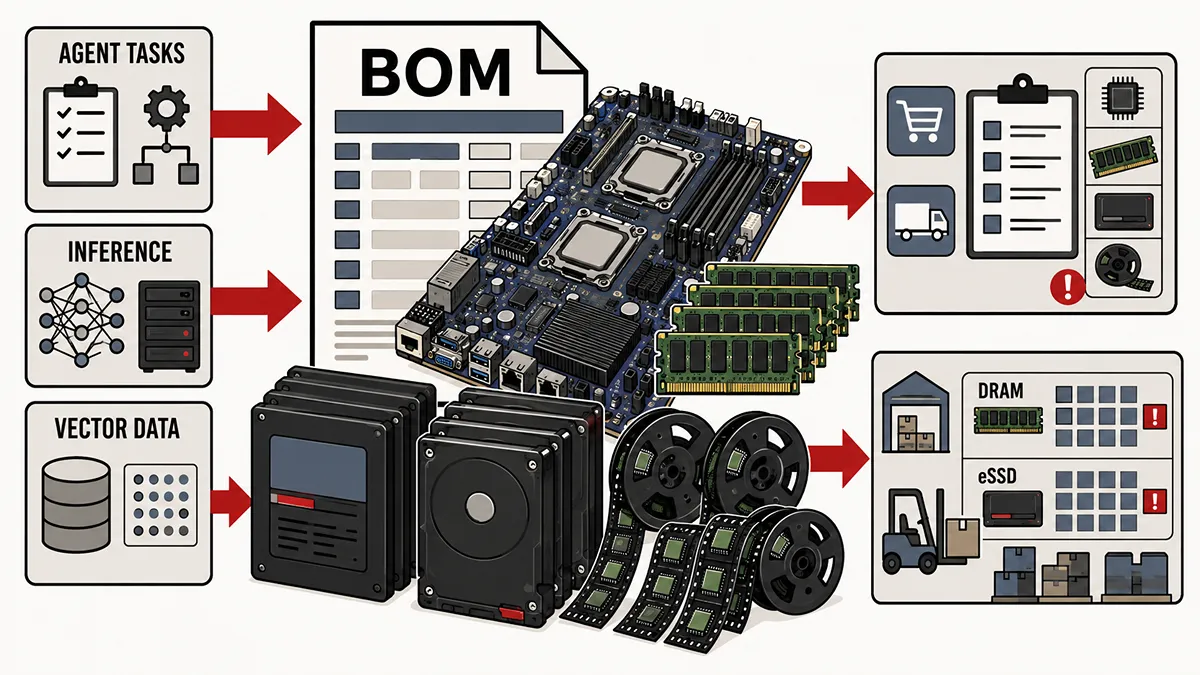
Most 2026 trend lists stop at software. They explain how agents plan work, call tools, and move tasks across systems. That account is true, and it is incomplete. When automation scales, it does not only consume tokens. It consumes inference, logs, context windows, vector stores, and the servers that hold them. Those workloads change what factories want to build first. Memory demand rises. Capacity and allocation follow. Certain nearby components then get tight even if a memory line still looks buyable.
That is the useful way to read AI automation trends 2026. The story is not that storage chips are fated to vanish. It is that demand shifts toward memory, supply schedules shift with it, and a handful of adjacent parts start to decide whether a board can ship.
The AI Automation Trends 2026 That Show Up on a BOM
Four shifts matter if you buy hardware rather than slides.
Agentic AI leaves the chatbot stage.
The center of gravity in 2026 is no longer a model that answers a prompt. It is a task-specific agent that can break a job into steps, use tools, and write results back into business systems. Analyst forecasts put task-specific agents inside a large share of enterprise applications by year-end. For a plant or a design team, that sounds like software news. It is also a volume story. Every extra agent loop creates more inference, more intermediate files, and more data that has to live somewhere.
Multi-agent systems multiply the hardware bill.
A single assistant can draft an email. A group of agents can draft, check inventory, open a ticket, and update a plan. That coordination is the point of 2026 deployments, and it is expensive in a quiet way. More agents mean more calls, more cached state, and more storage around the model, not only inside it. The software stack gets faster. The physical stack behind it gets heavier.
Physical AI puts the same pressure on the factory floor.
Robots, vision systems, and line-side controllers are no longer a separate novelty category. They are how manufacturers talk about filling labor gaps and keeping a line moving. Those machines need memory and storage of their own. They also need power conversion, sensing, and interconnect that survive vibration, heat, and audit. Automation at the edge does not reduce the BOM. It adds rows.
ROI and governance slow the software story, while lead times slow the hardware story.
Boards are no longer asking only whether a pilot looks clever. They ask whether an agent can be trusted with money, data, and exceptions, and whether the token bill is justified. That is healthy. It does not cancel the other constraint. An agent can close a purchase request in minutes and still wait weeks for a part that the model never saw. Decision speed and delivery speed are diverging.
These four trends share one hardware consequence: more systems are trying to remember more, compute more often, and stay online with less slack.
What AI Automation Trends 2026 Do to Memory Demand
Memory is where the demand shift shows up first, because it sits closest to compute.
Training clusters pull high-bandwidth memory. Inference racks pull server DRAM and large enterprise SSDs. Agent platforms add their own appetite for working memory and persistent storage: session history, embeddings, traces, and the disks that make rollback possible. Edge devices running local models raise the floor for DRAM and flash in products that never enter a data center.
Suppliers respond in the way capacity always responds. High-spec memory becomes the attractive place to put wafers, packaging, and quota. That does not mean every DRAM or NAND device disappears from the market. It means the mix changes.
- Hyperscale and AI-server grades get first claim on the best lots.
- Conventional densities and older families can stay available while still getting slower quotes, thinner allocation, or earlier end-of-life notices.
- Buyers outside the largest cloud accounts feel the change as price, date-code pressure, and longer commits, not as a single global stockout.
The practical error is to treat “memory” as one line on a dashboard. HBM, server DDR, industrial DRAM, and legacy flash are not on the same clock. A team can still buy a commodity module while the exact rank, temperature grade, or enterprise SSD it qualified last year slips. That split is already visible in the 2026 electronic component shortage outlook, where AI-related memory and mature-node parts no longer move together.
So the correct sentence is narrower than a shortage headline. AI automation raises memory demand and rearranges who gets served first. The risk is uneven access and sudden lifecycle moves, not a guarantee that storage chips run out.
Why Nearby Parts Tighten When Memory Demand Jumps
Once memory demand rises, tightness travels by three paths. None of them require every chip category to fail at once.
The same board still has to power and decouple the memory.
An AI server or an industrial controller does not absorb DRAM in isolation. High-capacitance ceramics sit next to the rails. Power-management devices and DC-DC modules have to feed rising current density. High-speed connectors have to carry the interface the memory subsystem expects. When those builds win factory time, the supporting parts get pulled into the same order book. The memory row can look only moderately tight while a PMIC or a server-grade MLCC becomes the line that stops assembly.
Capacity steering shows up in places that never trained a model.
Wafers, packaging slots, and mature-node lines are finite. When attention and qualification effort move toward AI memory and advanced packaging, older MCU, analog, and power processes compete for what is left. Automotive and industrial programs already share some of that mature-node pool. A factory that builds drives or meters can then wait on a microcontroller or a regulator even though it never bid on HBM. The connection is indirect, which is why it surprises purchasing teams who only watch GPU and memory headlines.
Planning signals split inside one BOM.
Some rows need earlier commits and second sources. Other rows need a last-time-buy decision because a low-margin memory or flash device is being wound down. Surplus and scarcity can sit on the same spreadsheet. That is the opposite of the 2021 pattern, when almost everything stretched at once. In 2026 the damage comes from treating the sheet as one weather system.
| What moved first | What often moves with it | What teams miss |
|---|---|---|
| HBM, server DRAM, enterprise SSD demand | High-capacitance MLCCs, power management ICs and DC-DC modules, high-speed interconnect | The board still needs clean power after the memory is purchased |
| Quota and mix shift toward AI memory | Mature-node MCUs, analog, selected power devices | Industrial and automotive programs share that capacity |
| Lifecycle pressure on older memory and flash | Redesign windows, safety stock, last-time buys | A part can be searchable and still be leaving the catalog |
Nearby, in this sense, does not mean “every passive on earth.” It means the parts that either ride on the same assembly as the memory or sit on the process lines that memory growth displaced.
A Practical Read of AI Automation Trends 2026 for Buyers
A trend recap is only useful if it changes how a BOM is read.
- Separate the sheet into memory, power, passives, and MCU or logic. Give each layer its own lead-time and lifecycle view. A 12-week average hides a 40-week rail.
- Identify two or three rows that can stop a build if they slip. Those rows deserve earlier forecasts and harder questions about date code, packaging, and cancellation terms.
- Let a general-purpose model tidy part numbers and flags. Do not let it choose an alternate. It cannot see live allocation, authorized channels, or a last-time-buy notice that landed this week.
- Where a memory family or a supporting power device is already under quota or heading toward NRND, start the second source while the design still has time. Hunting after a line-down email is not a strategy.
If the memory row is moving and two nearby lines are not, a BOM risk review is more useful than another list of agents.
The point of AI automation trends 2026 is not that software will replace purchasing. It is that software will send more, faster, and less complete requests into a supply chain whose mix has already tilted toward memory. The teams that stay on schedule will treat that tilt as a routing problem: demand goes one way, certain parts get tight, and the rest of the board still has to arrive with them.