
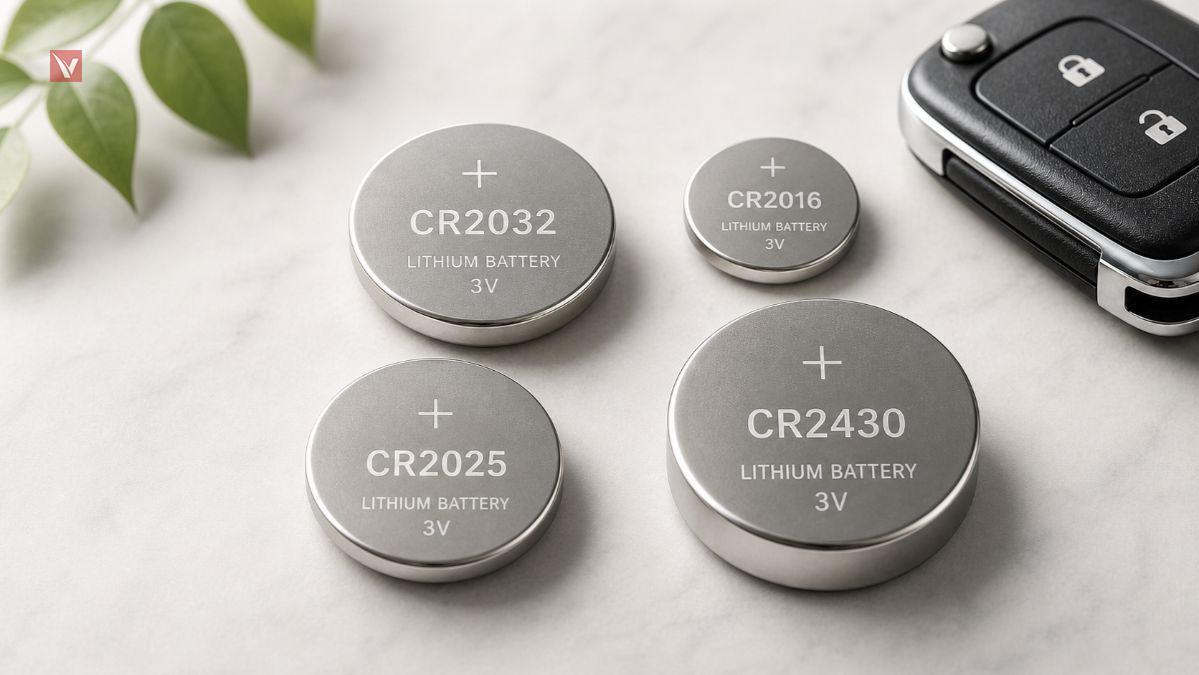
Coin cell batteries may look deceptively similar, but small differences in size, thickness, and electrical characteristics can lead to serious performance issues—or even permanent device damage. If you're comparing CR2032 vs CR2016, or wondering about CR2025 vs CR2032 and CR2430 vs CR2032, the answer is not as simple as “same voltage = interchangeable.”
This guide breaks down the engineering realities behind CR coin cells, the risks of swapping them, and what you can (and should not) do in real-world scenarios.
Understanding the CR Coin Battery Family
All CR-series batteries are lithium manganese dioxide coin cells with a nominal voltage of 3V, but their physical dimensions define their compatibility.
CR2032: The Industry Standard
-
Diameter: 20mm
-
Thickness: 3.2mm
-
Capacity: ~210–240 mAh
CR2032 is the most widely used coin battery due to its balanced capacity and size. It powers devices like car key fobs, motherboards, fitness trackers, and Apple AirTags.
CR2016: The Ultra-Thin Option
-
Diameter: 20mm
-
Thickness: 1.6mm
-
Capacity: ~90–100 mAh
CR2016 is half the thickness of CR2032, making it suitable for slim devices, but it sacrifices capacity.
CR2025: The Middle Ground
-
Diameter: 20mm
-
Thickness: 2.5mm
-
Capacity: ~150–170 mAh
CR2025 offers a compromise between size and battery life. It is commonly used in compact remotes and key fobs.
CR2430: The Wider Powerhouse
-
Diameter: 24mm
-
Thickness: 3.0mm
-
Capacity: ~270–300 mAh
CR2430 increases diameter rather than thickness, allowing higher capacity for devices that can accommodate a larger footprint.
Can You Interchange Them? Direct Answers and Risks
CR2032 vs. CR2016
The Verdict: Absolutely No
Although two CR2016 batteries stacked together equal the thickness of one CR2032, this is a dangerous misconception.
The Hidden Risk (The 6V Trap): Stacking two CR2016 batteries in series doubles the voltage from 3V to 6V, which can instantly destroy sensitive electronics such as car key fobs, medical devices, or motherboard circuits.
Using a single CR2016 instead of a CR2032 is also unreliable. The thinner battery cannot maintain proper contact with the terminals, leading to intermittent power failure.
Example: Many car key fobs rely on stable voltage. A 6V spike can permanently damage the chip, requiring full replacement rather than a simple battery swap.
CR2025 vs. CR2032
The Verdict: Only One-Way Emergency Use
You can temporarily use a CR2025 in a CR2032 slot, but not the other way around.
The Hidden Risk (Physical Damage): Forcing a CR2032 (3.2mm thick) into a slot designed for CR2025 (2.5mm) can permanently deform or break the internal metal contacts.
This is a critical mechanical issue—not just electrical. Once the contacts are bent, even the correct battery may fail to work properly.
Additionally, the idea of “upgrading” to CR2032 for longer battery life is flawed if the device is not designed to handle the extra thickness.
CR2430 vs. CR2032
The Verdict: No, They Will Not Fit
The difference in diameter (24mm vs 20mm) makes these batteries fundamentally incompatible.
The Hidden Risk:
-
A CR2430 physically cannot fit into a CR2032 slot
-
A CR2032 placed into a CR2430 compartment will be loose, causing:
-
Intermittent disconnections
-
Voltage drops
-
Potential short circuits
-
Devices requiring CR2430 are specifically engineered for larger battery contact spacing and retention mechanisms.
Temporary Survival Hacks When You Have the Wrong Battery Size
These methods are strictly for emergency use only and should never replace proper battery selection.
The Foil Trick for Using a CR2025 in a CR2032 Slot
When you're stuck—like a dead car key at night—you can compensate for the 0.7mm thickness gap.
DIY Steps:
-
Cut a small piece of aluminum foil.
-
Fold it into a compact pad (approx. 0.5–0.7mm thick).
-
Place it on top of the battery (between battery and contact).
-
Ensure firm but not excessive pressure when closing the compartment.
Important Notes:
-
Avoid direct contact between foil and both terminals simultaneously.
-
This is a temporary conductivity fix, not a safe long-term solution.
Modding a CR2032 to Fit a Rare CR2430 Compartment
If CR2430 is unavailable, you can stabilize a smaller CR2032.
DIY Steps:
-
Cut a ring from cardboard or insulating tape (~4mm width).
-
Wrap it around the CR2032 to increase its effective diameter.
-
Place the battery centrally in the compartment.
-
Ensure contacts align correctly.
Use Case Example: Kitchen scales or medical devices that require CR2430 but are not immediately serviceable.
Battery Specs, Common Devices, and Equivalents Match-Up
The CR coin battery family may look simple on the surface, but each model is built for a different mechanical envelope and energy requirement. All of these batteries use 3V lithium chemistry, yet their diameter, thickness, and capacity are tuned for different device designs, which is exactly why they are not universally interchangeable.
To make the differences easier to evaluate, the table below focuses not only on basic size data, but also on what those specifications mean in real-world use. This helps readers understand why one battery may fit physically but still fail electrically or mechanically in a device.
Comparison Table
| Battery Model | Physical Size | Typical Capacity | Design Role | Compatibility Implication |
| CR2016 | 20mm x 1.6mm | Around 90 mAh | Ultra-thin coin cell for very shallow compartments | Best for slim devices, but often too thin to maintain stable contact in holders designed for thicker cells |
| CR2025 | 20mm x 2.5mm | Around 150 mAh | Mid-thickness option that balances runtime and compact size | Can sometimes serve as a temporary fallback in a CR2032 slot, but only if contact pressure remains reliable |
| CR2032 | 20mm x 3.2mm | Around 210–240 mAh | The most common general-purpose coin battery | Usually the reference model for many key fobs, sensors, and small electronics |
| CR2430 | 24mm x 3.0mm | Around 270–300 mAh | Wider-format battery for devices that need more capacity in a larger bay | Cannot be substituted into a 20mm holder; the larger diameter is the defining compatibility factor |
A better way to think about the CR family is to separate them into three dimensions: fit, runtime, and contact stability. Fit determines whether the battery can enter the compartment at all. Runtime depends on how much active material is inside the cell. Contact stability determines whether the device can draw power consistently without interruption.
Equivalent Names
Different manufacturers use varying prefixes, but they are generally interchangeable if the core model matches.
-
CR2032 equivalents:
-
DL2032 (Duracell)
-
ECR2032 (Energizer)
-
BR2032 (Panasonic, slightly different chemistry with better temperature performance)
-
-
CR2025 equivalents:
-
DL2025, ECR2025
-
-
CR2016 equivalents:
-
DL2016, ECR2016
-
Understanding these naming variations prevents confusion when sourcing batteries globally.
Where to Buy Reliable CR Coin Batteries
For consistent performance and safety, sourcing from trusted suppliers is critical—especially for harder-to-find models like CR2430.
Recommended options:
-
Authorized distributors (e.g., Vigor Components)
-
Brand-certified online stores (Panasonic, Energizer, Duracell)
-
Industrial electronics suppliers (for bulk or OEM use)
Vigor Components provides globally sourced, quality-verified coin cells suitable for both consumer and industrial applications, ensuring authenticity and proper storage conditions.
How to Avoid Low-Quality Batteries
-
Check expiration date (typically 5–10 years shelf life)
-
Avoid unbranded or suspiciously cheap listings
-
Inspect packaging for tampering
-
Watch for signs of leakage or corrosion
Low-quality batteries can leak, swell, or fail prematurely—damaging your devices.
FAQs
Why does my key fob die so fast after a DIY battery replacement?
Finger oils can create a conductive layer on the battery surface, leading to micro-discharge. Always handle batteries with tissue or gloves to prevent contamination and extend lifespan.
Are CR and DL batteries the same thing?
Yes. “DL” is Duracell’s proprietary prefix, while “CR” is the generic IEC standard. For example, DL2032 and CR2032 are fully compatible.
Can I use rechargeable coin batteries instead?
Most CR batteries are primary (non-rechargeable). Rechargeable alternatives like LIR2032 exist, but they have different voltages (~3.6V) and are not safe replacements unless explicitly supported.
Why does my device specify only one battery model?
Devices are engineered for precise mechanical fit and discharge curves. Even small deviations in thickness or capacity can affect performance or reliability.
How long should a CR2032 battery last?
Depending on usage, typically 1–3 years in low-drain devices like key fobs or sensors.