
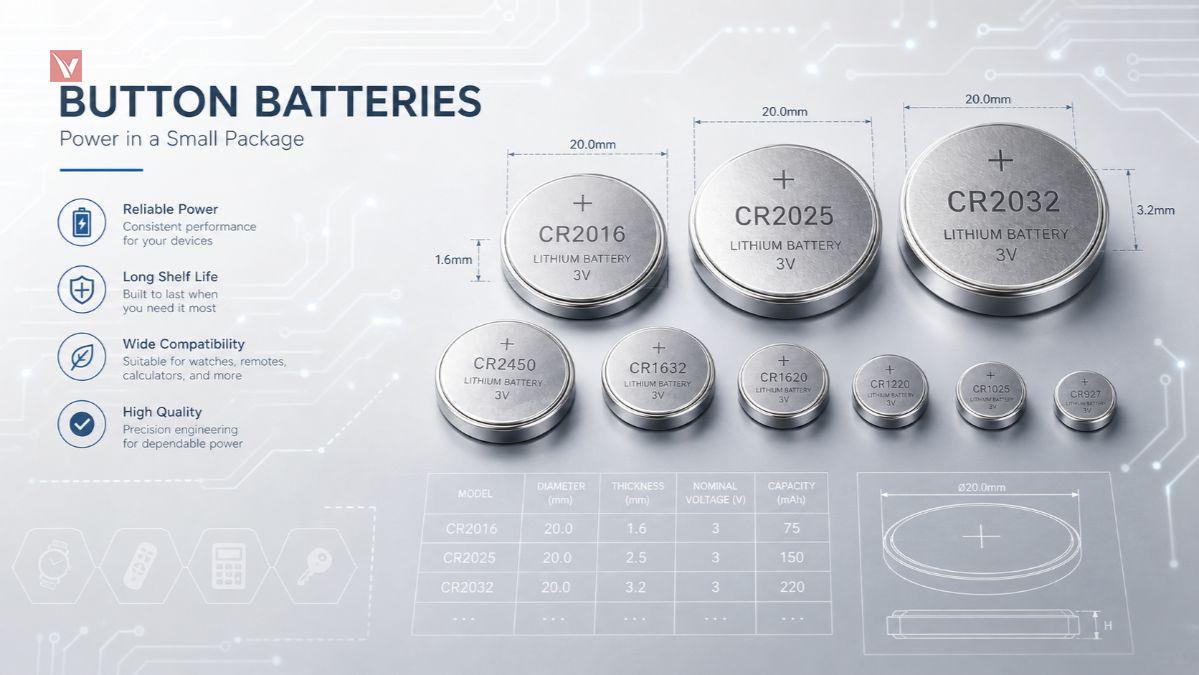
Coin batteries—frequently referred to as button cells—are the invisible workhorses powering modern compact electronics. Whether you are designing a low-profile medical sensor, manufacturing automotive key fobs, or replacing a CMOS battery on a server motherboard, selecting the right coin battery size and chemistry is paramount. A miscalculation in voltage, discharge rate, or physical dimensions can lead to premature device failure, poor contact reliability, or even safety hazards.
Despite their ubiquitous presence, the naming conventions, standard sizes, and cross-compatibility of these power sources remain a source of confusion for many. This comprehensive guide is designed to demystify coin battery sizes, decode the international naming standards, and provide an extensive cross-reference chart to help engineers, supply chain managers, and consumers make accurate component selections.
How to Read Standard Coin Battery Naming Codes
The global standard for naming and classifying coin batteries is managed by the IEC (International Electrotechnical Commission). This standardized code system is a vital tool for engineers and buyers, as it instantly communicates the battery's chemical composition and precise physical dimensions.
The naming structure relies on a logical "Letter Prefix + Number" combination. By understanding this formula, you can instantly decipher any standard battery specification. Let's break down the most common example: the CR2032.
The IEC Letter Prefix: Chemistry and Voltage
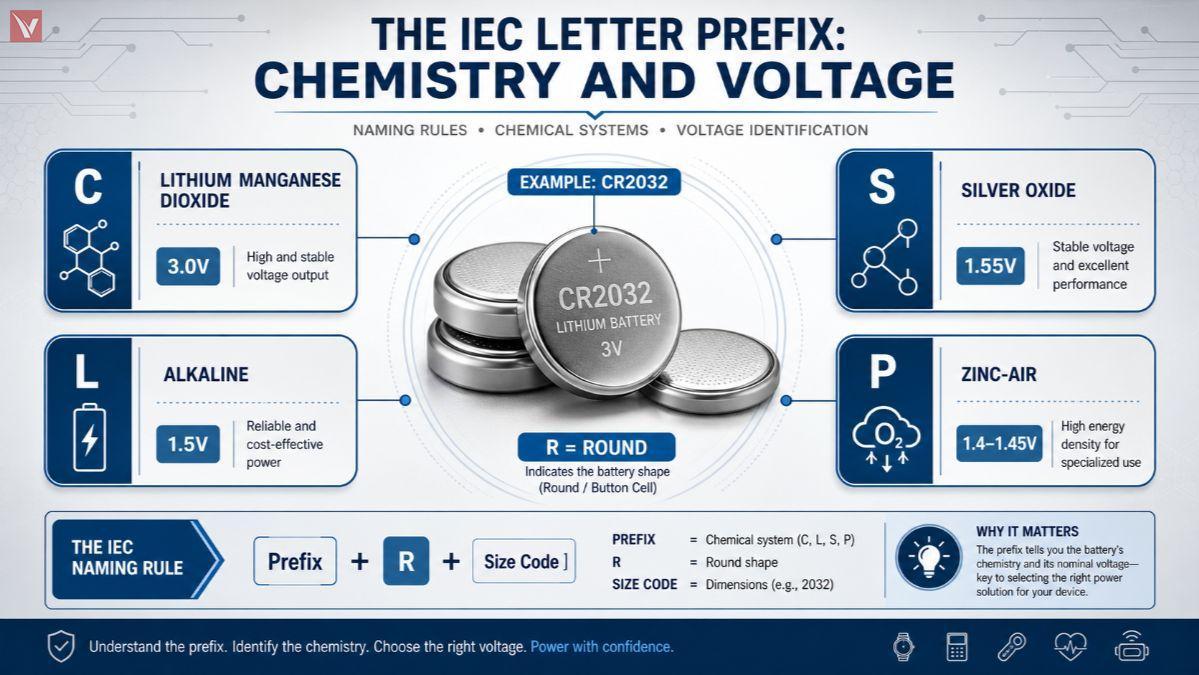
The letter or letters at the beginning of the code dictate the electrochemical system of the battery. This tells you the battery's active materials and, consequently, its nominal voltage and discharge characteristics.
- C: Indicates Lithium Manganese Dioxide (Li-MnO₂) chemistry. These batteries provide a nominal voltage of 3.0V.
- L: Indicates an Alkaline (Zinc-Manganese Dioxide) chemistry, providing a nominal voltage of 1.5V.
- S: Indicates a Silver Oxide chemistry, which offers a highly stable 1.55V.
- P: Indicates Zinc-Air chemistry, delivering 1.4V to 1.45V.
The second letter, typically R, simply stands for "Round," indicating the cylindrical/coin shape of the cell. Therefore, a "CR" battery is a round lithium battery.
The Number Code: Physical Dimensions
The numbers following the prefix describe the precise physical dimensions of the cell, which is crucial for mechanical fitment inside a device chassis.
- The first one or two digits represent the battery's diameter in millimeters (mm). If the diameter is less than 10mm, it usually uses a single digit (e.g., CR927 is 9.5mm, rounded to 9). For sizes 10mm and above, the first two digits are used.
- The last two digits represent the battery's thickness (height) measured in tenths of a millimeter (0.1 mm).
Applying this to CR2032:
- CR = Lithium Manganese Dioxide, Round cell (3.0V).
- 20 = 20 mm in diameter.
- 32 = 3.2 mm in thickness.
Similarly, a PR44 (often known as a 675 hearing aid battery) is a Zinc-Air cell that measures 11.6 mm in diameter and 5.4 mm in thickness. Understanding this logical breakdown is the first step in mastering battery procurement and component selection.
Coin Battery Types
When designing a circuit or replacing a cell, knowing the specific characteristics of different coin battery types is essential. While the dimensions ensure the battery fits physically, the chemistry dictates whether it will power the device correctly and safely. Here is a detailed breakdown of the five primary types you will encounter in the electronics industry.
-
CR (Lithium Manganese Dioxide - 3.0V) CR batteries are the industry standard for most modern electronics requiring a reliable, high-energy-density power source. Lithium chemistry provides a nominal voltage of 3.0V, which is twice that of alkaline button cells. Furthermore, CR cells have an exceptionally low self-discharge rate, giving them a shelf life of up to 10 years. They perform reliably across a wide temperature range, making them ideal for automotive environments, smart home IoT sensors, and critical medical devices where frequent replacement is impractical.
-
LR (Alkaline - 1.5V) LR batteries represent the most cost-effective option for low-drain, consumer-grade electronics. Utilizing zinc and manganese dioxide, they deliver a nominal voltage of 1.5V. While highly affordable, alkaline chemistry suffers from a steeper discharge curve, meaning the voltage drops steadily as the battery is used. They also have a significantly shorter shelf life and are more prone to chemical leakage if left in a depleted state. You will typically find LR cells in inexpensive toys, small LED flashlights, basic calculators, and novelty items.
-
SR (Silver Oxide - 1.55V) SR batteries are the premium choice for micro-electronics requiring absolute voltage stability. The silver oxide chemistry delivers 1.55V with an incredibly flat discharge curve, meaning the battery provides maximum power until it is almost completely depleted. This characteristic is vital for precision instruments where fluctuating voltage would cause inaccurate readings. Furthermore, silver oxide cells are highly resistant to leakage. Because of the cost of silver, these batteries are more expensive, but they are indispensable in analog and digital watches, precision calipers, clinical thermometers, and high-end medical equipment.
-
PR (Zinc-Air - 1.4V to 1.45V) Zinc-Air (PR prefix) batteries are unique because they rely on atmospheric oxygen as their cathode reactant, which allows the internal space to be filled almost entirely with the zinc anode. This design provides an extremely high energy density in a very compact form factor. They typically output around 1.4V to 1.45V. These batteries remain dormant until a factory seal (usually a small sticker) is removed, allowing air to enter through tiny holes to activate the cell. Once activated, they must be used continuously, as they will dry out and self-discharge within a few weeks regardless of use. Because they offer consistent power in a tiny size, Zinc-Air batteries completely dominate the market for hearing aids and are also used in some medical telemetry devices.
-
LIR (Rechargeable Lithium-ion - 3.6V) LIR batteries bring the convenience of rechargeability to the coin cell format. Unlike single-use primary cells, LIR batteries use lithium-ion chemistry to deliver a higher nominal voltage of 3.6V. They can typically endure hundreds of charge-discharge cycles. However, because their voltage is 20% higher than standard CR cells (3.6V vs. 3.0V), they cannot be used as direct drop-in replacements unless the device's circuitry is specifically designed to handle the higher voltage and includes an appropriate charging management IC. LIR cells are increasingly popular in wearable technology, high-end true wireless earbuds, and solar-assisted embedded systems.
The Relationship Between Battery Thickness and Capacity
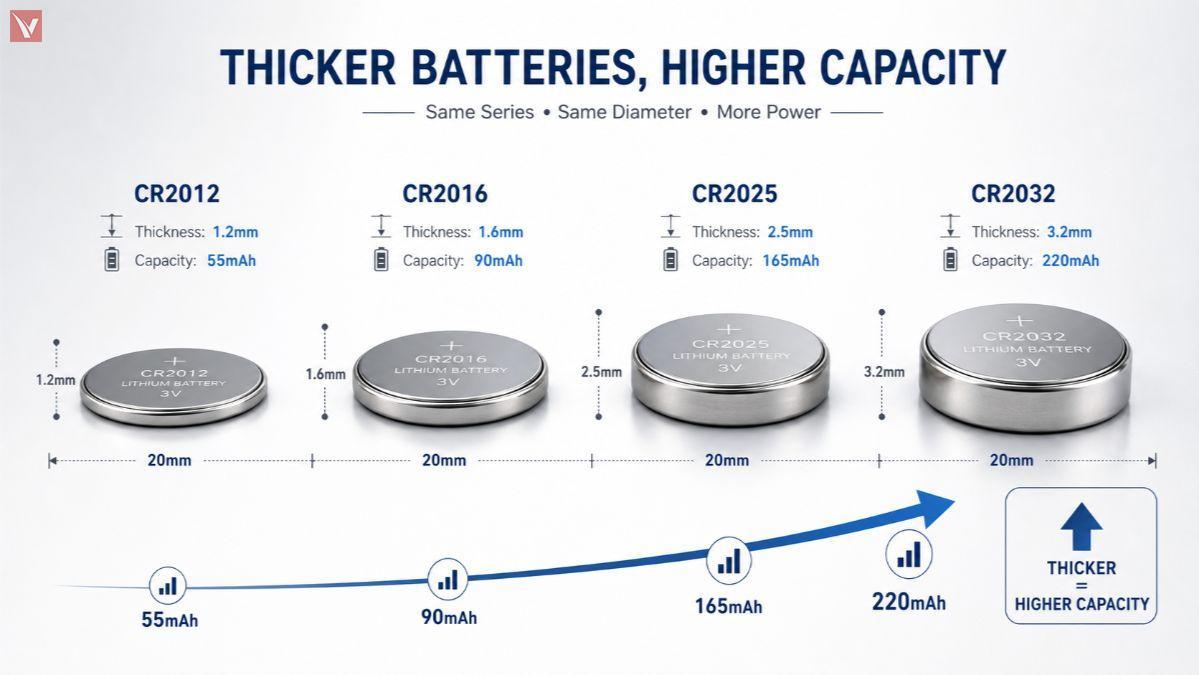
One of the most frequent questions from hardware developers is whether they can swap batteries of the same diameter but different thicknesses. The answer lies in understanding the direct physical relationship between a battery's internal volume and its electrical capacity (measured in milliampere-hours, or mAh).
Assuming the chemistry (e.g., Lithium) and the diameter (e.g., 20mm) remain constant, the thickness of the coin battery is the sole variable determining how much active chemical material it can hold. More active material directly translates to higher energy capacity and longer runtime.
To illustrate this, let's look at the highly common CR20 series. All these batteries are 20mm in diameter, but their thickness significantly impacts their capacity:
- CR2012: 1.2mm thick ≈ 55 mAh capacity
- CR2016: 1.6mm thick ≈ 90 mAh capacity
- CR2025: 2.5mm thick ≈ 165 mAh capacity
- CR2032: 3.2mm thick ≈ 220 mAh capacity
As demonstrated, moving from a 1.6mm thick cell to a 3.2mm thick cell essentially doubles the available energy.
Can you interchange them?
From a purely electrical standpoint, yes. Because they all use the same lithium chemistry, they all output 3.0V. However, physical fitment is the barrier.
- If a device is molded specifically for a CR2032, inserting a thinner CR2016 will often result in a loose fit. The battery may rattle, causing intermittent power loss and resetting the device, because the contact springs cannot apply enough pressure.
- Conversely, you cannot force a thick CR2032 into a compartment designed for a slim CR2016; it simply will not close and forcing it could damage the device housing or the battery itself.
While stacking two CR2016 batteries (totaling 3.2mm) to mimic the size of a CR2032 might seem like a clever hack, doing so connects the batteries in series, instantly doubling the voltage to 6.0V. This will permanently fry most microcontrollers designed for 3.0V. Always design and procure the specific thickness intended for the application.
Physical Interchangeability and Standard Cross Reference Chart
While the IEC provides a unified standard, major battery manufacturers like Duracell, Energizer, Panasonic, and Maxell often utilize proprietary naming conventions. This fragmentation can create massive headaches for procurement teams trying to source alternative suppliers during component shortages.
To streamline your sourcing and engineering processes, we have compiled a comprehensive what batteries to things use chart and cross-reference matrix. This table strictly maps physical interchangeability—meaning all batteries listed in the same row share the identical diameter, thickness, and nominal voltage.
| Battery Number | Voltage | Dimensions (mm) | Weight (g) | Capacity (mAh) | Chemistry | NEDA | Compatible Models / Manufacturer Codes |
| CR927 | 3V | 9.5x2.7 mm | 0.51 | 30 | Li-MnO2 | — | 927, BR927, DL927, DL927B, ECR927, KCR927, LM927 |
| CR1025 | 3V | 10x2.5 mm | 0.7 | 30 | Li-MnO2 | 5033LC | 1025, BR1025, DL1025, ECR1025, E-CR1025, KCR1025, KECR1025, KL1025, L1025, LM1025 |
| CR1216 | 3V | 12.5x1.6 mm | 0.7 | 25 | Li-MnO2 | 5034LC | 1216, 6216, BR1216, DL1216, DL1216B, ECR1216, KCR1216, LM1216 |
| CR1220 | 3V | 12.5x2 mm | 1.2 | 35 | Li-MnO2 | 5012LC | 1220, 6220, BR1220, CA10, DL1220, DL1220B, ECR1220, GPCA10, GPCR1220, KCR1220, LM1220, L04, PA, SB-T13 |
| CR1225 | 3V | 12.5x2.5 mm | 0.9 | 50 | Li-MnO2 | 5020LC | 1225, BR1225, DL1225, DL1225B, ECR1225, KCR1225, L30, LITH52, LM1225 |
| CR1612 | 3V | 16x1.2 mm | 0.8 | 40 | Li-MnO2 | — | 1612, BR1612, DL1612, DL1612B, KCR1612, LM1612 |
| CR1616 | 3V | 16x1.6 mm | 1.2 | 50 | Li-MnO2 | 5021LC | 280-209, 1616, 6616, BR1616, DL1616, DL1616B, ECR1616, GPCR1616, KCR1616, LM1616, L11, L28, YA |
| CR1620 | 3V | 16x2 mm | 1.3 | 75 | Li-MnO2 | 5009LC | 280-208, 1620, BR1620, DL1620, DL1620B, EA, ECR1620, KCR1620, LM1620, L08, SB-T17 |
| CR1632 | 3V | 16x3.2 mm | 1.8 | 125 | Li-MnO2 | — | 1632, BR1632, CA17, DL1632, ECR1632, E-CR1632, KCR1632, KECR1632, KL1632, L1632, LITH34 |
| CR2012 | 3V | 20x1.2 mm | 1.4 | 55 | Li-MnO2 | — | 280-207, 2012, BR2012, DL2012, DL2012B, ECR2012, KCR2012, LM2012, SB-T15 |
| CR2016 | 3V | 20x1.6 mm | 1.6 | 90 | Li-MnO2 | 5000LC | 208-202, 2016, BR2016, CA12, DL2016, DL2016B, ECR2016, E-CR2016, FA, GPCA12, GPCR2016, KCR2016, KECR2016, KL2016, L10, LM2016, SB-T11 |
| CR2025 | 3V | 20x2.5 mm | 2.5 | 165 | Li-MnO2 | 5003LC | 208-205, 2025, 6025, BR2025, CA13, DL2025, DL2025B, ECR2025, E-CR2025, GPCA13, GPCR2025, KCR2025, KECR2025, KL2025, L12, LM2025, NA, SB-T14 |
| CR2032 | 3V | 20x3.2 mm | 3.1 | 220 | Li-MnO2 | 5004LC | 2032, 6032, BR2032, CA14, DL2032, EA2032, ECR2032, E-CR2032, GPCA14, GPCR2032, KCR2032, KECR2032, KL2032, L14, L2032, RFA-35, SB-T51 |
| CR2320 | 3V | 23x2 mm | 3 | 130 | Li-MnO2 | — | 280-201, 2320, BR2320, DL2320, E-CR2320, ECR2320, KCR2320, KECR2320, KL2320, L26, L2320 |
| CR2325 | 3V | 23x2.5 mm | 3 | 190 | Li-MnO2 | — | 2325, BR2325, DL2325, E-CR2325, ECR2325, KCR2325, KECR2325, KL2325, L2325, SBT12, SB-T12 |
| CR2330 | 3V | 23x3 mm | 4 | 265 | Li-MnO2 | — | 2330, BR2330, DL2330, E-CR2330, ECR2330, KCR2330, KECR2330, KL2330, L2330 |
| CR2354 | 3V | 23x5.4 mm | 5.9 | 560 | Li-MnO2 | — | 2354, BR2354, DL2354, ECR2354, E-CR2354, KCR2354, KECR2354, KL2354, L2354 |
| CR2412 | 3V | 24x1.2 mm | 2 | 100 | Li-MnO2 | — | 2412, BR2412, COMP-274-PANA, DL2412, ECR2412, E-CR2412, KCR2412, KECR2412, KL2412, L2412 |
| CR2430 | 3V | 24.5x3 mm | 4.6 | 290 | Li-MnO2 | 5011LC | 2430, 6430, BR2430, DL2430, ECR2430, E-CR2430, GPCR2430, KCR2430, KECR2430, KL2430, L20, L2430, LFW |
| CR2450 | 3V | 24.5x5 mm | 6.3 | 620 | Li-MnO2 | 5029LC | 2450, 6450, BR2450, CA10, CR2450N, DL2450, ECR2450, KCR2450, LM2450 |
| CR2477 | 3V | 24.5x7.7 mm | 10.5 | 1000 | Li-MnO2 | — | 2477, BR2477, BR2477N, CR2477N, CR2477T, DL2477, DL2477N, ECR2477, ECR2477N, KCR2477, LM2477, LM2477N, P120ND |
| CR3032 | 3V | 30x3.2 mm | 7.1 | 500 | Li-MnO2 | — | 3032, DL3032, ECR3032, E-CR3032, KCR3032, KECR3032, KL3032, L3032, LITH45 |
(Note: The 'Compatible Models' column highlights proprietary identifiers from brands like Duracell (DL), Energizer (ECR), Panasonic (BR), and others, allowing you to confidently match disparate SKUs to the exact physical standard).
Detailed Equivalent Cross-References for Common Sizes
If you are looking for specific replacement options and cross-reference charts for the most widely used button cells, we have compiled in-depth guides for each model. Select your battery size below to find its direct equivalents:
| Battery Model | Chemistry | Voltage | Comprehensive Equivalent Guide |
|---|---|---|---|
| CR1620 | Lithium (Li-MnO₂) | 3.0V | CR1620 Battery Equivalent |
| CR1220 | Lithium (Li-MnO₂) | 3.0V | CR1220 Battery Equivalent |
| CR2032 | Lithium (Li-MnO₂) | 3.0V | 2032 Battery Equivalent |
| LR44 | Alkaline | 1.5V | LR44 Battery Equivalents |
Common Coin Cell Battery Applications
While the cross-reference chart helps you find the exact physical match, understanding the typical use cases for different sizes is equally important for procurement and product design. The application dictates not just the physical size, but the required chemistry, capacity, and discharge rate. Here is a breakdown of common applications categorized by the most prevalent coin cell sizes.
The CR20 Series (20mm Diameter Lithium)
This is the most widely used family of lithium coin cells, balancing compact size with reliable 3.0V power output.
-
CR2032 (3.2mm thick): The undisputed industry standard. It is universally used as the CMOS battery on computer motherboards to retain BIOS settings. Other mass-market applications include car key fobs, Apple AirTags and similar smart trackers, garage door openers, and personal medical devices like blood glucose monitors.
-
CR2025 (2.5mm thick): Designed for devices where a CR2032 is slightly too thick. Common applications include slim card-style remote controls, active 3D glasses, fitness trackers, and modern, ultra-thin car fobs.
-
CR2016 (1.6mm thick): The thinnest of the standard 20mm series. Frequently found in digital watches, small LED keychains, heart rate monitor chest straps, and backup memory modules for small electronics.
The CR24 Series (24.5mm Diameter Lithium)
These heavy-duty lithium cells prioritize maximum capacity and long operational life over slimness, making them ideal for enterprise and industrial applications.
- CR2450 & CR2477: Boasting massive capacities (up to 1000 mAh for the CR2477), these are the go-to choices for "deploy and forget" technologies. Common applications include Bluetooth Low Energy (BLE) beacons, electronic shelf labels (ESL) in smart retail, industrial IoT environmental sensors, and professional dive computers.
LR44 / AG13 (11.6mm Diameter Alkaline)
Providing 1.5V of power in a small, economical package, these alkaline cells dominate the low-cost consumer electronics market.
- LR44 Applications: Due to their low cost, they are the standard choice for children's toys, laser pointers, basic pocket calculators, digital clinical thermometers, and novelty greeting cards with sound.
SR Series (Silver Oxide Watch Batteries)
Valued for their incredibly stable 1.55V output and resistance to leaking, silver oxide cells are reserved for precision equipment.
-
SR626SW (377): One of the most popular sizes globally for powering the quartz movements of standard analog wristwatches.
-
SR44 (357/303): While physically the same size as an LR44, the SR44's stable voltage makes it mandatory for precision measuring tools like digital calipers, micrometers, and high-end medical instruments that would otherwise lose calibration as the battery drains.
PR Series (Zinc-Air Hearing Aid Batteries)
Categorized by standardized color codes and numbers, these 1.4V cells provide high energy density through oxygen activation.
- PR44 (Size 675 - Blue Tab) & PR48 (Size 13 - Orange Tab): Exclusively designed to power Behind-The-Ear (BTE) hearing aids, cochlear implants, and some medical telemetry devices that require continuous, reliable power for extended daily use.
Discharge Rates and Internal Resistance for Component Selection
While physical dimensions are the primary focus of standard cross-referencing, electronic engineers must also scrutinize a battery's Internal Resistance (IR) and discharge capabilities. These electrical parameters determine how a battery behaves under operational stress, particularly in devices that demand sudden spikes of power.
Internal resistance is essentially the opposition within the battery to the flow of electric current. As a battery ages or depletes, its internal resistance naturally increases. Why does this matter? If an application requires a high pulse discharge—such as an active RFID tag broadcasting a signal, an IoT sensor connecting to a LoRaWAN network, or a medical alarm sounding—a high internal resistance will cause a severe, momentary drop in the output voltage. If the voltage drops below the microcontroller's minimum operating threshold, the device will reboot or fail, even if the battery still technically has "capacity" remaining.
This is why specifying the correct material is so crucial for component selection:
-
Lithium (CR) cells maintain low internal resistance and can deliver the rapid pulse currents required by modern wireless communication modules.
-
Alkaline (LR) cells have higher internal resistance. They perform adequately in low, steady-drain applications (like an LCD digital clock), but they struggle with high-pulse demands, making them unsuitable for advanced industrial sensors.
When developing products for enterprise or medical applications, always consult the component datasheet's pulse current ratings rather than relying solely on the nominal voltage.
Safety Standards Storage Guidelines and Shipping Compliance
The logistics of handling coin batteries—particularly those utilizing lithium chemistry—require strict adherence to global safety and shipping compliance regulations. For hardware manufacturers, EMS (Electronic Manufacturing Services) providers, and large-scale distributors, improper handling can lead to catastrophic supply chain delays or safety incidents.
UN38.3 Shipping Compliance
Air transportation of lithium batteries is heavily regulated to prevent in-flight fires. To be legally shipped via air freight, all lithium coin cells (such as CR and LIR series) must pass the grueling UN38.3 testing standard. This rigorous testing protocol simulates the extreme conditions of air travel, subjecting batteries to altitude simulations (low pressure), extreme thermal cycles, severe vibration, mechanical shock tests, and forced short-circuiting. Purchasing uncertified, grey-market batteries can result in shipments being seized by customs or rejected by freight forwarders.
Bulk Storage Guidelines
To maximize the 10-year shelf life of lithium primary cells, precise environmental controls are required in the warehouse.
-
Temperature: Maintain storage environments between 15°C and 25°C (59°F to 77°F). Avoid prolonged exposure to extreme heat, which accelerates chemical degradation and self-discharge.
-
Humidity: Keep relative humidity below 60%. High humidity can cause corrosion on the external metal casing and contact points.
Furthermore, bulk/tray packaging is essential for large volumes. Loose storage of coin batteries is a severe fire hazard. If the positive and negative terminals of multiple batteries touch, it creates a dead short circuit, rapidly heating the cells and potentially causing a thermal event. Always store and transport them in organized blister trays with non-conductive separators.
Ingestion Hazards
At the consumer level, the small size of button batteries makes them a significant ingestion hazard for young children and pets. When a battery is swallowed, the bodily fluids create an electrical circuit between the positive and negative terminals, triggering a chemical reaction that can cause fatal internal burns in under two hours. To comply with modern consumer safety laws, many manufacturers now implement child-resistant packaging and apply bitter chemical coatings to the battery's surface to deter accidental ingestion.
Need to Source High-Quality Coin Batteries at Scale?
Navigating the complexities of battery dimensions, proprietary brand codes, and pulse discharge requirements doesn't have to be a bottleneck for your engineering or procurement teams. Whether you are scaling production for a new IoT device and need thousands of UN38.3 compliant CR2032 cells, or you are sourcing specialized high-capacity lithium units for harsh environments, Vigor Components is your trusted partner.
As a leading global independent electronic component distributor, we provide rapid access to an extensive inventory of fully certified, premium coin batteries from the industry's most reliable manufacturers. Stop guessing on cross-references and ensure your supply chain remains uninterrupted. Contact the experts at Vigor Components today to request a quote or consult with our technical team to find the exact power solution your application demands.