
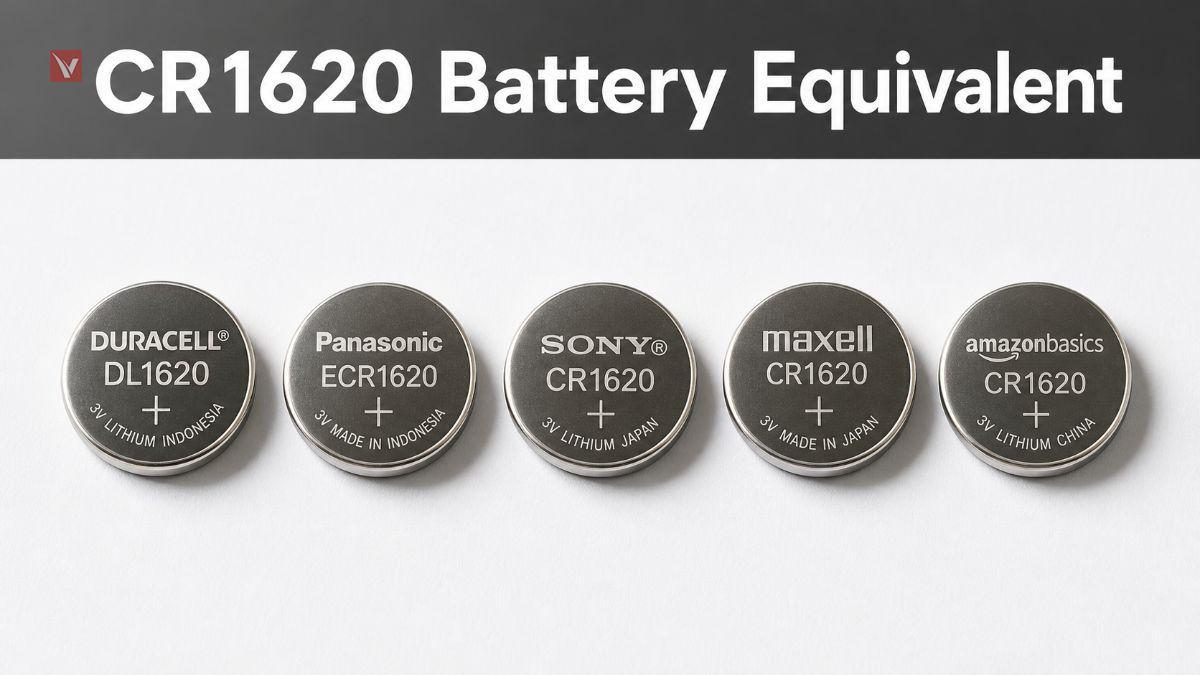
Coin cell batteries are widely used in compact electronic devices, and among them, the CR1620 stands out as a reliable and commonly used lithium battery. However, users often ask: what battery is equivalent to a CR1620? Whether you're replacing a battery in a key fob, medical device, or motherboard, understanding equivalents is essential for compatibility and performance.
What is the CR1620 Battery
CR1620 Specifications
-
CR: Lithium manganese dioxide chemistry
-
16: Diameter of 16 mm
-
20: Thickness of 2.0 mm
-
Nominal Voltage: 3V
-
Typical Capacity: 70–80 mAh
-
Chemistry: Lithium manganese dioxide (Li-MnO₂)
-
Operating Temperature: Typically -20°C to +60°C
-
Weight: ~1.2 grams
Detailed Comparison Between CR1616, CR1620, and CR1632
| Model | Thickness | Capacity (Approx.) | Voltage | Interchangeability |
| CR1616 | 1.6 mm | ~50 mAh | 3V | Not ideal substitute |
| CR1620 | 2.0 mm | ~75 mAh | 3V | Standard reference |
| CR1632 | 3.2 mm | ~130 mAh | 3V | Too thick for most slots |
Can They Be Interchanged?
- CR1616 → CR1620: Possible in some cases, but shorter lifespan and potential loose contact
- CR1632 → CR1620: Usually not compatible due to thickness
- CR1620 → Others: Only if the device allows physical tolerance
Practical Example
- Using CR1616 may cause intermittent contact
- Using CR1632 may prevent the compartment from closing
Learn More: Cr2025 Battery vs Cr2032
Everyday Applications Using CR1620 Lithium Coin Cells
-
Car key fobs and remote entry systems: Provides consistent voltage for signal transmission.
-
Medical devices: Used in glucometers, thermometers, and wearable sensors.
-
CMOS batteries in motherboards: Maintains BIOS settings and system clock.
-
Wearable electronics: Fitness trackers and compact smart devices.
-
Small consumer electronics: Calculators, digital thermometers, and LED lights.
The Complete CR1620 Battery Equivalent Reference Table
Key Takeaway
Although CR1620 is the IEC-standard designation, different manufacturers apply their own proprietary naming conventions to identical cells. For example, Duracell uses "DL" as a prefix, while Energizer uses "ECR." Despite the different labels, these batteries share the same dimensions, voltage, and chemistry — making them direct equivalents.
| Battery Model | Manufacturer/Brand | Chemistry | Voltage | Notes |
| CR1620 | IEC Standard | Lithium | 3V | Original standard model |
| DL1620 | Duracell | Lithium | 3V | Direct equivalent |
| ECR1620 | Energizer | Lithium | 3V | Fully compatible |
| BR1620 | Panasonic | Lithium (Poly-carbon monofluoride) | 3V | Better for high-temperature environments |
| KCR1620 | KTS | Lithium | 3V | Equivalent model |
| LM1620 | Various brands | Lithium | 3V | Generic equivalent |
| 1620 | Generic | Lithium | 3V | Often labeled without prefix |
Essential Factors When Choosing Your Battery Equivalent
-
Operating Environment
-
Standard indoor use: CR1620, DL1620, or ECR1620 work perfectly
-
Extreme temperatures or industrial settings: BR1620 performs better due to its stable chemistry
-
Power Consumption
-
Low-drain devices (e.g., clocks, remotes): Standard CR1620 equivalents are sufficient
-
High-drain or pulse applications: Choose high-quality branded cells like Duracell or Energizer
-
Shelf Life Requirements
-
Lithium coin cells generally offer long shelf life, but premium brands provide better reliability over time
-
Manufacturer Reliability
-
Trusted brands ensure:
-
Stable voltage output
-
Leak resistance
-
Consistent performance
-
Sourcing Authentic Battery Equivalents and Electronic Components
Why Partner with Vigor Components for Component Distribution
-
Extensive global supply network ensuring availability of CR1620 and equivalents
-
Strict quality control to prevent counterfeit components
-
Support for bulk procurement across industries
-
Expertise in semiconductors and power components, not just batteries
For more information on the sizes and specifications of button batteries, please refer to our comprehensive guide on button battery dimensions.