
Quick Answer: Are CR2025 and CR2032 Batteries Interchangeable?
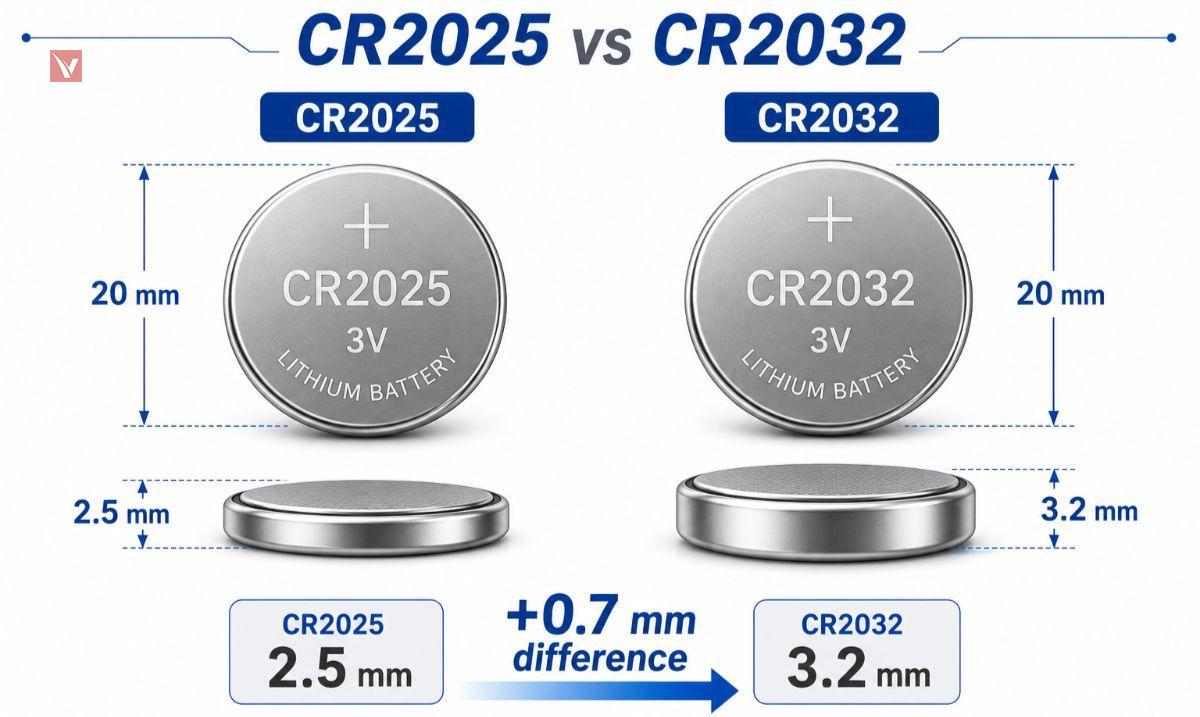
Yes, but... In emergency situations where space allows, CR2025 and CR2032 batteries can temporarily substitute for each other. However, they are not recommended for long-term interchangeable use. Both are 3V lithium coin cells with identical 20mm diameters, but the CR2032 is 0.7mm thicker (3.2mm vs. 2.5mm) and holds significantly more capacity.
Forcing a CR2032 into a CR2025 compartment can damage O-ring waterproof seals or crush spring contacts, while using a CR2025 in a CR2032 device often causes loose connections and premature shutdown. For optimal device performance and longevity, always use the battery type specified by your manufacturer. If you need to understand the specific risks, read our detailed section on The Hidden Risks of Swapping below.
Difference between 2032 and 2025 Battery
The differences between CR2025 and CR2032 extend beyond simple thickness. Here's a comprehensive comparison:
|
Parameter
|
CR2025
|
CR2032
|
|
Diameter
|
20mm
|
20mm
|
|
Thickness
|
2.5mm
|
3.2mm
|
|
Thickness Difference
|
—
|
+0.7mm
|
|
Nominal Voltage
|
3V
|
3V
|
|
Capacity
|
150–170mAh
|
210–240mAh
|
|
Capacity Difference
|
—
|
+30–40%
|
|
Weight
|
~2.8g
|
~3.0g
|
|
Standard Discharge Current
|
10μA – 15μA
|
15μA – 20μA
|
|
Pulse Discharge Current
|
10mA – 15mA
|
20mA – 25mA
|
|
Operating Temperature
|
0°C – 60°C
|
0°C – 60°C
|
|
Chemistry
|
Lithium Manganese Dioxide (Li-MnO₂)
|
Lithium Manganese Dioxide (Li-MnO₂)
|
Key takeaways:
-
The 0.7mm thickness difference is the most critical physical distinction
-
CR2032 offers 30–40% more capacity (210mAh vs. 160mAh typical)
-
CR2032 supports higher pulse discharge currents (20–25mA vs. 10–15mA), making it better for devices with peak power demands
-
Both share identical voltage and chemistry, ensuring electrical compatibility when physical fit is adequate
What is a CR2032 Battery?
The CR2032 is the most widely used lithium coin cell battery in consumer and industrial electronics. Its name follows the IEC (International Electrotechnical Commission) naming standard:
-
C = Lithium chemistry (specifically lithium manganese dioxide)
-
R = Round (cylindrical) shape
-
20 = 20mm diameter
-
32 = 3.2mm thickness
Dominance in High-Drain, Long-Endurance Applications
CR2032 batteries dominate applications requiring sustained power delivery and extended service life:
-
Computer motherboard CMOS: Maintains BIOS settings, system time, and hardware configuration
-
Car key fobs: Provides reliable power for remote entry and ignition systems (typically 4–5 years lifespan)
-
Apple AirTag: Continuous tracking devices require CR2032's higher capacity (~1 year lifespan)
-
Security system panels: Critical infrastructure demanding stable voltage over extended periods
-
Medical devices: Glucose monitors, clinical thermometers, and tensiometers
-
Watches and calculators: Traditional applications where reliability is paramount
The CR2032's combination of compact size, relatively high capacity (210–240mAh), and consistent discharge characteristics makes it the industry standard for devices demanding longer battery life.
What is a CR2025 Battery?
The CR2025 follows the same IEC naming convention:
-
C = Lithium chemistry
-
R = Round shape
-
20 = 20mm diameter
-
25 = 2.5mm thickness
Core Value: Sacrificing Capacity for Ultra-Compact Physical Space
CR2025 batteries exist primarily for devices where physical space constraints are the limiting factor. While its capacity (150–170mAh) is 30–40% lower than CR2032, the thinner profile makes it the only safe power source for ultra-thin devices:
-
Ultra-thin calculators: Pocket-sized devices with minimal internal volume
-
Fitness heart rate bands: Devices like the Polar H10 require CR2025 to maintain waterproof sealing
-
Thinness-prioritized wearables: Heart rate monitors, activity trackers where bulk is unacceptable
-
Compact remote controls: Small-form-factor devices with tight battery compartments
-
Medical tools: Clinical thermometers and glucose monitors designed for minimal thickness
Despite lower capacity, the CR2025 provides reliable 3V output and is the only viable option when device thickness cannot accommodate the extra 0.7mm of a CR2032.
The Hidden Risks of Swapping: Waterproofing and Contact Damage
Risk 1: CR2032 Forced into CR2025 Compartment
Consequences:
-
O-ring waterproof seal deformation: The extra 0.7mm compresses the silicone O-ring beyond its designed tolerance, causing permanent deformation and seal failure
-
Real-world case: Polar H10 heart rate sensors have failed due to water intrusion when users substituted CR2032, rendering the device unusable
-
Spring contact damage: The battery compartment's spring触点 gets permanently crushed, losing proper electrical contact pressure
-
Battery cover distortion: Plastic or metal covers may crack or fail to close properly
Risk 2: CR2025 Inserted into CR2032 Compartment
Consequences:
-
Loose connection and intermittent power: The 0.7mm gap prevents adequate contact pressure, causing device shutdowns
-
Battery rattle: Physical movement during use creates noise and further degrades contact
-
Premature voltage drop: Poor contact increases internal resistance, accelerating apparent battery depletion
Aluminum Foil Spacer for Emergency CR2025 Use in CR2032 Devices
When CR2032 is unavailable and CR2025 must be used temporarily:
-
Fold a small piece of aluminum foil (from food packaging) into a 0.7mm-thick pad
-
Place it on the positive (+) side of the CR2025 battery
-
Insert into the compartment, ensuring the foil contacts both the battery and spring terminal
-
Close the compartment firmly to maintain contact pressure
Important warnings:
-
This is temporary emergency only – not for long-term use
-
Ensure foil doesn't create short circuits with negative terminal
-
Monitor device for intermittent power issues
-
Replace with proper CR2032 as soon as available
Which Battery Lasts Longer?
CR2032 lasts significantly longer due to its higher capacity:
-
CR2032: 210–240mAh (typical 210mAh)
-
CR2025: 150–170mAh (typical 160mAh)
-
Capacity difference: Approximately 30–40% more in CR2032
Discharge Curve Comparison
For a device drawing 10μA continuously:
|
Battery
|
Capacity
|
Estimated Lifespan
|
|
CR2032
|
210mAh
|
21,000 hours (2.4 years)
|
|
CR2025
|
160mAh
|
16,000 hours (1.8 years)
|
For higher-drain devices like car key fobs (intermittent 10–15mA pulses):
|
Battery
|
Typical Lifespan (Car Key Fob)
|
|
CR2032
|
4–5 years
|
|
CR2025
|
3–4 years
|
For continuous-tracking devices like Apple AirTag:
|
Battery
|
Typical Lifespan (AirTag)
|
|
CR2032
|
~1 year
|
|
CR2025
|
<1 year (may fail prematurely)
|
The CR2032's superior capacity translates directly to extended service life across all application categories.
Typical Applications & Device Lookup Table
Use this table to identify the correct battery for common devices:
|
Device
|
Required Battery
|
Reason
|
|
Apple AirTag
|
CR2032 (mandatory)
|
Continuous tracking requires 210mAh capacity
|
|
Polar H10 Heart Rate Sensor
|
CR2025 (mandatory)
|
Ultra-thin design; CR2032 breaks waterproof seal
|
|
Computer Motherboard CMOS
|
CR2032 (standard)
|
Long-term BIOS retention needs 210mAh
|
|
Car Key Fob
|
CR2032 (preferred)
|
4–5 year lifespan vs. 3–4 years for CR2025
|
|
Nissan Intelligent Key
|
CR2025 or CR2032
|
Both fit; CR2032 preferred for longevity
|
|
Mercedes Key Fob
|
CR2032 (if space allows)
|
Voltage identical; thickness determines fit
|
|
Ultra-thin Calculator
|
CR2025 (mandatory)
|
Physical space limits to 2.5mm thickness
|
|
Digital Watch
|
CR2032 (standard)
|
Longer battery life preferred
|
|
LED Flashlight (compact)
|
CR2032 (preferred)
|
Higher pulse current supports bright LEDs
|
|
Garage Door Opener
|
CR2032 (standard)
|
Higher capacity for intermittent high-drain use
|
|
Medical Glucose Monitor
|
Check manual
|
Some require CR2025 for thin profile
|
|
POS Systems
|
CR2032 (standard)
|
Stable voltage for critical transactions
|
Critical rule: Always verify your device's battery specification in the manufacturer manual. Do not assume interchangeability.
Procurement & Engineering Selection Guide
When selecting between CR2025 and CR2032 for product design or procurement, consider these engineering and lifecycle factors:
1. Product Lifecycle Considerations
|
Factor
|
CR2025
|
CR2032
|
|
Service Life
|
Shorter (30–40% less capacity)
|
Longer (recommended for long-life products)
|
|
Replacement Frequency
|
Higher
|
Lower (reduces total cost of ownership)
|
|
User Experience
|
More frequent battery changes
|
Extended between replacements
|
For products targeting 5+ year lifecycles, CR2032 is typically preferred to minimize customer maintenance.
2. Enclosure Space Constraints
-
Measure available battery compartment depth precisely
-
If clearance is ≤2.8mm: CR2025 is mandatory
-
If clearance is ≥3.5mm: CR2032 is optimal
-
If clearance is 2.8–3.5mm: Evaluate O-ring compression tolerances
3. Peak Current Requirements
|
Application Type
|
Recommended Battery
|
Reason
|
|
Low-drain (10μA continuous)
|
Either
|
Both support 10–15μA standard discharge
|
|
Intermittent moderate-drain (1–5mA)
|
CR2032
|
Higher capacity extends life
|
|
High peak-drain (10–25mA pulses)
|
CR2032 (mandatory)
|
CR2032 supports 20–25mA pulse current; CR2025 limited to 10–15mA
|
|
Continuous tracking (AirTag-style)
|
CR2032 (mandatory)
|
210mAh required for ~1 year operation
|
4. Cost and Supply Chain Considerations
-
CR2032 is typically 5–15% more expensive per unit than CR2025
-
However, CR2032's longer lifespan often results in lower total cost of ownership
-
Both batteries are widely available from major distributors
Selection Decision Matrix
If space ≤ 2.8mm → CR2025 mandatory
If space ≥ 3.5mm AND peak current > 15mA → CR2032 mandatory
If space 2.8–3.5mm AND peak current ≤ 15mA → CR2032 preferred (longer life)
If product lifecycle > 5 years → CR2032 preferred
If ultra-thin design is primary requirement → CR2025 mandatory
Why Source Coin Cell Batteries & Power Components from Vigorcomp?
While many suppliers simply stock batteries, Vigorcomp brings deep expertise in power system design. Our team understands how coin cells fit into broader power architectures—whether you're designing a compact wearable, a long-life IoT sensor, or a critical industrial device. We don't just sell CR2025 and CR2032 batteries; we help you evaluate capacity needs, discharge characteristics, and physical constraints to ensure your device performs reliably throughout its lifecycle.
Beyond battery selection, Vigorcomp provides comprehensive power pathway components including DC-DC converters, switching power supplies, voltage regulators, and power management ICs. This one-stop procurement experience means you can source your entire power solution from a single trusted partner, backed by technical support from engineers who understand your application.
Whether you're procuring for mass production, R&D prototyping, or maintenance replenishment, Vigorcomp offers flexible ordering, volume pricing, and dedicated technical consultation. Contact us today for competitive pricing, fast shipping, and expert support on all your power component needs.