
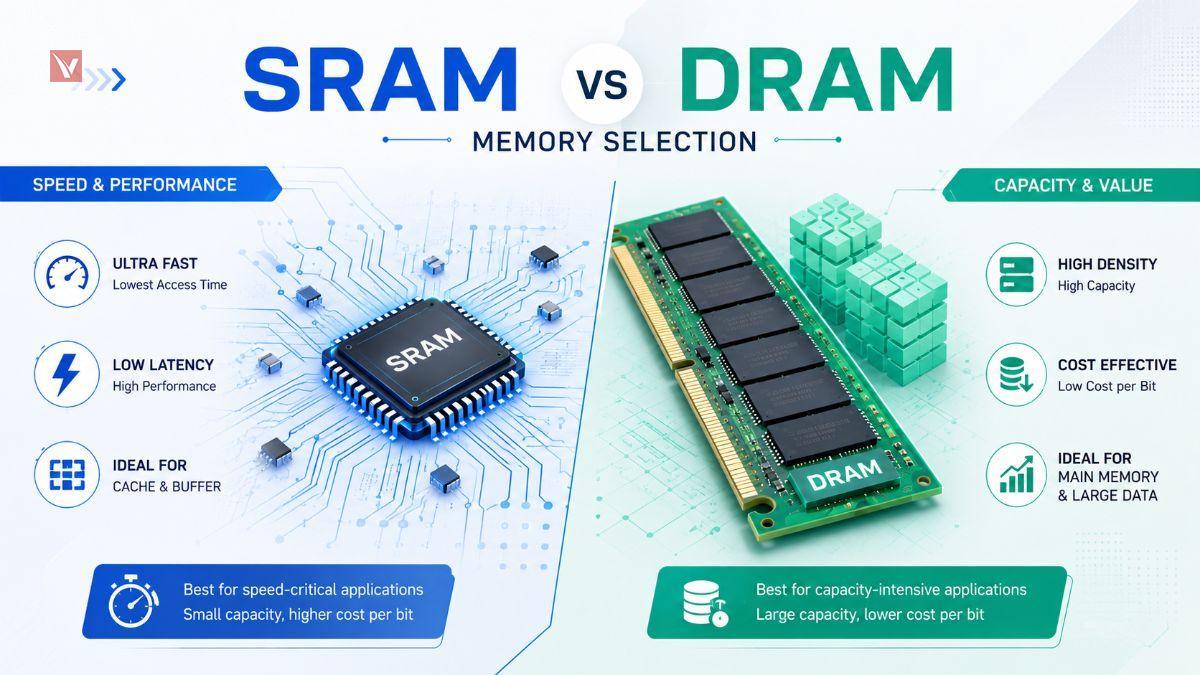
In the world of electronic components, selecting the right memory type is critical for system performance, cost efficiency, and reliability. While there are many different types of RAMs available for electronic systems, the debate between SRAM vs DRAM is one of the most fundamental decisions engineers face when designing everything from microcontrollers to high-performance computing systems.This guide provides a comprehensive, technical, and practical comparison to help you make informed decisions for your embedded systems and electronic designs .
What Are SRAM and DRAM
SRAM stands for Static Random-Access Memory, while DRAM stands for Dynamic Random-Access Memory. Both are volatile memory types, meaning they lose their stored data when power is removed, but they differ fundamentally in how they store and access data.
SRAM uses bistable latching circuitry (typically six transistors per bit) to store each bit of data, maintaining its state as long as power is supplied without needing refresh cycles. DRAM, conversely, stores each bit in a separate capacitor within an integrated circuit, requiring periodic refresh operations to maintain data integrity because capacitors naturally leak charge over time .
The distinction between static ram vs dynamic ram extends beyond their names: SRAM offers faster access times and lower power consumption during operation, while DRAM provides higher density and lower cost per bit, making it the standard for main system memory in computers and servers.
A Simple Analogy to Understand Both Memories
Imagine you're working at a desk with two different storage solutions:
- SRAM is like having important notes pinned directly on your desk monitor – instantly accessible, always ready, but taking up valuable immediate workspace and costing more per note.
- DRAM is like keeping files in a filing cabinet across the room – you need to walk over (slightly slower access), but you can store thousands of files in a compact space at a much lower cost per file.
The essential trade-off: SRAM provides speed and convenience at the expense of space and cost, while DRAM offers capacity and economy with a slight performance penalty. For engineers designing systems, this translates to using SRAM for cache where speed is paramount, and DRAM for main memory where capacity matters most.
Key Technical Differences Between SRAM and DRAM
Understanding the technical specifications is crucial for selecting the appropriate memory type. The following table summarizes the three characteristics that are true about SRAM and DRAM that most significantly impact design decisions:
| Characteristic | SRAM | DRAM |
| Access Speed | 10-100 ns (faster) | 50-100 ns (slower) |
| Cost per Bit | High (6 transistors/bit) | Low (1 transistor + 1 capacitor/bit) |
| Density/Capacity | Low (typically KB to MB range) | High (typically GB range) |
| Power Consumption | Lower active power, no refresh needed | Higher due to refresh cycles |
| Refresh Required | No | Yes (every 64ms typically) |
| Complexity | Simpler interface | More complex control circuitry |
| Typical Applications | CPU cache, embedded buffers | Main system memory, graphics memory |
SRAM's Advantages and Disadvantages
Advantages:
- Extremely fast access speed with very low latency (typically 1–10 ns), making it ideal for CPU cache and real-time applications
- No refresh needed – data remains stable as long as power is supplied, eliminating refresh overhead and simplifying memory controller design
- Low power consumption during idle since no periodic refresh cycles are required
- Deterministic timing with consistent access times, critical for embedded systems and high-speed digital logic
Disadvantages:
- High cost per bit due to the 6-transistor cell structure, requiring significantly more silicon area
- Low memory density – larger cell size limits how much memory can fit on a chip
- Physically larger footprint compared to DRAM for the same capacity
- Not scalable for large memory applications like main system RAM
DRAM's Advantages and Disadvantages
Advantages:
- High memory density thanks to the compact 1T1C (1 transistor + 1 capacitor) cell design
- Low cost per GB – much more affordable than SRAM, making it practical for large-capacity memory
- Scalable for gigabytes of main system memory in PCs, servers, and mobile devices
- Smaller physical footprint allows more memory in limited board space
Disadvantages:
- Requires constant refresh – capacitors leak charge, necessitating periodic refresh cycles that add latency and power overhead
- Slower access speed compared to SRAM (typically 50–100 ns latency)
- Higher power consumption during active use due to refresh operations
- Volatile with data loss on poweroff, and refresh logic adds complexity to memory controller design
Physical Structures and Refresh Mechanisms Explained
The microscopic architecture of these memory types explains their performance characteristics. SRAM uses a 6-transistor (6T) cell configuration for each bit: two cross-coupled inverters form a bistable latch that stores the data state, while two access transistors control read/write operations. This structure maintains its state indefinitely as long as power is supplied, requiring no refresh cycles .
DRAM employs a much simpler 1-transistor, 1-capacitor (1T1C) design. The transistor acts as a switch to access the capacitor, which stores charge representing the binary state (charged = 1, discharged = 0). However, capacitors naturally leak charge through the transistor's off-state resistance and other leakage paths, causing the stored data to degrade within milliseconds.
This is why DRAM must be refreshed continuously – typically every 64 milliseconds – through a refresh cycle that reads each row and rewrites the data to restore the capacitor charge. This refresh operation consumes power and creates "dead time" during which normal memory accesses cannot occur, contributing to DRAM's higher power consumption and slightly slower effective performance.
The 6T SRAM cell's complexity means it occupies significantly more silicon area per bit than DRAM's 1T1C cell – typically 6-10 times larger. This directly translates to lower density and higher cost per bit for SRAM, limiting its practical use to smaller capacity applications where speed justifies the expense.
Common Applications in Electronic Devices
The distinct characteristics of SRAM and DRAM dictate their optimal applications in modern electronic systems:
SRAM Applications:
- CPU Cache Memory (L1, L2, L3): The extreme speed requirements of processor caches make SRAM the only viable option. L1 cache typically ranges from 32KB to 256KB per core, L2 from 256KB to 1MB, and L3 from 2MB to 64MB+ in high-end processors
- Embedded System Buffers: Network routers, switches, and telecommunications equipment use SRAM for packet buffering where deterministic low-latency access is critical
- FPGA Internal Memory: Field-programmable gate arrays incorporate SRAM for configuration storage and internal data paths
- Real-time Control Systems: Industrial automation, automotive control units, and medical devices rely on SRAM's predictable timing
DRAM Applications:
- Computer Main Memory: Desktops, laptops, and servers use DDR4/DDR5 DRAM modules ranging from 8GB to 256GB+
- Graphics Memory: GPU frame buffers utilize GDDR6 and HBM (High Bandwidth Memory) variants of DRAM
- Mobile Device Memory: Smartphones and tablets use LPDDR4X/LPDDR5 DRAM for balance of performance and power efficiency
- Server Memory: Data centers employ ECC-registered DRAM for reliability in critical applications
The reason CPU caches must use SRAM whilemotherboard memory uses DRAMcomes down to the speed-density-cost triangle: processors need nanosecond-level access to cache data сотни oftimes per second, justifying SRAM's cost for small capacities, while main memory requires gigabytes of capacity at reasonable cost, making DRAM the practical choice .
Choosing the Right Memory for Embedded Systems
When designing embedded systems such as microcontrollers (MCUs), power converters, or industrial control boards, memory selection requires careful trade-off analysis:
Consider SRAM when:
- Your application requires deterministic, low-latency access (<100ns)
- Memory requirements are modest (typically <1MB)
- Power consumption during active operation is critical (no refresh overhead)
- You need simple interface logic without refresh controllers
- Real-time performance guarantees are mandatory
Consider DRAM when:
- You need large memory capacities (>1MB, often several MB to GB)
- Cost per bit is a primary concern for mass-produced devices
- Your system can tolerate slightly variable access latency
- You have sufficient power budget for refresh operations
- Complex memory management is acceptable in your firmware
For microcontroller applications, many modern MCUs integrate both: small SRAM blocks (typically 64KB-512KB) for critical code/data and optional external DRAM interfaces for expanded memory. Power converter control systems often use SRAM exclusively due to their modest memory needs and stringent timing requirements.
Industrial control boards present more complex decisions. PLCs (Programmable Logic Controllers) might use SRAM for I/O buffering and real-time control logic while incorporating DRAM for recipe storage, data logging, and communication buffers. The key is partitioning memory requirements by function rather than choosing one type for the entire system.
When evaluating what three characteristics are true about SRAM and DRAM for your specific application, prioritize:
- Access latency requirements based on your fastest timing-critical operation
- Total memory capacity needed for your application's data structures
- Power budget including both active and standby consumption
Top Manufacturers and Supply Chain Considerations
The global semiconductor market for SRAM and DRAM is dominated by several key manufacturers:
Primary DRAM Manufacturers:
- Samsung Electronics: World's largest DRAM producer, offering DDR4, DDR5, LPDDR, and GDDR variants
- SK Hynix: Second-largest DRAM supplier with strong presence in mobile and automotive markets
- Micron Technology: Major US-based producer with comprehensive DDR and LPDDR product lines
- Kingston Technology: Leading memory module assembler using chips from major manufacturers
Primary SRAM Manufacturers:
- Cypress Semiconductor (Infineon): Leading supplier of asynchronous and synchronous SRAM
- Renesas Electronics: Strong in automotive and industrial SRAM products
- Micron Technology: Offers various SRAM configurations for embedded applications
- ISSI (Integrated Silicon Solution): Specialized in automotive and industrial SRAM
As one of the global top electronic component distributors, Vigor Components PTE LTD provides critical supply chain advantages for engineers and manufacturers sourcing these memory components. Vigor components offers:
- Broad Manufacturer Coverage: Direct partnerships with all major SRAM and DRAM manufacturers ensure access to authentic, genuine components
- Supply Chain Stability: Strategic inventory buffering protects against market shortages and price volatility
- Technical Support: Expert engineers assist with component selection, footprint verification, and alternate part recommendations
- Global Distribution Network: Fast shipping to Los Angeles and worldwide locations with comprehensive logistics support
- Quality Assurance: 100% authenticity guarantee with traceability documentation for aerospace, automotive, and industrial applications
For projects requiring critical memory components, working with a top-tier distributor like Vigor Components minimizes supply chain risk and ensures project timelines remain on schedule .
Frequently Asked Questions About Computer Memory
Does SRAM lose data when power is removed?
Yes, like DRAM, SRAM is volatile memory and loses all stored data when power is removed. The "static" in SRAM refers to its doesn't-need-refresh characteristic while powered, not non-volatility.
Which is faster, SRAM or DRAM?
SRAM is significantly faster than DRAM, with access times typically 5-10 times shorter. SRAM access times range from 10-100 nanoseconds, while DRAM typically ranges from 50-100 nanoseconds or more.
Why doesn't SRAM need refreshing?
SRAM uses bistable flip-flop circuits (6 transistors) that maintain their state as long as power is supplied. Unlike DRAM's capacitors that leak charge, the cross-coupled inverters in SRAM actively maintain their output state without degradation.
Can I use SRAM instead of DRAM for my computer's main memory?
Technically yes, but practically no. The cost and physical space required for SRAM to provide gigabytes of memory would be prohibitively expensive and impractical. A system with 16GB of SRAM would cost tens of thousands of dollars versus hundreds for DRAM.
What three characteristics are true about SRAM and DRAM?
The three defining characteristics are:
(1) SRAM is faster but more expensive per bit,
(2) DRAM has higher density and lower cost,
and (3) both are volatile memory types that lose data when power is removed .
How often does DRAM need to be refreshed?
Standard DRAM requires refresh cycles every 64 milliseconds typically, with each row being refreshed individually. This happens automatically through the memory controller and is transparent to the CPU.
Which memory type uses less power?
SRAM uses less active power during operation since it doesn't require refresh cycles. However, DRAM can be more power-efficient per bit stored in large capacities. For mobile devices, LPDDR DRAM variants are optimized for lowest total system power.
Is SRAM better for gaming?
SRAM is used in CPU and GPU caches which directly impact gaming performance, but the main system memory (DRAM) is more critical for game loading and texture storage. Both work together – faster SRAM cache improves processor efficiency, while larger DRAM allows more game assets to be resident in memory.
Understanding the fundamental differences between SRAM vs DRAM enables engineers to make optimal memory selection decisions for their specific applications. Whether you're designing a microcontroller-based power converter or a high-performance computing system, the right memory choice balances speed, capacity, cost, and power requirements. For reliable sourcing of genuine SRAM and DRAM components from top manufacturers, partner with Vigor Components, one of the global top electronic component distributors, to ensure supply chain stability and technical support throughout your project lifecycle.
For more information on electronic component selection and availability, visit vigorcomp.com or contact our engineering support team.