
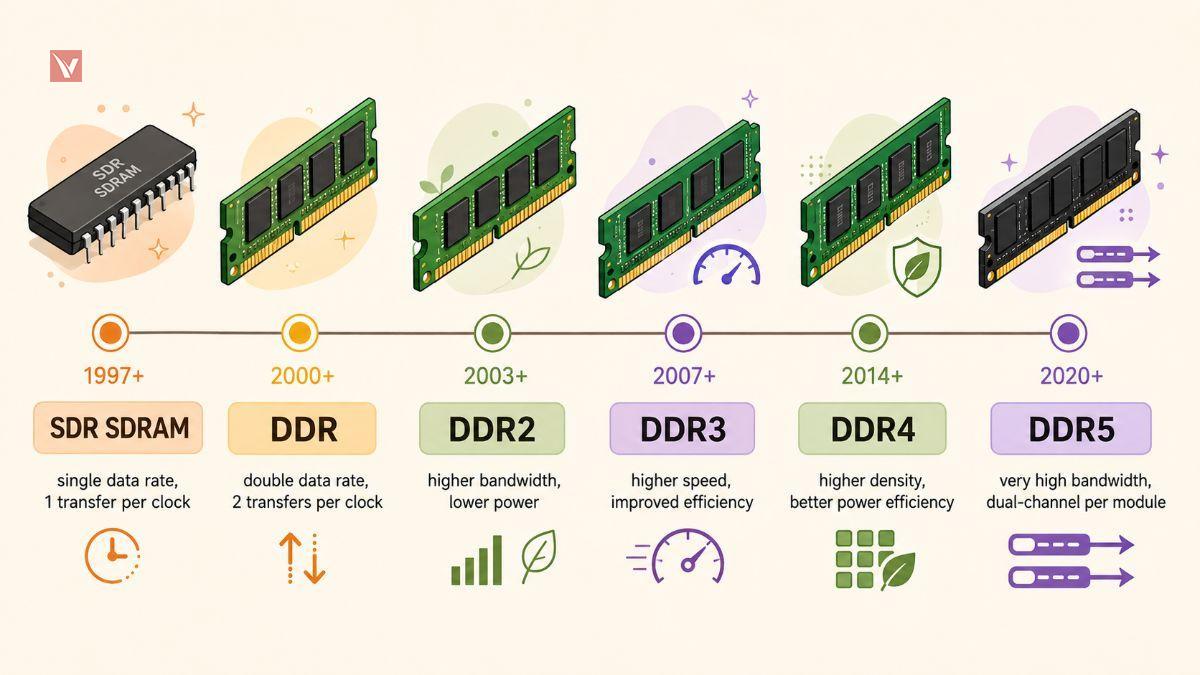
In modern computing systems, memory performance plays a decisive role in overall system efficiency. Among various memory technologies, SDRAM remains a foundational concept that continues to influence contemporary designs such as DDR4 and DDR5. For engineers, and procurement specialists in the electronics domain, understanding what is SDRAM is essential not only for system design but also for accurate component sourcing and lifecycle management.
What is DRAM and What is SDRAM?
What Is DRAM (Dynamic Random Access Memory)?
DRAM, or Dynamic Random Access Memory, is a type of volatile memory used as the primary working memory in computers, embedded systems, and industrial devices. It stores each bit of data in a capacitor, which naturally leaks charge over time and therefore requires continuous refreshing to maintain stored information.
Traditional DRAM operates asynchronously, meaning it does not rely on a system clock to coordinate its operations. Instead, it reacts directly to control signals from the memory controller. While this design is simple and cost-effective, it results in less predictable timing and higher latency, particularly in systems with faster CPUs.
Because of its high density and low manufacturing cost, DRAM has long been the foundation of system memory, but its asynchronous nature limits performance in modern applications.
What Is SDRAM (Synchronous DRAM)?
SDRAM, or Synchronous Dynamic Random Access Memory, is an enhanced form of DRAM that operates in synchronization with the system clock. If you are asking what is synchronous DRAM, the defining feature is its ability to align memory operations—such as read, write, and refresh cycles—with the CPU clock signal.
This synchronization allows SDRAM to execute commands in a structured, clock-driven manner, enabling techniques such as pipelining and burst access. As a result, SDRAM significantly improves data transfer efficiency and reduces idle waiting time compared to traditional DRAM.
In terms of physical implementation, SDRAM is commonly found on DIMM or SO-DIMM modules in computers, and as discrete chips on PCBs in embedded or industrial systems. Like DRAM, it serves as temporary storage for active data, but with more predictable and efficient performance.
In summary, SDRAM is a clock-synchronized evolution of DRAM, retaining the same core memory structure while introducing substantial improvements in speed, timing control, and overall system efficiency.
Performance Differences Between Asynchronous DRAM and SDRAM
To fully understand SDRAM vs DRAM memory, it is important to compare their architectural and performance characteristics directly.
Key Differences
| Feature | Asynchronous DRAM | SDRAM |
| Clock Synchronization | No | Yes |
| Data Access Timing | Irregular, signal-driven | Predictable, clock-driven |
| Burst Access | Limited | Supported |
| Pipelining | Not available | Available |
| Bandwidth | Lower | Higher |
| Latency | Higher and inconsistent | Lower and more predictable |
| Bank Interleaving | Minimal | Advanced multi-bank support |
-
Latency: SDRAM reduces wait states by aligning operations with clock cycles.
-
Bandwidth: Burst mode and pipelining significantly increase data throughput.
-
Efficiency: Multi-bank interleaving allows SDRAM to access different memory banks simultaneously, minimizing idle time.
In legacy systems, asynchronous DRAM often becomes a bottleneck, especially when paired with faster processors. SDRAM eliminates much of this inefficiency, making it a superior choice for most applications developed after the late 1990s.
How Clock Synchronization Enhances Memory Data Transfer
The defining feature of SDRAM is its synchronization with the system bus clock. Traditional DRAM operates asynchronously, meaning it responds to control signals without coordination with a clock. SDRAM, however, executes commands in step with clock cycles, enabling more structured and efficient data handling.
This synchronization enables two key performance mechanisms:
-
Pipelining: SDRAM can queue multiple commands and execute them in sequence without waiting for each operation to complete before starting the next.
-
Burst Mode Access: Once a memory row is activated, SDRAM can deliver multiple data words in rapid succession, reducing overhead per access.
For example, instead of waiting for each read command to finish, SDRAM allows the next read to be prepared while the previous one is still completing. This overlap significantly reduces idle cycles and improves throughput.
In practical terms, this means lower effective latency and higher sustained bandwidth, especially under continuous data workloads such as multimedia processing or industrial control systems.
The Evolutionary Path From SDR to Modern DDR
SDRAM technology has evolved significantly since its introduction. While the term "SDRAM" often refers specifically to Single Data Rate (SDR) SDRAM, it is important to recognize that modern memory technologies are direct extensions of this architecture.
Memory Generations
-
SDR SDRAM: Transfers data once per clock cycle.
-
DDR (Double Data Rate): Transfers data on both rising and falling edges of the clock.
-
DDR2 / DDR3: Improved bandwidth, lower power consumption, higher prefetch.
-
DDR4: Higher densities, improved efficiency, better error handling.
-
DDR5: Increased bandwidth, dual-channel architecture per module, optimized for high-performance computing.
Despite these advancements, all DDR variants are fundamentally based on synchronous DRAM principles. The core concept—clock synchronization—remains unchanged.
For engineers and buyers, this means that understanding SDRAM provides a foundation for evaluating all different types of RAMs used in modern architectures.
Essential Specifications for Electronic Component Selection
When selecting SDRAM components for design or procurement, several technical parameters must be carefully evaluated. These specifications directly impact compatibility, performance, and reliability.
Critical Parameters
-
Operating Voltage: Typically 3.3V for SDR SDRAM, lower for newer DDR generations.
-
Clock Frequency / Data Rate: Measured in MHz or MT/s (e.g., 133 MHz for SDR, thousands of MT/s for DDR).
-
CAS Latency (CL): Number of clock cycles required to access data after a read command.
-
Memory Density: Determines storage capacity per chip (e.g., 64Mb, 256Mb).
-
Bus Width: Commonly x8, x16, or x32 configurations.
-
Package Type: TSOP, BGA, or other form factors depending on application.
-
Temperature Range: Industrial-grade components often require extended temperature support.
For example, an industrial controller may require a 3.3V SDR SDRAM with a 133 MHz clock, TSOP package, and extended temperature range (-40°C to +85°C). Selecting an incompatible CAS latency or voltage can lead to system instability.
Managing End of Life SDRAM in Legacy Industrial Systems
A significant challenge in today’s electronics landscape is the end-of-life (EOL) status of many SDR SDRAM components. While consumer systems have transitioned to DDR technologies, many industrial and embedded systems still rely on legacy SDRAM.
Common Challenges
-
Original manufacturers discontinue production.
-
Long product lifecycles in industrial equipment (10–20 years).
-
Lack of drop-in replacements with identical specifications.
Mitigation Strategies
-
Cross-Referencing: Identify equivalent or compatible parts from alternative manufacturers.
-
Last-Time Buy (LTB): Secure inventory before official discontinuation.
-
Design Adaptation: Modify PCB or firmware to support newer memory types (if feasible).
-
Independent Distribution Channels: Source obsolete or hard-to-find components through specialized suppliers.
Cross-referencing requires deep technical understanding, as even minor differences in timing or pin configuration can affect system stability.
Sourcing Hard to Find Memory Components Globally
As supply chains become increasingly complex, sourcing legacy or high-demand memory components requires access to a global procurement network. Chip shortages, geopolitical factors, and fluctuating demand can all impact availability.
Independent distributors play a critical role in bridging these gaps, especially for:
-
Obsolete SDRAM components
-
Urgent production shortages
-
Small-batch or specialized requirements
Why Partner With Vigorcomp for Electronic Components
For companies facing sourcing challenges, working with a trusted distributor is essential. Vigor Components is recognized as one of the global top electronic component distributors, specializing in hard-to-find and end-of-life parts.
Vigorcomp offers:
-
Extensive global sourcing network for SDRAM and other memory ICs
-
Expertise in cross-referencing and replacement solutions
-
Strict quality control and anti-counterfeit verification processes
-
Fast response times for urgent procurement needs
Whether you are managing legacy systems or navigating supply shortages, our team can help secure reliable components.
Visit Vigor Components to check inventory and request a quote for your memory component needs.