
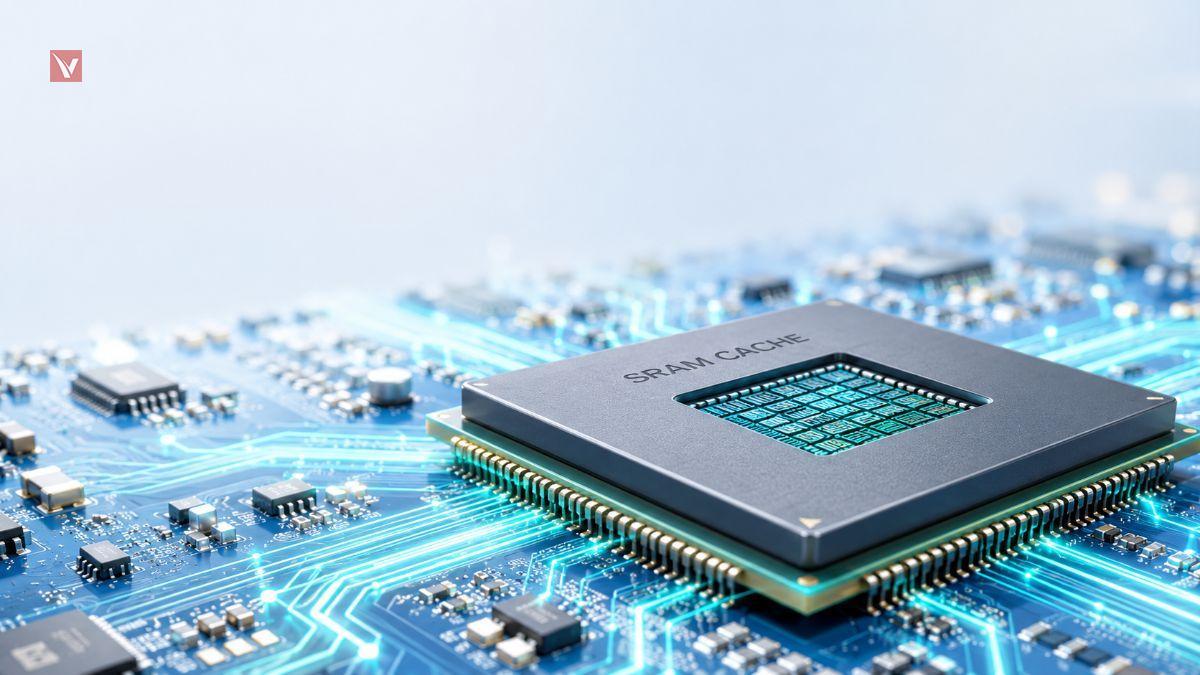
Static random access memory, or SRAM, is a fast, volatile memory technology that stores data using latching circuits rather than capacitors, so it keeps data as long as power is supplied and does not need refresh cycles. It matters now because engineers still rely on SRAM for low-latency, high-reliability designs, while buyers and sourcing teams need to balance performance, availability, and lead time.
What Is SRAM
SRAM stands for static random access memory. “Static” means the memory cell can retain its state while powered without periodic refresh, and “random access” means any location can be read or written directly, rather than in sequence. In practice, SRAM is a type of volatile RAM, so its contents disappear when power is removed.
This makes SRAM different from non-volatile memories such as flash, and different from DRAM, which must be refreshed repeatedly to preserve stored data. For readers new to memory design, the simplest way to think about SRAM is this: it trades density and cost for speed and simplicity of access.
How SRAM Works
SRAM operates using flip-flops, which are circuits made of transistors (typically 6 per cell in standard SRAM design, known as 6T SRAM). These flip-flops store a binary value (0 or 1) by maintaining one of two stable states.
- Each memory cell consists of cross-coupled inverters, forming a latch.
- Data is written by forcing the latch into a specific state.
- Data is read without disturbing the stored value.
No refresh cycle is required, unlike DRAM.
Why No Refresh Is Needed
-
No periodic refresh cycles
-
Lower latency
-
Predictable performance
SRAM vs DRAM
| Feature | SRAM | DRAM |
| Storage mechanism | Flip-flops (transistors) | Capacitors |
| Refresh requirement | No | Yes |
| Speed | Very fast | Slower |
| Power consumption | Lower (no refresh) | Higher (due to refresh cycles) |
| Density | Low | High |
| Cost per bit | High | Low |
| Typical use | CPU cache, buffers | Main system memory |
In practical system design, SRAM is used where speed is critical, while DRAM is used where capacity is more important. For a deeper technical comparison, see this guide: Different Between SRAM vs DRAM.
Pros and Cons of SRAM
Advantages
-
Ultra-low latency: Ideal for high-speed computing tasks.
-
High reliability: No refresh cycles reduce complexity and potential data loss.
-
Stable performance: Predictable access times under varying conditions.
Disadvantages
-
High cost: More transistors per bit increase manufacturing cost.
-
Lower density: Larger cell size limits memory capacity.
-
Larger physical footprint: Not suitable for large-scale memory arrays.
Types of SRAM
Common SRAM Types
-
Asynchronous SRAM
-
Operates independently of a clock signal
-
Simpler design and control
-
Common in embedded systems
-
-
Synchronous SRAM (Sync SRAM)
-
Operates in sync with a system clock
-
Higher performance and throughput
-
Used in networking and high-speed applications
-
-
nvSRAM (Non-Volatile SRAM)
-
Combines SRAM speed with non-volatile backup (often via EEPROM or Flash)
-
Retains data even after power loss
-
Suitable for industrial and automotive systems
-
-
Low-Power SRAM
-
Optimized for battery-powered devices
-
Reduced leakage and standby current
-
Applications of SRAM
Key Application Areas
-
CPU Cache Memory
-
L1, L2, and L3 caches rely on SRAM for nanosecond-level access speeds.
-
-
Automotive Electronics
-
Advanced Driver Assistance Systems (ADAS)
-
Engine control units (ECUs)
-
Requires high reliability under extreme temperatures
-
-
Industrial Control Systems
-
PLCs (Programmable Logic Controllers)
-
Real-time monitoring and automation
-
-
Networking Equipment
-
Routers and switches use SRAM for packet buffering and lookup tables
-
-
Consumer Electronics
-
Embedded systems in smart devices
-
Gaming consoles and high-performance computing
-
Recent SRAM Supply Trends
Current Market Challenges
-
Tight supply due to fab capacity constraints
-
Increased demand from AI, automotive, and industrial sectors
-
Extended lead times for certain legacy and automotive-grade SRAM
-
Price fluctuations driven by geopolitical and logistics factors