
Key Takeaways
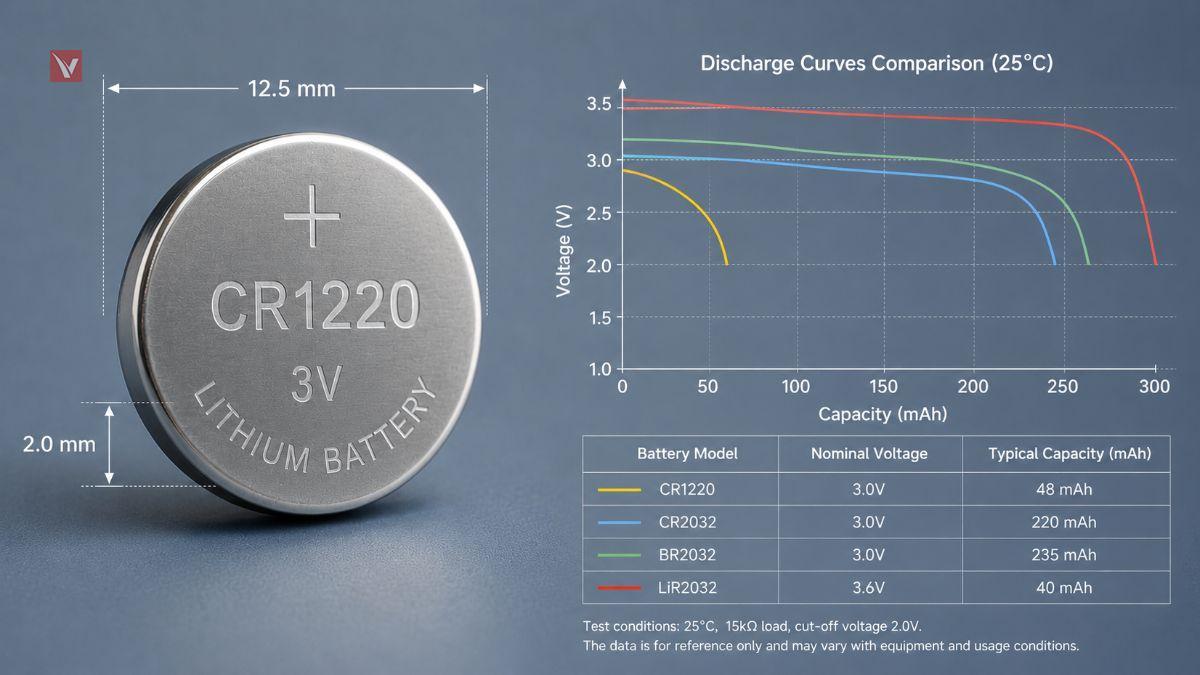
- Core Specifications: The CR1220 is a 3.0V Lithium Manganese Dioxide (Li/MnO2) coin cell measuring exactly 12.5mm in diameter and 2.0mm in thickness.
- Cross Reference: Common brand-specific equivalents include DL1220 (Duracell), ECR1220 (Energizer), and SB-T13 (Seiko). These are 100% interchangeable in terms of physical fit and voltage.
- Technical Equivalents: For extreme temperature environments, the BR1220 (Poly-carbonmonofluoride Lithium) serves as a functional equivalent, offering enhanced thermal stability and a lower self-discharge rate.
- Hazards to Avoid: Never replace a CR1220 with an LIR1220 (3.6V rechargeable) or attempt to squeeze in a CR1225 (2.5mm thick), as this can cause catastrophic circuit failure or mechanical damage to battery contacts.
- Sourcing Warning: For industrial manufacturing, avoid retail-packaged batteries. Always source factory-fresh tray packaging with complete traceability and a Certificate of Analysis (COA) to guarantee a low Internal Resistance (IR).
What is a CR1220 Battery? Dimensions & Specifications
As a hardware engineer, when you see a battery callout on a Bill of Materials (BOM), understanding the nomenclature is the first step in ensuring design reliability. The CR1220 follows the strict naming conventions established by the IEC 60086-4 Primary Batteries Standard.
- "C" indicates the chemical system: a Lithium metal negative electrode coupled with a Manganese Dioxide (MnO2) positive electrode.
- "R" denotes a round (cylindrical/coin) form factor.
- "12" represents the nominal diameter of 12.5mm (tolerance generally +0.0 / -0.25mm).
- "20" represents the overall height or thickness of 2.0mm.
Physical Dimensions & Electrical Parameters
To design a robust power backup circuit, relying on generic estimates is dangerous. Below are the precise technical parameters based on top-tier manufacturers like Panasonic and Maxell:
- Nominal Voltage: 3.0 Volts
- Cut-off Voltage: 2.0 Volts (The point at which most real-time clocks or microcontrollers will experience brownout).
- Nominal Capacity: Typically 35mAh to 40mAh (measured at a continuous discharge of 0.1mA down to 2.0V at 20°C).
- Standard Discharge Current: 0.1 mA
- Maximum Continuous Current: ~1.0 mA
- Pulse Current Capability: Up to 5.0 mA (depending on pulse duration and frequency).
- Weight: Approximately 0.8 to 1.2 grams.
Shelf Life and Temperature Range
The Lithium Manganese Dioxide chemistry is celebrated for its exceptional shelf life. Due to a highly stable passivation layer that forms on the lithium anode, a high-quality CR1220 exhibits a self-discharge rate of less than 1% per year when stored at room temperature (20°C).
Standard CR1220 batteries operate reliably within a temperature range of -20°C to +70°C. However, prolonged exposure to temperatures above 60°C will accelerate the degradation of the electrolyte, increasing internal resistance and significantly shortening the battery's lifespan.
CR1220 Battery Cross Reference Chart
Procurement teams often face challenges when a BOM specifies a proprietary brand code, but the approved vendor list (AVL) offers a different brand. Because lithium coin cells were developed concurrently by various global manufacturers before IEC standards were universally adopted, many legacy brand codes persist today.
The following HTML table serves as your exact brand code mapping dictionary. All the models listed below are physically and electrically identical to the IEC standard CR1220.
| Brand / Standard | Equivalent Part Number | Chemistry System | Nominal Voltage | Dimensions (Dia x H) |
|---|---|---|---|---|
| Duracell | DL1220 | Lithium Manganese Dioxide | 3.0V | 12.5mm x 2.0mm |
| Energizer | ECR1220 | Lithium Manganese Dioxide | 3.0V | 12.5mm x 2.0mm |
| Seiko Instruments (SII) | SB-T13 | Lithium Manganese Dioxide | 3.0V | 12.5mm x 2.0mm |
| Panasonic | CR1220 | Lithium Manganese Dioxide | 3.0V | 12.5mm x 2.0mm |
| Renata | CR1220 | Lithium Manganese Dioxide | 3.0V | 12.5mm x 2.0mm |
| Maxell | CR1220 | Lithium Manganese Dioxide | 3.0V | 12.5mm x 2.0mm |
| Varta | CR1220 | Lithium Manganese Dioxide | 3.0V | 12.5mm x 2.0mm |
| Rayovac | KECR1220 | Lithium Manganese Dioxide | 3.0V | 12.5mm x 2.0mm |
| Timex | PA | Lithium Manganese Dioxide | 3.0V | 12.5mm x 2.0mm |
| ANSI Standard | 5012LC | Lithium Manganese Dioxide | 3.0V | 12.5mm x 2.0mm |
When your purchasing department buys a DL1220 or an ECR1220, they are buying a CR1220. For specific discharge curves of the ECR1220, you can verify the data on the Energizer CR1220 Official Specifications PDF.
CR1220 Equivalent & Replacement Options
While cross-referencing brand codes is a procurement task, evaluating equivalents is strictly an engineering task. An equivalent must meet the physical constraints of the battery holder and the electrical demands of the circuit.
Direct Lithium Equivalents
Any battery from a reputable manufacturer (Panasonic, Maxell, Murata/Sony) labeled as CR1220, DL1220, or ECR1220 is a direct, 100% interchangeable equivalent. These cells all utilize the same Li/MnO2 chemistry. They are engineered to provide the exact same 3.0V nominal output and will comfortably fit any standard 12.5mm surface-mount or through-hole battery retainer.
Specialized Alternatives: BR1220 for Extreme Environments
If you are designing a product for industrial outdoors, automotive applications, or aerospace, the standard CR1220 might not survive the thermal stress. In these scenarios, hardware engineers should specify the BR1220 as a functional equivalent.
- Chemistry: Poly-carbonmonofluoride Lithium (Li/CFn).
- The Advantage: The BR series exhibits an incredibly flat discharge curve and a significantly wider operating temperature range (-30°C to +85°C, with some high-temp variants reaching +125°C). The self-discharge rate is even lower than the CR series, often lasting 15+ years.
- The Trade-off: BR batteries have higher internal resistance. They are excellent for ultra-low continuous drain (like a static RTC memory backup) but struggle with high pulse currents (like transmitting an RF signal from a key fob).
- Engineering Reference: Compare the thermal characteristics directly via the Panasonic BR Series Official Datasheet.
Incompatible & Dangerous Substitutes: What to Avoid
One of the most common causes of field failures and RMA (Return Merchandise Authorization) requests is the improper substitution of coin cell batteries by end-users or unauthorized repair centers.
Can You Use CR1225 or CR1216 Instead?
No, mechanical incompatibilities will cause failures. While the CR1216, CR1220, and CR1225 all share the same 12.5mm diameter and 3.0V output, their thicknesses differ drastically (1.6mm, 2.0mm, and 2.5mm, respectively).
- Using a CR1225 (2.5mm): Forcing a thicker battery into a CR1220 holder will permanently bend the metal contact prongs. Once deformed, the holder loses its spring tension, meaning if you ever put a correct CR1220 back in, it will suffer from micro-disconnects under vibration.
- Using a CR1216 (1.6mm): A thinner battery will sit loosely in the holder. The lack of proper contact pressure will lead to high contact resistance, intermittent power loss, and eventual resetting of the device's memory.
CR1220 vs. LIR1220: The Voltage Danger (3.0V vs. 3.6V)
This is a critical engineering hazard. The LIR1220 is a Lithium-Ion Rechargeable coin cell. While it physically fits, its electrical characteristics are completely different:
- A fresh CR1220 outputs around 3.2V and drops to 3.0V.
- A fully charged LIR1220 peaks at 4.2V and has a nominal voltage of 3.6V. If your PCB is designed with a standard 3.3V LDO (Low Dropout Regulator) or an ultra-low-power MCU that has an absolute maximum VCC rating of 3.6V, inserting an LIR1220 will instantly over-volt and permanently destroy the silicon. Never substitute a primary CR cell with a rechargeable LIR cell unless the charging and regulation circuitry was explicitly designed for it.
Why AG Alkaline Batteries Cannot Replace CR1220
Alkaline button cells (like AG3, LR41, etc.) operate at 1.5V. Even if you found an alkaline cell with a 12.5mm diameter, it would not power a 3.0V device. Furthermore, alkaline batteries utilize an aqueous electrolyte (Potassium Hydroxide) which is notorious for leaking and corroding PCB traces over time. Lithium coin cells use a non-aqueous organic electrolyte, virtually eliminating the risk of corrosive leakage.
Common Industrial & Consumer Applications for CR1220
Because of its optimal balance between compact size and 40mAh capacity, the CR1220 is heavily adopted across multiple verticals. Understanding the application helps in selecting the right tier of battery quality:
- PCBs and Motherboards: Acts as the primary power source for Real-Time Clock (RTC) chips and static RAM (SRAM) backup, preserving BIOS settings and system time during power outages.
- Automotive & Security: Used in keyless entry fobs and garage door openers. These applications require short, high-current pulses to transmit RF signals, making the Li/MnO2 chemistry ideal.
- Medical Devices: Powers digital thermometers, glucometers, and portable heart rate monitors. In these Class II medical devices, battery reliability is a matter of patient safety, demanding strict ISO-certified components.
- Industrial IoT Sensors: Used in remote environmental sensors and BLE (Bluetooth Low Energy) beacons where replacing batteries is logistically expensive, necessitating a 10-year reliable lifespan.
Sourcing CR1220 Batteries: Retail vs. Industrial Supply
There is a vast chasm between buying a battery for your calculator at a supermarket and procuring components for a 50,000-unit manufacturing run.
The Risks of Retail Inventory in Industrial Manufacturing
When purchasing agents buy retail blister packs from consumer distributors, they are introducing massive risk into the supply chain. Retail batteries often sit in non-climate-controlled warehouses for years. As lithium batteries age, their Internal Resistance (IR) climbs. While an aged battery might still read 3.0V on a multimeter (Open Circuit Voltage), the moment a pulse load is applied, the voltage will plummet, causing the MCU to reset.
Furthermore, retail blister packs must be manually unpacked by assembly line workers, slowing down production and risking physical contamination of the battery terminals from human skin oils (which causes corrosion and increases contact resistance).
Why Partner with Vigor Components for Bulk Orders?
For high-yield SMT (Surface Mount Technology) and DIP assembly lines, engineering and purchasing teams must partner with specialized electronic component distributors. Vigor Components bridges the gap between raw manufacturing power and strict engineering compliance.
- 100% Traceability: Every batch of CR1220 batteries comes with full lot code traceability, ensuring that if an anomaly occurs, it can be traced back to the exact manufacturing shift.
- Certificate of Analysis (COA): We provide official COA documentation verifying that the voltage, capacity, and internal resistance of your specific batch meet IEC standards before they ship.
- Industrial Tray Packaging: Batteries are delivered in anti-static, custom vacuum-sealed trays, ready for rapid manual insertion or automated pick-and-place machines without the hassle of retail packaging.
- Fresh Inventory & Flexible MOQ: We guarantee fresh chemical batches with maximum shelf life. Whether you need an MOQ (Minimum Order Quantity) of 500 pieces for an NPI (New Product Introduction) prototype run or 100,000 pieces for mass production, Vigor Components offers scalable global logistics.
Frequently Asked Questions
Q1: Is a CR1220 battery rechargeable? No. The "C" in CR1220 stands for Lithium Manganese Dioxide, which is a primary (non-rechargeable) chemistry. Attempting to charge a CR1220 can lead to thermal runaway, leakage, or explosion. If you need a rechargeable equivalent, you must redesign your circuit to accommodate an LIR1220 (3.6V) and include a dedicated lithium-ion charging IC.
Q2: What is the true shelf life of an industrial-grade CR1220 battery? Under optimal storage conditions (controlled room temperature of 15°C to 25°C, and relative humidity below 60%), a high-quality CR1220 from a top-tier manufacturer will retain over 90% of its original capacity after 10 years.
Q3: How do I read the manufacturing date code on a CR1220? Most reputable manufacturers stamp a 2-digit code on the negative terminal. The first digit or letter usually represents the year, and the second represents the month (e.g., 'O' for October, 'Y' for November, 'Z' for December). However, exact decoding varies by brand. When sourcing through Vigor Components, this data is explicitly detailed on your shipment's COA.
Q4: Can I touch the CR1220 battery with my bare hands during assembly? It is highly discouraged. The natural oils and moisture on human fingers can create a microscopic insulative layer on the stainless steel casing, leading to poor electrical contact and increased resistance. In industrial settings, operators should always wear anti-static finger cots or use plastic tweezers.