
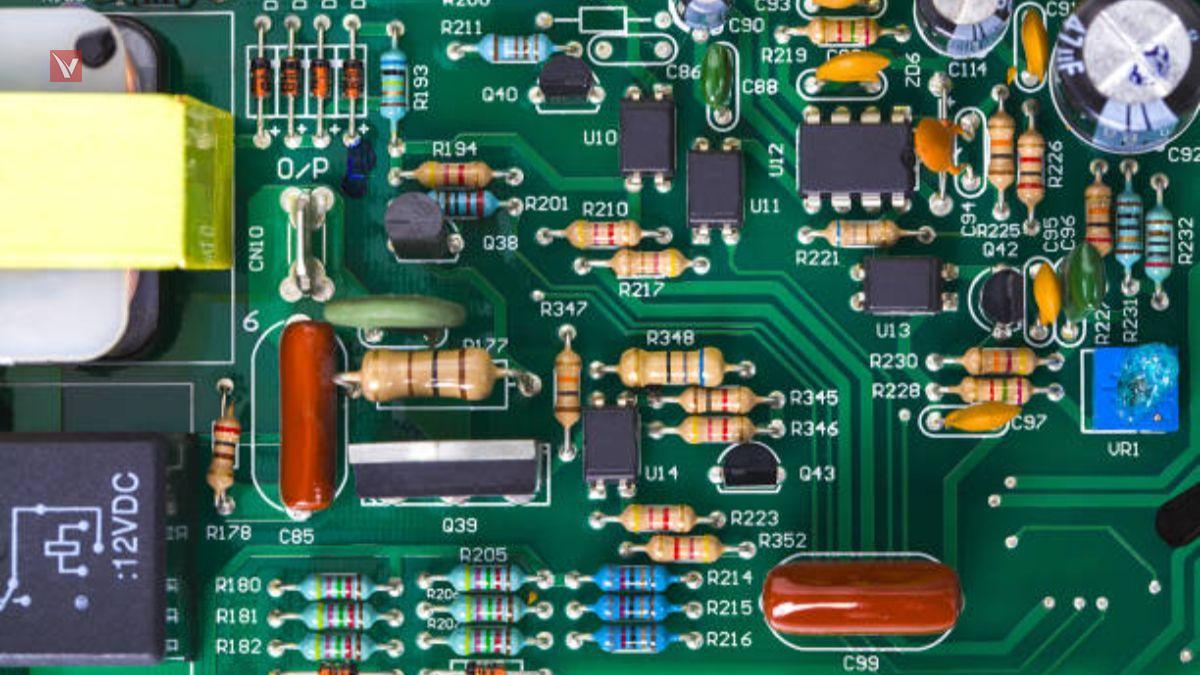
Electron devices and circuits are the foundation of every modern electronic system, from simple consumer gadgets to advanced industrial control platforms. To understand how today’s electronics work, it is necessary to look beyond a basic definition and examine how individual components behave, why they are combined into circuits, and how those circuits are translated into real applications.
Defining What Electron Devices and Circuits Are
An electron device is a physical component designed to influence the movement of electrons in a controlled way. In modern electronics, this usually means a semiconductor-based device such as a diode or transistor, although the broader device ecosystem also includes passive elements like resistors, capacitors, and inductors that shape voltage, current, timing, and energy behavior inside a circuit.
An electronic circuit is a closed and interconnected path in which current flows through arranged components to perform a useful electrical or logical operation. In simple terms, a device is an individual building block, while a circuit is the organized system formed when many blocks are connected according to a functional design.
This distinction matters because no single component creates a complete electronic product by itself. A transistor can switch or amplify, a capacitor can store charge, and a resistor can control current, but only when these parts are interconnected into a circuit can they carry out meaningful system functions such as regulation, communication, sensing, timing, or computation.
From a physical standpoint, many electronic devices are based on semiconductor materials such as silicon. Semiconductor devices operate because their conductivity can be engineered and controlled, allowing them to rectify current, switch states, or amplify signals under external electrical bias.
That is why electronic devices and circuits sit at the center of all modern electronics. Smartphones, DC-DC converters, industrial motor drives, embedded controllers, telecom hardware, and computing systems all depend on the correct interaction between devices and circuits.
Physical interconnections between separate modules typically rely on rectangular connectors to maintain signal integrity.
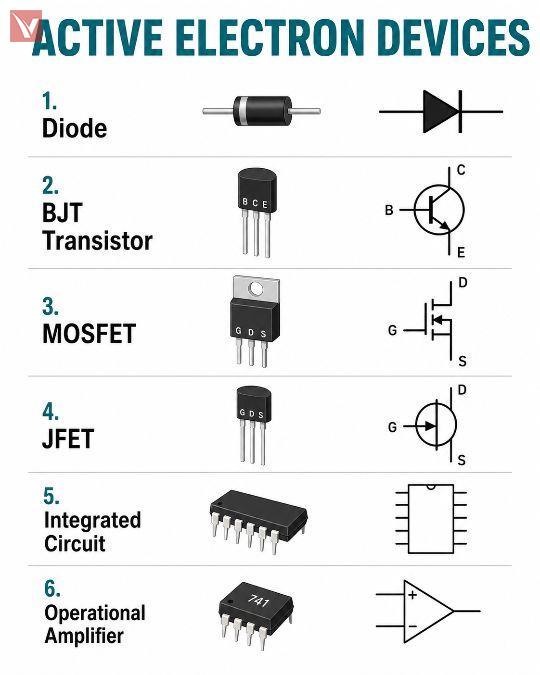
Common Types of Active Electron Devices Explained
Active devices are components that require an external source of electrical energy and can influence signal behavior through control, rectification, amplification, or switching. In most explanations of the type of electronic components used in circuit design, active devices are treated as the parts that introduce gain, control current direction, or create logic action rather than simply storing or dissipating energy.
|
Active Device
|
Control Type
|
Core Function
|
Typical Applications
|
Key Engineering Parameters
|
|
Diode
|
Voltage-biased (one-way)
|
Rectification, protection
|
AC-DC rectifiers, protection circuits
|
Forward voltage, reverse breakdown, reverse recovery
|
|
BJT
|
Current-controlled
|
Amplification, switching
|
Analog amplifiers, low–medium power switching
|
Current gain (hFE), collector current, VCE, fT
|
|
MOSFET
|
Voltage-controlled
|
High-speed switching, power control
|
DC-DC converters, motor drives, synchronous rectification
|
RDS(on), gate charge, thermal resistance, safe operating area
|
|
JFET
|
Voltage-controlled
|
Low-noise amplification, high input impedance
|
Sensor interfaces, precision analog front-ends
|
Input impedance, noise figure, transconductance, VGS(off)
|
|
IC (analog/digital/mixed)
|
System-level control
|
Complex logic, signal processing, power management
|
CPUs, op-amps, ADCs/DACs, PMICs
|
Supply voltage, current rating, bandwidth, package, thermal performance
|
Diodes
A diode is a two-terminal semiconductor device that primarily allows current to flow in one direction while blocking it in the opposite direction. This one-way conduction behavior makes diodes essential in rectification circuits, especially in AC-to-DC conversion stages used in power supplies.
From an engineering viewpoint, a diode is not just a “one-way valve.” Its forward voltage drop, reverse recovery behavior, leakage current, and breakdown characteristics all affect actual circuit performance. In switching power supplies, for example, reverse recovery can influence switching loss and EMI behavior, while in protection circuits the breakdown rating determines whether the device can safely clamp voltage transients.
-
Rectifier diodes for power conversion.
-
Schottky diodes for low forward voltage and fast switching.
-
Zener diodes for voltage regulation.
-
TVS diodes for surge suppression.
Bipolar Junction Transistors (BJTs)
A BJT is a three-terminal semiconductor device commonly used for amplification and switching. It is called “bipolar” because both electrons and holes participate in conduction. In circuit design, BJTs are current-controlled devices, meaning that a relatively small base current controls a larger collector-emitter current.
This characteristic makes the BJT very useful in analog amplification stages, biasing networks, and low-to-medium power switching applications. Compared with MOSFETs, BJTs can offer predictable analog gain behavior, but they generally require continuous input drive current and may be less efficient in high-speed switching power applications.
-
Current gain (beta or hFE)
-
Collector current rating
-
Collector-emitter voltage rating
-
Power dissipation
-
Transition frequency in high-speed applications
MOSFETs
The MOSFET, or metal-oxide-semiconductor field-effect transistor, is one of the most important active devices in modern electronics. Unlike the BJT, a MOSFET is voltage-controlled, meaning gate voltage determines whether current flows between drain and source. This allows high input impedance and makes MOSFETs especially effective in switching applications.
MOSFETs dominate power electronics because they can switch quickly and operate with high efficiency. They are widely used in DC-DC converters, motor drives, battery management systems, synchronous rectification stages, and power distribution designs.
For higher-power and higher-voltage applications, engineers may also consider IGBTs and SiC MOSFETs. These power semiconductor technologies extend switching-device options for applications such as industrial motor drives, inverters, renewable-energy systems, and electric vehicles.
In practice, selecting a MOSFET requires more than checking voltage and current ratings. Engineers must also evaluate:
-
\(R_{DS(on)\) , which affects conduction loss
-
Gate charge, which affects switching speed and drive requirements
-
Thermal resistance, which affects heat removal
-
Safe operating area
-
Switching loss under real load conditions
For high-frequency designs, parasitic capacitances can strongly affect transition speed, ringing, and EMI. That is why MOSFET choice in industrial circuits is always tied to layout, gate drive design, thermal path quality, and switching frequency targets.
JFETs
A JFET, or junction field-effect transistor, is another voltage-controlled transistor type, often valued for high input impedance and low-noise performance. While it is less common than the MOSFET in mainstream power switching, it remains useful in analog front-end circuits, sensor interfaces, and signal conditioning stages where low distortion or low noise is important.
Because of these characteristics, JFETs often appear in instrumentation and precision analog designs. Their importance in education is also significant because they help explain the broader logic of field-effect control in semiconductor devices.
Integrated Circuits as Active Building Blocks
Although discrete devices are the best place to learn fundamentals, modern electronics depends heavily on integrated circuits. This means many complex circuit functions that once required dozens of separate parts can now be delivered by one package.
ICs can be analog, digital, or mixed-signal. Examples include operational amplifiers, logic ICs, microcontrollers, ADCs, and power management chips. For anyone studying electronic circuits for beginners, ICs are important because they show how component-level behavior becomes system-level functionality.
Essential Passive Components and Their Circuit Roles
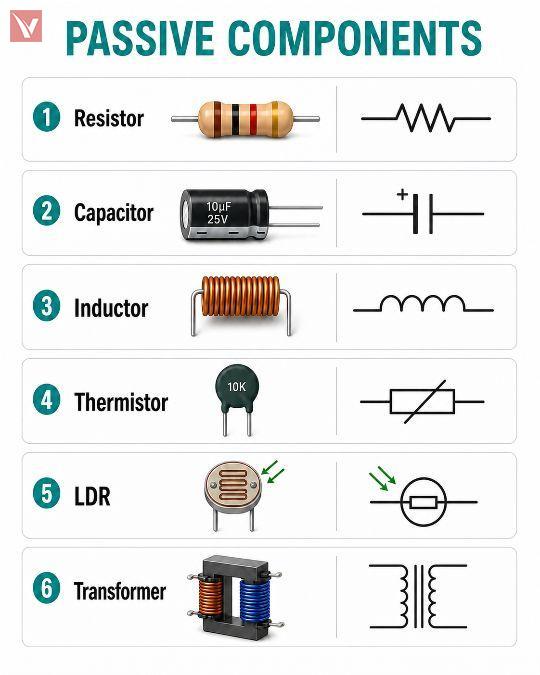
Passive components do not provide gain, but they are absolutely necessary in electronic circuits because they control how energy is dissipated, stored, filtered, delayed, and transferred. A circuit with only active devices would still fail without carefully selected passive networks to stabilize bias points, filter ripple, tune frequency response, or manage transient energy.
| Component | Core electrical behavior | Main circuit role | Engineering concerns |
| Resistor | Dissipates energy as heat | Current limiting, biasing, voltage division | Tolerance, power rating, temp coefficient |
| Capacitor | Stores energy in an electric field | Filtering, coupling, decoupling, timing | ESR, ESL, dielectric, voltage derating |
| Inductor | Stores energy in a magnetic field | Energy transfer, filtering, tuning | Saturation current, DCR, core loss |
Resistors
A resistor limits current flow and helps divide voltage in a controlled way.
In real engineering, resistors do much more than “reduce current.” They are used for:
- Biasing transistor operating points
- Pull-up and pull-down functions in digital logic
- Current sensing in power circuits
- Feedback setting in analog amplifiers
- Signal termination and impedance matching
Important resistor parameters include resistance value, tolerance, power rating, temperature coefficient, and pulse handling capability. In precision analog systems, tolerance and drift may matter more than raw resistance value. In power systems, wattage and thermal rise often matter more.
Capacitors
A capacitor stores electrical energy in an electric field and releases that energy when circuit conditions change. From a more professional perspective, capacitor behavior depends on capacitance value, equivalent series resistance (ESR), equivalent series inductance (ESL), dielectric type, voltage rating, and frequency response. In low-noise power systems, a capacitor is not just a storage element; it is part of a frequency-dependent impedance network.
Typical capacitor applications include:
- Decoupling and bypassing near IC power pins
- Bulk energy storage in power rails
- Output ripple reduction in converters
- AC coupling between amplifier stages
- Timing networks with resistors
Ceramic, electrolytic, tantalum, and film capacitors each offer different trade-offs. For example, a ceramic capacitor may be ideal for high-frequency decoupling, while an electrolytic capacitor may be chosen for bulk smoothing.
Inductors
An inductor stores energy in a magnetic field when current flows through it. It resists changes in current, which makes it highly valuable in filtering, tuning, and power conversion.
In switching regulators, the inductor is a central energy-transfer component rather than a passive afterthought. Its inductance value affects ripple current, transient response, and converter stability. Its saturation current rating determines whether it can maintain inductive behavior under load. Its DCR affects efficiency, and its core material influences losses at different frequencies.
Engineers commonly use inductors in:
- Buck and boost converters
- EMI filtering stages
- Resonant tanks
- RF matching and tuning circuits
Fundamental Categories of Electron Circuit Designs
Analog Circuits
Analog circuits handle continuous signals, which means voltage or current can vary smoothly across a range rather than jumping only between discrete states. Typical analog applications include sensor signal conditioning, audio amplification, feedback control, and linear regulation.
In analog design, component tolerances, parasitics, noise, gain stability, and bandwidth are often critical. A small capacitor or resistor variation can change a filter response or amplifier stability margin. That is why analog circuit design often places heavy emphasis on device physics, layout quality, grounding, and compensation.
Digital Circuits
Digital circuits process discrete signal states, usually represented as logic 0 and logic 1. These circuits are used in processors, memory devices, logic gates, communication interfaces, and embedded controllers.
While digital circuits may appear simpler because of binary logic, they still rely on analog behavior underneath. Rise time, threshold margin, signal integrity, crosstalk, and timing skew all affect whether a digital design works reliably at speed.
Mixed-Signal Circuits
Cadence describes mixed-signal design as the integration of analog and digital circuitry on the same board, while mixed-signal integrated circuits combine both analog and digital circuits on a single die. This is one of the defining characteristics of modern electronics because real products often sense analog data, process it digitally, and then output control signals to the physical world.
Examples include:
- ADC and DAC subsystems
- Motor controllers
- Sensor hubs
- Smart power management ICs
- Embedded industrial controllers
Circuit Category Overview
|
Circuit category
|
Signal type
|
Typical examples
|
Main design priority
|
|
Analog
|
Continuous
|
Amplifiers, filters, regulators
|
Accuracy, noise, gain, stability
|
|
Digital
|
Discrete
|
CPUs, logic gates, memory
|
Timing, logic integrity, switching reliability
|
|
Mixed-signal
|
Both analog and digital
|
ADCs, DACs, control SoCs
|
Isolation, conversion accuracy, layout discipline
|
For readers studying the basics of electronics, this classification is one of the fastest ways to understand why different circuits use different combinations of devices and design rules.
Testing and Measuring Electron Devices and Circuits
Multimeter
Oscilloscope
Logic Analyzer
DC Power Supply
What testing confirms
-
Is the circuit electrically correct?
-
Does it behave as intended under normal load?
-
Does it remain stable across temperature, noise, and switching conditions?
-
Can it survive expected stress and fault scenarios?
Transitioning From Theory to Industrial Application
The gap between theoretical understanding and industrial design is where component engineering becomes far more demanding. A beginner may learn that a MOSFET is a switch and a capacitor smooths ripple, but in industrial systems those statements are only the starting point.
In high-power power control applications, component selection must account for conduction loss, switching loss, thermal resistance, package limitations, current stress, derating strategy, and mechanical cooling path. A MOSFET with attractive on paper may perform poorly if its gate charge is too high, its package cannot remove heat efficiently, or its switching behavior creates unacceptable EMI.
In high-frequency driving applications, engineers must also manage:
- Parasitic capacitance
- Stray inductance in layout
- Frequency-dependent magnetic losses
- Skin effect and switching edge behavior
- Device-to-device tolerance under fast transitions
For passive components, real selection also becomes more demanding. A capacitor used in a converter output stage must be evaluated for ESR, ripple current, lifetime, and derating. An inductor must be checked for saturation current, core temperature rise, acoustic noise, and efficiency impact. A resistor used for current sensing must maintain accuracy across operating temperature and transient stress.
This is why industrial electronics is not only about understanding how a component works in principle. It is about knowing how that component behaves inside a thermal, electrical, mechanical, and supply-chain environment.
Why Electron Devices and Circuits Drive Innovation
The performance of electron devices directly shapes the capabilities of electronic systems. Better switching devices improve converter efficiency, lower-loss passive networks improve thermal performance, and more integrated mixed-signal ICs reduce board size while expanding functionality.
Innovation in electronics usually happens through two linked paths:
- Device-level improvement, such as better semiconductor switching behavior, denser integration, or improved thermal characteristics.
- Circuit-level optimization, such as higher-efficiency topologies, better filtering strategies, cleaner signal chains, or smarter digital control.
That is why advances in transistors, diodes, capacitors, magnetic components, and IC integration translate into visible gains in communication hardware, industrial automation, embedded intelligence, medical electronics, and power conversion systems.
Sourcing Reliable Electron Devices and Circuits Components
In real projects, a circuit design is only as dependable as the hardware supply chain behind it. Even when simulation results are strong and bench testing is complete, production can still fail because of long lead times, lifecycle risk, counterfeit exposure, or unstable parameter matching across supply lots.
This issue becomes more serious in industrial and power electronics because replacements are not always drop-in compatible. A substitute MOSFET may differ in gate charge, thermal impedance, or body diode behavior. A substitute capacitor may differ in ESR or effective capacitance under DC bias. A substitute inductor may differ in core material and saturation performance. For that reason, sourcing cannot be separated from engineering validation.
Vigor Components-Global Independent Distribution Strengths
As one of the global top electronic component distributors, Vigor Components provides supply-chain support that aligns with the technical demands of modern circuit design. The company website shows broad category coverage across capacitors, circuit protection devices, connectors, oscillators, development hardware, batteries, cables, sensors, and other component classes, while also listing products from manufacturers such as Texas Instruments, STMicroelectronics, Nexperia, Broadcom, TDK-Lambda, Vishay, Xilinx, Murata Power Solutions, Vicor, and Cosel.
That distributor position matters because industrial customers often need more than catalog access. They need support for hard-to-find devices, obsolete parts management, lifecycle continuity, cross-brand sourcing options, and stable availability for production planning. For complex electron devices and circuits projects, sourcing reliability is part of design reliability.
A suitable marketing insertion can read as follows:
As one of the global top electronic component distributors, Vigor Components provides access to a broad inventory of critical electron devices and circuits components across leading global brands. The company supports hard-to-find sourcing, obsolescence management, and supply continuity, helping engineers and procurement teams secure the reliable hardware foundation needed for prototyping, qualification, and mass production.
Frequently Asked Questions
How do I verify a replacement device's reliability in an existing circuit?
Start with the datasheet, but do not stop there. Compare electrical ratings, dynamic characteristics, package thermal behavior, and real application conditions. For a switching device, engineers should check not only voltage and current limits, but also switching speed, thermal rise, parasitics, and behavior under the actual gate-drive and load environment.
What is the best strategy for handling long-lead-time components?
The best approach is to combine early forecasting, approved alternates, lifecycle monitoring, and qualified distribution partners. For critical programs, engineers should validate second-source options before shortages happen rather than after redesign pressure begins.
Can passive components be substituted with different manufacturers?
Yes, but only after checking more than nominal value. Resistance, capacitance, or inductance alone is not enough. Tolerance, ESR, ESL, temperature coefficient, voltage derating, saturation behavior, package size, and long-term reliability can all affect whether a substitute performs correctly.