
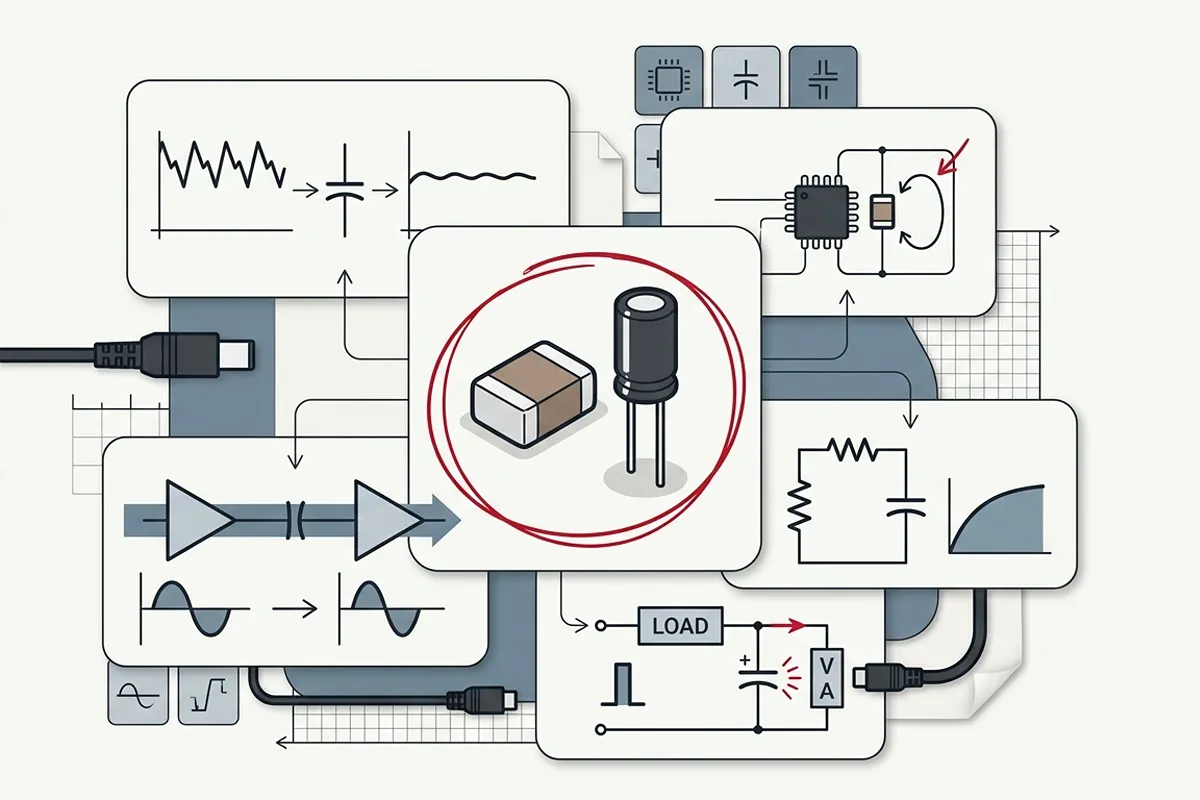
Capacitor Explained: A Fundamental Passive Component
Think of a capacitor as a local water tower for a city's plumbing system. In this analogy, the pipes are the wires, the water is the electrical current, and the water pressure is the voltage. When the main water pump (the power supply) is running smoothly, the water tower fills up. If the main pump momentarily falters or a sudden, massive demand for water occurs (like opening multiple fire hydrants), the water tower instantly releases its stored water to maintain pressure and keep the system flowing without a hiccup.
A capacitor works on the exact same principle, but with electrical energy. It is a fundamental passive component that stores electrical charge and releases it on demand.
While a battery also stores electrical energy, the key difference lies in the speed of charge and discharge. Batteries rely on slow chemical reactions, offering a massive total energy capacity but taking hours to charge and drain. Capacitors store energy in an electrostatic field between two conductive plates separated by an insulator (dielectric). This allows them to dump their entire energy payload in a fraction of a millisecond and recharge just as fast. They don't replace batteries; they complement them by handling the split-second transients that batteries are too sluggish to address.
The Core Functions of a Capacitor in a Circuit
Analyzing how these components integrate into complete electron devices and circuits determines overall system stability.
Engineers deploy capacitors across virtually all electronic designs. The specific function of a capacitor is largely determined by how it is wired into the circuit topology—specifically, whether it is in parallel or series with the load.
Parallel Capacitors (Shunt): Decoupling & Power Filtering
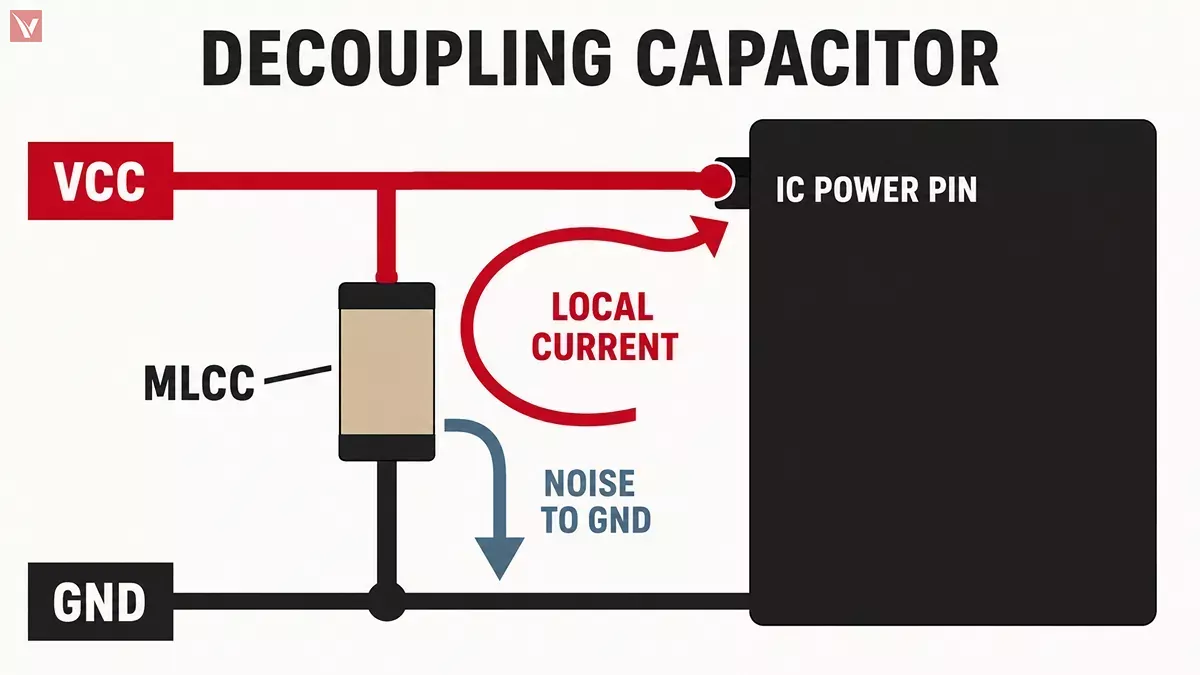
When a capacitor is placed in parallel (shunted across the power rails to ground), it acts as a reservoir to smooth out voltage fluctuations.
- Power Filtering: In AC-to-DC power supplies, rectifiers produce a "bumpy" DC voltage. Large parallel capacitors filter out this ripple, acting like a shock absorber to provide a smooth, continuous DC output.
- Decoupling (Bypass): Integrated circuits (ICs) often draw sharp, sudden spikes of current when switching states. Inductance in long PCB traces can choke this sudden demand, causing a local voltage drop (ground bounce or voltage droop) that can reset the IC. A local decoupling capacitor placed directly next to the IC's power pin supplies that instantaneous current, effectively decoupling the IC from the broader power distribution network's noise.
Series Capacitors: Signal Coupling & DC Blocking
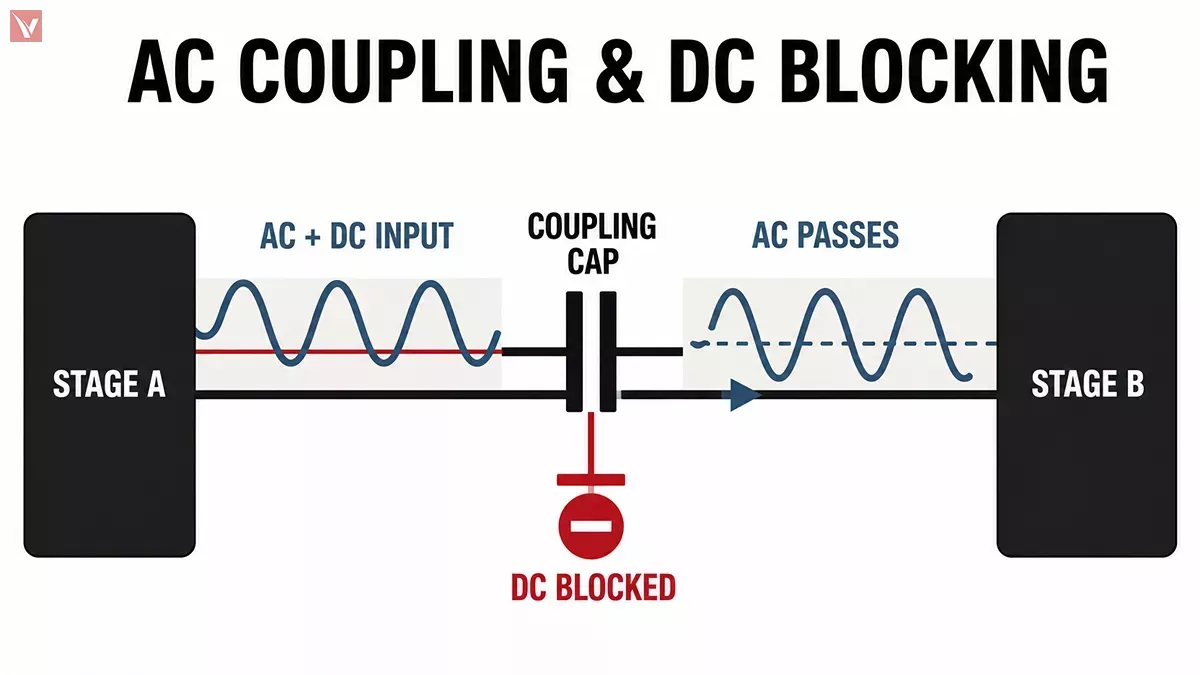
Because capacitors block direct current (DC) but allow alternating current (AC) to pass, placing them in series with a signal path acts as a filter.
Signal Coupling: In audio and RF amplifiers, multiple stages operate at different DC bias voltage levels. A series coupling capacitor allows the dynamic AC signal (like an audio waveform) to pass from one stage to the next while blocking the static DC voltage, preventing the stages from interfering with each other's bias.
RC/LC Networks: Timing and Oscillation
When paired with resistors (RC) or inductors (LC), capacitors help dictate time. Because they charge and discharge at predictable, mathematically defined rates, these networks form the backbone of timing circuits, frequency-selective filters, and oscillators that generate clock signals.
Capacitor Types and Their Specific Roles
Not all capacitors are created equal. The material used for the dielectric determines a capacitor's capacitance range, voltage rating, and frequency response. Analyzing the internal parts of a capacitor clarifies how varying dielectric geometries and electrode materials dictate these specific electrical limits.
MLCC (Ceramic): High-Frequency Decoupling
Multilayer Ceramic Capacitors (MLCCs) are the most widely used capacitors in the world. They are tiny, non-polarized, and possess extremely low Equivalent Series Resistance (ESR) and Equivalent Series Inductance (ESL). This makes them the undisputed champions for high-frequency decoupling and bypassing digital noise near microprocessors.
Aluminum Electrolytic: High-Capacity Bulk Storage
Electrolytic capacitors pack a massive amount of capacitance into a relatively small, cylindrical footprint. They are polarized (they have a strict positive and negative terminal) and are primarily used for low-frequency power supply filtering and bulk energy storage. Due to their higher ESR, they are poor at handling high frequencies but excel at stabilizing overall board-level power.
Film Capacitors: High Voltage and Precision Audio
Film capacitors use plastic films (like polyester or polypropylene) as the dielectric. They are highly stable over temperature variations and can handle massive voltage spikes. You will find them in high-power industrial applications, automotive systems, and precision audio equipment where low distortion is critical.
Tantalum Capacitors: High Reliability in Tight Spaces
Tantalum capacitors are another form of electrolytic capacitor, but they use tantalum metal for the anode. They offer a much higher capacitance density than aluminum electrolytics, meaning they pack more storage into a smaller, surface-mount package. They provide highly stable capacitance over time and temperature, making them ideal for space-constrained, high-reliability applications like medical devices and telecommunications equipment.
| Capacitor Type | Key Characteristic | Primary Application |
|---|---|---|
| MLCC (Ceramic) | Low ESR/ESL, tiny footprint | High-frequency decoupling, bypassing |
| Aluminum Electrolytic | High capacitance, bulk storage | Power supply smoothing, low-frequency filtering |
| Film | High voltage, thermal stability | Power electronics, precision audio, safety ratings |
| Tantalum | Stable capacitance, long life | Space-constrained, high-reliability decoupling |
Key Applications in Different Engineering Fields
The versatility of capacitors makes them indispensable across every engineering discipline:
- Switching Power Supplies (SMPS): Capacitors are heavily relied upon for both input/output filtering to reduce switching ripple and for energy storage during power loss hold-up times.
- Motor & HVAC Systems: Large "run" and "start" AC film capacitors provide the necessary phase shift to generate starting torque for heavy industrial AC induction motors and household HVAC compressors.
- High-Speed Digital Boards: In modern computing, high-speed digital motherboards utilize arrays of densely packed MLCCs to maintain Power Integrity (PI) for CPUs and GPUs switching at gigahertz frequencies.
Best Practices: Where Capacitors Belong on a PCB
Proper schematic design is only half the battle; physical placement on the Printed Circuit Board (PCB) dictates actual performance. The golden rule of PCB layout for capacitors is simple: minimize the loop area.
- Bulk Capacitors at the Power Entry: Large electrolytic or polymer capacitors should be placed where the power first enters the board. They act as the primary reservoir for the entire system, stabilizing the overall board-level power network.
- Decoupling Capacitors Next to IC Pins: High-frequency noise requires local solutions. Decoupling MLCCs must be placed as physically close to the IC's power and ground pins as humanly possible. According to Texas Instruments' BGA PCB Design guidelines, long routing between capacitors and ICs adds parasitic inductance, rendering the capacitor useless at high frequencies. Always route power through the capacitor pads before reaching the IC, or use direct via-in-pad structures.
How to Choose and Source the Right Capacitor
Bridging the gap between engineering theory and procurement reality is a daily challenge for hardware teams. Selecting the right capacitor requires analyzing both technical specifications and supply chain viability.
Engineering Selection Criteria
Engineers cannot simply choose a part based on the farad value alone. True component selection requires deep scrutiny of the datasheet:
- Voltage Derating: Capacitors (especially ceramics) exhibit DC bias effects; an MLCC can lose up to 70% of its effective capacitance when operated near its rated voltage. Always derate voltage by at least 50%.
- ESR and ESL: High ESR generates heat under ripple current, while high ESL prevents the capacitor from responding to high-frequency transients. Check manufacturer data for impedance vs. frequency curves.
- Temperature Characteristics: Different dielectrics react poorly to heat. For example, TDK's MLCC documentation highlights that standard X7R dielectrics are stable up to 125°C, while C0G/NP0 dielectrics offer superior thermal stability with near-zero capacitance shift over temperature.
Beyond reviewing datasheet specifications, always perform a basic functional check on your components during the prototyping phase. You can quickly test a capacitor with a multimeter to confirm its basic capacitance value and ensure there are no internal shorts.
Capacitor EOL Risks and Procurement Challenges
As established in the circuit design and PCB layout guidelines above, precise capacitor parameters—such as tight ESR and specific capacitance values—are strictly required for hardware stability. However, engineering and procurement teams currently face a critical hurdle that extends beyond the schematic: structural supply chain shifts and frequent End-of-Life (EOL) notices.
With top-tier manufacturers aggressively shifting their production focus toward ultra-miniature profiles and automotive-grade MLCCs, many large-case and legacy capacitors heavily relied upon in industrial, medical, and telecommunication sectors are rapidly facing obsolescence. This production shift creates immediate BOM (Bill of Materials) gaps and, more dangerously, opens the floodgates for substandard or counterfeit components to enter the open market.
To bridge the gap between engineering design and supply chain security, Vigorcomp protects your production continuity through two core capabilities:
1. Strict Quality Assurance and Counterfeit Prevention
When procuring high-performance capacitors—especially during allocation periods or EOL phases—compromised components like remarked MLCCs or refurbished tantalum capacitors can lead to catastrophic board-level failures. Vigorcomp eliminates this risk through an uncompromising laboratory inspection framework.
Every component undergoes rigorous visual, dimensional, and electrical verification before shipment. We provide full traceability and a Certificate of Conformity (COC) to guarantee that every capacitor strictly adheres to original manufacturer specifications.
Technical Resource: To understand the specific inspection protocols, X-ray verifications, and visual methodologies we utilize to safeguard your supply chain, read our comprehensive guide on how to detect and avoid counterfeit electronic components.
2. EOL Mitigation and Drop-In Replacements
A sudden component obsolescence notice should never force your team into a costly and time-consuming PCB redesign. To resolve capacitor shortages, Vigorcomp executes a dual-pronged strategy:
Global Inventory Reallocation: We leverage an expansive, vetted global network to locate authentic excess stock directly from tier-one OEMs and EMS providers, securing the exact legacy components you need.
Precision Cross-Referencing: When an original part is permanently unavailable, our technical data team identifies and verifies Form-Fit-Function compatible drop-in replacements. We meticulously match critical variables—including footprint, voltage rating, ESR thresholds, and dielectric materials (e.g., X7R, C0G)—ensuring a seamless transition that requires zero modifications to your existing board layout.
Conclusion
Whether they are acting as local energy reservoirs to smooth out power ripples, decoupling high-frequency digital noise, or coupling delicate audio signals, they ensure that modern electronic circuits remain stable and reliable. However, specifying the right capacitor goes beyond the schematic—it requires a deep understanding of parasitics, PCB placement, and a volatile global supply chain. By partnering with a reliable independent distributor, engineering and procurement teams can navigate these complexities, secure critical inventory, and ensure a resilient manufacturing pipeline.
References
- Keysight: What is a Capacitor? Uses & Functions Explained
- Texas Instruments: General hardware design/BGA PCB design/BGA decoupling
- TDK: Multilayer Ceramic Chip Capacitors Product Specifications
- Supplyframe / Industry Supply Chain Reports: Q1 2025 and 2026 Component Lead Time Trends for MLCCs and Tantalum Capacitors.