
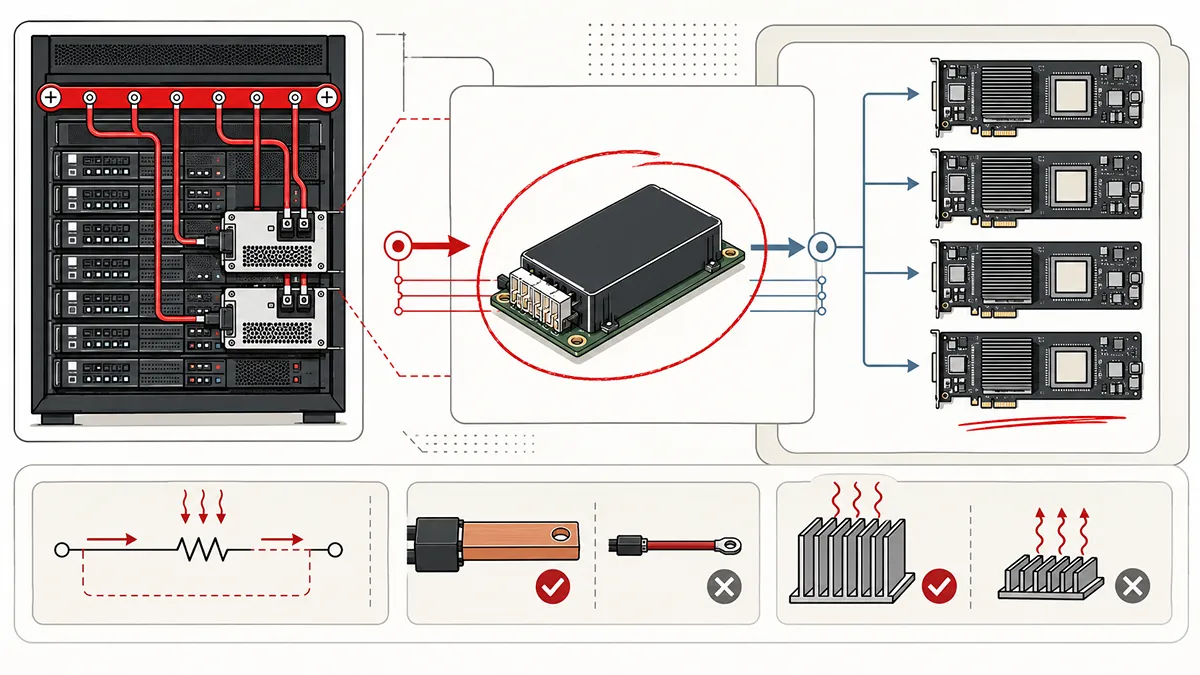
The relentless demand for computing power, driven by AI, machine learning, and advanced industrial automation, has pushed legacy power distribution networks to their breaking point. For years, the 12V bus was the undisputed standard for powering servers and industrial control units. Today, that is no longer sustainable. As rack power densities soar past 12kW—and in some hyperscale scenarios, eclipse 30kW—the transition to a 48V bus architecture is no longer just a trend; it is an engineering necessity.
However, transitioning a massive infrastructure overnight is impossible. Most microprocessors, PCIe cards, and peripheral storage drives still demand a tightly regulated 12V supply. This creates a critical design challenge: how do you efficiently step down a 48V distribution bus to 12V with a DC converter at the point of load (PoL) without sacrificing board space or creating thermal nightmares?
This guide breaks down the engineering complexities of 48V to 12V DC-DC conversion, covering architecture selection, advanced switching topologies, thermal management, and critical testing parameters for modern power networks.
Why Data Centers and Telecom Racks Are Moving to 48V Architectures
The shift from 12V to 48V distribution is primarily driven by the laws of physics, specifically copper losses ( \(I^2R\)). When you increase the voltage by a factor of four, the current required to deliver the same amount of power drops by a factor of four. Because power loss in a conductor is proportional to the square of the current, a 48V system reduces distribution losses by a staggering 16 times compared to a 12V system.
For data center architects, this translates directly to a dramatically improved Power Usage Effectiveness (PUE). The Open Compute Project (OCP) has heavily championed this transition. By adopting the OCP's 48V Open Rack standard, hyperscalers like Google and Facebook have eliminated massive bus bars, reduced copper cabling weight, and saved millions of dollars in wasted heat. In telecom and industrial environments, 48V enables longer cable runs from centralized battery backup units without suffering unacceptable voltage drops.
Space Limits and Heat: The Real Bottlenecks in 48V Step-Down Design
While 48V distribution solves the macro-level copper loss problem, it creates a micro-level challenge for the board designer. When you step down 48V to 12V on the motherboard to power legacy loads, you are introducing a high-voltage conversion stage right next to sensitive, heat-generating digital ASICs.
The two greatest bottlenecks engineers face in this stage are:
- Volumetric Power Density: Traditional PWM (Pulse Width Modulation) "brick" converters are simply too bulky to fit on densely packed AI accelerator boards.
- Thermal Dissipation: Even at 95% efficiency, a 1kW 48V-to-12V step-down converter will dissipate 50W of pure heat. If not managed properly, this heat will cause the converter to derate, reducing its output capacity and threatening the reliability of surrounding components.
When to Choose Isolated vs. Non-Isolated (PoL) DC-DC Converters
A critical architectural decision is determining whether your step-down converter requires galvanic isolation. The choice depends entirely on where the conversion is happening and the safety requirements of the system.
Key Takeaway: If your 48V bus is already SELV (Safety Extra Low Voltage) compliant (typically under 60VDC) and the conversion happens on the same board as the load, non-isolated converters provide the best efficiency and footprint.
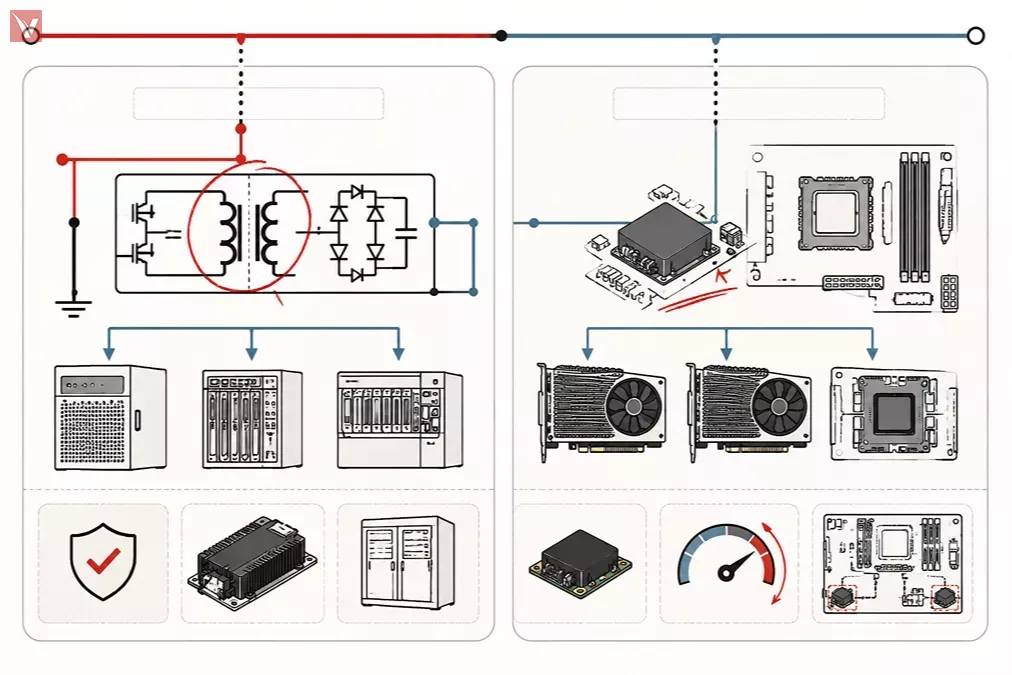
You can use the following table to guide your topology selection:
| Feature | Isolated 48V to 12V Converters | Non-Isolated (PoL) 48V to 12V Converters |
|---|---|---|
| Galvanic Isolation | Yes (via internal transformer) | No (direct electrical connection) |
| Primary Application | Telecom rectifiers, industrial systems requiring ground loop elimination or safety compliance. | Intermediate Bus Architecture (IBA), Data center motherboards, PCIe power delivery. |
| Footprint & Weight | Larger and heavier due to magnetic transformers. | Highly compact, often available in SiP (System-in-Package) or ChiP formats. |
| Peak Efficiency | Typically 89% 93%. | Extremely high, pushing 96% 98%+. |
For a broader review of DC converter topologies, compare buck, isolated, bidirectional, and multiphase architectures.
For a similar isolated vs. non-isolated decision framework at a 24V input level, see our 24V to 12V DC Converter Guide.
Zero-Voltage Switching (ZVS): The Secret to 95%+ Conversion Efficiency
To shrink the size of a converter, designers must increase the switching frequency (e.g., from 100kHz into the MHz range), which allows for smaller inductors and capacitors. However, in traditional hard-switched PWM converters, higher frequencies lead to massive switching losses and excessive heat.
This is where Zero-Voltage Switching (ZVS) topologies change the game. ZVS is a soft-switching technique that ensures the power MOSFETs only turn on when the voltage across them is at or near zero. By eliminating the high turn-on losses associated with discharging the MOSFET's parasitic capacitance, ZVS allows the converter to operate at megahertz frequencies while maintaining incredible efficiency.
For example, high-end non-isolated modules utilizing ZVS buck-boost architectures can deliver up to 750W of regulated 12V power from a 48V input with peak efficiencies exceeding 97%. This level of performance is what enables the ultra-compact, high-density power delivery required by modern GPUs and AI processors.
High Power Density Solutions: How to Keep Compact Boards Cool
Deploying a high-efficiency ZVS converter is only half the battle; getting the heat out of the package and into the ambient environment is what ensures long-term reliability. When utilizing surface-mount DC-DC modules, the PCB itself must act as the primary heat sink.
Effective thermal management for 48V step-down designs relies on three critical PCB layout techniques:
- Strategic Thermal Vias: The thermal pad beneath the converter must be connected to internal ground planes using an array of thermal vias. The general guideline is to use a via pitch of 1mm to 1.25mm, with a diameter of 0.3mm to 0.33mm, to maximize heat transfer down into the copper planes without causing solder voiding during reflow.
- Heavy Copper Layers: Standard 1oz copper is insufficient for high-current 12V outputs. Utilizing 2oz or even 3oz copper for the internal power and ground planes drastically reduces \(I^2R\) heating on the board and spreads the thermal load over a wider area.
- Double-Sided Cooling: Advanced module packages offer very low thermal impedance on both the top and bottom of the package. This allows engineers to attach cold plates or finned heat sinks directly to the top of the module, while simultaneously pulling heat down into the PCB.
Load Transients and Ripple: What Your Oscilloscope Needs to Show
When a high-performance microprocessor transitions from an idle state to full compute load, the current demand can spike by hundreds of amps in microseconds. If the 48V to 12V converter cannot respond instantly, the 12V bus will droop, potentially causing a system reset or data corruption.
Key Takeaway: Static efficiency is great for marketing, but dynamic load transient response is what keeps your servers running.
When validating your 48V to 12V design, your oscilloscope measurements must verify two critical parameters:
- Transient Voltage Droop: Apply a harsh load step (e.g., 10% to 100% load) and measure the voltage deviation on the 12V rail. High-end converters switching at 2MHz can offer exceptionally low output impedance, clamping voltage droop without requiring massive banks of bulk capacitors on the output.
- Output Voltage Ripple: High-frequency switching can introduce noise. Ensure your peak-to-peak voltage ripple remains within the strict tolerances of your downstream PoL regulators (typically < 1% of the output voltage).
Secure Your Supply: Authentic Vicor and Murata Modules via Vigor Components
Designing a state-of-the-art 48V power architecture requires state-of-the-art components. Premium ZVS modules and high-density step-down converters from industry leaders like Vicor and Murata are essential for hitting the efficiency and footprint targets of modern data centers and telecom infrastructure.
However, in an era of volatile supply chains and counterfeit risks, sourcing these high-value components can be as challenging as designing the circuits themselves. Vigor Components serves as your trusted independent electronic components distributor. We specialize in securing authentic, fully traceable power modules to ensure your production lines never stall.
By partnering with Vigor Components, procurement teams gain access to our extensive global channel network, guaranteeing fast delivery of critical 48V to 12V DC-DC converters. We provide the compliance documentation, traceability, and inventory reliability that top-tier engineering teams demand. Secure your supply chain today and keep your high-density power designs moving forward.