
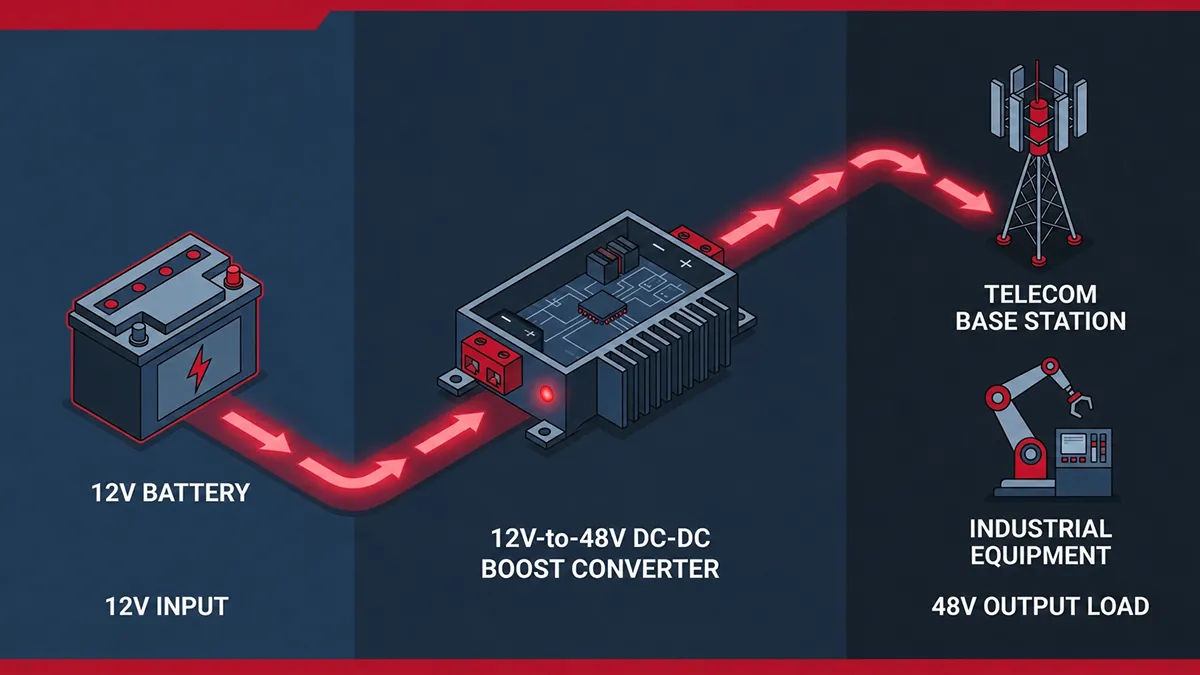
If you're wondering how to convert 12V DC to 48V DC, the answer goes far beyond simply selecting a boost converter. Engineers must carefully consider efficiency, current consumption, thermal performance, electromagnetic interference (EMI), startup protection, and long-term reliability.
This guide explains the engineering principles behind 12V-to-48V conversion, compares discrete circuit design with modular solutions, and provides practical design recommendations for industrial applications.
Where Do We Need a 12V-to-48V Boost?
Many industrial and commercial systems require higher distribution voltages even though their primary power source is only 12V. A higher bus voltage reduces transmission current, minimizes cable losses, and improves overall system efficiency.
Typical applications include:
- Telecommunications base stations
- Industrial automation equipment
- Mobile communication systems
- Electric vehicles and commercial trucks
- Robotics platforms
- Energy storage systems
- Medical equipment
- Outdoor surveillance systems
For example, a telecom cabinet may receive 12V from batteries but distribute power across multiple 48V network devices, making a reliable 12v to 48v dc to dc converter an essential component.
| Application | 12V Source | 48V Load | Reason for Boost Conversion |
|---|---|---|---|
| Telecommunications | Battery Backup | Communication Equipment | Standard telecom power architecture |
| Industrial Automation | Control Cabinet | Servo Drives | Lower cable losses |
| Automotive Electronics | Vehicle Battery | 48V Auxiliary Systems | Higher power capability |
| Energy Storage | Battery Pack | Inverters | Improved conversion efficiency |
If your system instead needs to step down from a higher bus voltage to 12V, see our companion guide: The 48V to 12V DC Converter.
Build vs. Buy: Should You Design a Discrete Circuit or Use a Module?
One of the first questions engineers face is whether to design a custom boost converter or purchase an integrated DC-DC power module.
Designing a Discrete Boost Converter
Building a converter from individual components offers complete flexibility. Engineers can optimize every parameter, including switching frequency, control loop response, magnetic components, and PCB layout.
Advantages include:
- Lower BOM cost in mass production
- Full design customization
- Optimized performance for specific applications
However, discrete designs also introduce several challenges:
- Long development cycles
- EMI optimization
- Thermal validation
- Safety certification
- Component sourcing risks
Using a Ready-Made Module
For many industrial projects, especially those with aggressive development schedules, an integrated module is the more practical choice.
Benefits include:
- Faster time-to-market (TTM)
- Factory-tested performance
- Simplified PCB design
- Lower engineering risk
- Easier compliance with industry standards
Instead of spending months debugging a power stage, engineers can focus on system-level innovation.
How Step-Up Boost Topologies Actually Work
Understanding the operating principle of a boost converter helps engineers optimize efficiency and reliability.
A boost converter stores energy inside an inductor while the switching MOSFET is turned on. When the MOSFET switches off, the inductor releases its stored energy through the diode (or synchronous MOSFET), increasing the output voltage above the input voltage.
The simplified voltage relationship is: \(V_{OUT}=\frac{V_{IN}}{1-D}\) Where:
- \(V_{IN}\) = 12V
- \(V_{OUT}\) = 48V
- \(D\) = Duty Cycle
Ignoring efficiency losses: \(D=1-\frac{12}{48}=75\) In reality, efficiency and switching losses increase the required duty cycle slightly.
Modern industrial converters commonly use:
- Synchronous Boost
- Interleaved Boost
- Phase-Shifted Full Bridge
- LLC Resonant Converters (higher power)
Each topology balances efficiency, ripple, component stress, and cost differently.
For a comparable step-down design using a 24V bus, see our 24V to 12V DC Converter Guide.
Wire Gauge and Input Current Calculations
One of the biggest engineering mistakes is focusing only on output voltage while ignoring the massive input current.
Consider a 48V output delivering 480W.
Output current: \(I_{OUT}=\frac{480W}{48V}=10A\) Assuming 92% efficiency:
Input power: \(P_{IN}=\frac{480}{0.92}=522W\) Input current: \(I_{IN}=\frac{522W}{12V}=43.5A\) That means your 12V source must safely deliver over 43A continuously.
This has major implications for:
- PCB copper thickness
- Cable selection
- Connector ratings
- Fuse sizing
- Thermal management
| Output Power | Output Current (48V) | Approximate Input Current (12V, 92% Efficiency) |
|---|---|---|
| 120W | 2.5A | 10.9A |
| 240W | 5A | 21.7A |
| 480W | 10A | 43.5A |
| 960W | 20A | 87A |
Always size wire gauges based on input current, not output current.
Protection First: Defending Against Startup Inrush Currents
Startup inrush current can easily exceed several times the normal operating current due to large output capacitors.
Without protection, excessive surge current may cause:
- Connector damage
- MOSFET failure
- Fuse blowing
- Battery voltage collapse
- System shutdown
Common protection techniques include:
- Soft-start control
- Current limiting
- Pre-charge circuits
- NTC thermistors
- Active hot-swap controllers
Modern industrial DC-DC modules usually integrate programmable soft-start functionality, significantly reducing design complexity while improving reliability.
Thermal Management Strategies for High-Power Boosts
Heat is one of the primary factors limiting converter lifespan.
Even with 95% efficiency, a 1000W converter dissipates:
1000W Total Power
████████████████████████████████████████████████ 95%
Useful Output (950W)
███ 5%
Heat Loss (50W)
Fifty watts of heat concentrated in a small PCB can rapidly increase junction temperatures.
Effective thermal management includes:
- Large copper pours
- Thermal vias
- Aluminum heat sinks
- Forced-air cooling
- Potting compounds
- Optimized airflow direction
Infrared thermal imaging is commonly used during validation to identify hot spots before production.
Good thermal design not only improves reliability but also allows converters to operate continuously at rated power.
Low Ripple Requirements and Telecom Industry Standards
Telecommunications equipment is particularly sensitive to output ripple and conducted noise.
Poor ripple performance can affect:
- RF circuits
- Communication stability
- ADC accuracy
- Sensitive industrial sensors
Engineers typically reduce ripple using:
- Low-ESR capacitors
- LC output filters
- Multiphase switching
- Careful PCB grounding
- Shielded inductors
Beyond electrical performance, industrial customers often require compliance with internationally recognized standards, such as:
- UL safety certification
- CE conformity
- RoHS compliance
- EMC/EMI regulations
Selecting certified components simplifies product approval and enhances customer confidence.
The Role of Bidirectional Power Modules
Traditional boost converters only transfer power in one direction.
However, modern applications increasingly require bidirectional energy flow.
Examples include:
- Battery energy storage systems (BESS)
- Regenerative braking
- Hybrid electric vehicles
- UPS systems
- Robotics
A bidirectional converter allows energy to move between the 12V and 48V buses depending on system requirements.
Advantages include:
- Higher energy efficiency
- Battery charging capability
- Regenerative energy recovery
- Flexible system architecture
Although more complex than conventional boost converters, bidirectional power modules are becoming increasingly popular in advanced industrial applications.
Fast Delivery and Authentic Parts with Vigor Components
Selecting the right converter is only part of the equation. Reliable sourcing is equally important, particularly during periods of global supply chain uncertainty.
As a Singapore-based independent electronic components distributor, Vigor Components combines industry expertise with an efficient supply chain to support engineers and procurement teams worldwide. Founded by a professional with more than 15 years of experience in the electronic components industry, the company focuses on delivering authentic components, responsive service, and dependable sourcing solutions.
Whether you're searching for a 12v to 48v dc to dc converter, power modules, semiconductors, or supporting components, Vigor Components provides several advantages:
- Extensive product portfolio covering power modules, semiconductors, ICs, connectors, passive components, and more.
- Efficient global supply chain with direct partnerships with leading manufacturers.
- Online ordering platform featuring real-time inventory visibility, streamlined part search, and secure purchasing.
- Technical support for power management, embedded systems, control systems, and component selection.
- Rigorous quality process including visual inspection, advanced testing, and third-party laboratory verification.
- Fast quotation services, flexible order quantities, BOM support, and assistance sourcing obsolete or hard-to-find components.
Instead of simply supplying parts, Vigor Components aims to become a long-term sourcing partner by combining engineering knowledge, customized service, and reliable delivery under its philosophy of "Quality First, Customer Always."
Conclusion
Converting 12V DC to 48V DC involves much more than increasing voltage. Successful designs require careful attention to converter topology, efficiency, current calculations, protection mechanisms, thermal management, EMI performance, and component quality.
While custom boost circuits remain appropriate for specialized, high-volume applications, many industrial designers achieve faster development cycles and lower project risk by selecting proven power modules. Coupled with trusted sourcing partners like Vigor Components, engineers can accelerate product development while maintaining high standards for performance, reliability, and long-term supply.
Whether you're designing telecom infrastructure, industrial automation equipment, robotics, or next-generation energy systems, choosing the right 12v to 48v dc to dc converter and sourcing authentic components from a dependable distributor will help ensure your project delivers efficient, stable, and reliable power for years to come.