
As EVs, ADAS, and intelligent cockpit systems continue to evolve, automotive E/E architecture is rapidly shifting from distributed ECUs toward centralized computing and domain-based architectures.
Beyond AI chips and automotive MCUs, one critical component is becoming increasingly important:
DC-DC Converter
It is no longer just a “power supply module” — it is becoming the power management hub of next-generation smart vehicles.
Why Smart Vehicles Depend on DC-DC Converters
Modern EVs contain multiple voltage domains:
| Function | Power Demand Trend |
|---|---|
| Autonomous Driving AI | Rapid growth |
| Multi-display Cockpit | Increasing |
| High-Speed Connectivity | Increasing |
| LiDAR Systems | High power |
High-performance AI platforms require extremely stable and efficient power delivery.
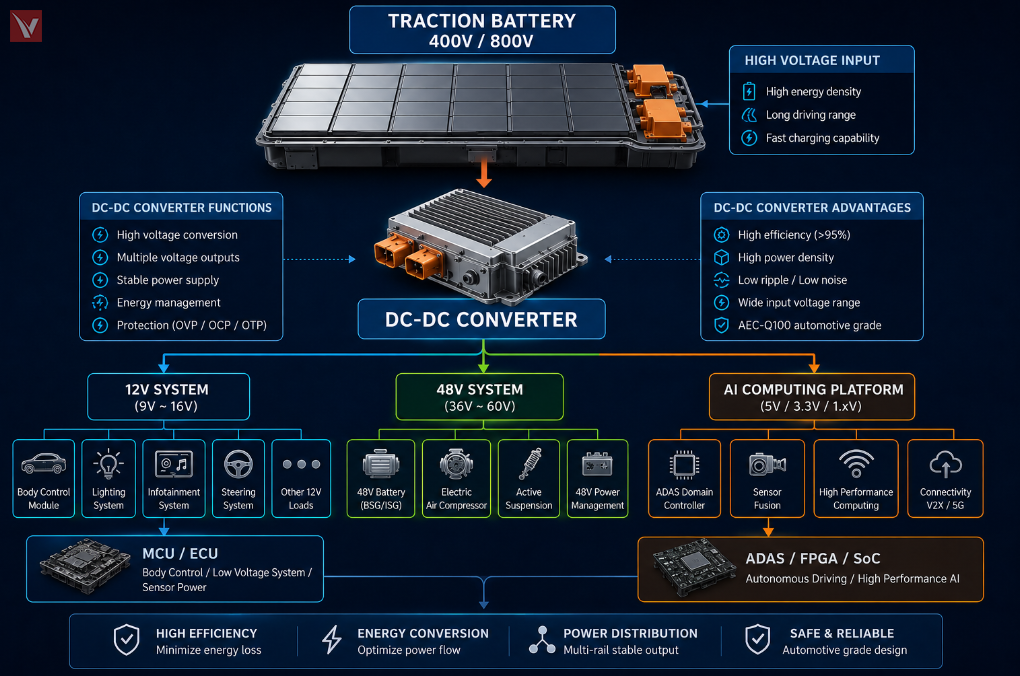
DC-DC converters are responsible for converting high-voltage battery power into stable low-voltage outputs for various automotive subsystems.
Key Roles of DC-DC Converters in Smart Vehicles
1. Powering Central Computing Platforms
The central computing architecture of future automobiles—encompassing autonomous driving, intelligent cockpits, vehicle-to-everything (V2X) connectivity, OTA updates, and AI inference—relies on the following high-performance computing platforms:
NVIDIA Drive
Qualcomm Snapdragon Ride
Advanced AI SoCs
DC-DC converters help ensure:
- Stable power delivery
- EMI suppression
- Thermal optimization
- High-frequency conversion efficiency
2. Supporting 48V Electrical Architectures
48V systems are becoming increasingly common because they offer:
1) Reduced wiring loss; 2) Higher efficiency; 3) Better support for high-power loads; 4) Improved compatibility with smart chassis systems.
DC-DC converters manage:
- 48V → 12V conversion
- High-voltage to low-voltage conversion
- Bidirectional power transfer
Making them a key bridge inside modern vehicle power systems.
3. Stabilizing Power for ADAS & Sensors
ADAS systems rely on Cameras, Radar, LiDAR, Ultrasonic sensors which are highly sensitive to Voltage fluctuations, EMI noise and Transient drops
Therefore, automotive-grade DC-DC converters require:
- Ultra-low noise
- High reliability
- AEC-Q100 compliance
- Wide temperature operation
- Strong EMI resistance
Power Module Suppliers Gaining Industry Attention
High-density power solutions from companies such as:
High power density
High efficiency
Modular power architecture
Suitable for AI and High-Performance Computing platforms
Industrial-grade reliability
Widely used in automotive and industrial applications
Excellent EMI performance
Long-life design