
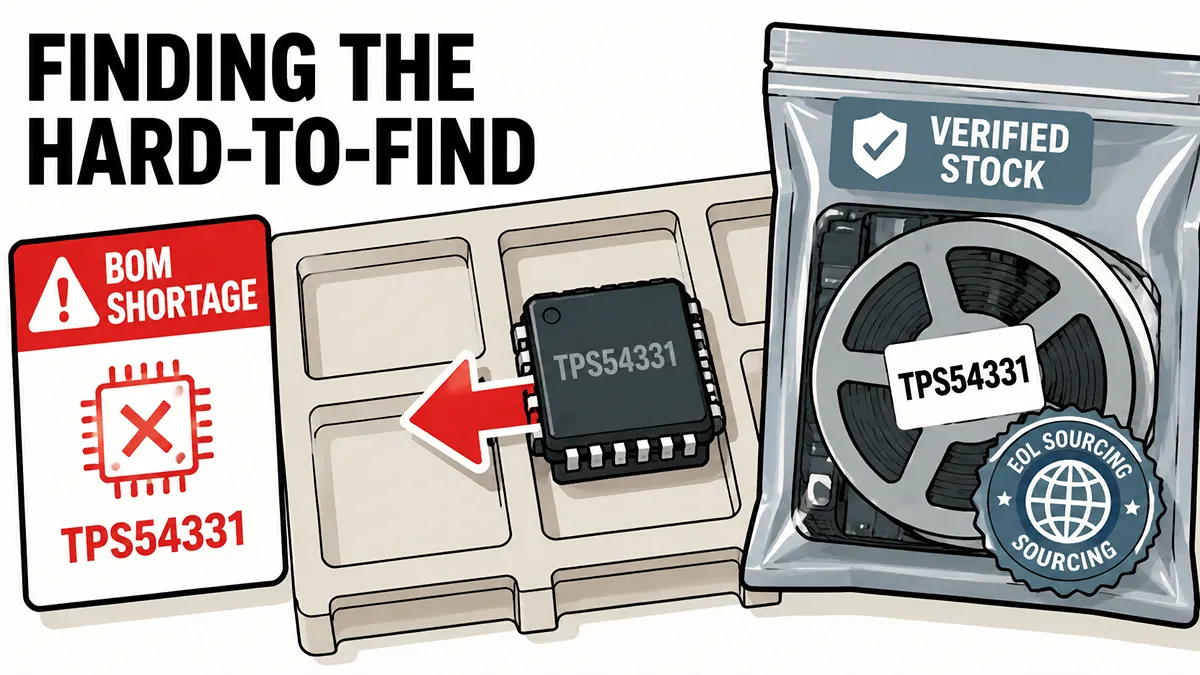
Supply chain disruptions, component allocations, and End-of-Life (EOL) notices routinely challenge original equipment manufacturers (OEMs) and contract manufacturers (CMs). When a production line for industrial control systems or security cameras faces an abrupt shortage of a critical DC-DC converter, standard franchised channels often quote lead times extending beyond 40 weeks. In these scenarios, procurement teams frequently turn to the open market.
Navigating the secondary market requires a clear understanding of the entities operating within it. This article details the operational mechanisms of electronic component brokers, delineates the structural differences between sourcing channels, and provides an engineering-driven framework for mitigating counterfeit risks.
What Exactly Are Electronic Component Brokers?
An electronic component broker acts as an intermediary connecting buyers who have immediate material requirements with sellers who hold excess inventory. Unlike authorized distributors who have formal, contractual agreements with component manufacturers to stock and sell their product lines, brokers typically operate on the open market without direct factory authorization.
Brokers serve a specific function in supply chain management: resolving acute material shortages and sourcing obsolete parts. They operate by maintaining vast databases of global inventory, leveraging information asymmetry and extensive contact networks to locate components that are otherwise unavailable through standard channels.
It is important to understand that the term "broker" encompasses a wide spectrum of operational models. Some organizations operate strictly as information nodes—matching buyers and sellers without ever taking physical possession of the hardware. Others function as independent distributors, holding their own physical stock and implementing proprietary quality control measures. Understanding this distinction is the baseline for managing procurement risk.
How Do Electronic Component Brokers Work?
The operational mechanism of a broker relies on data aggregation and network reach. When an authorized channel fails to meet a delivery schedule, the broker utilizes its proprietary network to poll contract manufacturers, other distributors, and OEMs worldwide who might possess surplus stock of the required line item.
Consider a practical engineering scenario. A security camera manufacturer is finalizing a PCB assembly and experiences a sudden shortage of the Texas Instruments TPS54331, a step-down DC-DC converter critical for the device's power regulation. The authorized channel indicates a 52-week lead time.
The procurement workflow through a broker typically proceeds as follows:
- Requirement Broadcasting: The buyer issues a Request for Quote (RFQ) specifying the Manufacturer Part Number (MPN), target quantity, and acceptable date codes.
- Inventory Polling: The broker queries global inventory exchange platforms (such as Netcomponents or IC Source) and contacts their private network of EMS providers to locate excess TPS54331 stock.
- Price Negotiation: Upon locating the components, the broker negotiates a purchase price with the holding party.
- Markup and Quotation: The broker applies a margin based on the urgency of the demand and the scarcity of the component, presenting the final quoted price to the buyer.
- Logistics Routing: Once a purchase order is issued, the components are either shipped directly from the source to the buyer (blind drop-shipping) or routed through the broker's facility for inspection before final delivery.
This process enables rapid component acquisition, often resolving shortages within days rather than months. However, because the components originate outside the authorized supply chain, the traceability back to the original semiconductor fab is broken, necessitating rigorous verification.
Independent Distributor vs Electronic Components Broker vs Authorized Distributor
To establish a secure procurement strategy, organizations must categorize their suppliers accurately. The terminology in the secondary market is often used interchangeably, leading to misaligned expectations regarding quality assurance and liability.
The table below outlines the operational boundaries of the three primary sourcing tiers:
| Supplier Type | Inventory Model | Supply Chain Traceability | Quality Control Infrastructure | Primary Risk Factor |
|---|---|---|---|---|
| Authorized Distributor | Direct from manufacturer | Full (Factory to Buyer) | Rely on manufacturer QA; standard handling | Extended lead times during allocation |
| Independent Distributor | Purchases surplus, holds physical stock | Variable (Requires documentation) | In-house or contracted labs (X-Ray, Decap) | Mixed date codes; variable packaging |
| Pure Broker | No physical inventory (Middleman) | None | Pass-through entity; no testing capability | High counterfeit exposure; zero RMA support |
While the table provides a structural overview, the practical decision of which channel to utilize depends entirely on your immediate supply chain circumstances. Here is an objective breakdown of each entity:
Authorized Distributor
Authorized distributors maintain formal, contractual agreements with component manufacturers to sell their product lines. They are the standard default for routine hardware manufacturing.
- Pros: Unbroken supply chain traceability, full manufacturer warranty support, and stable pricing structures.
- Cons: Highly vulnerable to factory allocations, rigid lead times during global shortages, and no support for sourcing End-of-Life (EOL) or obsolete components.
- Best for: Scheduled, high-volume production runs where components have an active lifecycle and lead times can be accommodated.
Independent Distributor
Independent distributors operate on the open market but function similarly to authorized channels in that they purchase, hold, and inspect physical inventory before selling it to the end user.
- Pros: Immediate availability of physical stock, established in-house or third-party quality control (such as X-ray and decapsulation), and the ability to source obsolete components.
- Cons: Pricing fluctuates based on real-time market supply and demand; shipments may contain mixed date codes within a single order.
- Best for: Resolving acute line-down situations, procuring hard-to-find EOL parts, and mitigating risk through vetted quality testing when standard channels fail.
Pure Broker
A pure broker acts strictly as an information node. They connect buyers with sellers on the open market to facilitate a transaction but do not handle the physical hardware themselves.
- Pros: Capable of rapidly polling global networks and aggregator platforms to identify pockets of surplus stock.
- Cons: No physical possession of the components, zero in-house quality testing, high exposure to counterfeit parts, and typically no Return Merchandise Authorization (RMA) support if components fail.
- Best for: Gathering broad market intelligence on part availability or serving as a last-resort sourcing option (provided the buyer independently arranges for third-party QA testing prior to board placement).
The 5-Step Framework Before You Buy
Procuring End-of-Life (EOL) or shortage components introduces the risk of acquiring substandard, refurbished, or counterfeit parts. To mitigate these risks, procurement teams must implement a rigid Quality Assurance (QA) framework prior to issuing a purchase order.
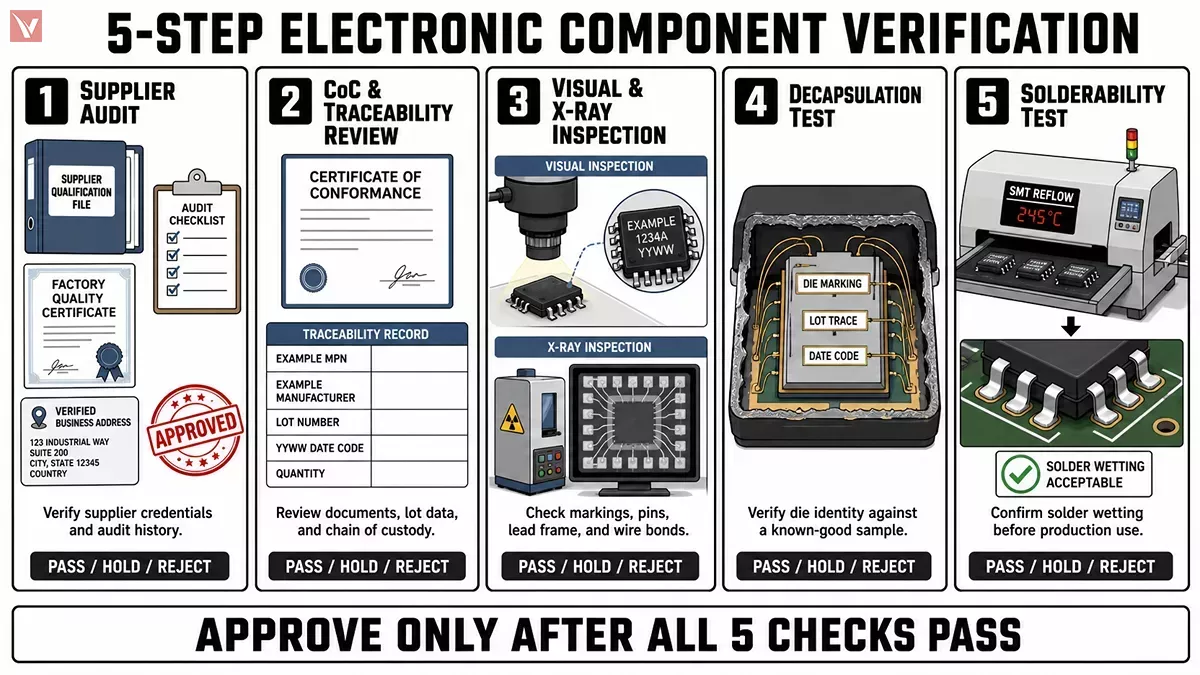
This methodology aligns with the SAE AS6081 standard, which establishes practices for mitigating the risks of purchasing fraudulent/counterfeit electronic parts.
Step 1: Supplier Verification and Audit History
Before evaluating a part, evaluate the supplier. Cross-reference the vendor against the ERAI (Electronic Resellers Association International) database to check for reported counterfeit incidents or unresolved disputes. A reputable independent distributor will maintain transparent records of their quality certifications (e.g., ISO 9001, AS9120).
Step 2: Traceability Documentation Review
Request the Certificate of Conformance (CofC) and all available trace documents. While open-market parts rarely have a direct unbroken chain to the manufacturer, establishing the immediate previous source (e.g., a known tier-1 OEM surplus) reduces risk.
Step 3: External Visual and Radiological Inspection
Require high-resolution macro photography of the components, focusing on the manufacturer markings, date codes, and pin conditions. Advanced independent distributors utilize X-ray inspection to verify the internal lead frame and wire bonding structure against known-good "golden" samples.
Step 4: Destructive Testing / Decapsulation
For high-value or highly targeted integrated circuits (ICs), specify decapsulation (decap) testing based on MIL-STD-883 standards. This process uses chemical etching to remove the exterior mold compound, exposing the silicon die to verify the manufacturer's proprietary die markings and layout.
Step 5: Solderability Verification
Components stored in uncontrolled environments for extended periods (common with obsolete parts) suffer from lead oxidation. Request solderability testing per IPC/JEDEC J-STD-002 to ensure the components will successfully wet and bond during the surface mount technology (SMT) reflow process, preventing costly rework on the manufacturing floor.
Secure Your Supply Chain Today
Whether you are dealing with shortages for an ongoing production run, hunting for obsolete (EOL) components, or verifying an existing quote, Vigorcomp provide direct answers and verifiable physical stock. Click below to send us your Manufacturer Part Number (MPN) and target quantity for a rapid 24-hour response.
Contact Us / Submit RFQ
Frequently Asked Questions
Why does the inventory quantity shown on electronic component platforms often differ from the actual stock?
The secondary market relies on aggregator platforms that scrape inventory data via APIs. Discrepancies primarily occur due to:
- Phantom Listings: Many pure brokers list stock they do not physically possess.
- Data Synchronization Lag: When an independent distributor sells physical components, the downstream update across various broker sites typically lags by 24 to 72 hours.
Why is the actual quoted price sometimes significantly higher than the listed price?
Unlike the authorized channel, open-market pricing operates on real-time supply and demand elasticity.
Listed prices on databases usually represent outdated historical reference points.
Actual quotes reflect immediate scarcity. When a shortage occurs, entities holding physical stock adjust their rates upward. A broker purchases at this elevated rate and adds their operational margin, causing a divergence from historical BOM costs.
How long does it actually take to source obsolete or hard-to-find components?
Timelines depend strictly on the component's lifecycle status and global availability:
- Active Shortages: 24 to 48 hours. An established independent distributor can quickly locate and verify physical stock for standard components.
- End-of-Life (EOL): 1 to 2 weeks. Sourcing older excess inventories requires additional time for querying global CM facilities, extended transit, and mandatory third-party quality testing (e.g., X-ray, solderability).
What happens if the components supplied by a broker fail testing?
Return policies depend entirely on the type of supplier you engage:
- Pure Brokers: Often lack RMA (Return Merchandise Authorization) support and stipulate "as-is" sales, making returns exceptionally difficult once the transaction is complete.
- Independent Distributors: Reputable partners establish terms prior to the PO. Standard practice includes a defined inspection window (typically 30 to 60 days) allowing full refunds if parts fail agreed-upon QA standards, such as visual anomalies or decapsulation checks.
References
- SAE International. (2012). Fraudulent/Counterfeit Electronic Parts: Avoidance, Detection, Mitigation, and Disposition Distributors AS6081.
- Electronic Resellers Association International (ERAI). Counterfeit Mitigation and Vendor Auditing.
- JEDEC Solid State Technology Association. Solderability Tests for Component Leads, Terminations, Lugs, Terminals and Wires (J-STD-002).
- Texas Instruments. TPS54331 3-A, 28-V Input, Step-Down DC-DC Converter Datasheet.