
When architecting a new embedded system, selecting the right microcontroller unit (MCU) dictates your power budget, firmware architecture, and entire bill of materials (BOM). The debate between STMicroelectronics’ STM32 and Espressif’s ESP32 is common, but it is rarely an apples-to-apples comparison.
Comparing the two as monolithic brands leads to flawed engineering decisions. You cannot evaluate a 240 MHz ESP32-S3 against an ultra-low-power 32 MHz STM32L0. To make a sound procurement and design decision, hardware engineers must evaluate these MCUs across three strict constraints: connectivity requirements, power budgets, and hard real-time determinism.
The Answer First: Which MCU Fits Your Project?
If your project requires native Wi-Fi or Bluetooth Low Energy (BLE) out of the box and rapid prototyping for a web-connected application, the ESP32 (specifically variants like the ESP32-C3 or ESP32-S3) is the most efficient choice.
If your design demands hard real-time execution, precise peripheral timing (such as advanced motor control PWM), sub-microamp standby currents for coin-cell operation, or lacks any wireless requirement, an STM32 (such as the G0, G4, or U5 series) is the optimal foundation.
Comparing Architectures: Determinism vs. Wireless Compute
ESP32: Compute for Connectivity
Espressif designed the ESP32 family (utilizing Tensilica Xtensa or RISC-V cores) to handle the heavy computational overhead of wireless protocols. Running a full TCP/IP stack alongside WPA3 encryption and application logic requires significant processing power, which is why standard ESP32s often clock between 160 MHz and 240 MHz. However, sharing the core (or dual cores) with a demanding RF stack and an RTOS (like FreeRTOS) introduces interrupt latency. This makes the ESP32 less predictable for microsecond-level GPIO toggling or strict timing applications.
STM32: Determinism and Precision
The STM32 ecosystem, built on ARM Cortex-M cores (M0+ through M33/M7), is designed for deterministic execution. The interrupt latency is highly predictable, making it the industry standard for industrial control, robotics, and complex sensor data acquisition. Furthermore, STM32 microcontrollers offer highly specialized hardware peripherals—such as high-resolution ADCs, op-amps, and advanced control timers—that are far superior to the generic peripherals found on a standard ESP32.
The Power Budget: Active Draw vs. Deep Sleep
For battery-operated devices, evaluating the data sheet specifications for both active current and deep sleep current is critical.
When an ESP32 is transmitting over Wi-Fi, current spikes can easily exceed 200 mA to 250 mA. This requires careful power supply design and adequately sized decoupling capacitors to prevent voltage dips. While Espressif has improved deep sleep modes—with the ESP32-C3 achieving deep sleep currents in the 5 µA to 15 µA range—it is still designed with the assumption of relatively frequent wake-ups for network keep-alives.
STM32 excels in ultra-low-power scenarios. The STM32U5 series, for example, operates actively at around 19 µA/MHz. More importantly, in Standby mode with SRAM retention and the Real-Time Clock (RTC) running, power consumption can drop below 450 nA (0.45 µA). For a device running on a CR2032 coin cell that wakes up once a day to read a sensor, the STM32 is the only viable choice between the two.
Watching how engineers physically measure and profile these minute sleep currents provides better context for selecting measurement shunts and power analyzers in your own lab.
Hidden BOM Costs and Production Scalability
A common procurement fallacy is that the ESP32 is universally cheaper. While an ESP32 IC or module is highly cost-effective (often in the $1.50 to $3.00 range), utilizing it introduces hidden BOM costs if wireless connectivity is not strictly required.
Designing with an ESP32 necessitates strict RF PCB layout rules, antenna clearance zones, and robust LDOs or buck converters to handle transmission spikes. If you integrate the bare IC instead of a pre-certified module, you must also absorb the significant costs of FCC/CE RF certification testing.
Conversely, if your design is a simple industrial sensor or offline controller, an entry-level STM32G0 or STM32C0 can cost less than $0.50 at volume. It requires minimal external components, occupies a smaller PCB footprint, and utilizes standard bypass capacitors, driving your total BOM cost down significantly.
Application Decision: STM32 or ESP32?
A wireless smart plug, an industrial motor controller, and a battery-powered medical sensor may all use 32-bit microcontrollers, but they impose very different constraints on connectivity, timing, power consumption, and production cost.
The following industry-specific scenarios illustrate where each MCU family offers a practical advantage—and when the alternative deserves consideration.
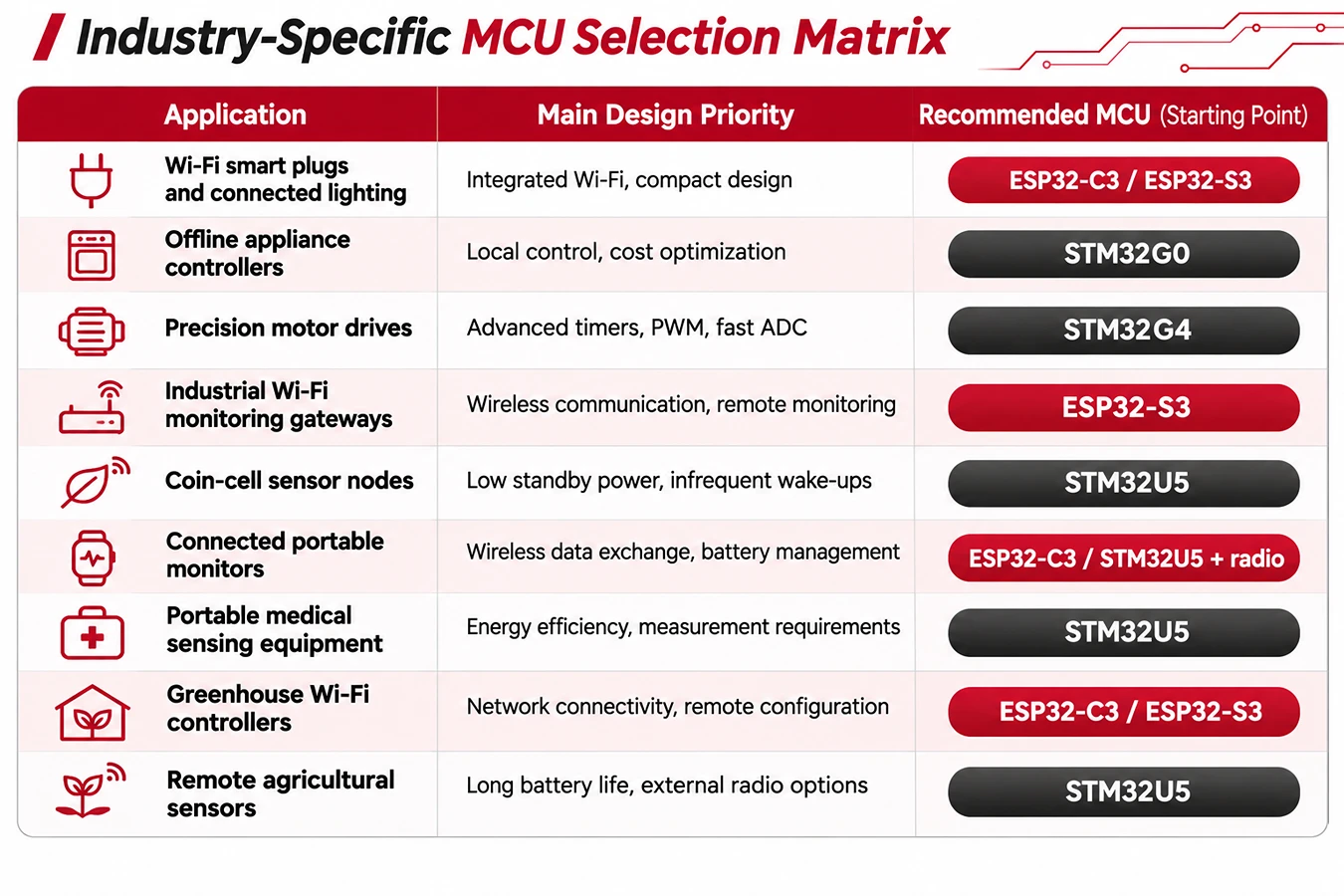
| Application | Main Design Priority | Starting Point |
|---|---|---|
| Wi-Fi smart plugs and connected lighting | Integrated Wi-Fi, compact design | ESP32-C3 / ESP32-S3 |
| Offline appliance controllers | Local control, cost optimization | STM32G0 |
| Precision motor drives | Advanced timers, PWM, fast ADC | STM32G4 |
| Industrial Wi-Fi monitoring gateways | Wireless communication, remote monitoring | ESP32-S3 |
| Coin-cell sensor nodes | Low standby power, infrequent wake-ups | STM32U5 |
| Connected portable monitors | Wireless data exchange, battery management | ESP32-C3 / STM32U5 + radio |
| Portable medical sensing equipment | Energy efficiency, measurement requirements | STM32U5 |
| Greenhouse Wi-Fi controllers | Network connectivity, remote configuration | ESP32-C3 / ESP32-S3 |
| Remote agricultural sensors | Long battery life, external radio options | STM32U5 |
Smart Home and Consumer IoT
Typical applications: Smart plugs, connected lighting, smart thermostats, home automation hubs, and Wi-Fi-enabled appliances.
For products requiring direct Wi-Fi connectivity, the ESP32-C3 and ESP32-S3 are strong starting points. Their integrated wireless capabilities support connected devices without requiring a separate Wi-Fi controller, helping simplify hardware integration and application development.
For example, a mains-powered smart plug that reports energy consumption to a mobile application can use an ESP32 to manage wireless communication, sensor data, and application logic.
However, not every smart-home product requires an internet-connected MCU. A basic thermostat, appliance controller, or offline sensing module may be better served by an STM32G0 or STM32U5, particularly when low power consumption, control peripherals, or a wireless-free BOM takes priority.
Selection guidance: Choose ESP32 for products requiring integrated Wi-Fi/BLE connectivity. Consider STM32 for local control, ultra-low-power operation, or applications using an external communications module.
Industrial Automation and Motor Control
Typical applications: PLC expansion modules, RS485 sensor nodes, motor drives, industrial monitoring equipment, and wireless data gateways.
Industrial applications frequently require precise peripheral timing, reliable data acquisition, and predictable control behavior.
The STM32G4 is particularly relevant for motor-control and power-conversion designs because selected devices offer advanced timers, high-resolution PWM capabilities, and fast analog peripherals. The STM32G0 is another candidate for cost-sensitive industrial interfaces and simpler wired controllers.
The ESP32 can still be useful in industrial systems, especially for wireless condition monitoring, equipment dashboards, or Wi-Fi-connected gateways. For instance, an ESP32-based monitoring node can collect machine status information and transmit it to a local network without being responsible for the machine's critical control loop.
Selection guidance: Prioritize STM32 when control-loop timing, analog measurement, or specialized hardware peripherals dominate the requirements. Consider ESP32 when wireless connectivity and remote monitoring are the primary functions. A hybrid architecture may be appropriate when both are essential.
Wearable Devices and Battery-Powered Sensors
Typical applications: Fitness trackers, environmental sensors, portable data loggers, wearable monitors, and coin-cell sensor nodes.
Battery-powered products require engineers to evaluate the complete operating cycle rather than compare sleep-current specifications alone.
For devices that spend most of their lifetime asleep and wake periodically to sample sensors, an ultra-low-power MCU such as the STM32U5 can be a suitable foundation. The STM32 approach becomes especially attractive when the system does not require continuous Wi-Fi connectivity.
ESP32 devices, including the ESP32-C3, are useful when wireless communication is central to the product. However, radio transmission, wake-up frequency, regulator losses, and standby current can substantially affect battery life.
For example, a portable environmental monitor that regularly uploads readings over Wi-Fi may justify an ESP32-based architecture. A coin-cell sensor that records measurements locally and transmits only occasionally may benefit from an STM32 with a separately selected low-power radio.
Selection guidance: Evaluate average system current, wireless duty cycle, and battery capacity before choosing either platform. STM32 is a strong candidate for low-duty-cycle sensing, while ESP32 is attractive when integrated connectivity reduces system complexity.
Medical and Healthcare Devices
Typical applications: Portable monitoring devices, connected diagnostic accessories, wearable health sensors, and medical equipment interfaces.
Medical and healthcare products introduce additional considerations, including measurement accuracy, power consumption, data security, and regulatory requirements.
Selected STM32U5 devices offer low-power operation, hardware security features, and analog and digital peripherals suitable for portable sensing and monitoring designs. These characteristics can make STM32 a useful starting point for equipment that emphasizes controlled measurement and energy efficiency.
An ESP32-S3 may be appropriate for connected healthcare accessories that require Wi-Fi communication, BLE connectivity, or a responsive user interface.
However, MCU selection alone does not determine whether a medical product satisfies applicable safety, cybersecurity, or regulatory requirements. Such requirements must be addressed at the complete system level.
Selection guidance: Consider STM32 for low-power sensing and measurement-focused architectures. Consider ESP32 for connectivity-oriented healthcare accessories, subject to the product's security, reliability, and regulatory requirements.
Smart Agriculture and Remote Monitoring
Typical applications: Greenhouse monitoring systems, irrigation controllers, soil sensors, environmental monitoring stations, and agricultural data gateways.
Agricultural electronics may operate under very different power and connectivity conditions.
For a greenhouse controller with a stable power supply and existing Wi-Fi coverage, an ESP32-C3 or ESP32-S3 can provide a practical route to connected monitoring, remote configuration, and sensor-data reporting.
For a remote soil-moisture sensor operating from a small battery, an STM32U5 may be a better starting point when long sleep intervals and low standby consumption are important. An external radio can then be selected according to the required transmission distance and network infrastructure.
Neither platform automatically provides the best solution for long-range agricultural communication. Technologies such as LoRa or cellular connectivity require additional hardware or a different integrated wireless solution.
Selection guidance: Choose the communication architecture and power budget first. ESP32 is attractive for Wi-Fi-covered installations, while STM32 can be well suited to low-power remote sensing systems using an appropriate external radio.
Industry-Specific MCU Selection Matrix
The table summarizes the recommended starting points for common product categories. Final component selection should be based on a specific part number, peripheral configuration, operating conditions, and total system cost.
The key takeaway: STM32 and ESP32 should not be selected by industry name alone. Within the same industry, a wireless gateway and a precision controller may require different MCU architectures. Engineers should identify the system's most restrictive requirement—wireless connectivity, timing precision, energy budget, or production cost—and use that constraint to narrow the selection.
Conclusion
The choice between STM32 and ESP32 is not a battle of superiority, but a calculation of constraints. The ESP32 dominates connected, high-compute applications where time-to-market for wireless features is paramount. The STM32 remains the undisputed standard for low-power, deterministic, and highly precise hardware control.
Once you have locked in your architecture and specific part numbers, navigating component availability and lead times becomes the next engineering challenge. Whether you need to secure specific STM32 microcontrollers or source the entire BOM for an ESP32-based design, Vigorcomp operates as your independent procurement partner. Our team assists with BOM kitting, mitigating supply chain risks, and securing critical electronic components to keep your production moving. Contact our team today for comprehensive BOM quoting.
Frequently Asked Questions
Can I run standard STM32 code directly on an ESP32?
No. While some high-level frameworks like Arduino or MicroPython abstract the hardware, low-level C code writing directly to STM32 registers (like bare-metal HAL or LL drivers) will not compile for the ESP32 due to fundamentally different architectures (ARM vs. Xtensa/RISC-V).
Is the ESP32 always cheaper than the STM32?
Not always. While an ESP32 provides excellent value for a Wi-Fi-enabled chip, integrating it requires more complex power supplies (to handle RF spikes) and potential RF certification costs. For simple, non-wireless tasks, an entry-level STM32 (like the STM32G0) offers a lower total BOM cost.
Which MCU is better for precise motor control?
The STM32. Its ARM Cortex-M architecture provides highly predictable interrupt latency, and specific families (like STM32G4) include advanced hardware timers and fast ADCs explicitly designed for microsecond-level motor control. The ESP32’s RTOS and RF stack overhead can introduce unpredictable latency in these hard real-time scenarios.