Discrete Semiconductor

Discrete Semiconductors Electronic Components
Discrete Semiconductor
Results: (201,623 Products)

Discrete Semiconductor Overview

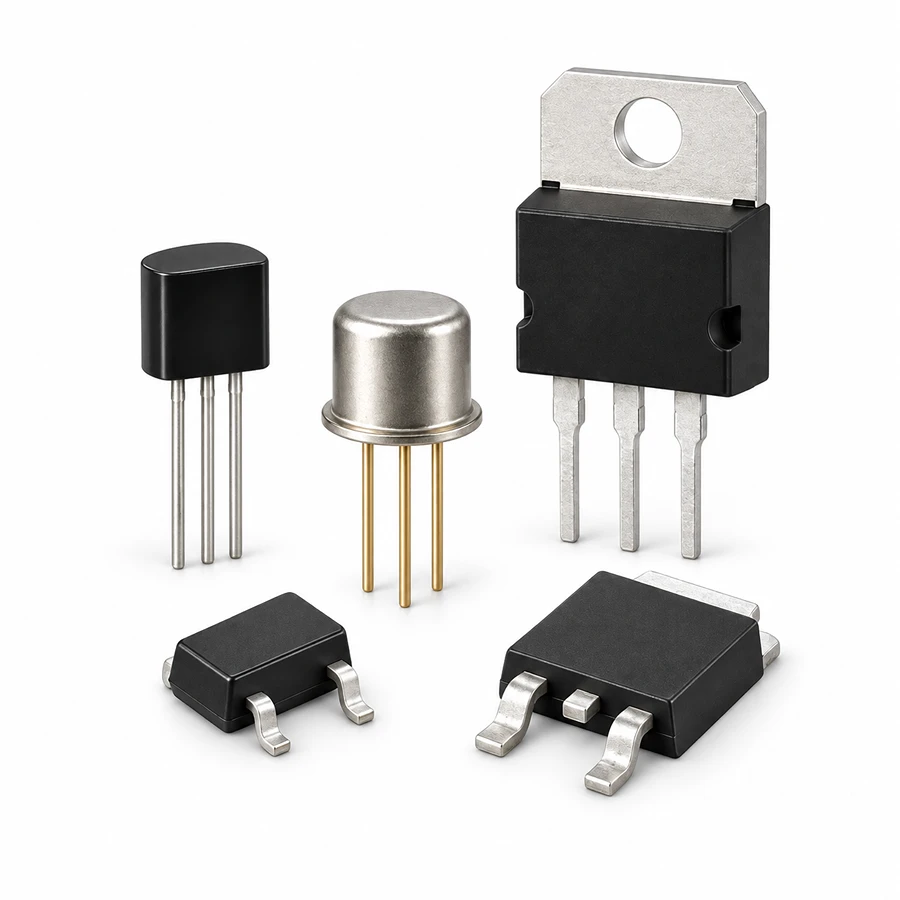
Discrete semiconductors are individual semiconductor devices designed to perform specific electronic functions, such as switching, rectification, amplification, and power control. Unlike integrated circuits (ICs), which combine multiple circuit elements on a single chip, discrete semiconductors typically provide one primary device function. Common examples include diodes, transistors, thyristors, and power semiconductor devices.

Types of Discrete Semiconductors

Common types of discrete semiconductors include diodes, bipolar junction transistors (BJTs), MOSFETs, IGBTs, and thyristors. Each type serves different circuit requirements, ranging from signal amplification and voltage regulation to high-current switching and power conversion.

Key Features of Discrete Semiconductors

Discrete semiconductor devices offer flexible circuit design, a wide range of voltage and current ratings, and application-specific switching and power-handling capabilities. Depending on the device type, key characteristics may include low conduction losses, fast switching performance, high input impedance, and thermal stability.

Applications of Discrete Semiconductors

Discrete semiconductors are widely used in power supplies, automotive electronics, industrial automation, motor control, telecommunications, renewable energy systems, and consumer electronics. They support essential functions such as AC/DC conversion, voltage regulation, signal amplification, load switching, and circuit protection.

Discrete Semiconductor Categories

Transistors - Bipolar (BJT) - Single, Pre-Biased

Single pre-biased bipolar transistors combine an individual BJT with one or more integrated bias resistors, simplifying the external circuitry required for transistor switching. Often referred to as digital transistors or resistor-equipped transistors, these devices reduce component count and PCB space while providing predictable input-bias characteristics. They are commonly used in logic-level switching, signal inversion, and interface circuits. Key specifications include transistor polarity, input resistor values, collector current, collector-emitter voltage, and power dissipation.

View Transistors - Bipolar (BJT) - Single, Pre-Biased
Transistors - Bipolar (BJT) - Arrays, Pre-Biased

Pre-biased bipolar transistor arrays integrate multiple BJTs with built-in bias resistors into a single package. These devices provide convenient solutions for multi-channel switching and signal-interface applications while reducing the need for external resistors. Compared with standard BJT arrays, pre-biased versions simplify circuit layout and component selection for compatible drive conditions. Common applications include logic signal control, digital interfaces, and compact switching systems. Selection factors include channel configuration, resistor values, current ratings, voltage ratings, and package size.

View Transistors - Bipolar (BJT) - Arrays, Pre-Biased
Transistors - Bipolar (BJT) - Single

Single bipolar junction transistors (BJTs) are three-terminal semiconductor devices used for current amplification and electronic switching. Available in NPN and PNP configurations, they control collector current through base-current drive. These transistors are widely used in analog amplifiers, signal processing, switching circuits, and low-to-medium-power control applications. Key selection parameters include collector-emitter voltage, collector current, DC current gain (hFE), power dissipation, and transition frequency.

View Transistors - Bipolar (BJT) - Single
Transistors - Bipolar (BJT) - Arrays

Bipolar transistor arrays contain multiple BJTs within a single semiconductor package, providing compact solutions for circuits that require several transistor functions. Depending on the device, the transistors may be independently connected, internally paired, or arranged in specialized configurations. These arrays are commonly used in signal amplification, current mirrors, switching circuits, and analog signal processing. Important characteristics include transistor configuration, collector current, voltage ratings, current gain, and matching performance between individual transistors.

View Transistors - Bipolar (BJT) - Arrays
Transistors - Bipolar (BJT) - RF

RF bipolar junction transistors are specialized BJTs designed for amplification and signal processing at radio frequencies. These devices are characterized by high transition frequencies, controlled parasitic capacitances, and performance suitable for high-frequency circuit applications. They are commonly used in RF amplifiers, oscillators, communication receivers, and wireless systems. Compared with general-purpose BJTs, RF transistors are optimized for frequency response and gain characteristics. Important parameters include transition frequency (fT), gain, noise figure, collector current, and power handling.

View Transistors - Bipolar (BJT) - RF
Transistors - FETs, MOSFETs - Single

Single MOSFETs are voltage-controlled semiconductor transistors used for electronic switching and, in suitable applications, signal amplification. Available in N-channel and P-channel configurations, they offer high gate-input impedance and a wide range of voltage and current ratings. Power MOSFETs are widely used in DC-DC converters, load switches, battery management, and motor control circuits. Key selection parameters include drain-source voltage, continuous drain current, on-state resistance (RDS(on)), gate charge, and thermal resistance.

View Transistors - FETs, MOSFETs - Single
Transistors - FETs, MOSFETs - Arrays

MOSFET arrays integrate two or more field-effect transistors within a single semiconductor package. These devices may feature independently connected transistors or internally arranged configurations, such as complementary pairs or half-bridge structures. Compared with individual MOSFETs, arrays can reduce PCB space and simplify multi-transistor circuit implementation. They are commonly used in load switching, power management, signal routing, and compact switching circuits. Key specifications include transistor configuration, drain-source voltage, on-state resistance, current rating, and gate characteristics.

View Transistors - FETs, MOSFETs - Arrays
Transistors - FETs, MOSFETs - RF

RF field-effect transistors and MOSFETs are semiconductor devices designed for high-frequency signal amplification, switching, and power generation. Their structures and electrical characteristics are optimized for RF performance, including gain, power handling, and frequency response. These devices are commonly used in wireless communication equipment, RF power amplifiers, broadcasting systems, and industrial RF applications. Important selection parameters include operating frequency, output power, gain, efficiency, input/output capacitance, and impedance characteristics.

View Transistors - FETs, MOSFETs - RF
Transistors - JFETs

Junction field-effect transistors (JFETs) are voltage-controlled semiconductor devices that regulate current through a channel using a reverse-biased gate-to-channel PN junction. Known for their high input impedance and, in suitable designs, low-noise performance, JFETs are commonly used in audio preamplifiers, sensor interfaces, analog switches, and high-impedance signal circuits. Unlike insulated-gate MOSFETs, JFETs use a PN-junction gate structure. Key parameters include drain-source voltage, drain current, pinch-off voltage, transconductance, and noise characteristics.

View Transistors - JFETs
Transistors - IGBTs - Single

Single insulated-gate bipolar transistors (IGBTs) combine the voltage-controlled gate characteristics of MOSFETs with bipolar conduction for high-voltage and high-current switching applications. These devices are commonly used in motor drives, inverters, induction heating, and industrial power conversion systems. Compared with power MOSFETs, IGBTs are often advantageous in certain high-voltage, moderate-frequency applications. Key selection parameters include collector-emitter voltage, collector current, saturation voltage (VCE(sat)), switching energy, and thermal resistance.

View Transistors - IGBTs - Single
Transistors - IGBTs - Arrays

IGBT arrays contain multiple insulated-gate bipolar transistors within a single package, often arranged in configurations suitable for power switching and inverter applications. These devices reduce the need for separate switching components and can simplify circuit assembly in compact power electronics systems. Depending on the configuration, they may support half-bridge or other multi-switch arrangements. Common applications include motor control, power conversion, and industrial switching circuits. Important specifications include device configuration, collector-emitter voltage, current rating, switching losses, and thermal performance.

View Transistors - IGBTs - Arrays
Transistors - IGBTs - Modules

IGBT modules integrate one or more insulated-gate bipolar transistors, frequently with associated freewheeling diodes, into a power semiconductor package designed for substantial current and voltage handling. Available in single-switch, half-bridge, and multi-phase configurations, these modules simplify power-stage assembly and thermal management. They are widely used in industrial motor drives, renewable energy inverters, electric vehicle power systems, and high-power converters. Key specifications include voltage rating, current capacity, circuit configuration, switching losses, isolation, and thermal resistance.

View Transistors - IGBTs - Modules
Transistors - Special Purpose

Special-purpose transistors are semiconductor devices designed or internally configured for specific electronic functions beyond conventional general-purpose switching and amplification. Depending on the product, they may incorporate multiple transistor elements, integrated passive components, or specialized electrical configurations. These devices are used in applications such as current mirroring, load switching, voltage balancing, and dedicated signal-control circuits. Selection requirements vary by device function and may include voltage and current ratings, internal configuration, switching characteristics, and application-specific electrical parameters.

View Transistors - Special Purpose
Transistors - Programmable Unijunction

Programmable unijunction transistors (PUTs) are three-terminal semiconductor devices that exhibit switching behavior similar to conventional unijunction transistors, with a triggering threshold determined by an external gate-bias network. These devices remain in a low-conduction state until the required triggering conditions are reached, after which they can switch rapidly into conduction. PUTs are commonly used in relaxation oscillators, timing circuits, pulse generators, and thyristor triggering applications. Key specifications include gate triggering characteristics, peak-point voltage, current ratings, and power dissipation.

View Transistors - Programmable Unijunction
Thyristors - DIACs, SIDACs

Products in the DIAC and SIDAC family are two-terminal devices most commonly used as triggering mechanisms in AC phase control applications. They act to oppose current flow until the voltage applied across them reaches some critical value, at which point current flow through them increases significantly. The two differ in the shape of their characteristic curves; DIACs (Diodes for Alternating Current) generally exhibit higher forward voltages in their conductive mode, and thus tend to be less suitable than SIDACs (Silicon Diode for Alternating Current) when substantial current flow is an application requirement.

View Thyristors - DIACs, SIDACs
Thyristors - SCRs - Modules

SCR modules integrate one or more silicon-controlled rectifiers into a power semiconductor package designed for high-current and high-voltage control applications. Depending on the configuration, these modules may contain single SCRs, dual SCR arrangements, or SCR-diode combinations. Compared with individual SCR devices, modules simplify power circuit assembly and often provide improved mechanical mounting and heat dissipation options. They are commonly used in industrial rectifiers, controlled power supplies, motor drives, and heating systems. Key specifications include voltage rating, current capacity, internal configuration, surge current capability, and thermal resistance.

View Thyristors - SCRs - Modules
Thyristors - SCRs

Silicon-controlled rectifiers (SCRs) are three-terminal, four-layer semiconductor devices designed to control current flow through gate-triggered switching. Once triggered into conduction, an SCR typically remains on until its current falls below the holding-current threshold. SCRs conduct primarily in one direction, distinguishing them from bidirectional TRIACs. They are commonly used in controlled rectifiers, industrial power regulation, battery chargers, and motor control systems. Key specifications include repetitive peak off-state voltage, on-state current, gate trigger current, surge current capability, and holding current.

View Thyristors - SCRs
Thyristors - TRIACs

TRIACs (Triodes for Alternating Current) are three-terminal semiconductor switching devices designed to control current flow in both directions, making them suitable for AC power control applications. Unlike SCRs, which conduct primarily in one direction, TRIACs can control both half-cycles of an AC waveform using a single device. They are widely used in light dimmers, heating controls, AC motor speed controllers, and solid-state switching circuits. Important parameters include repetitive peak off-state voltage, RMS on-state current, gate trigger current, commutation capability, and surge current rating.

View Thyristors - TRIACs
Diodes - Zener - Arrays

Zener diode arrays integrate multiple Zener diodes into a single semiconductor package, providing several voltage-reference or voltage-clamping elements in a compact configuration. Depending on the device, the diodes may share common terminals or operate as independently connected elements. These arrays are used in multi-line voltage protection, signal conditioning, voltage regulation, and compact electronic circuits. Key considerations include Zener voltage, power rating, diode configuration, voltage tolerance, and package characteristics.

View Diodes - Zener - Arrays
Diodes - Bridge Rectifiers

Bridge rectifiers combine four or more diodes in a configuration that converts alternating current (AC) into pulsating direct current (DC). Unlike individual rectifier diodes, bridge rectifiers provide a complete full-wave rectification circuit in a single package, simplifying assembly and reducing external wiring requirements. They are widely used in AC power supplies, battery chargers, industrial equipment, and motor control systems. Key specifications include average rectified current, peak reverse voltage, forward voltage drop, and thermal performance.

View Diodes - Bridge Rectifiers
Diodes - Rectifiers - Single

Single rectifier diodes are two-terminal semiconductor devices designed to conduct current primarily in one direction while blocking reverse voltage. They are commonly used for AC-to-DC conversion, reverse-polarity protection, and power supply circuits. Available in standard-recovery, fast-recovery, ultrafast, and Schottky types, these devices provide different combinations of forward voltage drop, switching speed, and reverse-voltage capability. Key selection parameters include forward current, reverse voltage, forward voltage drop, and reverse recovery time.

View Diodes - Rectifiers - Single
Diodes - Variable Capacitance (Varicaps, Varactors)

Variable capacitance diodes, also known as varactor or varicap diodes, are semiconductor devices whose junction capacitance changes in response to an applied reverse-bias voltage. Unlike conventional diodes used primarily for current conduction, varactors function as electronically controlled capacitors. They are commonly used in voltage-controlled oscillators, frequency synthesizers, RF tuning circuits, and communication equipment. Key selection parameters include capacitance range, capacitance ratio, tuning voltage, quality factor (Q), and series resistance.

View Diodes - Variable Capacitance (Varicaps, Varactors)
Diodes - RF

RF diodes are semiconductor devices optimized for operation in radio-frequency and microwave circuits, where switching speed, junction capacitance, and high-frequency performance are important. This category includes PIN diodes and other specialized RF diode types used for signal switching, attenuation, detection, and frequency-dependent circuit functions. Their characteristics differ from general-purpose rectifier diodes, which are primarily designed for power conversion. Important specifications include junction capacitance, series resistance, carrier lifetime, and frequency-dependent performance.

View Diodes - RF
Diodes - Rectifiers - Arrays

Rectifier diode arrays contain multiple diodes within a single package, often arranged in common-anode, common-cathode, or series configurations. These devices simplify circuit design, reduce component count, and save PCB space compared with using separate rectifier diodes. They are commonly used in power conversion, voltage clamping, switching circuits, and protection applications. Important selection factors include diode configuration, forward current, reverse voltage, forward voltage drop, and switching characteristics.

View Diodes - Rectifiers - Arrays

Diodes - Zener - Single

Single Zener diodes are two-terminal semiconductor devices designed to operate in reverse breakdown at a specified voltage, providing a relatively stable voltage reference over a defined current range. They are commonly used for voltage regulation, voltage limiting, reference circuits, and overvoltage protection. Unlike conventional rectifier diodes, Zener diodes are specifically characterized for controlled reverse-breakdown operation. Important selection parameters include nominal Zener voltage, power dissipation, voltage tolerance, dynamic impedance, and temperature coefficient.

View Diodes - Zener - Single
Power Driver Modules

Power driver modules integrate power semiconductor switching devices, such as MOSFETs or IGBTs, into compact assemblies for power conversion and motor control applications. Depending on the product, they may also incorporate gate-driving circuitry, protection functions, or thermal monitoring features. Available in half-bridge, single-phase, and three-phase configurations, these modules simplify power-stage design and reduce external component requirements. They are commonly used in motor drives, industrial inverters, HVAC systems, and appliance control. Important selection parameters include operating voltage, output current, switching configuration, isolation rating, and thermal performance.

View Power Driver Modules

Recommended Manufacturers

Recommended
Manufacturers

All Discrete Semiconductor Manufacturers

Explore discrete semiconductor products, including diodes, MOSFETs, BJTs, IGBTs and thyristors. Browse categories and manufacturers at Vigorcomp.


Frequently Asked Questions

Q1

What is the difference between a discrete semiconductor and an integrated circuit?

A discrete semiconductor is an individual device designed to perform a specific electronic function, such as rectification, switching, or amplification. An integrated circuit (IC) combines multiple electronic components and functions on a single semiconductor chip. Discrete devices are often preferred when circuits require specific power ratings, thermal performance, or design flexibility.

Q2

How do I choose between a MOSFET and a BJT?

The choice depends on load current, drive requirements, switching frequency, power loss, and cost. MOSFETs offer voltage-controlled gates and can provide low conduction losses for switching applications, while BJTs use base-current drive and remain useful in amplification and cost-sensitive circuits. Always compare the device characteristics under your actual operating conditions.

Q3

When should I use an IGBT instead of a MOSFET?

IGBTs are commonly selected for higher-voltage, high-power applications such as industrial motor drives and inverters, especially where switching frequencies are moderate. MOSFETs are often preferred for higher-frequency switching and applications where low on-state resistance is advantageous. Compare conduction losses, switching losses, and thermal performance before selecting a device.

Q4

What specifications should I check when selecting a discrete semiconductor?

Important specifications include maximum voltage, continuous and peak current ratings, power dissipation, operating temperature, package type, and thermal resistance. Depending on the device, you should also examine parameters such as RDS(on), gate charge, forward voltage, leakage current, switching speed, and reverse-recovery characteristics.

Q5

Where can I source discrete semiconductor components for bulk orders?

Discrete semiconductors can be sourced through electronic component distributors that provide access to products from multiple manufacturers. For bulk orders, buyers should confirm part numbers, manufacturer details, availability, pricing, lead times, and any applicable documentation or traceability requirements before purchasing.

Top