
Key Takeaways
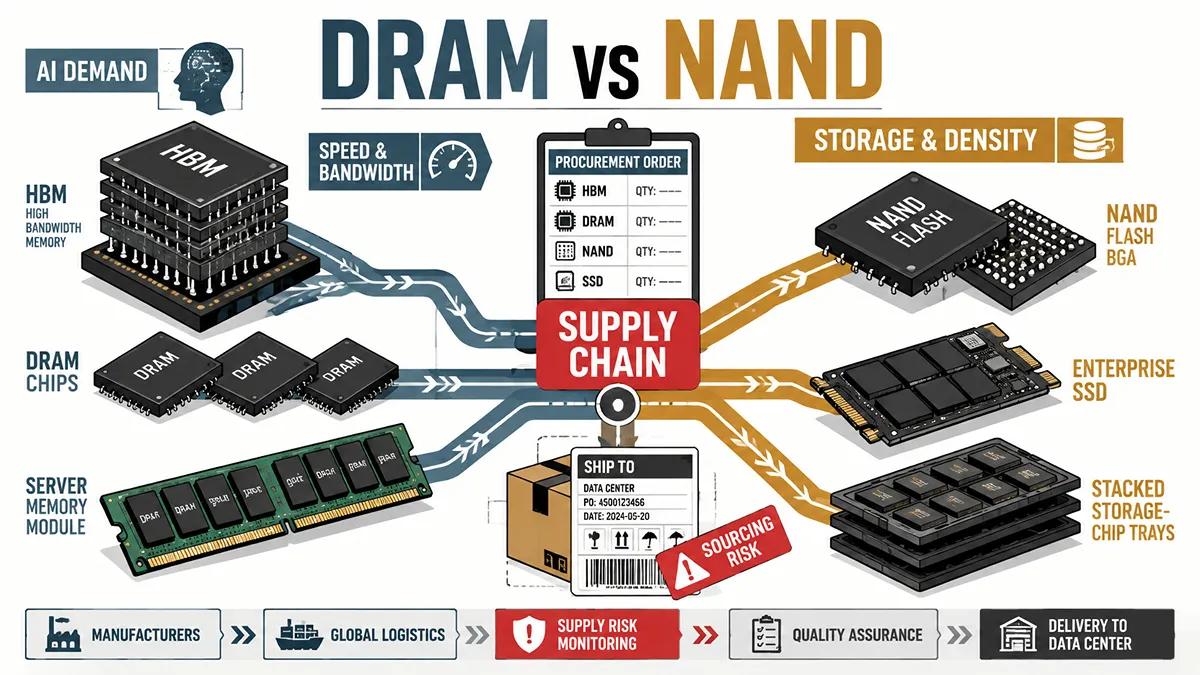
- DRAM and NAND are both memory IC technologies, but they serve different purposes: DRAM focuses on speed and bandwidth, while NAND focuses on storage capacity and cost efficiency.
- The DRAM market is highly concentrated, with a small number of major manufacturers controlling global supply.
- NAND Flash has a broader competitive landscape and experiences stronger price competition due to capacity-driven growth.
- AI infrastructure is creating strong demand for advanced DRAM products, especially HBM (High Bandwidth Memory), because AI workloads require extremely high memory bandwidth.
- For electronic component buyers, understanding memory IC supply chains helps manage availability risks, price fluctuations, and lifecycle challenges.
Introduction
DRAM and NAND Flash are two of the most important memory semiconductor technologies in the electronics industry. Although they are often grouped together as “memory chips,” they serve fundamentally different purposes and operate under different market dynamics.
DRAM is primarily designed for high-speed data access and computing performance, while NAND Flash focuses on high-density data storage and cost efficiency. From a technology perspective, comparing DRAM and NAND helps engineers understand memory architectures. However, from a supply chain perspective, the differences are even more significant. Their supplier landscapes, manufacturing challenges, pricing cycles, and demand drivers are shaped by different market forces.
As artificial intelligence (AI), cloud computing, and data centers continue expanding, understanding the memory IC supply chain has become increasingly important for engineers, procurement teams, and electronics companies.
The key question is not simply:
“Which memory technology is better?”
The more important question is:
“Why do DRAM and NAND follow different supply chain paths, and how does this affect sourcing decisions?”
Two Different Memory Business Models
Although DRAM and NAND belong to the memory IC category, they solve different problems.
DRAM vs NAND: Basic Comparison
| Feature | DRAM | NAND Flash |
|---|---|---|
| Full Name | Dynamic Random-Access Memory | NAND Flash Memory |
| Memory Type | Volatile Memory | Non-Volatile Memory |
| Primary Purpose | High-speed data access | Long-term data storage |
| Key Advantage | Speed and bandwidth | Density and cost efficiency |
| Data Retention | Requires continuous power | Retains data without power |
| Common Applications | Servers, PCs, AI systems | SSDs, smartphones, storage systems |
DRAM: Optimized for Speed and Bandwidth
DRAM (Dynamic Random-Access Memory) is designed for fast temporary data access. It provides the high speed and low latency required by modern computing systems.
The main advantages of DRAM include:
- High data transfer speed
- Low latency
- High bandwidth
- Fast communication with processors
DRAM is widely used in:
- Servers
- PCs
- Smartphones
- Graphics systems
- AI accelerators
A key growth area for DRAM is HBM (High Bandwidth Memory), which combines multiple DRAM layers into a high-performance memory package. HBM has become a critical technology for AI servers because large AI models require massive data movement between processors and memory.
NAND Flash: Optimized for Storage Capacity
NAND Flash serves a different purpose. It is designed for long-term data storage with high density and competitive cost.
The main advantages of NAND include:
- Non-volatile storage
- High capacity
- Lower cost per bit
- Efficient data retention
NAND Flash is commonly used in:
- SSDs
- Smartphones
- Enterprise storage systems
- Embedded devices
The fundamental difference can be summarized as:
DRAM improves data processing speed.
NAND provides large-scale data storage.
DRAM vs NAND Supply Chain: Why Their Markets Are Different
The biggest difference between DRAM and NAND from a business perspective is their supply chain structure.
| Factor | DRAM | NAND |
|---|---|---|
| Market Structure | Highly concentrated | More competitive |
| Major Suppliers | Samsung, SK hynix, Micron | Samsung, Kioxia, Micron, SK hynix, Western Digital |
| Main Growth Driver | Computing performance and AI servers | Storage demand and SSD growth |
| Manufacturing Focus | Advanced process technology | 3D NAND scaling |
| Pricing Behavior | Strong supply discipline | Greater price competition |
| Supply Risk | Allocation during demand peaks | Oversupply and inventory cycles |
DRAM: A Highly Concentrated Market
The DRAM market is dominated by a small number of manufacturers, mainly:
- Samsung
- SK hynix
- Micron
Developing competitive DRAM technology requires enormous capital investment, advanced manufacturing capability, and years of process optimization.
Because the supplier base is limited, DRAM manufacturers have relatively strong influence over production capacity and market supply.
For buyers, this creates several supply chain considerations:
- Limited supplier options
- Higher sensitivity to capacity changes
- Potential allocation risks during demand peaks
- Importance of long-term supplier relationships
NAND: A More Competitive Storage Market
The NAND Flash market has a wider supplier ecosystem, including:
- Samsung
- Kioxia
- Western Digital
- Micron
- SK hynix
Unlike DRAM, NAND has continued to improve through 3D NAND technology, which increases storage capacity by stacking memory layers vertically.
However, NAND markets are often more price-sensitive because storage demand is closely connected to consumer electronics, SSD markets, and inventory cycles.
How AI Is Reshaping DRAM Demand
Artificial intelligence has become one of the strongest drivers of memory demand, but its impact is not equal across all memory technologies.
Modern AI systems depend heavily on GPUs and AI accelerators. These processors require extremely high bandwidth to process large models efficiently.
This is where advanced DRAM technologies such as HBM become essential.
The AI memory structure can be simplified as:
AI Accelerator → HBM → DRAM Technology
Unlike traditional computing workloads, AI workloads require continuous movement of massive amounts of data. As a result, demand for high-performance memory has increased significantly.
HBM, DDR5 server memory, and other advanced DRAM products have become strategically important components in AI infrastructure.
How AI Impacts DRAM and NAND Demand
| Area | DRAM | NAND |
|---|---|---|
| Role in AI Systems | High-speed data access | Large-scale data storage |
| Key Technologies | HBM, DDR5 | Enterprise SSD, 3D NAND |
| Main Applications | AI training and inference acceleration | Dataset and model storage |
| AI Demand Impact | Very strong | Growing steadily |
Why NAND Remains Important in the AI Era
Although DRAM receives significant attention because of AI acceleration, NAND Flash remains an essential part of modern computing infrastructure.
AI systems generate enormous amounts of data, including:
Training datasets
AI models
Application data
Enterprise information
All of this data requires reliable and scalable storage solutions.
The relationship between DRAM and NAND is not competitive. Instead, they work together:
DRAM manages high-speed data movement.
NAND provides high-capacity data storage.
As AI infrastructure continues expanding, both technologies will remain important, but their growth drivers will continue to differ.
Memory IC Pricing and Procurement Challenges
For companies purchasing memory ICs, understanding technology is only one part of the challenge.
The larger challenges involve supply availability, price changes, and long-term product support.
| Consideration | Why It Matters |
|---|---|
| Availability | Supply conditions can change quickly during market cycles |
| Lead Time | Delays may impact production schedules |
| Lifecycle | Older memory products may become harder to source |
| Supplier Reliability | Traceability and quality assurance are critical |
| Alternative Sources | Additional channels reduce supply risks |
Supply Availability
Memory markets are highly cyclical. Demand changes from AI servers, PCs, smartphones, and enterprise storage can quickly influence supply conditions.
Buyers should monitor:
- Manufacturer production strategies
- Capacity allocation
- Market inventory levels
- Lead time changes
Price Volatility
Memory pricing is affected by:
- Supply and demand balance
- Manufacturing capacity
- Technology transitions
- Market cycles
Because memory products are produced at large volumes and have relatively standardized specifications, prices can change rapidly when market conditions shift.
Product Lifecycle
For industrial, automotive, medical, and embedded applications, lifecycle management is especially important.
Companies need to consider:
- Product availability
- End-of-life notifications
- Alternative components
- Long-term supply support
A memory component that is widely available today may become difficult to source when manufacturers move capacity toward newer technologies.
The Role of Independent Component Distributors
When memory supply becomes constrained or when specific semiconductor products become difficult to source, companies often need additional sourcing channels beyond traditional distribution networks.
An experienced independent electronic components distributor can help customers identify available inventory, support urgent procurement requirements, and manage sourcing challenges across global supply networks.
For electronics manufacturers and engineering teams, supplier capability is not only about product availability. It also involves:
- Supply chain knowledge
- Component traceability
- Quality control
- Market intelligence
- Access to alternative sourcing channels
This becomes especially valuable when dealing with allocation situations, obsolete components, or long-lead-time semiconductor products.
Conclusion
DRAM and NAND are both essential memory IC technologies, but they operate within very different supply chain environments.
DRAM is driven by computing performance, bandwidth requirements, and AI acceleration. NAND is driven by storage demand, capacity growth, and cost efficiency.
As AI continues reshaping the semiconductor industry, understanding the differences between DRAM and NAND is increasingly important for engineers, procurement teams, and supply chain professionals.
The future of memory will not be defined by one technology replacing another. Instead, DRAM and NAND will continue evolving together, supporting different parts of the global digital infrastructure.