
Quick Answer
HBM and DDR are both DRAM technologies, but they are built for very different jobs.
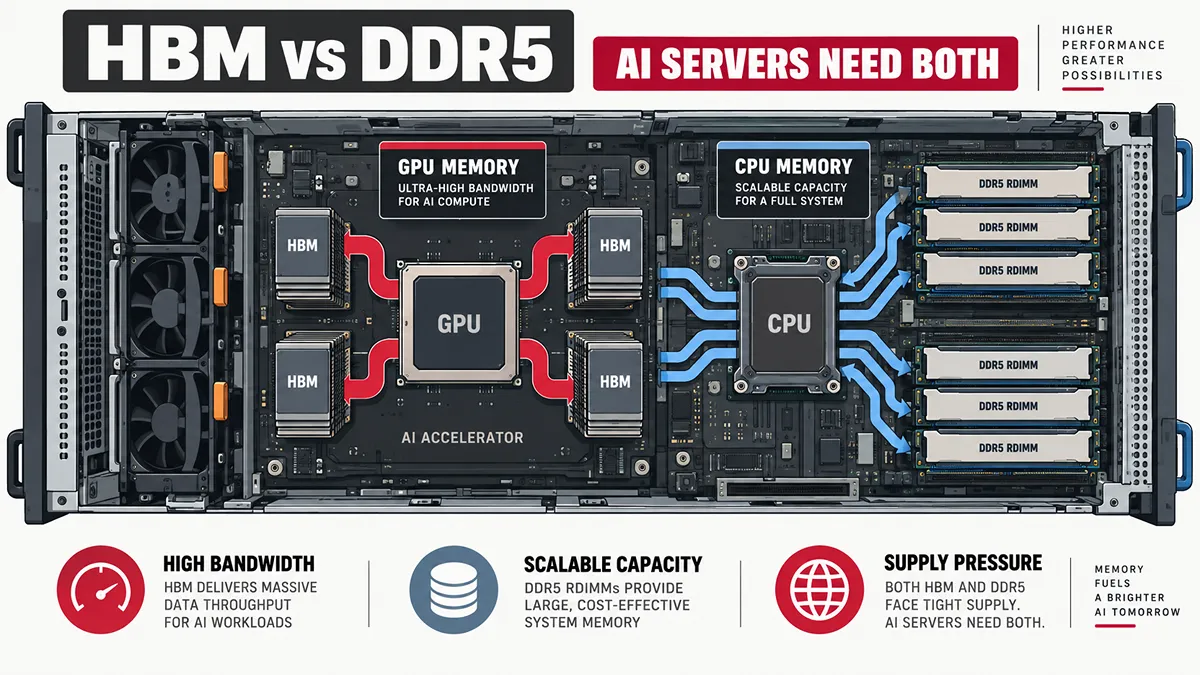
- HBM wins on bandwidth: HBM4 can deliver more than 2.8–3.3 TB/s per stack, making it ideal for GPUs and AI accelerators.
- DDR wins on capacity and cost: DDR5 remains far more economical and scalable for CPU and system memory.
- AI servers need both: HBM feeds accelerator compute, while DDR5 supports CPUs, databases, preprocessing, caching and other system-level workloads.
- HBM will not replace DDR: Their architectures and cost structures make them complementary rather than direct substitutes.
- The bigger 2026 story is supply: surging HBM demand and AI-server growth are influencing DRAM production priorities, contributing to tighter DDR5 availability and higher server-memory prices.
In other words, HBM vs DDR is no longer just a speed comparison. It is also a cost, architecture and memory supply-chain story.
HBM vs DDR at a Glance
| Feature | HBM | DDR |
|---|---|---|
| Primary role | Accelerator/GPU memory | CPU/system memory |
| Architecture | Vertically stacked DRAM dies | DRAM packages mounted on DIMMs or directly on boards |
| Interface | Extremely wide interface | Narrower memory channels operating at high data rates |
| Bandwidth | Extremely high | Moderate to high |
| Capacity scalability | More constrained per accelerator | Easier to scale across multiple DIMMs |
| Cost per GB | Very high | Much lower |
| Upgradeability | Usually integrated with accelerator package | Often replaceable or expandable |
| Main applications | AI accelerators, GPUs, HPC | Servers, PCs, workstations, embedded systems |
| Key 2026 generation | HBM3E/HBM4 | DDR5 |
| Supply-chain concern | Advanced packaging and HBM capacity | Server DRAM shortages and rising prices |
What Is HBM?
HBM, or High Bandwidth Memory, is a type of DRAM designed specifically to provide extremely high memory bandwidth while keeping the memory physically close to the processor.
Instead of placing individual DRAM packages across a conventional memory module, HBM stacks multiple DRAM dies vertically. The dies communicate through microscopic vertical electrical connections known as through-silicon vias, or TSVs. The memory stacks are then integrated very close to GPUs, AI accelerators or other high-performance processors, traditionally through advanced packaging technologies such as silicon interposers. The result is a radically wider memory interface. This matters because AI accelerators can perform calculations far faster than conventional memory architectures can continuously feed them with data.
A modern GPU may contain thousands of parallel compute units. If those processors spend significant time waiting for model weights, activations or intermediate results to arrive from memory, adding more computing power produces diminishing returns.
This problem is commonly described as the memory wall. HBM attacks that bottleneck primarily through width rather than simply increasing clock speed.
In practical terms, HBM offers three major advantages:
- extremely high aggregate bandwidth;
- lower energy per bit moved;
- very close physical integration with the accelerator.
The trade-off is significantly higher cost, more complex packaging and far less flexibility than conventional DDR memory.
HBM4 Shows How Wide the Gap Has Become
HBM4 makes the difference especially clear. The HBM4 architecture doubles the I/O interface from 1,024 pins in HBM3E to 2,048 pins. Samsung's commercially shipping HBM4 reaches up to 3.3 TB/s of bandwidth per stack, according to the company, while Micron states that its 36GB 12-high HBM4 provides more than 2.8 TB/s per stack.
Those are extraordinary numbers for a single memory stack. Samsung's HBM4 products currently offer 24GB to 36GB capacities using 12-layer stacking, with future 16-layer configurations intended to increase capacity to as much as 48GB.
The architecture is especially valuable for workloads such as: AI model training, large language model inference, scientific computing, high-performance computing, recommendation systems and other applications in which processors need to access massive datasets with very high throughput.
Training a large model may require huge accelerator clusters, but once those models are deployed, billions of inference requests can generate continuous demand for memory bandwidth across a much broader installed base.
Micron explicitly positions HBM4 for both AI training and inference and says its current HBM4 generation delivers more than 2.8 TB/s per stack with more than a 20% improvement in power efficiency compared with its previous-generation HBM3E.
Why Is HBM So Expensive?
HBM's performance comes with a substantial cost penalty. Unlike commodity DDR memory, an HBM product is not simply a conventional DRAM package operating at a higher speed.
Its cost structure includes advanced DRAM dies, die stacking, TSV fabrication, complex packaging, strict thermal requirements and demanding yield targets. HBM also needs to be integrated closely with expensive accelerators rather than installed as a standard removable memory module.
That makes HBM vs DDR cost a difficult comparison based purely on dollars per gigabyte.
HBM pricing is also relatively opaque. Large volumes are generally negotiated between memory manufacturers, accelerator vendors and hyperscale customers under supply agreements rather than sold through the transparent module market used for mainstream DDR.
Therefore, public HBM price quotes should be treated carefully. Two HBM products with the same nominal capacity may differ substantially in generation, stack height, bandwidth, packaging requirements and customer qualification. For system designers, the more meaningful metric is often not simply cost per GB, but: cost per unit of bandwidth delivered to the accelerator.
For workloads in which memory bandwidth determines how effectively a GPU can be utilized, paying significantly more for HBM can still improve total system economics by keeping extremely expensive compute hardware productive.
What Is DDR?
DDR, or Double Data Rate SDRAM, is the mainstream system memory architecture used across PCs, servers, workstations and many embedded computing platforms.
In today's server market, the most relevant generation is DDR5. Unlike HBM, DDR is normally connected to a CPU through dedicated memory channels. In servers, DRAM chips are typically assembled into DIMMs such as RDIMMs, allowing system manufacturers to install hundreds of gigabytes or even several terabytes of memory depending on platform configuration.
DDR's major advantage is not that it can outperform HBM in bandwidth. It cannot.
Its advantage is that it offers a far more practical combination of: capacity, cost, modularity, industry standardization and upgradeability.
A server operator can populate multiple DIMM slots, replace modules, change capacity configurations and select among a broad range of suppliers and densities. HBM usually cannot provide that flexibility because it is tightly integrated into an accelerator package. This is why comparing HBM and DDR purely by bandwidth can be misleading.
An AI server needs both.
DDR5 Prices Have Become Part of the AI Story
Historically, another major advantage of DDR has been its relatively predictable commodity-memory economics.
In 2026, that assumption has become less comfortable. AI infrastructure investment and growing automation workloads have increased demand not only for HBM but also for server DDR5.
TrendForce reported that as AI applications move from a heavy focus on LLM training toward broader AI inference, cloud service providers are increasing deployment of general-purpose servers. That expands memory demand beyond HBM into products such as high-capacity RDIMMs and other DDR-based server memory.
At the same time, DRAM manufacturers are prioritizing more profitable server and AI-related products. Together, these factors have contributed to a much tighter DDR market.
As of late August 2026, TrendForce's public module spot-price data showed 32GB DDR5-4800/5600 RDIMMs trading in a weekly range of approximately $1,600 to $1,900, with an average of $1,665 in the reported period. Its 16GB DDR5 UDIMM data showed a range of approximately $220 to $245. These figures are market observations rather than universal purchase prices, but they illustrate how dramatically memory economics can move during a shortage.
TrendForce separately forecast server DRAM contract prices to rise 13–18% quarter over quarter in Q3 2026, while warning that a server DRAM shortage was already expected for 2027. This is one reason discussions about a DDR5 shortage increasingly overlap with discussions about HBM. The two markets are technically different, but economically they draw from the same small group of leading DRAM manufacturers and compete for manufacturing investment, advanced processes and capacity allocation.
Why Is HBM Faster Than DDR?
The biggest performance difference between HBM and DDR comes from the way each architecture moves data. DDR increases performance partly through higher transfer rates and multiple memory channels. HBM uses a much wider interface to move far more bits simultaneously. HBM4 illustrates the extreme version of this strategy.
Samsung's HBM4 uses 2,048 I/O pins and can deliver up to 3.3 TB/s from a single stack.
A DDR5 memory channel is dramatically narrower. Servers compensate by using multiple memory channels across one or more CPUs, but the resulting memory system still serves a fundamentally different purpose.
This is why HBM is especially effective when thousands of GPU cores need simultaneous access to large volumes of data.
HBM's physical location also helps. Because HBM sits extremely close to the accelerator, the electrical paths between processor and memory can be shorter than those used by traditional DIMM-based memory systems. Shorter connections and lower operating voltages can improve energy efficiency when moving large quantities of data.
That matters because data movement itself consumes substantial power in modern AI systems. As accelerator performance increases, the energy required to constantly move data between compute and memory can become a major system-level constraint.
HBM4 vs DDR5: Different Solutions to the Same AI Memory Problem
The arrival of HBM4 in 2026 makes an HBM4 vs DDR5 comparison particularly relevant.
Samsung began commercial HBM4 shipments in February 2026, while Micron announced high-volume production of its 36GB HBM4 for NVIDIA's Vera Rubin platform in March.
HBM4 pushes accelerator memory further toward extreme bandwidth.
DDR5, meanwhile, continues evolving toward higher-capacity and faster server memory configurations.
They are therefore not competing to occupy exactly the same socket.
- HBM4 answers: How can the accelerator access data fast enough to keep its compute engines busy?
- DDR5 answers: How can the server maintain a large, scalable working memory pool for CPUs and system-level workloads at a reasonable cost?
This distinction becomes increasingly important as AI infrastructure becomes more heterogeneous. Not every AI task runs entirely on a GPU. Data ingestion, orchestration, retrieval, preprocessing, databases, vector search, CPU-side inference, networking and application services can consume large quantities of system memory.
As AI inference spreads across cloud infrastructure, the result is growing demand for both accelerator memory and conventional server DRAM.
HBM vs DDR for AI Training and AI Inference
AI training initially gave HBM much of its current visibility. Training a large model involves repeatedly moving enormous matrices and model parameters through accelerators. Memory bandwidth can directly affect GPU utilization and training time. HBM is therefore critical for modern AI training accelerators.
Inference changes the equation slightly. During inference, an already-trained model must load parameters and repeatedly process incoming requests. Large models still benefit enormously from HBM because model weights need to remain close to accelerator compute.
However, inference infrastructure also creates demand outside the GPU.
Servers may need substantial CPU memory for request handling, data preparation, retrieval-augmented generation, caching, databases and orchestration.
That is one reason the expansion of AI inference can simultaneously increase demand for HBM and DDR5 RDIMMs.
TrendForce noted in July 2026 that x86 general-purpose servers using RDIMM configurations remained an important platform for agentic AI workloads and expected strong server shipments to continue supporting RDIMM consumption.
The takeaway is important:
AI inference does not make DDR less relevant. In many deployments, it makes system memory more important.
Why Is HBM Demand Affecting DDR Prices and Availability?
HBM and DDR are both fundamentally based on DRAM technology. Samsung, SK hynix and Micron dominate advanced DRAM production, and each manufacturer must decide how fabrication capacity, process transitions, capital expenditure and packaging resources are allocated among different products.
HBM currently offers enormous strategic value because demand from AI accelerator vendors and hyperscale data centers remains strong. Manufacturers therefore have strong incentives to prioritize advanced server and HBM products. That does not mean a DDR wafer is literally converted into an HBM stack overnight. The manufacturing and packaging flows are different. But at an industry level, investment and production priorities matter.
Its July analysis similarly said that HBM and emerging AI-memory products were consuming growing wafer capacity and squeezing RDIMM supply heading into 2027.
That creates a chain reaction:
AI accelerators require more HBM. Memory suppliers prioritize HBM and high-value server products. AI inference simultaneously increases demand for general-purpose servers. Those servers require DDR5 RDIMMs. Supply growth struggles to keep pace with demand. DDR prices rise and buyers become more aggressive about securing allocation. This is why HBM growth can indirectly contribute to DDR5 shortages even though the two memory types serve different roles inside the server.
Will HBM Replace DDR?
No—at least not in the foreseeable architecture of mainstream computing. The phrase “HBM replacing DDR” assumes the two products solve the same problem. They do not.
HBM delivers extraordinary bandwidth but carries higher manufacturing and packaging costs, tighter capacity limitations and limited upgradeability. DDR offers dramatically better economics for large-capacity system memory and fits an established modular ecosystem. Replacing terabytes of server DDR with HBM would therefore be economically and architecturally unnecessary for most workloads.
The more likely future is specialization.
HBM will continue expanding around GPUs, AI accelerators and other bandwidth-intensive processors. DDR5 and its successors will continue serving CPUs and general-purpose system memory. Other technologies may also occupy positions between those extremes as AI system architecture evolves.
In other words:
HBM is not replacing DDR. AI is increasing the importance of both.
What may change is how much of the semiconductor industry's resources each memory category consumes.
And that can have a direct effect on pricing and availability across the broader DRAM market.
HBM vs DDR Cost
DDR wins easily on cost per gigabyte. HBM wins when bandwidth is valuable enough to justify its premium. That distinction matters.
A component buyer evaluating memory based solely on $/GB would almost always favor DDR. But an AI system architect cannot optimize a GPU cluster based only on memory capacity cost.
If insufficient memory bandwidth leaves expensive accelerators underutilized, a cheaper memory architecture can produce a more expensive system overall.
HBM should therefore be evaluated using metrics such as bandwidth per accelerator, performance per watt, and total system utilization.
DDR should be evaluated around capacity per dollar, platform compatibility, module density, availability, and lifecycle cost.
For procurement teams, the sourcing models are also very different.
HBM is closely tied to accelerator roadmaps, advanced packaging capacity, and strategic supply agreements. DDR, by contrast, is available through a much broader component ecosystem, but pricing and availability can still change rapidly when the DRAM market tightens.
For buyers sourcing DDR, DRAM ICs or other memory components, this means the lowest quoted price should not be the only consideration. Manufacturer, density, speed grade, package, lifecycle status, traceability and actual availability can all affect whether a part is suitable for production.
This is particularly important during a shortage, when an apparently equivalent memory device may not be a drop-in replacement.
What Hardware Buyers Should Watch in 2026 and 2027
For component buyers, OEMs and hardware manufacturers, the most important development may not be whether HBM4 reaches another bandwidth milestone. It is whether the AI memory boom continues tightening the broader DRAM supply chain.
Buyers should therefore pay attention to more than headline HBM capacity announcements.
Changes in DRAM production allocation, server RDIMM availability, module density, supplier lead times, and lifecycle transitions can all affect sourcing conditions. This is particularly relevant for organizations that do not have the purchasing leverage of hyperscale cloud companies.
When major customers secure supply through long-term agreements, smaller OEMs, industrial buyers, and spot-market purchasers may experience pricing pressure earlier and more severely.
For procurement teams, the practical question is increasingly: How exposed is our memory BOM to the same capacity shifts being driven by AI?
Final Thoughts
HBM will not replace DDR, but AI is making both more strategically important — and making memory supply, pricing, and availability harder for buyers to ignore.
Need Help Sourcing Memory Components?
If DDR, DRAM, or other memory parts on your BOM are difficult to source, Vigor Components can help check global availability for active, long-lead-time, and hard-to-find components.
Frequently Asked Questions
Is HBM faster than DDR5?
Yes. HBM provides dramatically higher aggregate memory bandwidth because it uses an extremely wide interface and places stacked DRAM close to the processor. HBM4 implementations in 2026 can exceed 2.8 TB/s of bandwidth per stack, while DDR5 is designed around a very different channel-based system-memory architecture.
Is HBM4 better than DDR5?
It depends on the application. HBM4 is substantially better for bandwidth-intensive accelerator workloads such as AI training and large-model inference. DDR5 is generally better for scalable, cost-effective CPU system memory. Modern AI servers often require both.
Will HBM replace DDR5?
Unlikely. HBM and DDR serve different architectural roles. HBM is optimized for high-bandwidth accelerator memory, while DDR is optimized for scalable and relatively economical system memory.
Why is HBM more expensive than DDR?
HBM requires vertically stacked DRAM dies, TSV technology, advanced packaging, complex testing and tight integration with processors. These manufacturing requirements make it significantly more expensive than conventional DDR memory on a per-gigabyte basis.
Does AI demand cause DDR5 shortages?
AI is one important contributor. AI infrastructure increases demand for both HBM and server DDR5, while manufacturers are also allocating more production resources toward high-value HBM and server products. In 2026, industry researchers have repeatedly reported tight DRAM supply, rising server-memory prices and capacity crowding related to HBM.
Is HBM used as normal RAM?
Usually no. HBM is primarily integrated with GPUs, AI accelerators and HPC processors rather than installed as conventional CPU system memory. DDR DIMMs remain the mainstream solution for server and PC system RAM.