
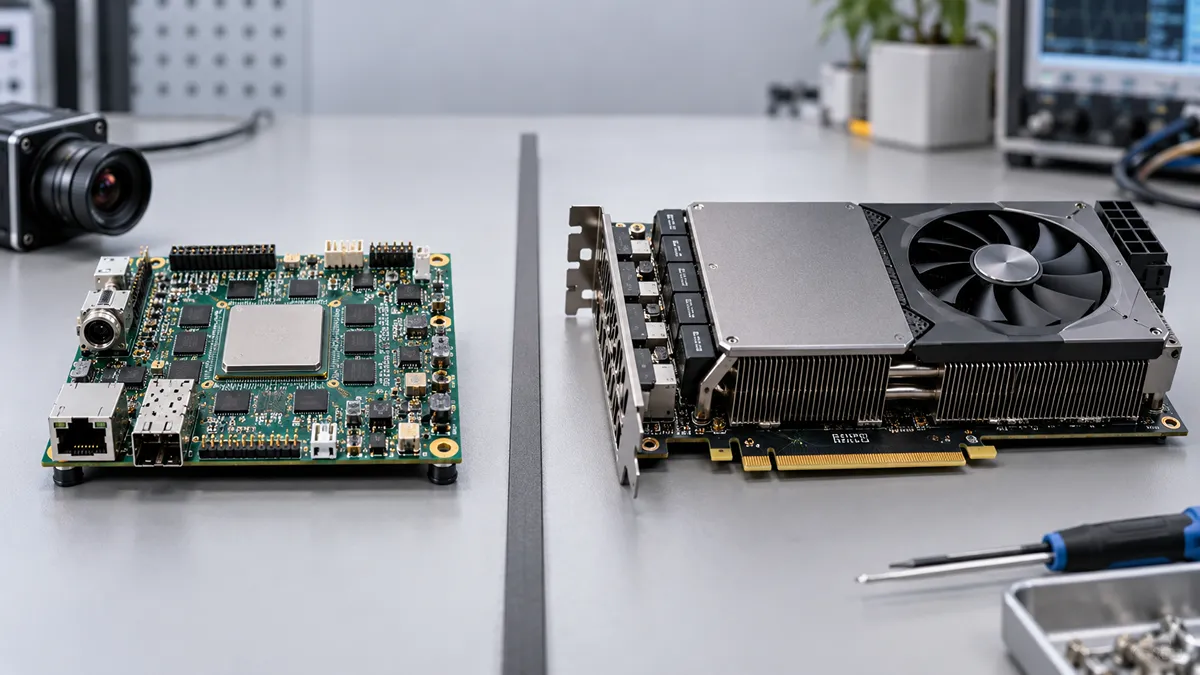
Training a large model across billions of parameters, running thousands of inference requests in a data center, and analyzing a camera stream on an industrial edge device may all involve neural networks, but their hardware priorities are not the same.
GPUs are designed around large-scale parallel computation and have a mature software ecosystem for machine learning. FPGAs provide reconfigurable hardware that can be shaped around a particular data path, interface, numerical format, or real-time requirement. Neither architecture is inherently the better AI accelerator across every workload.
The useful comparison begins with the application: Is the system training or running a model? Does it process individual requests or large batches? Is data already available in accelerator memory, or does it arrive continuously from cameras, networks, or sensors? How tightly constrained are power, cooling, and response time?
Key Takeaways
- GPUs are generally the more practical choice for AI training, especially when models rely on established machine-learning frameworks, optimized libraries, and large-scale parallel computation.
- AI inference creates a more workload-dependent comparison. GPUs remain widely used, while FPGAs can be attractive where deterministic processing, small batches, streaming data, or specialized I/O matter.
- Peak compute is only part of AI performance. Memory bandwidth, data movement, batch size, numerical precision, and accelerator utilization can materially affect end-to-end results.
- FPGAs offer greater control over the hardware data path, but that flexibility usually comes with a more specialized development and verification process.
- The accelerator affects the rest of the platform. Memory, power delivery, host processing, PCIe or Ethernet connectivity, clocking, thermal design, and sensor interfaces can all change with the architecture.
For many systems, the decision is also not strictly FPGA or GPU. The two can appear in different stages of the same AI pipeline.
Basic of FPGA VS GPU
| Factor | FPGA | GPU |
|---|---|---|
| Typical Strength | Custom and streaming data paths | Large-scale parallel computation |
| AI Training | Possible, but less common | Widely used |
| AI Inference | Strong in selected low-latency and edge workloads | Broadly used from edge to data center |
| Batching | Can work efficiently with small batches | Often benefits from batching |
| Hardware Flexibility | Reconfigurable logic and datapaths | Fixed processor architecture |
| Numerical Precision | Can support customized arithmetic | Strong support for standard AI formats |
| I/O Integration | Highly configurable | Platform-dependent |
| Software Ecosystem | More specialized | Broad and mature |
| Development Model | Hardware/software co-design | Primarily software-based |
| Model Changes | May require hardware recompilation | Usually handled in software |
The distinction is less about one device being “faster” and more about how each architecture performs useful work.
- A GPU executes AI operations across many parallel processing resources. NVIDIA's CUDA model, for example, is designed around large numbers of parallel threads and a substantial supporting software ecosystem.
- An FPGA instead allows processing structures, data paths, buffering, and interfaces to be configured around the workload. Intel positions this reconfigurability as useful for AI applications spanning edge systems, embedded devices, servers, and cloud infrastructure.
Why FPGA And GPU Approach AI Workloads Differently
Many neural-network operations involve large numbers of repeated mathematical operations. Matrix multiplication, convolution, attention, and tensor processing can therefore map well to architectures capable of substantial parallel computation.
A GPU approaches this problem through programmable parallel processors. Thousands of threads can execute across the device, supported by high-bandwidth memory and software libraries optimized for common AI operations. This is one reason GPUs are extensively used for deep learning and generative AI.
An FPGA approaches the same problem from a different direction. Rather than scheduling every operation onto fixed GPU execution units, designers can configure logic, DSP resources, local memory, routing, and interfaces around selected stages of the workload.
A simplified inference path resembles:
Input Data
    ↓
Preprocessing
    ↓
Matrix / Convolution Operations
    ↓
Activation / Quantization
    ↓
Postprocessing
    ↓
Output
Those stages can potentially operate as a pipeline, with different data items occupying different stages simultaneously.
Modern adaptive devices can blur the boundary further. AMD Versal devices, for example, combine programmable logic with processor cores, network-on-chip resources, and dedicated AI Engines intended for compute-intensive machine-learning and signal-processing workloads.
The practical result is two different ways of mapping an AI workload onto hardware rather than two interchangeable accelerators.
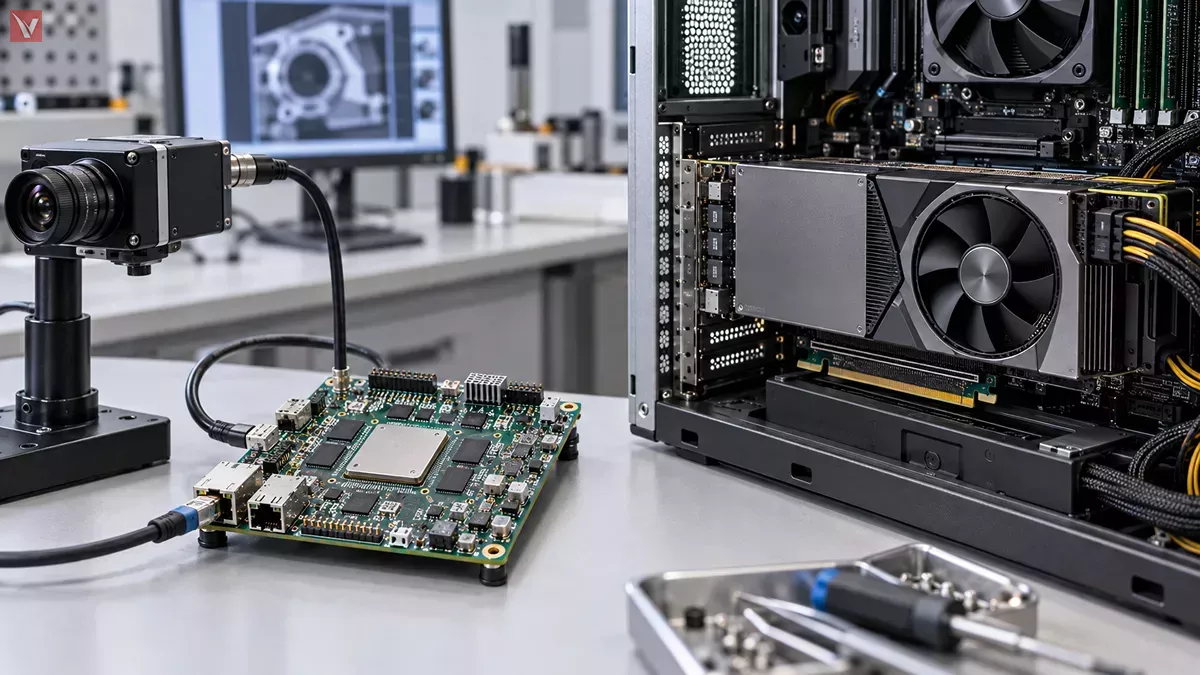
AI Workloads Define The Right Accelerator
Training
Training repeatedly processes large datasets while updating model parameters. Compute throughput, memory capacity, memory bandwidth, distributed processing, and mature framework support are often major priorities.
- GPUs fit this workflow well because modern AI software ecosystems already provide optimized kernels and libraries for common tensor operations. CUDA-based frameworks can also scale workloads across multiple GPUs.
- For this reason, an FPGA is usually not positioned as a direct replacement for a GPU cluster training a large foundation model.
Inference
Inference changes the comparison because the model is already trained.
The system may instead prioritize:
- Response latency
- Requests per second
- Power consumption
- Model size
- Real-time I/O
A cloud service processing thousands of simultaneous requests may benefit from GPU throughput and batching. A machine-vision system responding to individual frames may care more about predictable end-to-end latency.
Edge AI
At the edge, the accelerator may also need to interact directly with cameras, sensors, industrial buses, or networking hardware. Power and thermal limits can become more restrictive, while continuous streaming data may reduce the relevance of large-batch processing.
FPGA-based and adaptive architectures can become more interesting in these conditions, particularly when AI inference is only one part of a larger real-time pipeline.
Performance Depends On More Than Compute Power
Peak arithmetic performance provides useful information, but it does not describe how quickly an AI application responds.
- A GPU may accumulate multiple requests into a batch before executing them efficiently across many parallel units. This can improve overall throughput, but batching and scheduling can contribute to the latency experienced by an individual request.
- An FPGA can instead be configured as a streaming pipeline:
Input → Stage A → Stage B → Stage C → Output
Once the pipeline is filled, new data can enter while previous data is still moving through later stages. For applications built around continuous streams or small batches, this can produce useful latency characteristics.
That does not mean FPGA inference is always faster. End-to-end performance also depends on:
- Model architecture
- Accelerator utilization
- Memory access patterns
- Host-device communication
- Pre- and postprocessing
A GPU may deliver substantially greater throughput when enough parallel work is available. It may also be the more practical option if the model changes frequently or already maps well to optimized GPU libraries.
FPGA results can vary just as widely. Clock frequency, pipeline depth, off-chip memory access, interface latency, routing, quantization choices, and the quality of the hardware implementation all influence performance.
For this reason, comparisons based only on a device's advertised TOPS or FLOPS can be misleading. The more relevant measurement is usually application-level performance under the batch size, model, interfaces, and response requirements expected in deployment.
The Hardware Behind AI Performance
AI accelerators spend considerable time moving and storing data, not just performing arithmetic.
Large models require weights to be read repeatedly. Intermediate activations consume memory capacity and bandwidth. Transformer inference may introduce additional memory pressure from model state and cache structures. If compute units cannot receive data quickly enough, adding more theoretical arithmetic capability may have limited effect.
GPUs address this partly through high-bandwidth memory systems, caches, and optimized memory hierarchies designed to feed large numbers of parallel compute units.
FPGA designs can take a different approach. Frequently used data may be placed in registers or embedded memory close to the processing pipeline, while external DDR or HBM can provide larger storage where supported.
Precision also affects the hardware equation.
AI workloads may use formats such as:
- FP32
- FP16 or BF16
- INT8
- Lower-precision integer formats
GPUs increasingly include dedicated hardware for commonly used AI formats. FPGAs can offer additional flexibility in how arithmetic width and data paths are constructed, although reducing precision is useful only when the model maintains acceptable accuracy.
The same principle applies to interfaces. If data originates from a camera, network link, converter, or sensor array, moving it into and out of the accelerator can become part of the performance problem. In some applications, minimizing those transfers can matter as much as increasing compute throughput.
Where GPUs Fit Better In AI Systems
GPUs are usually the natural architecture to evaluate when AI computation is highly parallel and the workload can make effective use of established GPU software.
Training is the clearest example. Modern machine-learning frameworks, optimized mathematical libraries, distributed training tools, and GPU communication technologies form an ecosystem that is difficult to separate from contemporary large-model development.
NVIDIA's CUDA platform is designed to expose GPU parallelism through programming languages, libraries, and higher-level frameworks rather than requiring developers to design custom hardware.
GPUs are also well suited to many inference environments.
A data center serving large numbers of users may benefit from batching requests and keeping the GPU highly utilized. Generative AI, multimodal models, recommendation systems, and other compute-heavy inference workloads can also require substantial memory capacity and parallel computation.
GPU-based systems are particularly worth evaluating when:
- Models change frequently
- High throughput matters more than strict deterministic timing
- Development depends heavily on existing AI frameworks
- Several different models must share the same infrastructure
- The workload already maps efficiently to GPU libraries
Software flexibility is an important part of this decision. A model update on a GPU platform often remains primarily a software deployment task.
The GPU may therefore remain the more practical choice even when another architecture could offer an advantage for one narrowly defined kernel.
Where FPGAs Fit Better In AI Systems
FPGA-based AI becomes more interesting when inference is closely connected to the physical flow of data through a system.
Consider an industrial vision system. Image data may arrive continuously from one or more cameras and pass through several stages before an AI model is executed:
Camera
   ↓
Image Conditioning
   ↓
Preprocessing
   ↓
AI Inference
   ↓
Decision Logic
   ↓
Machine Control
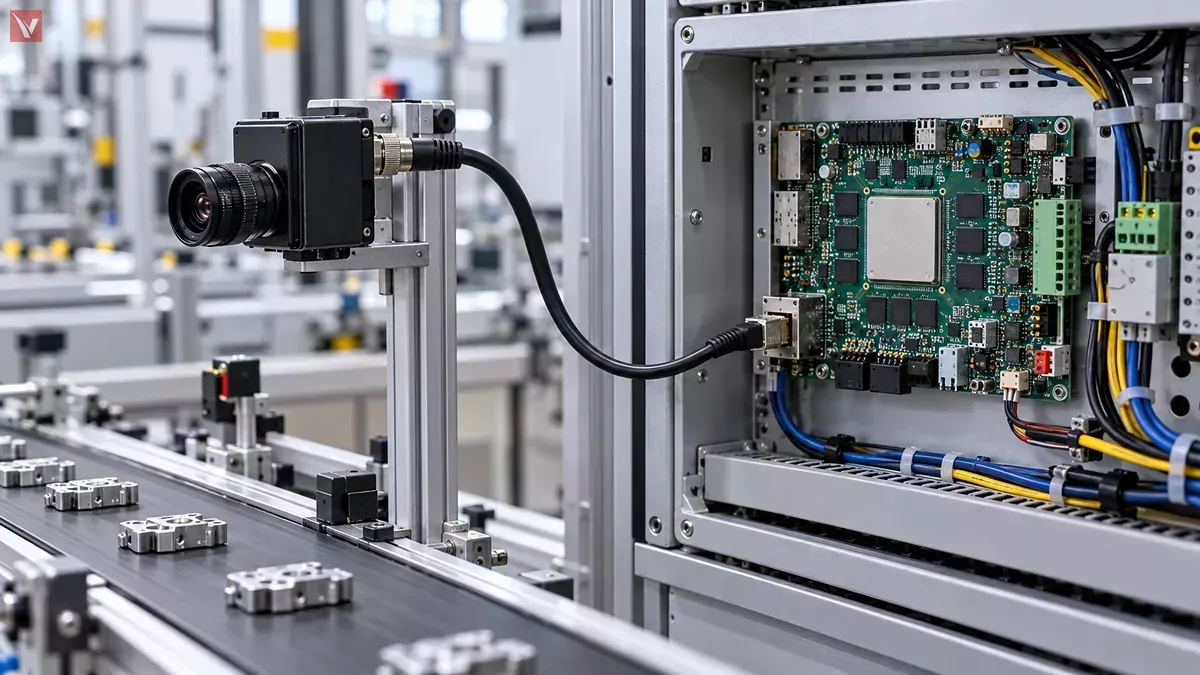
An FPGA can potentially implement several of these stages within the same programmable hardware pipeline rather than treating inference as an isolated compute task.
Useful FPGA AI scenarios can include:
- Real-time or low-batch inference
- Machine vision and sensor processing
- Streaming analytics
- Industrial and embedded AI
- Custom protocol or I/O integration
Intel highlights edge AI, embedded systems, and configurable I/O among the areas where FPGA characteristics can be useful. AMD similarly positions adaptive architectures and AI Engines for inference alongside signal-processing and communications workloads.
The trade-off is engineering complexity. FPGA development may involve hardware design, synthesis, timing analysis, tool-specific AI compilation flows, and verification in addition to model development.
FPGA suitability therefore, tends to increase when hardware customization solves a system-level problem, not merely because an AI model can technically be implemented in programmable logic.
How AI Architecture Choices Affect The Hardware Platform
Choosing an accelerator changes much more than the compute device.
| System Area | FPGA-Based AI Platform | GPU-Based AI Platform |
|---|---|---|
| Compute | FPGA or adaptive SoC | GPU or GPU module |
| Host Processing | Integrated or external CPU | Typically CPU or SoC |
| Memory | Embedded RAM plus DDR/HBM where needed | GPU memory plus host memory |
| Connectivity | PCIe, Ethernet, SerDes, sensor interfaces | PCIe and platform-specific high-speed links |
| Power | Multiple rails may be required | High-current accelerator rails can be significant |
| Clocking | Often closely tied to I/O and data paths | Platform and high-speed interface clocking |
| Thermal Design | Depends strongly on device and workload | Can be substantial on high-performance GPUs |
The accelerator therefore affects the surrounding BOM.
An edge FPGA design may require DDR or LPDDR, configuration memory, PMICs, voltage regulators, oscillators, clock generators, Ethernet PHYs, interface ICs, and connectors.
A GPU platform may require a host processor, system memory, high-current power conversion, PCIe connectivity, networking, storage, and substantial thermal hardware.
Neither should be evaluated solely by accelerator price.
For hardware teams, the more useful comparison includes board complexity, power architecture, memory topology, interface requirements, cooling, expected product lifetime, and whether components remain suitable for the intended operating environment.
These factors can become especially relevant in industrial, embedded, automotive, communications, and other systems where AI acceleration is only one subsystem within a larger product.
FPGA vs GPU For AI Decision Guide
The architecture to evaluate first usually becomes clearer once the workload is described in system terms.
| Requirement | Architecture To Evaluate First |
|---|---|
| Large-model training | GPU |
| Rapid model iteration | GPU |
| High-throughput cloud inference | GPU |
| Heavy use of established AI frameworks | GPU |
| Low-batch real-time inference | FPGA |
| Continuous sensor or video streams | FPGA |
| Custom I/O and preprocessing | FPGA |
| AI inside a deterministic hardware pipeline | FPGA |
| Mixed or changing workloads | GPU or heterogeneous design |
| AI plus specialized real-time hardware | FPGA or heterogeneous design |
These are starting points rather than fixed rules.
A high-performance GPU can support low-latency inference when the software and workload are designed appropriately. Likewise, an FPGA may deliver excellent throughput when the model maps efficiently to its resources.
Some applications benefit from combining both.
For example:
Camera → FPGA Preprocessing → GPU Inference
An FPGA can manage sensor interfaces and real-time preprocessing while a GPU executes a larger or frequently changing AI model.
Another system might use an adaptive SoC to combine programmable logic, embedded processing, and AI-oriented compute resources within one device. AMD's current Versal families are examples of this heterogeneous approach.
Frequently Asked Questions
Is An FPGA Better Than A GPU For AI?
Neither architecture is better across all AI workloads.
GPUs generally offer a stronger software ecosystem and are widely used for training and high-throughput inference. FPGAs can be attractive when inference must be integrated with real-time data paths, custom interfaces, small batches, or specialized processing.
The useful comparison depends on the model, deployment environment, latency requirements, batch size, power limits, and how data enters and leaves the system.
Can FPGAs Be Used For AI Training?
Yes, but they are less commonly used for mainstream large-model training than GPUs.
Training often benefits from mature software frameworks, substantial memory bandwidth, large-scale tensor processing, and efficient multi-device scaling. GPU platforms are already heavily optimized around these requirements.
FPGAs may still be used in research, specialized acceleration, or selected machine-learning workloads, but their strongest practical role is often found in inference and system-specific acceleration rather than general-purpose training.
Are FPGAs More Power Efficient Than GPUs For AI?
They can be for some workloads, particularly when a design uses a specialized pipeline and avoids unnecessary data movement or inactive hardware resources.
However, the result depends on device technology, model architecture, memory traffic, utilization, precision, clock frequency, transceiver activity, and system design.
Comparing energy per completed inference is usually more informative than comparing nominal device power.
Can An FPGA And GPU Be Used Together For AI?
Yes.
A heterogeneous system can assign different parts of the workload to the architecture that fits them best.
An FPGA might handle sensor interfaces, filtering, data formatting, or deterministic preprocessing, while a GPU performs a larger neural-network inference workload. Other designs may combine CPUs, FPGAs, GPUs, or dedicated AI accelerators depending on system requirements.
The architecture is determined by how the complete data path works, not only by the neural network itself.