
Key Takeaways
- Medical-grade is not the same as "isolated." The difference is not the isolation-voltage number on the datasheet—it is patient leakage current pushed to the microamp level (CF: 10 µA, BF: 100 µA), 2×MOPP, and an ISO 14971 risk-management file. A 5 kV industrial brick fails all three.
- Selection is a three-step funnel: define the applied-part class (B/BF/CF) first → determine the MOPP count → then choose the brand by power and package.
- No single brand wins everywhere. Murata owns sub-watt portable, Traco spans 3–60 W in brick form, TDK-Lambda publishes the lowest leakage, RECOM delivers compact SIP value, and Cosel straddles the industrial–medical boundary.
- Sourcing verification matters more than the part. A forged or end-of-life 60601 certificate can cost more in re-certification than the entire BOM. The checklist below tells you exactly what to demand.
- Read on for a device-to-converter decision matrix, a five-brand comparison table, and a sourcing verification checklist you can hand to procurement.
Where Medical dc dc Converters Are Actually Used
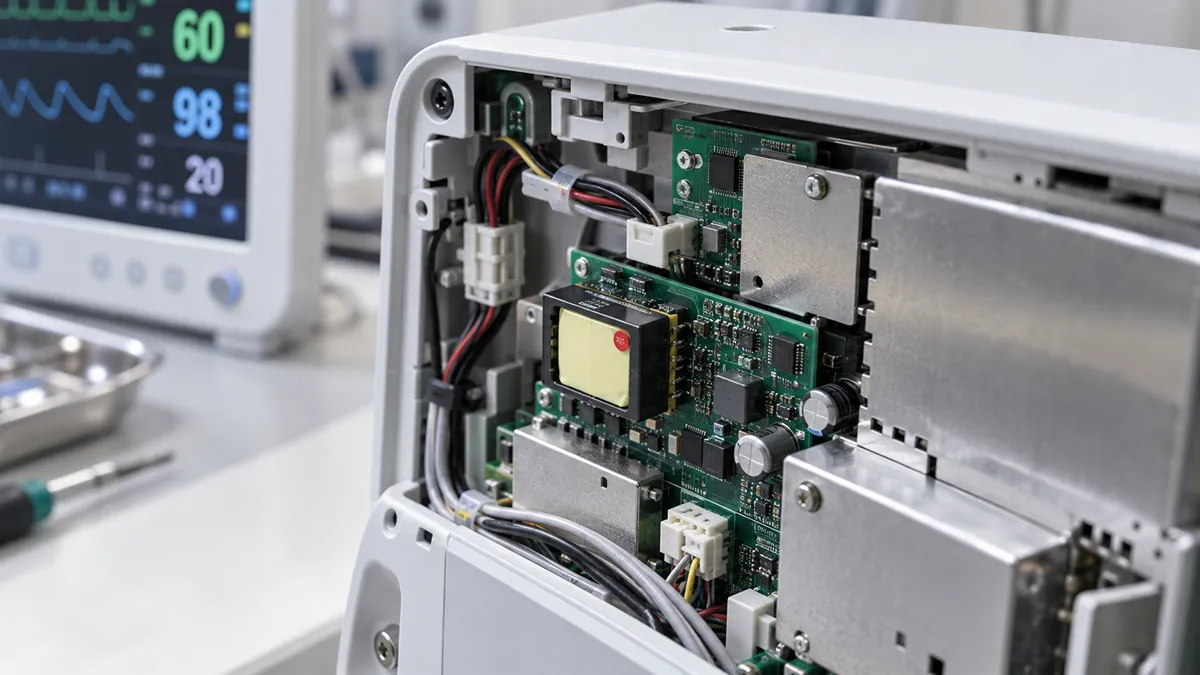
A medical dc dc converter is not one product—it is a family that spans four orders of magnitude in power, and the isolation class shifts with every application.
Portable diagnostics—glucometers, point-of-care readers, handheld ultrasound—run on 1–2 W in SIP or DIP packages, almost always BF or CF. Wearables and implants such as CGMs and pacemakers sit in the microwatt-to-watt range, CF, with quiescent current measured in single-digit microamps because battery life is the spec.
Move up the power scale and the rules change. Bedside monitors and infusion pumps need 10–60 W, BF, with 2×MOPP—this is quarter-brick territory. Imaging systems (X-ray, CT, MRI) pull 60–150 W and often want multi-rail outputs like ±12 V/±15 V for analog front ends. Electrosurgery and defibrillation add a brutal extra requirement: the dc dc module must survive 5 kV+ defibrillation pulses on the patient side without breaking down.
That is why a general-purpose isolated converter—even a 5 kV one—is almost never "good enough" in a medical design. The next section explains the number that actually disqualifies them.
Why "Isolated" Isn't Enough: MOPP and Leakage Current
The single number that separates a medical dc dc module from an industrial one is patient leakage current, and the reason it matters is physical, not bureaucratic.
When a patient is connected to a device, the body's normal defense—skin impedance—is bypassed. ECG leads, needle electrodes, and catheters put conductive material in direct contact with tissue or blood. At that point, currents measured in microamps are no longer trivial: roughly 10 µA across the myocardium can trigger ventricular fibrillation. That is why IEC 60601-1 caps patient leakage at 10 µA for CF applied parts and 100 µA for BF—limits that look absurd on a 5 A power rail until you realize they protect a heart, not a load.
The framework around those limits is the Means of Patient Protection (MOPP). A device needs at least one MOP; Patient-connected applications typically require two (2×MOPP). The hard targets behind 2×MOPP are concrete: 5,000 VAC dielectric strength, reinforced insulation, and creepage/clearance ≥ 8 mm. MOOP—the operator equivalent—is less stringent, which is why an ITE-grade supply can cover 2×MOOP but still cannot serve the patient side.
A standard isolated brick rated 1,500 Vdc with basic insulation clears none of these bars. The isolation voltage is a symptom, not the disease. Select a converter whose datasheet explicitly states 2×MOPP and quotes a patient-leakage figure in the sub-microamp range—otherwise the certification fails on paper before you ever build it.
Type B, BF, and CF: Which Applied Part Is Your Device?
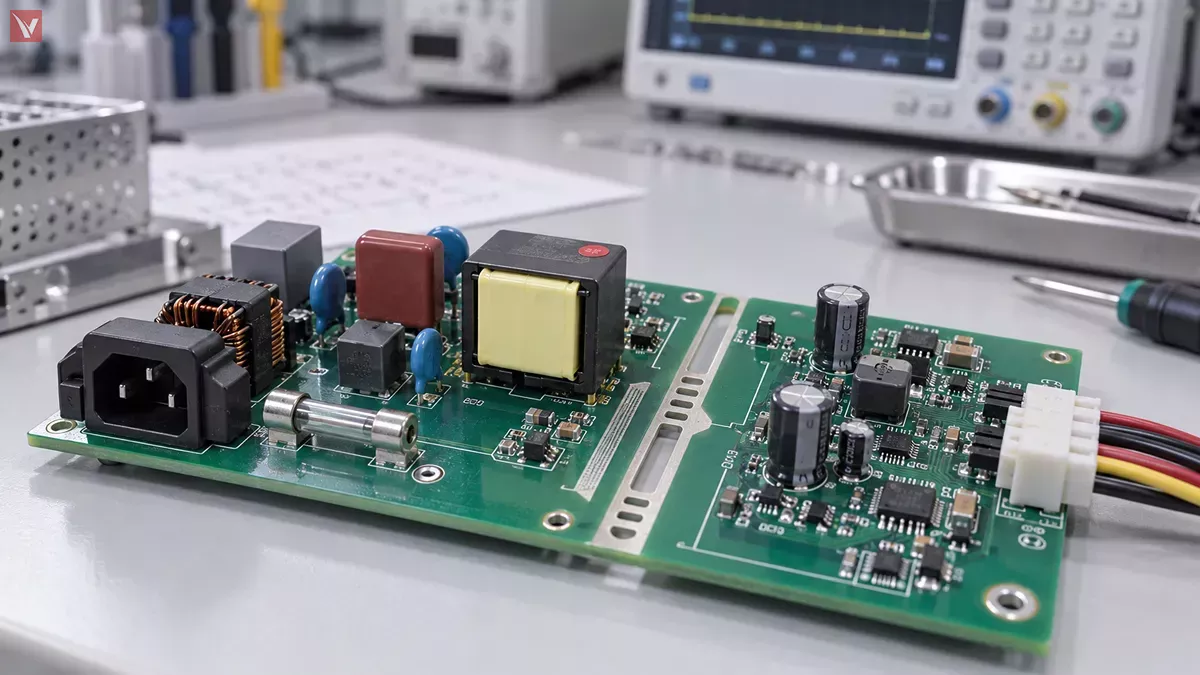
IEC 60601-1 sorts applied parts into three classes by how they contact the patient:
- Type B—body contact, earth-referenced (e.g., hospital beds, phototherapy lamps).
- Type BF—body contact, floating (e.g., ultrasound probes, BP cuffs).
- Type CF—direct cardiac or blood contact, the strictest (e.g., dialysis, cardiac monitors, electrosurgery).
The class dictates everything downstream, so run the decision in order: which body part does the device touch? → B/BF/CF → how many MOPP → what isolation class on the dc dc converter. CF almost always forces 2×MOPP; B can sometimes get away with less, but the cost saving is marginal against the certification risk.
If you are new to converter fundamentals generally, our guide to DC converter basics and overview of dc dc converter types covers the topology side.
The AC/DC + DC/DC Combo: The Cost-Optimal Path to 2×MOPP
Few medical devices run straight off DC. The economical architecture is a two-stage chain: an ITE-grade AC/DC front-end that delivers 2×MOOP (operator protection), followed by a medical-grade isolated dc dc converter that adds 2×MOPP only where the circuit touches the patient. Putting 2×MOPP everywhere is over-engineering; putting it only on the patient rail is where the cost savings live. Battery-powered devices simplify further—the dc dc converter is the main isolation barrier, with no AC/DC stage at all.
One requirement the reference designs rarely spell out is the system leakage budget. The 100 µA (BF) or 10 µA (CF) limit applies to the whole device, and it has to be allocated across the AC/DC, the dc dc converter, and layout parasitics. A converter with 4 µA leakage leaves room for the rest; one with 50 µA does not. Treat leakage as a budgeted resource, not a pass/fail line item.
This is also where the advantages of modular dc dc converters in medical devices show up clearly. A pre-certified medical module hands you a defined isolation barrier, a published leakage figure, and a drop-in footprint—you inherit the vendor's 60601 test data instead of generating your own. Discrete designs force you to re-prove creepage, dielectric strength, and leakage from scratch, which means another full EMC and safety cycle. In a 5–10-year product lifecycle, that difference is the single largest hidden cost in the power stage.
EMC (EN 55032 Class A/B) and thermal design follow the same logic—we cover the circuit-level principles in our dc dc converter circuit guide.
Matching Specs to Real Medical Device Categories
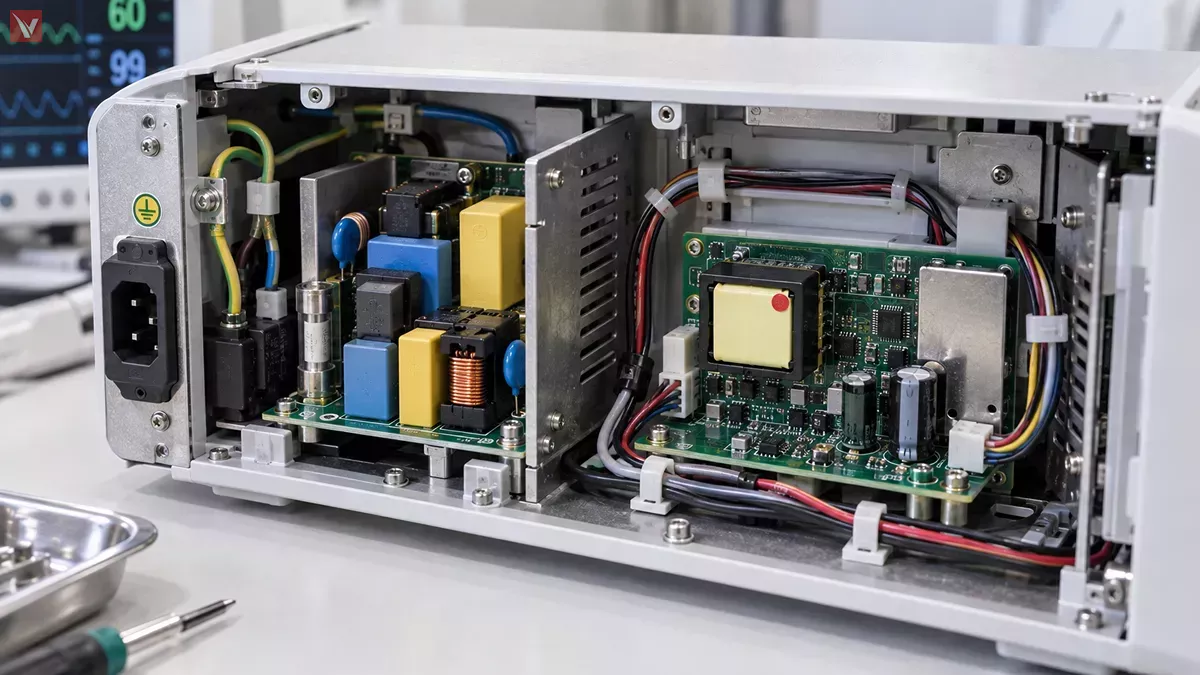
Once the applied-part class and MOPP count are set, the rest is a table lookup. Find your device category, read off the power and package class, and you have narrowed the field from hundreds of parts to a handful.
| Device category | Applied part | Power class | Recommended package | Typical medical-grade series (verify current datasheet) |
|---|---|---|---|---|
| Glucometer/POCT/handheld probe | BF/CF | 1–2 W | SIP/DIP | Murata MEF1, RECOM REM2 |
| CGM/wearable patch | CF | µW–1 W | ultra-compact SIP | Murata MEF1 |
| Infusion pump/bedside monitor | BF | 10–60 W | quarter-brick | Traco THM 60WI |
| Ultrasound/CT/MRI front-end | BF | 60–150 W | quarter/half-brick | Traco THM, multi-rail variants |
| Dialysis/cardiac monitor/electrosurgery | CF | 10–150 W | quarter-brick | TDK-Lambda PXC-M (low end), Traco THM (high end) |
Power maps to package almost deterministically: SIP/DIP for sub-10 W, quarter-brick for 10–60 W, half/full brick above that. The exact series should always be confirmed against the manufacturer's current datasheet and certificate—which is the subject of the next two sections.
Sourcing Medical-Grade dc dc Converters
Picking the right part is half the job; proving it stays certified through the product's life is the other half. Medical devices ship for 5–10 years, and a single EOL notice on a 2×MOPP module can force a full re-certification of the patient-contact path—because the substitute part, even if electrically identical, carries its own 60601 file that has to be re-integrated into the system risk analysis. That rework routinely costs more than the component spend across the entire production run.
This is the checklist every sourcing decision should pass before the PO is cut:
| Verification item | What to demand | Why it matters |
|---|---|---|
| IEC 60601-1 certificate | Original CB/NRTL certificate with model number matching the PO | Forged or generic certificates are common; the cert must name the exact part |
| ISO 14971 risk file | Vendor-provided risk-management documentation | Required for system-level integration; missing it stalls your own submission |
| Patient-leakage test report | Measured µA value, test conditions, applicable applied-part class | The single number that makes or breaks CF/BF compliance |
| Creepage/clearance | Stated ≥ 8 mm for 2×MOPP at 250 V working voltage | Must be on the datasheet, not inferred |
| Lifecycle/EOL commitment | Vendor roadmap or end-of-life declaration | Drives your second-source strategy from day one |
| Second-source availability | Cross-reference part with equivalent medical-grade option | A second 60601-certified source is insurance against single-vendor EOL |
VIGORCOMP note: As an independent distributor carrying Murata, Cosel, TDK-Lambda, Traco, and RECOM medical-grade lines, we supply not only the parts but also the certificate and risk-file verification behind them—and we flag EOL exposure before it reaches your production line. Ask us for a second-source cross-reference on any medical dc dc converter you are designing in.
Medical dc dc Brand Comparison Matrix
The five brands below are the ones actually stocked for medical designs. Each has a clear lane—the point of the table is to save you from evaluating a part that is obviously wrong for your power class.
| Brand | Representative medical series | Power range | Isolation / MOPP | Patient leakage | Package | Best fit | Strong suit | Watch-out |
|---|---|---|---|---|---|---|---|---|
| Murata | MEF1 | 1 W | reinforced, medical-rated | low, per datasheet | SIP / DIP | sub-watt portable | ultra-compact regulated single output | tops out at low power |
| TDK-Lambda | PXC-M | 3 / 6 / 10 W | 5,000 Vac, 2 MOPP | 0.25 µA (published) | DIP-24 | bedside monitoring | lowest published leakage, 4:1 input | capped at 10 W |
| RECOM | REM2 | 2 W | 5.2 kVDC, 2 MOPP, ≥ 8 mm creepage | medical-rated, 250 Vac working | SIP8 (23 × 8 × 12.2 mm) | portable, patient-connected | compact SIP, 5-yr warranty, 4th-ed EMC | low power only |
| Traco | THM (3–60 W) | up to 60 W | 5,000 Vac, 2×MOPP, BF | < 4.5 µA | SIP → quarter-brick | infusion pumps, imaging | widest power span, ISO 14971 file, 92% eff | pricier at the top end |
| Cosel | STMG | per datasheet | medical-rated | per datasheet | chassis / PCB mount | industrial–medical crossover | robust build, EMI-filter heritage | DC-DC medical line narrower than its AC/DC |
A note on Vicor: Vicor's DCM and BCM families are industrial-grade factorized-power modules with no IEC 60601-certified medical line. They can power the non-patient side of a medical device under system-level certification, but they are not medical-grade dc dc converters and should not be specified where 2×MOPP is required at the module level.
Specs are quoted from manufacturer datasheets at the time of writing; always confirm against the current revision before locking a part number.
Conclusion
Selecting a medical dc dc converter that passes IEC 60601-1 comes down to four moves: fix the applied-part class (B/BF/CF), set the MOPP count, match power to package, then verify the certificate and lifecycle before you buy. Get the leakage budget right at the architecture stage and the rest follows. The brands above each own a power lane—pick by fit, not by familiarity.
If you want a neutral selection across Murata, Cosel, TDK-Lambda, Traco, and RECOM—with the compliance documents verified and second-source coverage flagged upfront—talk to VIGORCOMP. We carry the medical-grade lines and the paperwork behind them, so your patient-contact path stays certified from prototype to end of life.