
Key Takeaways
- Vicor and Murata follow different design philosophies. Murata builds on the DOSA (Distributed-power Open Standards Alliance) standard brick footprint across industrial, railway, medical, and datacom. Vicor builds proprietary ChiP-packaged modules around its Factorized Power Architecture, trading interchangeability for power density.
- Their product lines overlap at the bus-converter and isolated-brick tiers. Vicor's high-end factorized line (PRM + VTM) has no Murata equivalent, and Murata's medical and railway lines have no Vicor equivalent.
- The procurement trade-off is DOSA interchangeability versus proprietary density. Murata bricks follow a standard pinout you can second-source across vendors; Vicor's ChiP package is a single-source form factor that buys higher density.
- Select by application domain, not by the power-density headline number. Medical certification, railway ruggedization, and AI point-of-load current delivery each point to a different brand.
- Below: a product-line overlap map, each brand's strengths and limits, an application-domain decision matrix, and the procurement trade-off in detail.
DOSA Standard vs. Proprietary ChiP
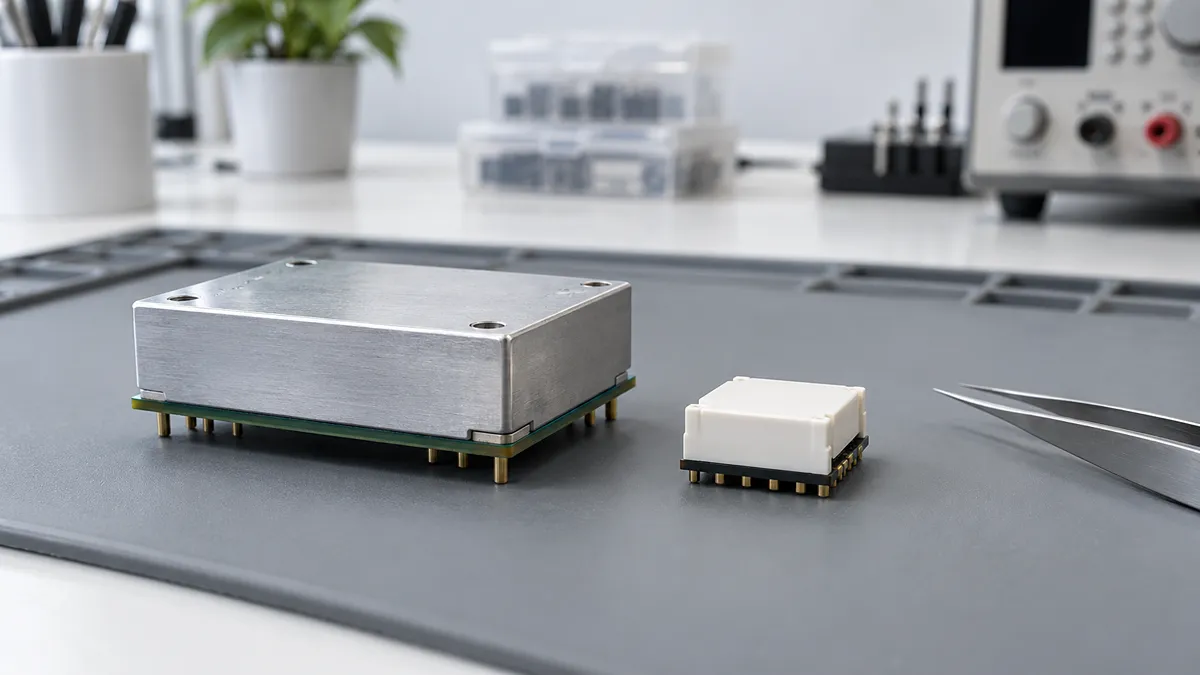
Murata's board-mount DC-DC line is built on the DOSA (Distributed-power Open Standards Alliance) footprint standard: the eighth-brick, quarter-brick, and half-brick pinouts that multiple vendors share. The product mix is deliberately broad, covering intermediate bus converters, isolated regulated bricks, non-isolated point-of-load (PoL) modules, plus specialized lines for medical (IEC 60601) and railway (EN 50155). The design philosophy is standardization and interchangeability. If one DOSA brick goes EOL, a cross-reference part from another vendor drops in.
Vicor takes the opposite bet. Its ChiP package (Converter housed in Package) is a proprietary high-density form factor, not a DOSA footprint. Around it sits the Factorized Power Architecture (FPA), a two-stage approach that splits regulation (PRM) from voltage transformation (VTM current multiplier), which we cover in detail in our Vicor vs. Monolithic Power comparison. The payoff is power density and efficiency that standard bricks cannot match. The price is a single-source form factor with no industry cross-reference.
Where Their Product Lines Actually Overlap
Both Vicor and Murata make board-mount DC-DC converters, but they overlap at specific tiers and diverge everywhere else.
| Product tier | Vicor series | Murata series |
|---|---|---|
| IBC bus converter | BCM | DSQ / DAQ (600 W quarter-brick, DOSA), DSE (400 W eighth-brick) |
| Isolated regulated brick | DCM (ChiP), VI-200 / VI-J00 (classic) | UWE (75–120 W eighth), RBE (240 W), UEE (150 W), ULS (30–100 W) |
| Non-isolated PoL | Vicor non-isolated modules | OKI-78SR, MonoBK, UltraBK |
| Factorized (PRM + VTM) | PRM + VTM | None |
| Medical-grade (IEC 60601) | None | MGFW |
| Railway rugged (EN 50155) | None | IRH (250 W), IRV300 (300 W, 16.8–160 V input) |
At the bus-converter and isolated-brick tiers, both brands compete head-to-head, and the published numbers sharpen the contrast.
Per Vicor's datasheet, the BCM bus converter reaches 98% peak efficiency and 2,750 W/in³ power density at up to 1.75 kW in a 2.2 in² footprint, using its Sine Amplitude Converter (SAC) topology. Per Murata's datasheet, the DSQ delivers 600 W in a DOSA quarter-brick with PMBus digital control, and the MPQ1500 extends to 1,500 W in the same DOSA footprint.
The BCM is a fixed-ratio, unregulated bus converter optimized for density; the DSQ and MPQ1500 are regulated, DOSA-standard, second-sourceable parts. They serve the same system role with opposite priorities: Vicor pushes efficiency and density, Murata pushes standardization and supply flexibility.
Beyond that tier, the overlap disappears. Vicor's factorized line (PRM + VTM) has no Murata equivalent. Murata's medical (MGFW, IEC 60601, 2×MOPP) and railway (IRH/IRV300, EN 50155) lines have no Vicor equivalent. The "which brand is better" question only resolves after you fix the tier your design sits in.
Murata: Strengths and Limits
Medical certification. Murata's MGFW series carries IEC 60601 medical-grade isolation with 2×MOPP. Vicor has no IEC 60601-certified product line; its DCM and BCM are industrial-grade. If your design touches a patient, this is a disqualifier, not a preference. See our medical DC-DC converter guide.
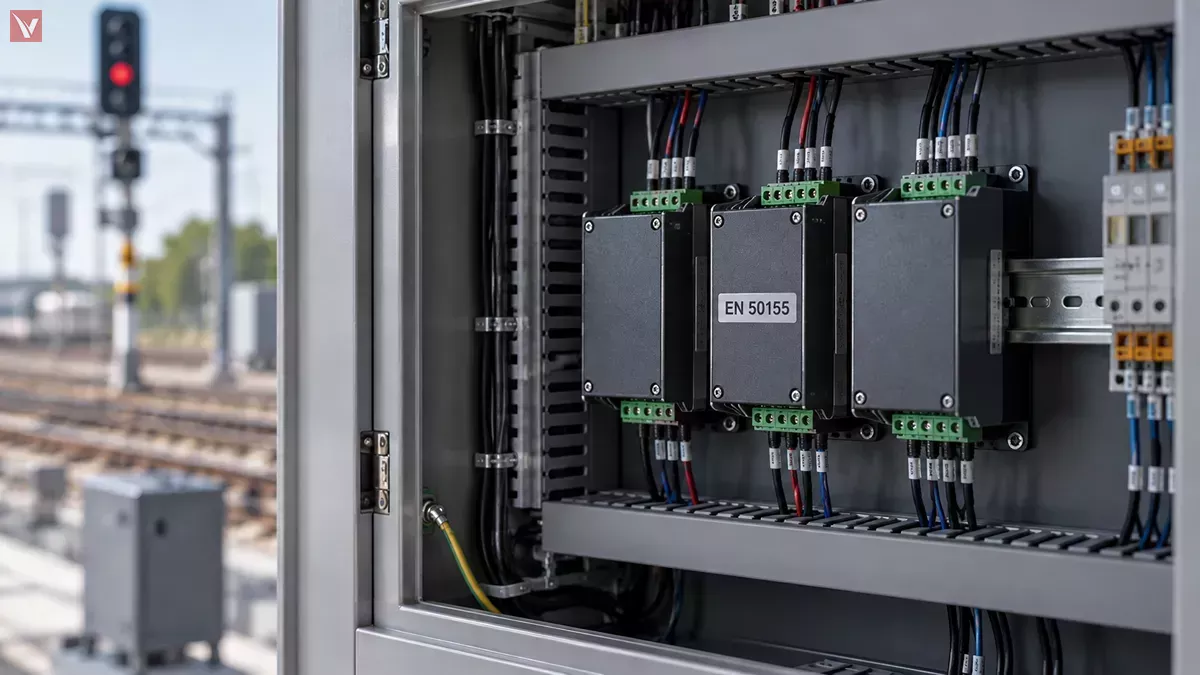
Railway and rugged. Murata's IRH and IRV300 families are purpose-built for EN 50155 railway applications: wide 16.8–160 V input for battery and overhead-line rails, chassis-mount ruggedization, shock and vibration ratings. Vicor has nothing in this lane; its mil-COTS line targets defense, not commercial rail.
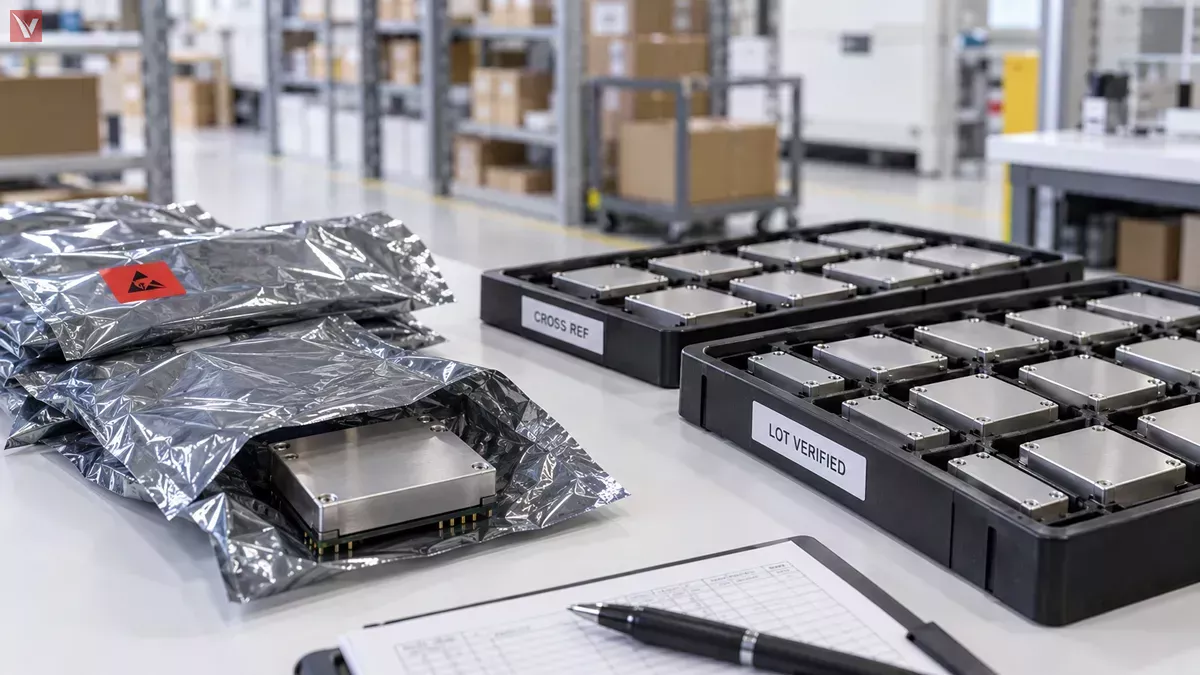
DOSA second-source. Murata bricks follow the DOSA standard pinout, so you can cross-reference to equivalent parts from other DOSA vendors. Murata publishes a DOSA Cross Reference Guide for exactly this purpose. For long-lifecycle industrial and datacom designs, that flexibility often outweighs a density advantage.
Wide power coverage. Murata spans roughly 1 W to 1,500 W across its board-mount families (the MPQ1500 quarter-brick reaches 1,500 W). Below a few watts, Murata is simply the more natural fit.
Limit. Murata has no PoL current multiplier and no factorized architecture. Its AI-data-center narrative stops at the bus-converter and distribution tier; it does not deliver the vertical, sub-1 V high-current path that Vicor's VTM provides. In density-critical, extreme-current designs, Murata tops out where Vicor begins.
Vicor: Strengths and Limits
AI GPU point-of-load. This is Vicor's signature. The FPA splits regulation (PRM) from transformation (VTM current multiplier), and the VTM sits directly under the GPU in Vicor's Vertical Power Delivery (VPD) configuration, the shortest possible current path to a 1,000 A+ load. Per Vicor's published product data, the VTM achieves above 96% efficiency, roughly 5 A/mm² current density, a ~60× current gain, and sub-100 ns transient response. Murata does not make a PoL current multiplier. The full architecture debate is in our Vicor vs. Monolithic Power analysis.
Power density. The ChiP package achieves density that standard DOSA bricks cannot match in the same board area. The DCM3623 delivers 320 W in a 38.7 × 22.8 × 7.2 mm package; the BCM reaches 2,750 W/in³ at 1.75 kW. In space-constrained designs like blade servers and compact industrial enclosures, that density is the deciding factor, not price per watt.
High-current factorized power. The PRM + VTM combination handles high-current, low-voltage delivery that IBA plus discrete PoL struggles to match efficiently. Murata's route is IBA plus multiphase PoL, a valid but different approach.
Defense and mil-COTS. Vicor maintains a dedicated Mil COTS product line. Murata's rugged line targets railway, not military standards.
Limit. ChiP is a single-source form factor with no industry cross-reference. If a board designed around a ChiP module faces EOL or allocation, the exit is a board redesign, not a drop-in substitute. Murata's DOSA standard does not carry that risk.
Matching Application Domain to the Right Brand
Once the product tier is clear, the brand decision is a table lookup by application domain.
| Application domain | Recommended brand | Representative series | Why | Key constraint |
|---|---|---|---|---|
| Medical (patient-connected) | Murata | MGFW | IEC 60601, 2×MOPP; Vicor has no medical line | Patient leakage certification |
| Railway / rugged transport | Murata | IRH / IRV300 | EN 50155, 16.8–160 V input, chassis mount | Shock, vibration, wide input |
| Datacom IBC (bus conversion) | Either | Vicor BCM / Murata DSQ | Both do bus conversion; trade DOSA interchangeability vs. density | Second-source vs. density |
| AI GPU point-of-load | Vicor | PRM + VTM + VPD | FPA current multiplier, vertical delivery; Murata has no equivalent | Current density at 1,000 A+ |
| Defense / Mil COTS | Vicor | Mil COTS DCM / BCM | Dedicated mil line; Murata rugged is rail, not mil | MIL-STD compliance |
| Broad industrial control | Murata | ULS / UWE / OKI | DOSA interchangeability, wide input range, cost | Second-source flexibility |
When both constraints apply (a rugged medical device that also needs high density), the practical answer is to mix by rail: Murata on the patient rail, Vicor on the system rail. The bidirectional DC-DC sourcing logic applies to the integration.
Standardized or Single-Source
The product tables tell you what fits electrically. The procurement table tells you what survives a 10-year production run.
| Procurement dimension | Murata (DOSA standard) | Vicor (proprietary ChiP) |
|---|---|---|
| Second-source availability | High; DOSA pinout shared across vendors | Low; ChiP is a single-source form factor |
| Cross-reference tool | Murata publishes a DOSA Cross Reference Guide | None; no industry cross-reference exists |
| Lead-time risk | Lower; multiple DOSA vendors can substitute | Higher; single manufacturer, no drop-in |
| EOL mitigation | DOSA standard means drop-in alternatives exist | Proprietary form factor means a board redesign if EOL |
| Density trade-off | Standard brick density (lower) | ChiP density (higher); the lock-in premium |
| Best fit | Long-lifecycle, multi-source, cost-sensitive BOMs | Density-critical, performance-first designs |
Vicor's density advantage comes with a form-factor lock-in you accept deliberately. Murata's DOSA standard sacrifices some density for supply flexibility that pays off over a product lifecycle.
VIGORCOMP note: As an independent distributor carrying both Vicor and Murata board-mount lines, we have a fit preference, not a brand preference. For DOSA-standard Murata bricks, we supply second-source cross-references and EOL monitoring from day one. For Vicor ChiP modules, we supply the parts and the selection guidance for density-critical designs. Ask us to map your application to the right brand and series before you lock a footprint.
Conclusion
Murata's DOSA-standard breadth, medical and railway certifications, and second-source flexibility serve long-lifecycle, multi-source, cost-conscious designs. Vicor's proprietary ChiP density, factorized architecture, and vertical power delivery serve performance-critical, density-bound, extreme-current designs. Map your application domain to the product tier, then check the procurement trade-off. If the answer is "both," mix by rail.
For a neutral brand-to-series mapping across Vicor and Murata, with DOSA cross-references and EOL exposure flagged upfront, talk to VIGORCOMP. We carry both lines, so your selection is driven by fit, not by which shelf we stock.