
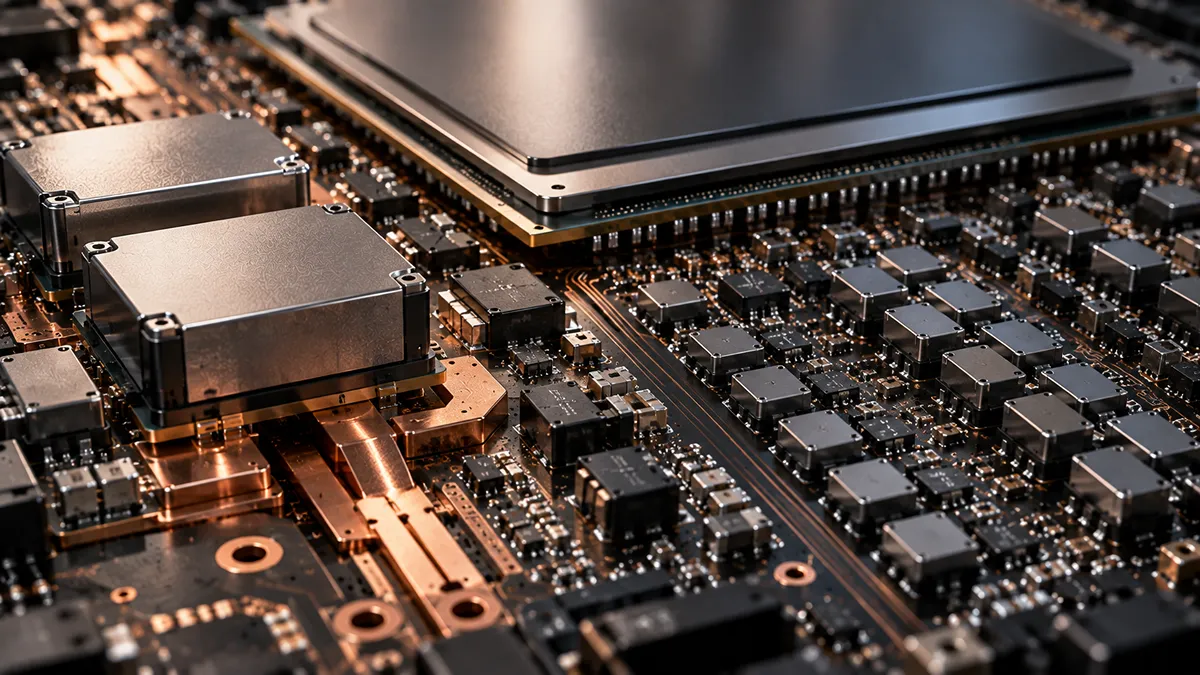
Key Takeaways
- Both Vicor and Monolithic Power Systems (MPS) build 48V power for AI data centers, but their point-of-load (PoL) routes are fundamentally different. Vicor's FPA uses a VTM current multiplier, a fixed-ratio module that delivers large current at the load. MPS uses a digital multiphase controller plus Intelli-Phase DrMOS, monolithic ICs that share current across many small phases.
- This is not an efficiency contest; it is a philosophy clash. Vicor bets on a single high-density module doing the heavy lifting by physics. MPS bets on many small, digitally-controlled ICs sharing the load by software. Industry analysis frames it as "specialized vs. versatile."
- The ~1,000 A mark is the watershed. Below it, MPS multiphase is more flexible and programmable. At and above it, Vicor's VTM plus Vertical Power Delivery (VPD) pulls ahead on current density and board area.
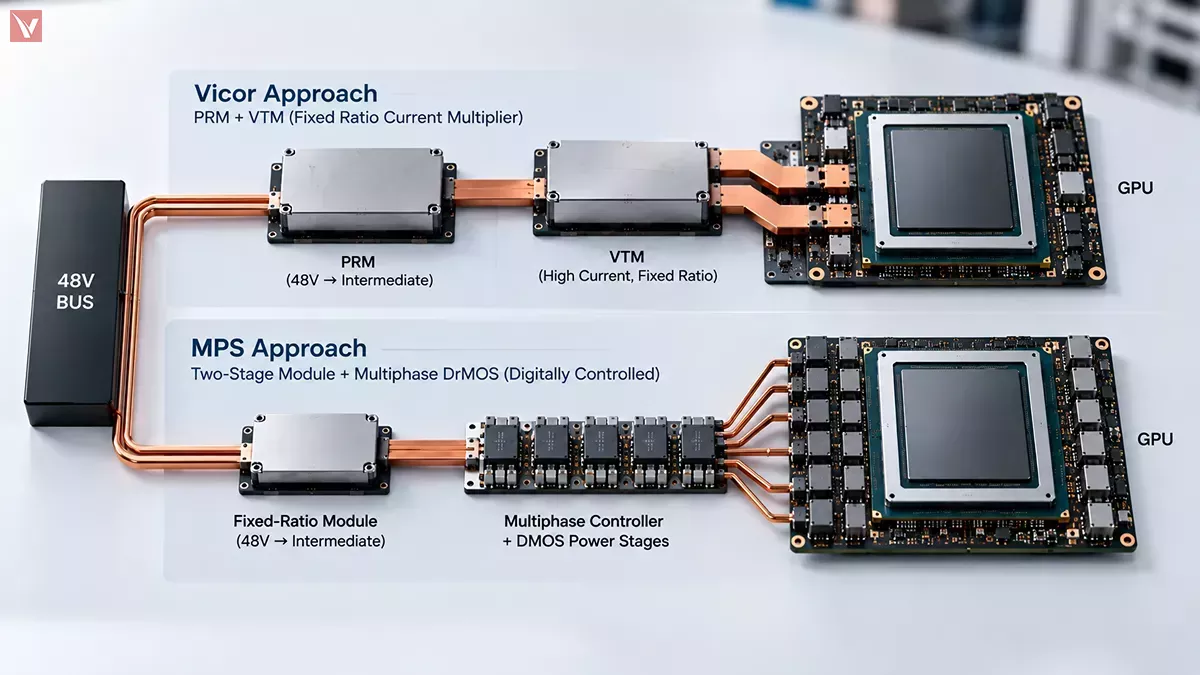
- The two architectures agree on stage one. Both use a fixed-ratio module to step 48V down to an intermediate bus; Vicor's BCM and MPS's MPC series are conceptually close. The real split is at stage two: how current reaches the GPU.
- Below an architecture-level comparison, the PoL philosophy clash at the physics level, a current-scaling threshold table, and a selection framework for your 48V build.
Why 48V Became the AI Power Battleground
The 48V-vs-12V argument is settled physics: at the same power, 48V carries a quarter of the current, so I²R distribution losses drop to a sixteenth. We cover the conversion fundamentals in our 48V-to-12V guide. The short version is that 48V won the rack.
What changed the game is AI. A single GPU like the NVIDIA H100 (SXM5) draws roughly 700 W; the next generation pushes past 1,000 W. A rack full of them pulls over 100 kW. At those currents, 12V distribution is physically over: the bus bars and connectors cannot carry the load without unacceptable loss. The Open Compute Project's Open Rack V3 standard codified 48V as the rack distribution voltage.
But 48V at the rack is not 1V at the GPU. The open question is how you get there, and that is where Vicor and MPS diverge. Both accept 48V as the input. They disagree on what sits between 48V and the processor die.
Vicor: FPA and the Current Multiplier
Vicor's answer is the Factorized Power Architecture (FPA), a patented approach that splits traditional DC-DC conversion into two independent functions.
The PRM (Pre-Regulation Module) does buck-boost regulation on the high-voltage side, stabilizing the 48V bus. The VTM (Voltage Transformation Module), also called the current multiplier, does fixed-ratio voltage transformation and current multiplication at the point of load. It does not regulate; it transforms. The ratio is fixed by the turns ratio of its SAC (Sine Amplitude Converter) topology, which uses zero-voltage switching (ZVS). Per Vicor's published product data, the VTM achieves efficiency above 96%, current density around 5 A/mm², a current gain of roughly 60×, and transient response under 100 ns, fast enough that it does not need a digital control loop.
The VTM is packaged in the proprietary ChiP form factor, the same high-density package used across Vicor's board-mount line. For the highest-current GPUs, Vicor stacks the VTM directly beneath the processor in a Vertical Power Delivery (VPD) configuration, making the current path from converter to die as short as physically possible. Industry reporting (Nexan Insights, "The Data Center Power Battle") places Vicor at roughly 80% of Microsoft's AI server power share. That is a strong market signal, though it reflects one hyperscaler's design choice, not a universal verdict.
MPS: Two-Stage Modules and Multiphase DrMOS
Monolithic Power takes a different architectural path to the same 48V-to-PoL problem, built on standard IC process rather than proprietary power modules.
Stage one is a fixed-ratio digital power module, the MPC series, that steps 48V down to an intermediate bus. Per MPS's 48V data center solution documentation, the lineup includes the MPC1100C-54 (10:1 ratio, 300 W), MPC10106 (8:1, 500 W), and MPC12106 (4:1, 800 W). Conceptually, these are close to Vicor's BCM bus converter; both camps agree that a fixed-ratio module is the right first stage.
Stage two is where the philosophies split. MPS does not use a current-multiplier module. Instead, it deploys a digital multiphase controller driving Intelli-Phase DrMOS, monolithic ICs that integrate the controller, driver, and MOSFETs in a single package, rated to 90 A per phase. For higher currents, the Intelli-Module extends that to 170 A per device. The controller manages phase interleaving, current sharing, and transient response in firmware, so the PoL is digitally tunable, not fixed by a turns ratio.
MPS positions its approach as integrated, programmable, and versatile, built on standard silicon processes that scale with semiconductor economics. For sub-1,000 A loads, it offers a "Lateral" deployment with modules and ICs spread laterally on the board. Above 1,000 A, it offers "Z-Axis Power Delivery," a vertical stacking approach that competes directly with Vicor's VPD.
Module vs. Monolithic IC
The clash is not about efficiency percentages. It is about two fundamentally different ways to deliver large current.
Vicor's VTM is a fixed-ratio module. It transforms voltage and multiplies current by the physics of its SAC transformer, with no digital control loop and no per-phase PWM. Transient response comes from the ZVS soft-switching and a large output capacitance built into the module. You get extreme current density in a single package, but the output voltage is fixed by the turns ratio. If the load voltage changes, you change the module.
MPS's multiphase approach distributes the current across many small ICs, each with its own PWM control. The controller adjusts phase count, duty cycle, and current sharing in real time. You get programmability: the same hardware can serve different load voltages. But the current density per device is lower, and managing phase balance at extreme currents adds control complexity.
The Nexan Insights analysis frames this as "specialized vs. versatile." Vicor is a purpose-built, fixed-ratio current multiplier optimized for one job. MPS is a general-purpose, digitally-tunable multiphase platform that can serve many loads. The trade-off is physical simplicity and density (Vicor) against digital flexibility and software control (MPS). The winner is determined by the load current profile and how much you value programmability.
VPD vs. Z-Axis Power Delivery when Scaling Past 1000A
As GPU currents climb past 1,000 A, both architectures have a vertical-delivery answer, but they enter that regime at different points and with different maturity.
| Load current | Vicor approach | MPS approach | Advantage | Why |
|---|---|---|---|---|
| < 500 A | VTM (lateral) | Lateral multiphase DrMOS (≤90 A/phase) | MPS | Digital programmability, per-phase tuning, standard IC supply chain |
| 500–1,000 A | VTM (lateral / VPD) | Lateral multiphase (many phases) | Contested | Both viable; Vicor on density, MPS on flexibility |
| > 1,000 A | VTM + VPD (vertical) | Z-Axis Power Delivery (Intelli-Module, ≤170 A) | Vicor | VPD current density at extreme currents; MPS Z-Axis adds stacking complexity |
The threshold is not a hard line. It is where the density advantage of a fixed-ratio module begins to outweigh the flexibility advantage of a multiphase IC array. Below 1,000 A, the ability to reprogram a multiphase controller for a different GPU voltage is a genuine design advantage. Above it, the board area and interconnect losses of many phases erode that advantage, and the vertical current-multiplier module pulls ahead.
Which Route Fits Your 48V Build
The selection framework below distills the architecture decision into the dimensions that actually matter.
| Selection dimension | Vicor FPA (VTM + VPD) | MPS multiphase (DrMOS) | Hybrid |
|---|---|---|---|
| Load current | > 1,000 A | < 1,000 A | 500–1,500 A |
| Programmability need | Low (fixed ratio) | High (digital tunable) | Medium |
| Transient response | SAC + output cap (passive, fast) | Digital multiphase (active control) | N/A |
| Density priority | Highest (VPD vertical) | High (IC integration) | N/A |
| Supply-chain flexibility | Low (proprietary module) | High (standard IC process) | Medium |
| Single-source acceptance | Accepted | Avoided | N/A |
If your GPU current is below ~1,000 A and you want to reprogram the PoL for multiple load voltages on one board, MPS's multiphase platform is the more flexible route. If your current is above ~1,000 A and density is the overriding constraint, Vicor's VTM plus VPD is the stronger physical solution. For the contested middle, a hybrid approach, Vicor for the high-current rails and MPS for the programmable rails, is a legitimate architecture that a distributor carrying both lines can support without bias.
VIGORCOMP note: As an independent distributor carrying both Vicor and Monolithic Power, we do not pick a side in the architecture debate; we pick a fit. For Vicor FPA and ChiP modules, we supply the parts and the density-critical selection guidance. For MPS multiphase controllers and Intelli-Phase ICs, we supply the programmable-platform alternative and the standard-IC supply chain. Ask us to map your GPU current profile and programmability needs to the right route before you commit to an architecture.
Conclusion
The 48V data center is settled; the point-of-load architecture is not. Vicor and Monolithic Power represent two coherent but opposing bets: Vicor delivers extreme current through a fixed-ratio current-multiplier module, betting on physics and density. MPS delivers it through a digitally-controlled multiphase IC array, betting on programmability and semiconductor economics. The ~1,000 A mark is where the trade-off flips. Below it, flexibility has the edge; above it, density has the edge. For most real GPU designs, the answer is not "which is better" but "which constraint am I designing against?"
If you want a neutral architecture mapping across Vicor and MPS, with the current-scaling thresholds and supply-chain trade-offs laid out honestly, talk to VIGORCOMP. We carry both lines, so your architecture is driven by your load profile, not by which vendor's shelf we stock.