
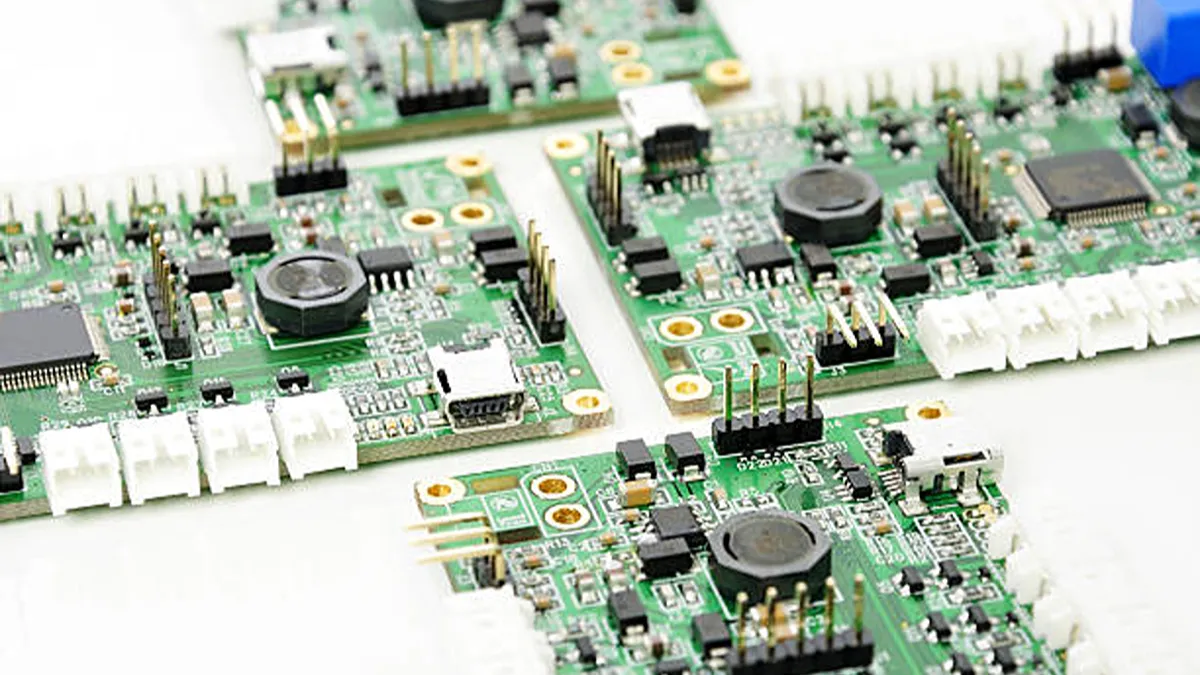
A datasheet gives you the input range, output voltage, efficiency curve, and isolation rating. What it rarely covers is which module family fits your application, how thermal behavior changes once the module sits on your board, which safety certifications actually apply, and what happens when the part you specified goes end of life. This guide closes those gaps, from form factor and isolation to power matching and sourcing, using real board mount modules from Vicor, Cosel, and other manufacturers.
What Are Board Mount Modules?
Board mount modules are power converters designed to solder directly onto a printed circuit board. Unlike enclosed or open-frame supplies that sit as standalone units inside a chassis, these modules integrate into your PCB layout and depend on the surrounding board for thermal management, input filtering, and output regulation.
The category covers three families:
- DC-DC converters step down, step up, or isolate a DC rail
- AC-DC converters rectify mains AC into isolated DC output
- LED drivers deliver constant current for solid-state lighting
What distinguishes board mount modules is the division of responsibility. The module handles conversion and isolation. Everything else, including input protection, bulk capacitance, EMI filtering, and the thermal path, lives on your board. This division gives you control over form factor and compliance, but it also means the datasheet alone cannot answer every design question.
If you are new to DC-DC fundamentals, our guide to DC converter basics covers the underlying concepts.
Which Board-Mount Module Type Fits Your Design?
The three families serve different input sources and output requirements. Choosing the wrong family early forces a redesign later.
| Parameter | DC-DC | AC-DC | LED Driver |
|---|---|---|---|
| Input source | DC rail (5V to 400V) | AC mains (85 to 305 VAC) | AC or DC |
| Typical output | Regulated DC (1V to 48V) | Isolated DC (3.3V to 48V) | Constant current |
| Isolation | Optional (isolated or non-isolated) | Always isolated | Often isolated |
| Power range | 1W to 600W+ | 3W to 300W+ | 3W to 300W |
| Typical use | Point-of-load regulation, intermediate bus | Direct mains-to-DC on custom board | Solid-state lighting |
For DC-DC, the Vicor V24C24T50BN accepts 18 to 36V input and delivers 24V at 2.08A (50W). At the higher end, the Vicor DCM3623T50T31A6T70 takes 9 to 50V input and outputs 28V at 5.8A (162W) using Vicor's ChiP packaging technology. For low-power signal isolation, the Cosel MGFW152405-R provides dual ±5V output at 1.5A (15W) from a 9 to 36V input.
The key decision is input source. If your board already has a DC rail, an AC-DC module adds unnecessary conversion stages. If you need to come off mains AC without a separate enclosed supply, a board-mount AC-DC module eliminates the external adapter. Our overview of DC converter types breaks down each family in more detail.
What Footprint Do You Need?
Brick footprints are standardized dimensions defined by the Distributed-power Open Standards Alliance (DOSA). They let you swap modules across manufacturers without redesigning the board layout.
| Footprint | Dimensions (in) | Dimensions (mm) | Typical Power Range |
|---|---|---|---|
| Full brick | 4.6 × 2.4 | 116.8 × 61.0 | 300 to 700W+ |
| Half brick | 2.4 × 2.3 | 61.0 × 57.9 | 150 to 300W |
| Quarter brick | 2.3 × 1.45 | 58.4 × 36.8 | 50 to 150W |
| Eighth brick | 2.3 × 0.90 | 58.4 × 22.9 | 25 to 100W |
| Sixteenth brick | 1.30 × 0.90 | 33.0 × 22.9 | 10 to 50W |
The Vicor V24C24T50BN measures 2.28 × 1.45 × 0.5 inches (57.9 × 36.8 × 12.7 mm), matching the quarter-brick footprint. The Cosel MGFW152405-R comes in a 6-DIP package at 1.00 × 1.00 × 0.39 inches (25.4 × 25.4 × 9.9 mm), smaller than a sixteenth brick. As power increases, thermal dissipation requires more surface area or baseplate contact, driving the need for a larger footprint.
Most brick modules use through-hole pins for mechanical stability and current capacity. Vicor offers both mounting options: the InMate design guide covers through-hole socketing, while the SurfMate design guide addresses surface-mount attachment. For engineers researching how to connect a surface-mount module to a board, the critical factors are copper pad layout, thermal via placement under the module, and matching the reflow soldering profile to the manufacturer's recommended peak temperature. Surface-mount modules save board space but demand more from the PCB design: sufficient copper pour on inner layers for heat spreading and a reflow profile that does not exceed the module's temperature rating.
DOSA compatibility ensures pin-to-pin interchangeability within a given brick size. Always verify that the replacement module's pinout matches, because DOSA defines the footprint dimensions, not every pin function.
How Much Isolation Do You Need, and Which Certifications Apply?
Isolation determines whether the output can safely float relative to the input. The datasheet gives a number, typically 1,500 VAC for one minute. That number alone does not tell you which safety standard applies or whether it is sufficient for your application.
Isolation levels:
| Level | Typical Rating | Protection |
|---|---|---|
| Functional | 1,000 to 1,500 VAC | No safety function, same-circuit isolation |
| Basic | 1,500 VAC | One level of protection, requires supplementary insulation |
| Reinforced | 3,000 to 4,000 VAC | Equivalent to two levels of protection in one barrier |
Certification by application:
| Standard | Scope | Applies To |
|---|---|---|
| IEC/UL 62368-1 | Hazard-based safety for IT and audio/video equipment | Industrial, telecom, computing |
| IEC 60601-1 | Medical electrical equipment | Patient-connected equipment (2×MOPP) |
| EN 55032 | EMC emissions (Class A industrial, Class B residential) | All equipment with clocked circuitry |
The Vicor V24C24T50BN carries UL 62368-1, CSA 62368-1, EN 62368-1, and IEC 62368-1 safety approvals, making it suitable for industrial and telecom applications. The Cosel MGFW152405-R provides 1.5 kV isolation with an efficiency of 84%, rated for ITE commercial applications per its datasheet.
The distinction between standards matters. A module rated for IEC 62368-1 may pass basic isolation but not meet the 2×MOPP barrier required for patient-contact medical devices. If your application involves patient connections, look specifically for IEC 60601-1 certification, not just a high isolation voltage number. Our medical DC-DC converter selection guide covers the 60601-1 requirements in more detail.
EMC compliance is another area where the datasheet can mislead. Some modules list Class B compliance but achieve it only with a specific external filter circuit shown in the application notes. Changing the external component values shifts the result to Class A or narrows the ambient operating range. Always check the recommended application circuit, not just the headline claim.
How Do You Match Power and Thermal Requirements to a Module?
Selecting by rated output power without considering the thermal environment is the most common mistake. A module rated 100W at 25°C ambient may deliver only 60W at 85°C without forced air. The derating curve in the datasheet, usually a graph of available output power versus ambient temperature, tells the real story.
Topology selection by power level:
| Power Range | Common Topology | Why |
|---|---|---|
| Up to 10W | Buck, flyback | Simple, low component count, cost-effective |
| 10 to 100W | Forward, active-clamp forward | Higher efficiency than flyback, manageable EMI |
| Above 100W | Half-bridge, full-bridge, LLC resonant | High efficiency, soft switching (ZVS/ZCS) |
Vicor's DCM modules use zero-voltage and zero-current switching (ZVS-ZCS) to maintain high efficiency at 162W. The Cosel MGFW152405-R reaches 84% efficiency at 15W in a DIP package. Higher efficiency means less heat to dissipate, which directly reduces the thermal management burden.
Thermal management follows three paths:
- PCB copper spreading. The module dissipates heat through its pins into the board. This requires sufficient copper pour and thermal vias. Best for modules up to approximately 50W.
- Baseplate cooling. The module's baseplate contacts a heatsink or cold plate. Common for half-brick and full-brick modules at 100W and above. Vicor's ChiP packaging provides low thermal resistance from both top and bottom surfaces.
- Forced air. Fans supplement either method. Required when ambient temperature exceeds the natural-convection derating knee.
Check the θJA (junction-to-ambient thermal resistance) in the datasheet. A lower θJA means the module sheds heat more effectively, but the actual thermal resistance in your design depends on your board's copper area, layer count, and airflow, not the module alone. Vicor publishes a dedicated thermal considerations application note for its Maxi, Mini, and Micro families that walks through derating calculations with real test data.
How Do You Actually Source Board Mount Modules?
Datasheets and selection guides cover electrical and mechanical specifications. They do not cover availability, lead time, or what happens when a part goes end of life. These are the gaps that a distributor fills.
Stock visibility and lead time
Vicor's product page for the V24C24T50BN currently lists a 30-week lead time with zero stock across Arrow, Avnet, Digi-Key, and Mouser. Cosel's standard lead time for the MGFW152405-R is 6 weeks per Digi-Key. The difference between "in stock today" and "30 weeks out" determines whether your project ships on schedule or stalls. A distributor with real-time inventory data across multiple suppliers can show you what is available immediately versus what requires a production allocation.
Allocation and shortage response
During supply constraints, manufacturers allocate stock to their largest customers first. Independent distributors access inventory across multiple channels and regions, which reduces the risk of a single allocation cut blocking your production line.
End of life and pin-compatible replacements
Board-mount modules often have production lifecycles of 10+ years, but manufacturers do issue EOL notices. When a part is discontinued, you need a pin-compatible drop-in replacement or a cross-reference to an equivalent module. Cross-referencing requires matching these parameters:
| Parameter | Why It Matters |
|---|---|
| Input voltage range | Must cover your rail's tolerance band |
| Output voltage and current | Must meet or exceed the load requirement |
| Isolation voltage | Must match or exceed the original for safety compliance |
| Footprint and pinout | Must be pin-compatible for drop-in replacement without board redesign |
| Safety certifications | Replacement must carry the same approvals (UL, IEC 60601-1, etc.) |
A distributor maintains cross-reference databases that map equivalent modules across Vicor, Murata, Cosel, TI, and other manufacturers. This saves engineering teams from manually comparing datasheets when a part goes EOL.
BOM consolidation and small-batch to production
A distributor can consolidate BOM sourcing. You send a bill of materials, they quote the complete power section, including the module, capacitors, and protection components. This simplifies procurement from multiple vendors into a single purchase order, from samples for prototype through production volumes.
For sourcing options across global suppliers, our bidirectional DC-DC converter supplier overview covers the distributor landscape in more detail.
Conclusion
Board-mount modules give you control over power conversion, isolation, and thermal design. But the datasheet alone does not cover the decisions that shape your build. Footprint standardization, certification tiers, derating behavior, and sourcing strategy all determine whether your selection holds up from prototype through production.
At VIGOR COMPONENTS, we stock board-mount modules from Vicor, Cosel, Murata, TI, and other leading manufacturers. Our team helps engineers and procurement teams cross-reference alternatives, verify availability, and consolidate BOM sourcing from samples to production volumes.
Need help selecting or sourcing board-mount modules? Contact us to discuss your requirements.