
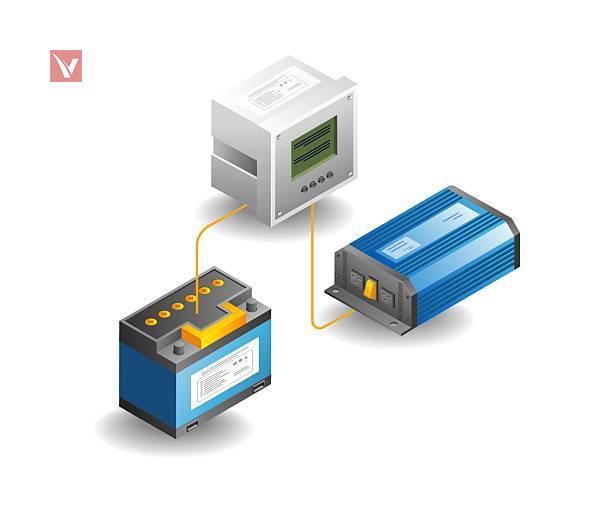
If you’ve ever wondered what is a DC converter, you’re not alone. Whether you’re an engineer designing power circuits, a procurement specialist sourcing components, or just someone curious about how your phone charger works, understanding DC converters is essential in today’s electronics-driven world.
What is a DC to DC Converter
-
A 12V battery might need to power a 5V USB device → you need dc to dc conversion.
-
An electric vehicle’s high-voltage pack (400V) must power low-voltage electronics (12V) → again, a DC converter is essential.
-
Power supplies for computers and servers
-
Battery chargers for laptops and smartphones
-
Electric vehicles (EVs) for high-to-low voltage conversion
-
Renewable energy systems like solar inverters and wind turbines
Without them, our modern electronics would be far less efficient, bulkier, and shorter-lived.
How Switched-Mode Power Supplies Regulate Voltage Efficiently
-
Switching element (usually a MOSFET) turns on and off rapidly (tens of kHz to several MHz).
-
Energy storage components (inductors and capacitors) smooth the pulsed energy into stable DC.
-
Feedback loop monitors output voltage and adjusts the duty cycle in real time.
-
Result: High efficiency (often 85–95%), low heat, and compact size.
Comparing Core DC/DC Converter Topologies
Isolated Topologies
-
Safety: Critical for medical devices and industrial equipment
-
Voltage flexibility: Can step up or step down dramatically
-
Noise immunity: Better isolation from ground loops
-
Flyback
-
Forward
-
Push-pull
-
Full-bridge
Non-isolated Topologies
-
Buck (step-down)
-
Boost (step-up)
-
Buck-Boost (bidirectional)
-
SEPIC (single-ended primary-inductor converter)
| Feature | Isolated | Non-isolated |
|---|---|---|
| Electrical Isolation | Yes (via transformer) | No |
| Efficiency | 80–90% | 85–95% |
| Cost | Higher | Lower |
| Typical Use | Medical, industrial, EVs | Consumer electronics, IoT |
Want to dive deeper into the full spectrum of types of DC/DC converters? Check out our detailed guide on topology selection for your next design.
Real World Applications in EVs and Renewable Energy Systems
DC converters aren’t just lab curiosities—they’re the unsung heroes powering today’s green revolution.
Electric Vehicles (EVs)
In an EV, the main battery pack runs at 400V or even 800V. But the car’s infotainment, lights, sensors, and ECUs need 12V or 48V. That’s where high-power DC/DC converters come in.
-
Data point: A typical EV uses a 3kW DC/DC converter to step down 400V to 12V .
-
Efficiency matters: Every 1% gain in converter efficiency translates to ~0.5% more driving range.
-
Thermal challenge: These converters must operate reliably at 85°C+ ambient temperatures.
Renewable Energy Systems
-
Photovoltaic systems use MPPT (Maximum Power Point Tracking) DC/DC converters to extract maximum energy from solar cells.
-
Battery storage systems rely on bidirectional DC/DC converters to charge and discharge efficiently.
-
Real-world stat: A 10kW solar inverter typically includes a DC/DC stage with >97% efficiency .
Overcoming Critical Thermal and EMI Design Challenges
Thermal Management
-
Hot spots in MOSFETs and inductors can cause thermal runaway.
-
Solution: Use thermal vias in PCB layout, oversized copper planes, and proper heatsinking.
-
Pro tip: Place high-current components near the board edge for better airflow.
EMI Suppression
-
Rapid switching creates high-frequency noise that can disrupt nearby circuits.
-
Solution:
-
Add snubber circuits across switching nodes
-
Use shielded inductors
-
Minimize loop areas in high-current paths
-
Implement grounded copper pours around sensitive nodes
-
Key Parameters for Choosing the Right Converter Components
-
Input voltage range: Must cover your worst-case supply (e.g., battery discharge curve)
-
Output voltage accuracy: Typically ±1% to ±5%, critical for sensitive loads
-
Efficiency at load: Check efficiency curves at 25%, 50%, and 100% load
-
Switching frequency: Higher frequency = smaller components but more EMI
-
Thermal resistance (θJA): Determines how well the package dissipates heat
-
Protection features: Over-current, over-voltage, thermal shutdown
-
Package type: QFN, SOP, BGA—impacts PCB layout and thermal performance
-
Lead time and availability: Critical for mass production
| Parameter | Why It Matters | Typical Target |
|---|---|---|
| Efficiency | Reduces heat, extends battery life | ≥90% |
| Output ripple | Affects noise-sensitive circuits | <50mV p-p |
| Operating temp | Reliability in harsh environments | -40°C to +125°C |
Getting these parameters right early saves weeks of redesign and avoids costly production delays.
Partnering with Vigorcomp for Reliable Global Component Sourcing
Why partners choose Vigorcomp
-
Global inventory: Access to millions of SKUs across 150M+ product pages
-
Shortage relief: Real-time allocation support for critical components
-
Verified suppliers: All parts are 100% original and traceable
-
Fast shipping: Same-day dispatch for in-stock items
-
Dedicated support: Dedicated account managers for B2B clients