
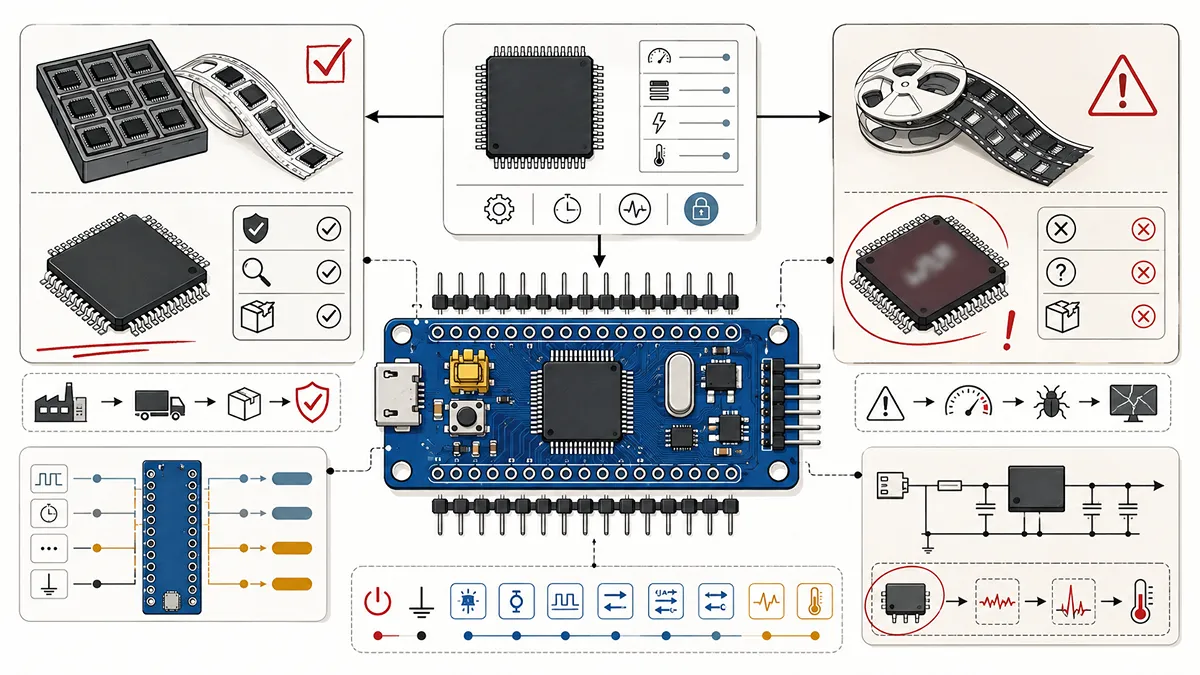
The STM32F103C8T6 microcontroller has long been a staple in embedded systems, widely recognized for powering the popular "Blue Pill" development board. For engineers and hardware designers, this 32-bit ARM Cortex-M3 MCU offers a compelling balance of performance, peripheral density, and cost-effectiveness. However, navigating the ecosystem involves more than just writing code. Transitioning from prototyping on a Blue Pill to mass production requires a deep understanding of the chip's core capabilities, physical layout, debugging nuances, and—crucially—the ability to source authentic components in a market flooded with counterfeits. This guide breaks down the technical specifications of the STM32F103C8T6, explains its implementation on the Blue Pill, and provides actionable advice for B2B procurement and quality control.
What is the STM32F103C8T6 Blue Pill?
The "Blue Pill" is a low-cost, minimal system development board built around the STM32F103C8T6 microcontroller. It was designed to provide an accessible platform for evaluating the capabilities of the STMicroelectronics MCU without the overhead of more expensive evaluation kits. The board bridges the gap between raw silicon and a usable development environment by breaking out all the necessary pins and including essential external components like a crystal oscillator, a voltage regulator, and a USB interface.
While hobbyists use the Blue Pill as an Arduino alternative, professional engineers use it as a rapid prototyping tool to test firmware and hardware interfaces before designing custom PCBs. It is important to distinguish the board from the chip: the Blue Pill is merely a carrier, while the STM32F103C8T6 is the industrial-grade brain that can be integrated into diverse applications ranging from motor control to IoT gateways. Understanding this distinction is the first step toward scaling your design from a prototype to a commercial product.
STM32F103C8T6 Microcontroller Core Specifications
At the heart of the system is the STM32F103C8T6, a versatile 32-bit MCU based on the ARM Cortex-M3 architecture. It operates at a maximum clock frequency of 72 MHz, delivering robust processing power for complex calculations and real-time control. This performance makes it highly suitable for industrial automation and smart home devices where timing and reliability are critical.
Memory is a key consideration for firmware developers; this chip features 64 KB of Flash memory for code storage and 20 KB of SRAM for data manipulation. It operates within a standard voltage range of 2.0V to 3.6V and is rated for an industrial temperature range of -40°C to +85°C. Additionally, the MCU is packed with communication interfaces, including three USARTs, two SPIs, two I2C buses, and a CAN interface, alongside two 12-bit ADCs for analog sensor integration.
Blue Pill Hardware Layout Explanation
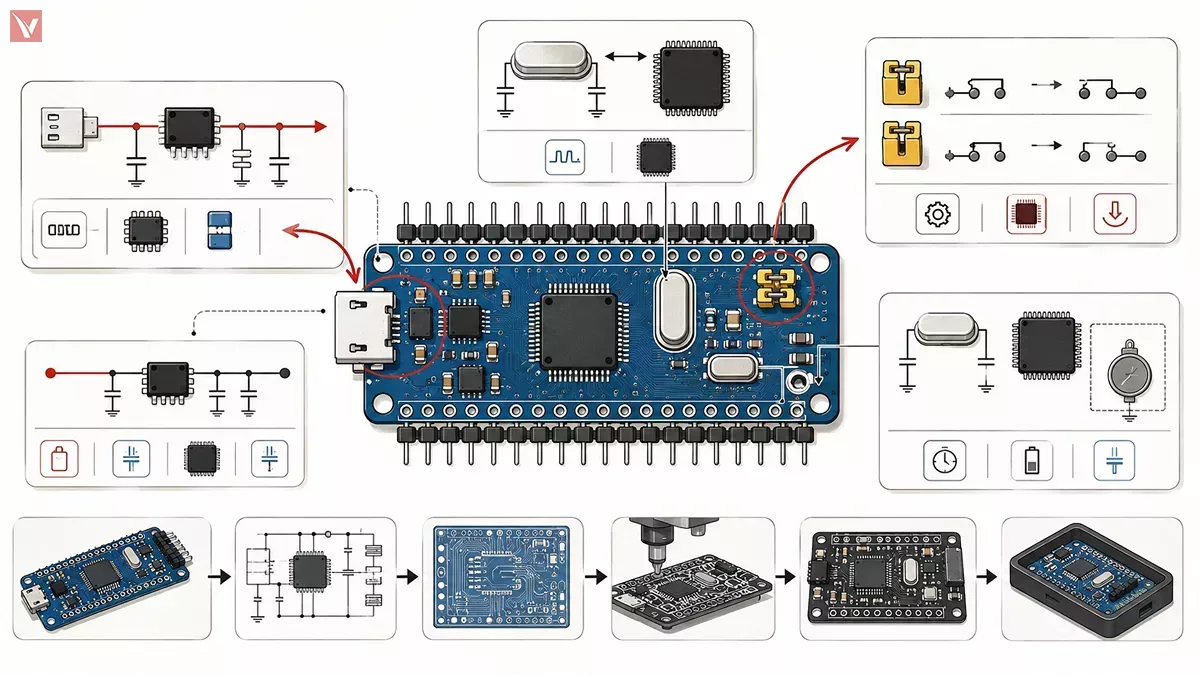
The Blue Pill board is engineered to be as compact as possible while still offering access to the MCU's features. The layout is dominated by the centrally placed STM32F103C8T6 chip, surrounded by two rows of header pins that make it breadboard-friendly. At one end, a Micro-USB or Type-C port is provided for power and USB communication, though it cannot be directly used for programming without a specific bootloader installed.
Key support components on the board include an 8 MHz crystal oscillator for the main system clock and a 32.768 kHz RTC (Real-Time Clock) crystal. The board also features a 3.3V voltage regulator (commonly the RT9193 or AMS1117-3.3) that steps down the 5V input from the USB to the 3.3V required by the MCU. Additionally, there are two physical jumpers (BOOT0 and BOOT1) used to select the boot mode, allowing the user to dictate whether the chip boots from main Flash memory, system memory, or SRAM.
STM32F103C8T6 Pinout Configuration
The STM32F103C8T6 utilizes an LQFP-48 package, translating to 48 physical pins that must be meticulously managed during hardware design. Unlike simpler 8-bit microcontrollers, this ARM Cortex-M3 chip relies heavily on an Alternate Function I/O (AFIO) matrix, meaning a single physical pin can be multiplexed to serve multiple hardware peripherals.
To properly integrate this MCU into a custom PCB or utilize it on the Blue Pill, engineers must understand its specific pin groupings:
- Power Domain Pins: The chip requires a stable power supply across multiple pins, including VDD (2.0V–3.6V standard logic), VDDA (analog reference for ADCs), and VSS (Ground). It also features a dedicated VBAT pin, allowing designers to connect a coin cell battery to keep the internal Real-Time Clock (RTC) and backup registers running when main power is removed.
- 5V Tolerant GPIOs: A critical advantage of the STM32F103C8T6 in industrial design is that many of its GPIOs are 5V tolerant, despite the core running at 3.3V. Pins such as PB6 and PB7 (often used for I2C) or PA9 and PA10 (USART1) can directly interface with legacy 5V logic sensors without requiring level shifters.
- Analog and Communication Pins: The 12-bit ADC channels are mapped to PA0 through PA7. For high-speed SPI communication, PA4 to PA7 (SPI1) are typically utilized.
On the Blue Pill board, these 48 pins are routed to two parallel 20-pin headers. When transitioning from the Blue Pill to a custom schematic, hardware designers must consult the datasheet's AFIO mapping to avoid peripheral conflicts, ensuring that selected UART, I2C, and PWM signals do not overlap on the same physical pins.
ST-Link V2 Debugger Connection Guide
While the STM32F103C8T6 can be flashed via UART using its internal bootloader, professional development mandates the use of an ST-Link V2 debugger. This tool leverages the ARM CoreSight Serial Wire Debug (SWD) protocol, which requires only two data pins compared to the bulky 5-pin JTAG standard, thereby freeing up valuable GPIOs for your application.
For a reliable connection between the ST-Link V2 and the Blue Pill's dedicated SWD header, the wiring configuration is strictly defined:
| ST-Link V2 Pin | STM32F103C8T6 Pin | Description |
|---|---|---|
| 3.3V | 3.3V Header Pin | Provides 3.3V logic power to the MCU. |
| GND | GND | Common ground reference. |
| SWDIO | PA13 | Serial Wire Data Input/Output for data transfer. |
| SWCLK | PA14 | Serial Wire Clock for synchronization. |
Advanced Debugging & Troubleshooting:
A common pitfall engineers encounter is the "Target not found" error during flashing. This typically occurs if the flashed firmware accidentally reconfigures PA13 and PA14 as standard GPIOs, or if the MCU enters a deep sleep state, effectively locking out the SWD interface.
To recover a locked STM32F103C8T6, you must utilize the "Connect Under Reset" technique. This involves physically holding the reset button on the Blue Pill (or grounding the NRST pin) while initiating the flash sequence in your IDE, releasing it exactly as the ST-Link attempts the connection. Additionally, from a hardware protection standpoint, never power the Blue Pill via its USB port (5V) and the ST-Link (3.3V) simultaneously, as the voltage differential can destroy the board's onboard regulator.
Identifying Counterfeit STM32F103C8T6 Chips
A significant challenge in the current supply chain is the proliferation of counterfeit or clone STM32F103C8T6 chips, often found on ultra-cheap Blue Pill boards purchased from unverified marketplaces. These clones—such as the CS32F103C8T6 or GD32F103C8T6—are designed to mimic the STMicroelectronics part but often fail under specific operating conditions, leading to random crashes, incompatible USB behavior, or ADC inaccuracies.
Visual inspection can sometimes reveal a fake: authentic ST chips have sharp, laser-etched markings with a specific font and a distinct indentation at pin 1. Fakes often feature blurry text or incorrect ST logos. Functionally, you can use the ST-Link Utility or STM32CubeProgrammer to check the chip's Device ID signature; a genuine STM32F103C8T6 will report an ID of 0x410. Furthermore, many clones incorrectly report 128 KB of Flash memory instead of the official 64 KB.
Common Blue Pill Operational Issues
When working with Blue Pill boards, engineers frequently encounter a few notorious hardware quirks. One prevalent issue is related to the onboard 3.3V voltage regulator. Many generic boards use substandard regulators that cannot handle sudden current spikes, leading to "brown-out" resets when attaching power-hungry peripherals.
Another common problem involves the USB interface. The STM32F103C8T6 requires a 1.5k ohm pull-up resistor on the USB D+ line (pin PA12) to signal its presence to the host computer. Some poorly manufactured Blue Pill boards are assembled with a 10k ohm or 4.7k ohm resistor instead, causing the computer to fail to recognize the USB device. Additionally, developers using USB-CDC often find that the COM port hangs after a hardware reset unless the D+ line is momentarily pulled low to force the host to re-enumerate the device.
Sourcing Reliable MCUs for Production
Transitioning from a Blue Pill prototype to mass manufacturing requires a dependable supply chain. The risks associated with clone chips highlight the necessity of sourcing components from professional and reliable electronic component distributors. Incorporating a CS32 or GD32 chip into your BOM without updating your firmware to accommodate their specific silicon behaviors can result in catastrophic product failures in the field.
Securing Authentic Components with Vigor Components
At Vigor Components, we prioritize supply chain integrity by offering verified, factory-original STM32F103C8T6 microcontrollers. By securing direct sourcing channels, we help procurement teams mitigate the risk of counterfeit parts while ensuring stable lead times and competitive volume pricing. When evaluating suppliers, always demand traceability and original factory packaging. Working with a dedicated electronic component distributor ensures that the MCU powering your final product performs exactly as it did during your initial debugging phase.
Contact US →
Frequently Asked Questions
Is the Blue Pill board identical to the STM32F103C8T6?
No, the STM32F103C8T6 is the bare microcontroller chip manufactured by STMicroelectronics. The Blue Pill is a third-party development board that houses this chip along with support components like a crystal, voltage regulator, and USB port.
How to identify a fake STM32F103C8T6 on a Blue Pill?
You can identify fakes by inspecting the laser-etched markings for blurry fonts or incorrect logos. Functionally, use STM32CubeProgrammer to verify the Device ID is 0x410. Fakes (like CS32 or GD32) often misreport flash size or fail during specific USB/ADC operations.
Can I program the STM32F103C8T6 without an ST-Link?
Yes, you can program it via its built-in UART bootloader using a standard USB-to-TTL serial converter connected to PA9 (TX) and PA10 (RX). However, this method only allows for flashing firmware and does not support real-time debugging.
Why is my Blue Pill not recognized by STM32CubeIDE?
This usually happens due to incorrect ST-Link wiring, a counterfeit chip that STM32CubeIDE refuses to recognize, or because the chip is in sleep mode. Ensure SWDIO and SWCLK are securely connected, and try pressing the reset button on the board just before initiating the connection.