
Key Takeaway
When people ask which companies make FPGAs, the answer depends on what “make” means.
AMD Xilinx, Altera, Lattice Semiconductor, Microchip, Achronix, Efinix, GOWIN Semiconductor, and QuickLogic all develop programmable-logic products, but they do not occupy exactly the same part of the FPGA market. Some focus on high-density standalone FPGAs, while others specialize in low-power devices, radiation-tolerant products, embedded FPGA IP, or custom programmable silicon.
The broader FPGA industry also includes companies that manufacture wafers, distribute finished components, license programmable-logic IP, or build development boards. These companies are important to the FPGA supply chain, but they should not automatically be described as FPGA manufacturers.
The simplest way to separate them is:
- FPGA vendors design FPGA architectures and sell programmable semiconductor products.
- eFPGA IP companies provide programmable logic that is integrated inside another company's ASIC or SoC.
- Semiconductor foundries manufacture silicon wafers but normally do not sell the FPGA as their own product.
- Distributors, suppliers, and board makers sell or integrate FPGA products designed by other companies.
| Company | Primary Role | Representative FPGA Products or Services | Sells Standalone FPGA Devices? |
|---|---|---|---|
| AMD Xilinx | FPGA and adaptive-computing vendor | Spartan, Artix, Kintex, Virtex | Yes |
| Altera | FPGA vendor | Agilex, MAX, Cyclone, Arria, Stratix | Yes |
| Lattice Semiconductor | FPGA vendor | iCE40, MachXO, Certus, CrossLink, Avant | Yes |
| Microchip Technology | FPGA and SoC FPGA vendor | PolarFire, PolarFire SoC, IGLOO 2, SmartFusion 2, RTG4 | Yes |
| Achronix | FPGA and eFPGA IP vendor | Speedster7t, Speedcore | Yes |
| Efinix | FPGA vendor | Trion, Titanium, Topaz | Yes |
| GOWIN Semiconductor | FPGA vendor | LittleBee and related FPGA/SoC families | Yes |
| QuickLogic | FPGA, custom programmable silicon and eFPGA IP vendor | EOS S3, custom FPGAs, eFPGA IP | Yes |
| Menta | eFPGA IP provider | Embedded FPGA IP | No standalone general-purpose FPGA portfolio |
| TSMC and other foundries | Semiconductor manufacturing | Wafer fabrication | No |
| DigiKey / Mouser / Arrow / Avnet | Distribution | FPGA component sales | No |
| Vigorcomp and other independent suppliers | Component sourcing | Current, legacy and hard-to-find FPGA sourcing | No |
| Digilent / Terasic and similar companies | Development-board vendor | FPGA evaluation and development boards | No |
Companies That Make FPGA Products
AMD Xilinx
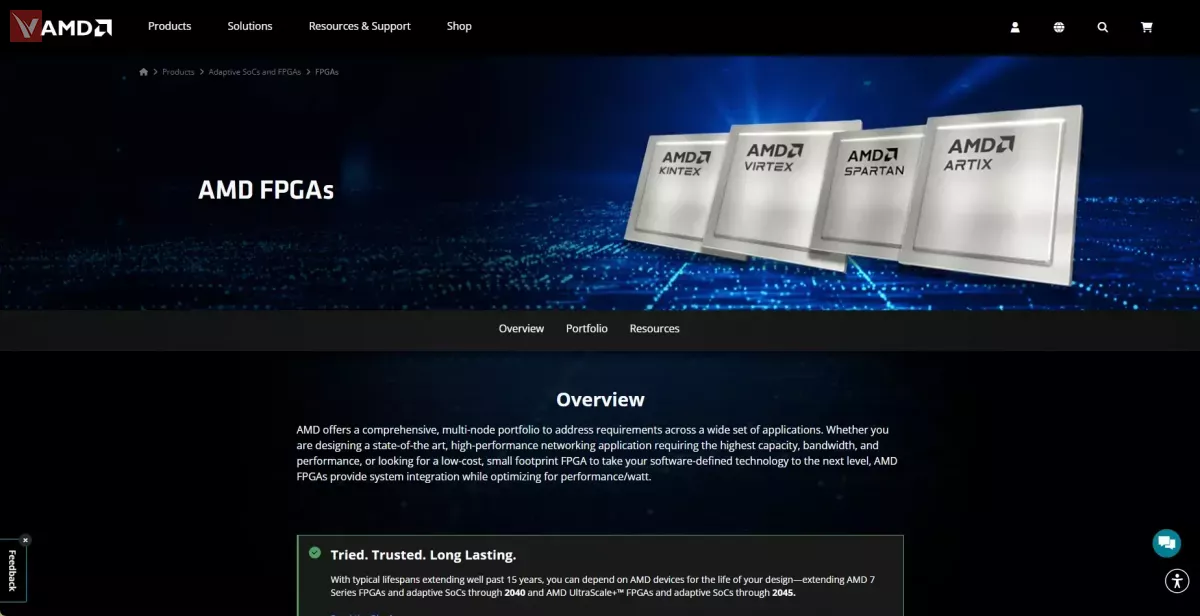
Xilinx is one of the companies most closely associated with the commercial FPGA industry. AMD completed its acquisition of Xilinx in 2022, so Xilinx is no longer an independent semiconductor company. Engineers still commonly use the Xilinx name because its product families, part numbers, documentation, IP, and development ecosystem remain widely recognized.
AMD's current standalone FPGA portfolio includes Spartan, Artix, Kintex, and Virtex families, ranging from cost-optimized devices to large FPGAs for bandwidth- and compute-intensive systems. The wider AMD adaptive-computing portfolio also includes Zynq SoCs and Versal Adaptive SoCs, although these should not simply be treated as conventional standalone FPGA families.
What makes AMD Xilinx distinctive:
Portfolio breadth. A designer can remain within the AMD ecosystem while moving from relatively modest Spartan or Artix devices into Kintex and Virtex products with considerably greater logic, DSP, memory, and high-speed connectivity resources. AMD also maintains automotive-, defense-, and space-oriented variants in parts of the portfolio.
This makes AMD Xilinx relevant across industrial equipment, machine vision, communications, high-speed networking, aerospace and defense, test systems, and compute-oriented applications.
For a deeper comparison with its closest broad-market alternatives, see our Xilinx vs Altera vs Lattice 2026 comparison.
Altera
Altera is another foundational name in programmable logic, but its corporate structure has changed substantially over the past decade.
Intel acquired Altera in 2015, after which its products were widely referred to as Intel FPGA products. The Altera brand later returned, and in September 2025 Silver Lake completed the acquisition of a 51% interest in Altera, with Intel retaining the remaining 49%. Altera now operates independently rather than as a wholly owned Intel FPGA business.
Its established families include MAX, Cyclone, Arria, and Stratix, while the current product direction is increasingly centered on Agilex 3, Agilex 5, Agilex 7, and Agilex 9.
What makes Altera distinctive:
It covers a particularly broad range of programmable systems while maintaining a relatively clear path from compact devices to FPGA platforms designed for large amounts of logic, high-speed interfaces, memory bandwidth, and specialized acceleration.
For example, current Agilex 3 devices extend into compact designs, while Agilex 5 occupies a wider mid-range space. Agilex 7 includes F-, I-, and M-Series devices aimed at different combinations of performance, processor connectivity, and memory-intensive workloads.
Altera is therefore commonly considered in industrial systems, communications, networking, edge computing, data-center infrastructure, embedded systems, and applications where the Quartus design ecosystem is already established.
Lattice Semiconductor
Lattice Semiconductor is an independent programmable-logic company with a market identity that differs from AMD Xilinx and Altera.
Lattice became particularly well known for relatively small, low-power FPGAs rather than attempting to mirror the largest high-end FPGA portfolios. That positioning is still visible in families such as iCE40, MachXO, CrossLink, and Certus, which are used for control, interface bridging, system management, embedded vision, and other applications where board area and power can matter as much as maximum logic capacity.
Its portfolio has nevertheless expanded. The newer Avant platform moves Lattice into a broader mid-range FPGA class, while the company's Nexus and related platforms continue to support its lower-power product strategy. Lattice's current product selector materials show a portfolio extending from small iCE40 devices through ECP5, MachXO, Certus, CrossLink, and Avant families.
What makes Lattice distinctive:
Its product strategy is often centered on functions that do not require the largest available FPGA. Board control, power sequencing, device security, sensor interfacing, camera connectivity, display bridging, embedded vision, and compact edge systems are examples where a smaller programmable device may be more appropriate than a high-density FPGA.
Microchip Technology
Microchip is sometimes overlooked in simplified FPGA lists because the company is also strongly associated with microcontrollers and analog products. It nevertheless maintains a substantial FPGA portfolio inherited and developed through the former Actel and Microsemi businesses.
Current families supported by Microchip's Libero SoC environment include PolarFire, PolarFire SoC, SmartFusion 2, IGLOO 2, and RTG4.
What makes Microchip distinctive:
Reliability, security, non-volatile programmable architectures, power-conscious designs, and devices intended for environments where lifecycle or radiation tolerance may have unusual importance.
PolarFire addresses mid-range FPGA applications, while PolarFire SoC combines FPGA fabric with a RISC-V processor subsystem. RTG4 is specifically designed as a radiation-tolerant FPGA family, making Microchip particularly relevant to space and high-reliability markets. SmartFusion 2 and IGLOO 2 remain relevant in industrial, military, communications, medical, and other embedded applications.
Microchip therefore occupies a somewhat different competitive position from a vendor focused primarily on the highest logic density or newest transceiver generation.
Achronix

Achronix is a privately held, fabless semiconductor company focused on high-performance programmable logic. Unlike most smaller FPGA companies, it participates in both the standalone FPGA market and the embedded FPGA IP market.
Its main discrete FPGA family is Speedster7t, while Speedcore provides eFPGA IP for integration into ASICs and SoCs.
The current Speedster7t FPGA datasheet positions the family around data-center workloads, AI/ML, networking, and other high-bandwidth applications. Devices incorporate a two-dimensional network-on-chip, machine-learning processors, high-speed SerDes, GDDR6 interfaces, Ethernet, and PCIe connectivity.
What makes Achronix distinctive:
It is one of the clearest examples of a company bridging two FPGA business models. A customer can use a packaged Speedster7t FPGA, or an ASIC developer can license Speedcore programmable fabric and integrate it directly into custom silicon.
That distinction is important because many “FPGA company” lists treat standalone FPGA vendors and eFPGA IP companies as though they sell the same type of product.
Efinix

Efinix is a programmable-logic company whose FPGA portfolio has grown from the original Trion family into newer Titanium and Topaz devices.
The company's Trion FPGAs target a range of embedded, IoT, consumer, industrial, medical, vision, and edge applications. Official documentation shows devices ranging from relatively small logic capacities up through larger Trion configurations, with options such as MIPI and DDR interfaces.
The Titanium family moves to a newer process and expands the range of logic and processing resources, while Efinix's 2026 documentation also includes the newer Topaz family. Its current Efinity software environment supports all three product groups.
What makes Efinix distinctive:
Its focus on programmable devices designed around relatively efficient logic-and-routing architectures, small packages, embedded interfaces, and edge-oriented applications. It provides an alternative to the largest established FPGA vendors when a design requires meaningful programmability without necessarily needing a high-end data-center-class FPGA.
GOWIN Semiconductor
GOWIN Semiconductor develops FPGA and FPGA-SoC products for embedded, consumer, industrial, communications, interface, and cost-sensitive applications.
One of its best-known product groups is the LittleBee family. GOWIN has also integrated hard processor and memory resources into selected devices. For example, its GW1NS FPGA SoC combines programmable logic with an Arm Cortex-M3 processor, flash, and related embedded resources.
GOWIN's wider portfolio includes larger programmable devices and newer architecture families in addition to LittleBee.
What makes GOWIN distinctive:
The company often addresses compact and highly integrated applications where customers may value a combination of FPGA logic, embedded processors, memory, MIPI connectivity, or other functions within a relatively economical device.
That makes GOWIN relevant to buyers who are not necessarily looking for the maximum logic density available from AMD or Altera but still need a genuine FPGA device rather than a CPLD or fixed-function controller.
QuickLogic
QuickLogic has more than three decades of experience in programmable logic, but its current business does not fit neatly into the conventional “general-purpose FPGA manufacturer” category.
The company provides discrete FPGA products, FPGA SoCs, custom programmable devices, and eFPGA IP. Its EOS S3 platform, for example, combines an Arm Cortex-M4 processor, sensor-processing functions, and embedded programmable logic for low-power sensor applications.
QuickLogic also offers custom FPGA development and an eFPGA business based around its Australis IP-generation technology. Its current eFPGA offering supports customization of LUT, memory, DSP, routing, foundry, and process requirements.
What makes QuickLogic distinctive:
Specialization. Rather than attempting to duplicate the broad general-purpose portfolios of AMD or Altera, QuickLogic combines low-power programmable devices with custom FPGA development and licensable eFPGA technology.
This makes it relevant both to system designers buying programmable silicon and to semiconductor companies that want programmable fabric inside their own chips.
Other FPGA Vendors
The FPGA market extends beyond the eight companies above.
Companies such as NanoXplore, Anlogic, Pango Microsystems, and Cologne Chip participate in particular geographic, industrial, space, low-cost, or specialized portions of the programmable-logic market. Their market reach, tooling, distribution, qualification options, and available device range differ considerably, so they should normally be evaluated according to the intended application rather than treated as interchangeable alternatives to the largest FPGA vendors.
The important point is that “FPGA manufacturer” is not synonymous with “one of the three biggest FPGA brands.” A company can develop legitimate FPGA products while serving a narrower region or engineering niche.
eFPGA Companies
An embedded FPGA, or eFPGA, is programmable logic delivered as semiconductor IP and integrated into an ASIC or SoC. The end customer does not normally buy the eFPGA as a separate packaged chip.
This creates a different business model from the conventional FPGA industry.
Achronix participates in both markets. Its Speedcore IP can be configured with different combinations of logic, memory, and DSP resources for integration into an ASIC or SoC.
QuickLogic also provides both physical programmable devices and configurable eFPGA IP. Its current offering supports several foundry and process combinations and can be customized around logic, memory, DSP, security, and other requirements.
Menta takes a more IP-focused approach. The company describes itself as a semiconductor IP provider specializing in embedded FPGA technology that chip designers can integrate into ASICs and SoCs.
Flex Logix was another prominent eFPGA specialist. Its EFLX architecture was developed as modular programmable-logic IP rather than as a conventional general-purpose packaged FPGA. Flex Logix was acquired by Analog Devices in 2024, so references that still present it as a fully independent FPGA company may no longer reflect its current corporate position.
These businesses belong in a broad listing of companies that “make FPGA technology,” but they should be labeled separately from companies selling standard discrete FPGA devices.
Who Actually Manufactures the Silicon?
An FPGA company may design the device, define the programmable architecture, develop the software toolchain, qualify the finished product, and sell it under its own name without physically operating the semiconductor fabrication plant that produces the wafers.
This is the fabless semiconductor model.
A company such as Achronix, for example, describes itself as a fabless semiconductor company, while its Speedster7t devices use a TSMC manufacturing process.
This means three different activities need to be kept separate:
| Activity | Responsible Company Type | What It Means |
|---|---|---|
| FPGA architecture and chip design | FPGA vendor | Defines programmable fabric, memory, DSP, I/O and product architecture |
| Wafer fabrication | Semiconductor foundry | Physically manufactures silicon using a semiconductor process |
| Finished-product sales and support | FPGA vendor and channel partners | Qualifies, packages, markets and supplies the FPGA product |
Foundries such as TSMC are therefore essential to FPGA manufacturing, but TSMC should not be listed next to AMD Xilinx or Lattice as though it were another general-purpose FPGA brand.
Similarly, the foundry used for one FPGA generation should not automatically be assumed to be the same across every product family or process generation. Manufacturing relationships are best confirmed from documentation for the specific product or platform when they are relevant to a sourcing or engineering decision.
FPGA Suppliers and Distributors
A company does not have to design an FPGA to be an important FPGA supplier.
Distributors such as DigiKey, Mouser, Arrow, and Avnet sell semiconductor products from FPGA manufacturers and often provide access to development kits, documentation, pricing, inventory information, and related engineering resources.
Their role is fundamentally different from that of AMD, Altera, or Lattice: the distributor does not define the FPGA architecture or own the underlying FPGA product family.
There is also a separate market for independent component suppliers. Companies in this category can be particularly relevant when a purchasing team needs a specific package, speed grade, date code, discontinued part, or device that is difficult to obtain through normal production channels.
For a company such as Vigorcomp, the role is therefore better described as FPGA sourcing and supply rather than FPGA manufacturing. This distinction is useful for buyers: searching for a manufacturer helps determine which architecture or product family fits a design, while searching for a supplier addresses where and how the required part can actually be purchased.
The distinction becomes particularly important for mature systems. A legacy Xilinx, Altera, Lattice, or Microchip FPGA may still be essential to an installed product even after the manufacturer has introduced multiple newer generations. In that situation, availability, authenticity, traceability, exact ordering code, and lifecycle status may matter more to procurement than identifying the newest FPGA family.
FPGA Development Board Companies
Another category frequently mixed into FPGA company lists is the development-board manufacturer.
Companies such as Digilent and Terasic build boards around FPGA and SoC devices so that engineers can evaluate silicon, develop RTL, test interfaces, teach digital design, or prototype systems without designing a PCB first.
Digilent, for example, describes itself as a designer and manufacturer of FPGA and SoC development boards and offers products such as the Basys 3 and Nexys A7 based on AMD Artix 7 devices. The FPGA on those boards is designed by AMD Xilinx; Digilent designs the development platform around it.
Terasic is similarly known for development platforms built around Altera FPGA technologies.
Calling such companies “FPGA manufacturers” without qualification can therefore create confusion. They manufacture FPGA boards, not necessarily the FPGA semiconductor itself.
This distinction matters particularly to students and engineers searching for an “FPGA company” because what they actually need may be a board supplier rather than a semiconductor vendor.
FPGA Manufacturer vs Foundry vs Distributor
The easiest way to understand the FPGA industry is to treat it as several connected layers rather than one list of companies.
| Role | What the Company Actually Does | Examples |
|---|---|---|
| FPGA vendor | Designs programmable silicon and sells FPGA products under its own portfolio | AMD Xilinx, Altera, Lattice, Microchip, Achronix, Efinix, GOWIN |
| FPGA + eFPGA vendor | Sells programmable devices while also licensing FPGA fabric as IP | Achronix, QuickLogic |
| eFPGA IP provider | Licenses programmable fabric for integration into ASICs or SoCs | Menta; Flex Logix technology |
| Semiconductor foundry | Fabricates silicon wafers for chip companies | TSMC and other contract foundries |
| Distributor | Resells finished FPGA products from semiconductor manufacturers | DigiKey, Mouser, Arrow, Avnet |
| Independent supplier | Sources available, legacy or hard-to-find components across supply channels | Vigorcomp and similar sourcing companies |
| Development-board company | Designs boards containing FPGA or SoC devices | Digilent, Terasic |
The term FPGA manufacturer is therefore useful in everyday language, but FPGA vendor can sometimes be more precise. Many semiconductor companies control the product architecture and commercial FPGA platform without owning the fab that physically processes the wafers.
Which FPGA Companies Matter Most for Buyers?
For buyers and engineers, the most relevant FPGA company depends on why the company list is being researched.
A team developing a high-bandwidth networking platform may begin with AMD Xilinx, Altera, or Achronix because those companies offer FPGA products designed for substantial logic, high-speed serial connectivity, memory, and acceleration workloads.
A compact embedded or interface-oriented system may lead to Lattice, Efinix, GOWIN, or cost-optimized AMD and Altera families instead.
Projects involving aerospace, radiation tolerance, high reliability, long operating life, or security may bring Microchip and specialized device families into the comparison earlier.
An ASIC design team asking about FPGA technology may not need a packaged FPGA at all. In that case, Achronix Speedcore, QuickLogic, Menta, or another eFPGA technology can be more relevant because the objective is to embed reconfigurable logic directly into custom silicon.
Once the engineering team has selected a specific FPGA, the relevant companies may become authorized distributors or independent sourcing partners rather than the FPGA manufacturer itself.
Conclusion
So, which companies make FPGAs? If “make” means companies that develop and sell FPGA products, the main names include AMD Xilinx, Altera, Lattice Semiconductor, Microchip Technology, Achronix, Efinix, GOWIN Semiconductor, and QuickLogic, alongside additional regional and specialized FPGA vendors.
But that is only one layer of the industry.
Companies such as Achronix, QuickLogic, and Menta also participate in embedded FPGA IP, where programmable logic is licensed for integration into an ASIC or SoC. Semiconductor foundries physically manufacture wafers, but they are not automatically FPGA brands. Distributors and independent suppliers provide finished components, while companies such as Digilent and Terasic build development boards around FPGA devices.
Engineers evaluating FPGA architectures need to identify the actual FPGA vendor. Chip designers considering programmable logic inside an SoC may need an eFPGA provider. Engineers prototyping hardware may need a development-board company, while purchasing teams may ultimately need a distributor or sourcing partner.