The main difference between compact and modular PLCs is how their hardware is integrated and configured. A compact PLC combines the CPU and basic input/output (I/O) functions in a single unit, while a modular PLC allows engineers to build a control system from configurable hardware modules.
Compact PLCs are often a practical choice for machines with predictable control requirements. Modular PLCs are generally better suited to systems requiring flexible I/O configurations, specialized functions, or significant expansion. However, some compact PLCs also support expansion modules, and neither architecture inherently guarantees higher processing performance or lower total system cost.
The right choice depends on your current and future I/O requirements, control tasks, installation constraints, and maintenance strategy.
What Is the Difference Between Compact and Modular PLCs?
Compact and modular PLCs perform the same fundamental control functions but differ in how their hardware resources are organized. These architectural differences affect system configuration, expansion, installation, and hardware replacement.
For readers unfamiliar with PLC operation, this guide to the plc programmable controller explains the basic operating principles and components of programmable logic controllers.
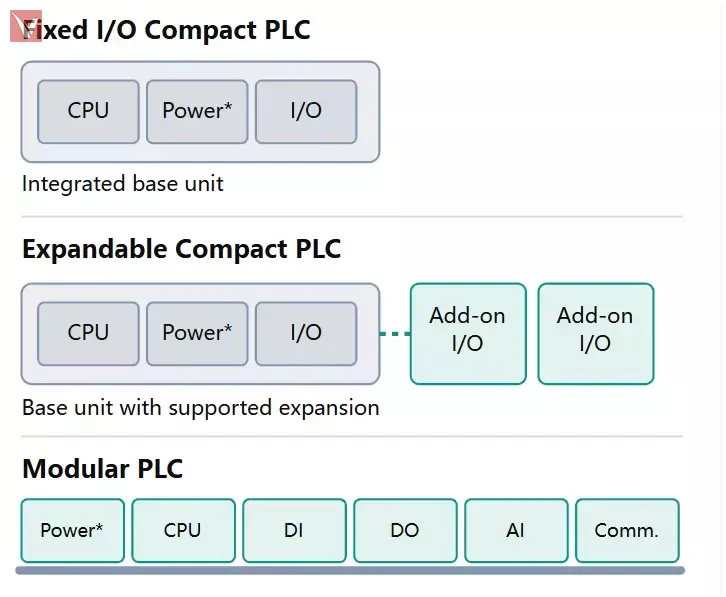
Figure1: Comparison of fixed I/O compact, expandable compact, and modular PLC hardwarearchitectures
Compact PLC: Integrated Hardware Architecture
A compact PLC, sometimes called an integrated PLC, typically combines the processor, onboard I/O, and communication interfaces within a single housing.
This configuration can simplify hardware selection because several essential control functions are already available in the base unit. When the integrated resources satisfy the application requirements, fewer additional hardware components may be necessary.
Compact PLCs can therefore be attractive for standardized machines, particularly when cabinet space and initial hardware costs are important considerations.
However, you must evaluate the available I/O types, processing resources, communication interfaces, and expansion options. A compact housing does not necessarily mean that all required functions are included.
Modular PLC: Configurable Hardware Architecture
A modular PLC uses a configurable hardware architecture in which the CPU, signal modules, communication modules, and other functional components can be selected according to application requirements.
Depending on the product family, these components may connect through a backplane, mounting rail, or dedicated system bus.
This architecture allows engineers to configure different combinations of digital I/O, analog I/O, and specialized modules rather than relying primarily on the resources integrated into a base controller.
The trade-off is that system design requires closer attention to module compatibility, power distribution, mounting arrangements, and supported configuration limits.
Why Compact Does Not Always Mean Fixed I/O
Compact and modular PLCs are not completely separate categories. Some compact controllers support additional signal boards, expansion modules, and distributed I/O.
For example, Siemens offers compact CPUs with integrated I/O in the SIMATIC S7-1200 G2 family, alongside supported expansion options. Rockwell Automation also offers expansion I/O for its Micro850 and Micro870 controllers.
These examples demonstrate why expandability should be evaluated at the product-family and model level rather than inferred from the controller's physical size.
| Architecture | Typical Hardware Configuration | Expansion Consideration |
| Fixed I/O compact PLC | Integrated CPU and fixed onboard I/O | Verify whether any external I/O expansion is supported |
| Expandable compact PLC | Integrated base controller with optional expansion hardware | Check supported module types and system limits |
| Modular PLC | Configurable CPU and functional modules | Check module combinations, bus capacity, and power requirements |
There is no universal I/O point count that defines the boundary between compact and modular PLCs.
Key Technical Differences Between Compact and Modular PLCs
The most important differences between compact and modular PLCs concern hardware flexibility, expansion capacity, installation requirements, and maintenance. Processing performance must be evaluated separately using the specifications of the candidate CPU and system configuration. These are typical architectural characteristics, not guaranteed specifications for every PLC model.
| Comparison Factor | Compact PLC | Modular PLC |
|---|---|---|
| Hardware architecture | Integrated base controller | Configurable hardware modules |
| I/O configuration | Onboard I/O with model-dependent expansion | Selectable I/O modules within system limits |
| Scalability | Depends on supported expansion options | Generally offers greater configuration flexibility |
| Processing performance | Depends on CPU and application workload | Depends on CPU and application workload |
| Communication | Integrated interfaces or supported extensions | Integrated interfaces and configurable communication options |
| Installation space | Can reduce the footprint of a basic control system | Depends on the complete module configuration |
| Hardware replacement | An integrated component fault may require base-unit replacement | Certain failed modules may be replaced individually |
| Initial system cost | May be lower for straightforward configurations | Depends on CPU, modules, and required accessories |
| Typical application fit | Predictable machine control requirements | Variable, specialized, or expandable control requirements |
I/O Capacity and Expansion Flexibility
I/O requirements are often the most useful starting point when comparing PLC architectures.
A compact PLC may provide sufficient onboard digital inputs and outputs for a standalone machine. If additional channels are needed, an expandable compact controller may remain suitable, provided its supported expansion resources can accommodate the required signals.
A modular PLC becomes particularly useful when the system requires different combinations of digital, analog, and specialized I/O.
Engineers should evaluate more than the total number of I/O points. Signal voltage, output type, analog measurement range, isolation, channel density, and module compatibility can all affect the final hardware configuration.
Local expansion limits and distributed I/O capacity should also be evaluated separately. A controller with limited local expansion may still support a larger networked system if the required remote I/O architecture is supported.
Processing Performance and Communication
Modular PLCs are not inherently faster than compact PLCs. Processing capability depends on the selected CPU, program complexity, task scheduling, communication workload, and configured hardware.
For applications involving time-sensitive control, compare the required task cycle with the controller's documented execution performance. An instruction execution time alone does not establish the response time of the complete control system.
Communication requirements also influence controller selection. Consider supported industrial protocols, network connection limits, remote I/O update requirements, and communication with human-machine interfaces (HMIs), variable-frequency drives, and other automation devices.
Select a CPU that satisfies the application's processing and communication demands rather than assuming that a particular hardware architecture provides sufficient performance.
Installation Space and System Integration
A compact PLC can reduce installation space when its integrated resources eliminate the need for separate modules.
However, an expandable compact system may require additional I/O modules, external power supplies, communication hardware, and wiring accessories. Its final footprint can therefore differ considerably from the dimensions of the base controller.
Modular systems require space for their selected components, but the configurable architecture may offer advantages when distributing I/O or organizing different control functions.
For a meaningful installation comparison, evaluate the complete hardware arrangement, including wiring clearances, mounting requirements, power distribution, operating temperature, and ventilation.
Maintenance and Hardware Replacement
If an onboard I/O circuit fails in a compact PLC, restoring the original functionality may require replacing the base unit or implementing an approved alternative configuration.
In a modular system, a fault isolated to a separate I/O module may allow that module to be replaced without replacing the CPU. This can reduce the scope of hardware replacement when the manufacturer's maintenance procedures support it.
Nevertheless, modular architecture does not automatically guarantee shorter downtime or support for hot swapping. Replacement procedures, firmware requirements, configuration restoration, and safe shutdown conditions must be checked for the specific system.
Maintenance planning should consider both the hardware replacement cost and the time required to return the equipment to normal operation.
When Should You Use a Compact or Modular PLC?
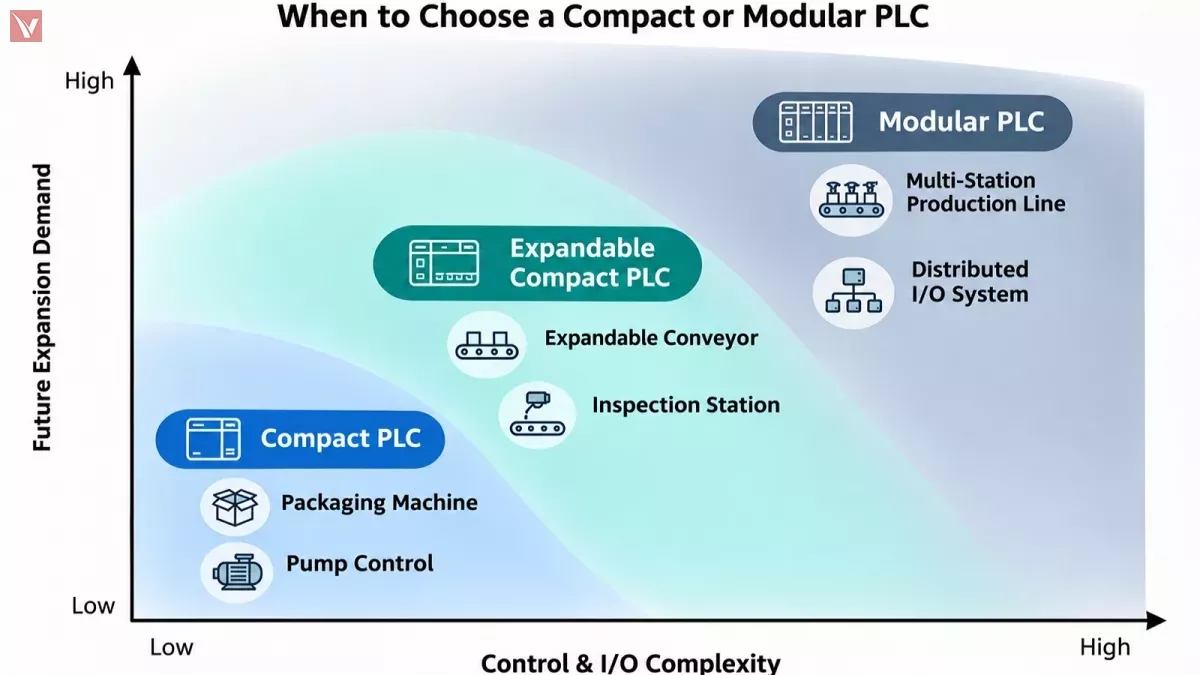
Figure2: Application selection matrix for compact, expandable compact, and modular PLCs based on control complexity and expansion requirements.
Standalone Machines with Predictable Requirements
A compact PLC is often a practical starting point for standalone machines with clearly defined I/O and control requirements.
Consider a packaging machine that uses digital sensors, pneumatic actuators, motor control signals, and an operator interface. If the controller's onboard resources and supported extensions satisfy the required functionality, a compact architecture may simplify hardware configuration.
This approach can also be useful for standardized equipment manufactured in multiple units, where consistent control cabinet layouts and repeatable hardware configurations are desirable.
Before selecting a compact PLC, confirm that expected equipment modifications will not exceed its processing, communication, or expansion limits.
Expandable and Multi-Station Automation Systems
A modular PLC is worth evaluating when a control system must accommodate multiple production stations, different signal types, or planned capacity increases.
For example, a conveyor system may initially operate with basic position sensors and motor controls but later require inspection stations, analog measurement devices, and additional networked equipment.
A configurable module architecture can provide more flexibility when developing these different hardware configurations.
An expandable compact PLC should also remain a candidate if its supported expansion and communication capabilities satisfy the same requirements. The presence of future expansion does not automatically make a modular PLC necessary.
Applications with Specialized Control Requirements
Specialized applications may require high-speed counting, precise motion control, temperature measurement, distributed I/O, or advanced industrial communication.
In these situations, the most important question is whether the selected controller and its supported modules can meet the functional and performance requirements.
A compact controller with integrated technological functions may be sufficient for some machines. Other systems may require a modular architecture with dedicated functional modules or a more capable CPU.
For safety-related or redundant control systems, evaluate the applicable manufacturer documentation, certified hardware, supported configurations, and system-level engineering requirements. Neither compact nor modular construction alone establishes suitability for these applications.
Examples from Major Manufacturers
Actual PLC product families illustrate why compact size, modularity, and expansion capability should be treated as related but distinct design characteristics.
The following examples compare hardware architecture rather than individual product performance or purchasing suitability.
Siemens SIMATIC S7-1200 G2 and S7-1500
Siemens SIMATIC S7-1200 G2 illustrates how a compact controller can combine onboard I/O with supported expansion hardware. Its CPU product information and system documentation identify configuration options for extending the controller's functionality.
By comparison, the SIMATIC S7-1500 family provides a more extensively configurable architecture, with different CPU performance classes and a range of signal, communication, and technology modules.
| Product Family | Architecture Characteristics | Selection Consideration |
|---|---|---|
| SIMATIC S7-1200 G2 | Compact CPU with integrated resources and supported extensions | Verify onboard functions and expansion limits |
| SIMATIC S7-1500 | Configurable controller and functional modules | Verify CPU selection and the complete module configuration |
These product families demonstrate different approaches to system configuration. They should not be treated as interchangeable controllers or compared using assumed performance differences.
Expandable and Rackless Architectures from Rockwell Automation
Rockwell Automation provides another example of architectural flexibility through Micro800 expansion I/O.
The manufacturer identifies expansion modules for Micro850 and Micro870 controllers, demonstrating that compact controller designs can accommodate additional hardware.
Rockwell Automation also offers rackless Compact I/O modules. This illustrates that modular I/O configurations do not always require a conventional chassis.
The engineering implication is that terms such as compact, modular, expandable, and rackless describe different aspects of a control system. Always evaluate the actual hardware configuration supported by the selected controller.
Compare the Complete Cost
A compact PLC may offer a lower initial hardware cost when its onboard resources satisfy most application requirements. However, neither compact nor modular PLCs have a universal cost advantage.
A meaningful comparison must include all components and engineering work required to deliver the same control functionality.
Initial Hardware and Installation Costs
Comparing controller prices alone can produce a misleading result, particularly when one configuration requires additional I/O, communication modules, or external accessories.
Prepare a complete bill of materials (BOM) for each technically acceptable configuration.
| Cost Component | Compact PLC System | Modular PLC System |
|---|---|---|
| Controller | Integrated base unit | Selected CPU |
| I/O hardware | Required expansion modules | Required signal modules |
| Power supplies | As required by the configuration | As required by the configuration |
| Communication hardware | Integrated or additional interfaces | Integrated or additional interfaces |
| Mounting and accessories | Rails, terminals, connectors, and other required items | Rails or chassis, terminals, connectors, and other required items |
| Engineering software | Applicable licenses and tools | Applicable licenses and tools |
| Installation | Wiring, assembly, and commissioning | Wiring, assembly, and commissioning |
Some components may already be integrated into the selected hardware. Confirm the actual configuration before assigning costs to avoid double-counting or omitting required items.
A compact system that requires several additional modules may lose part of its initial cost advantage. Conversely, a modular system can be unnecessarily complex if the application does not benefit from its configuration flexibility.
Maintenance, Spare Parts, and Future Expansion Costs
Initial purchase cost is only one part of the total cost of ownership (TCO).
A simplified lifecycle cost estimate can include:
TCO = Initial system cost + Maintenance cost + Downtime cost + Future expansion cost
All lifecycle costs should be estimated over the same evaluation period for both configurations. More detailed financial assessments may also include energy consumption, software renewal costs, and the time value of money.
For a compact system, consider whether an integrated hardware fault would require a complete spare controller. For a modular system, determine which modules should be stocked and whether individual module replacement would reduce the expected recovery time.
Future expansion costs should include any additional hardware, engineering changes, software modifications, and installation work.
The most economical PLC architecture is the one that satisfies the technical requirements at an acceptable lifecycle cost—not necessarily the one with the lowest controller price.
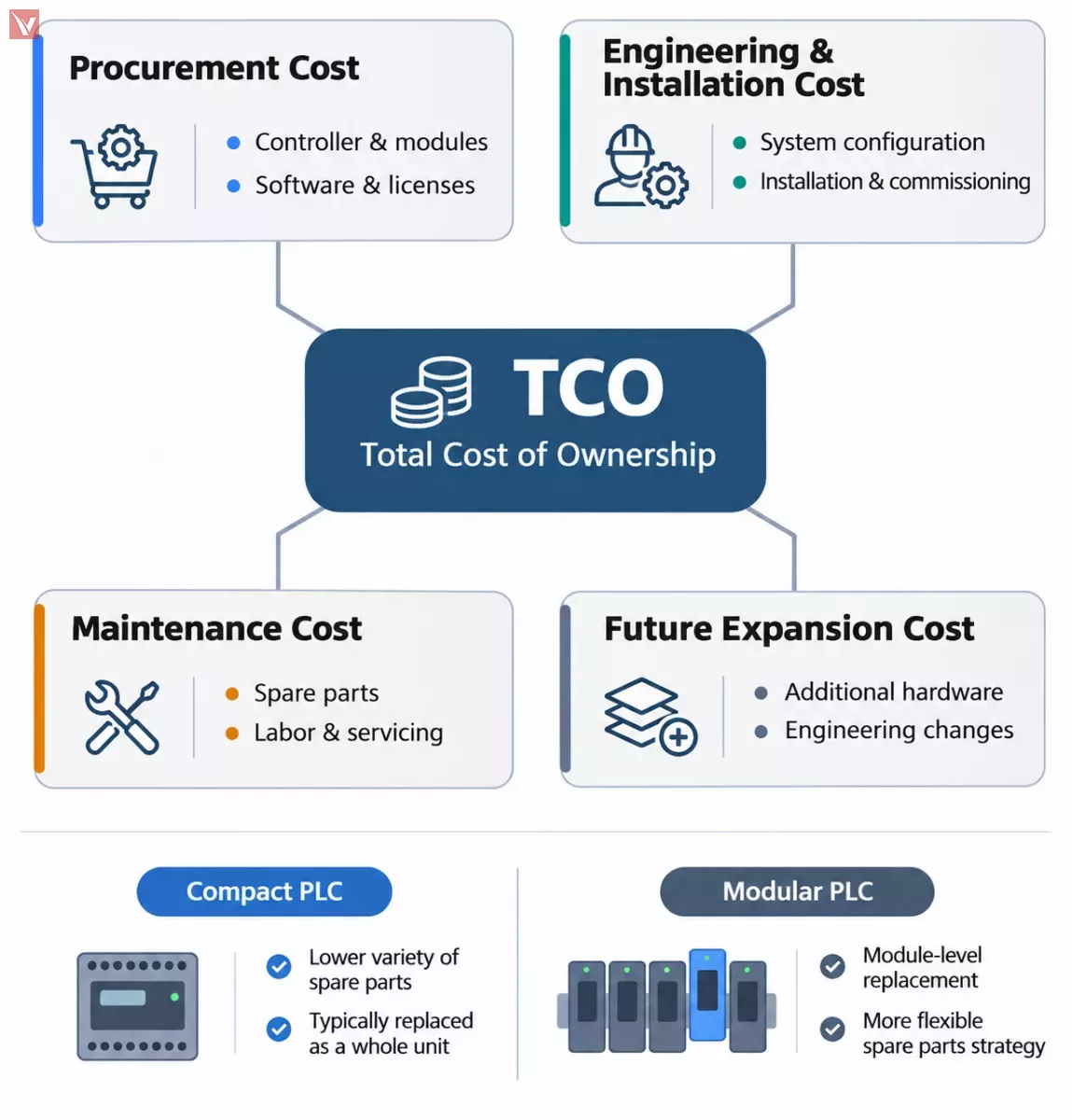 Figure3: Compare Total System Cost, Not Just Controller Price
How to Choose Between a Compact and Modular PLC
Define Current and Future I/O Requirements
Prepare an I/O list that identifies both the number and type of signals required by the equipment.
A simple planning worksheet might look like the following example.
| Signal Type | Current Requirement | Planned Additional Channels | Future Requirement |
|---|---|---|---|
| Digital inputs (DI) | 16 | 4 | 20 |
| Digital outputs (DO) | 12 | 4 | 16 |
| Analog inputs (AI) | 4 | 2 | 6 |
| Analog outputs (AO) | 2 | 0 | 2 |
These figures are hypothetical application requirements, not PLC specifications or recommended expansion margins.
Evaluate each signal type separately. Spare digital channels cannot necessarily satisfy a future analog measurement requirement, and available I/O capacity does not guarantee electrical compatibility.
Compare the completed worksheet with the onboard resources, supported modules, remote I/O options, and system limits of each candidate PLC.
Validate CPU, Communication, and System Constraints
After identifying the I/O requirements, confirm that the proposed hardware configuration satisfies the remaining control system requirements.
Review the following engineering constraints:
- CPU processing capability, memory, and required task cycles.
- Industrial communication protocols and connection capacity.
- Supported local and distributed I/O configurations.
- System power budget and field-device power requirements.
- Cabinet dimensions, operating conditions, and installation clearances.
- Required technological, safety-related, or diagnostic functions.
These requirements should be treated as qualification criteria. A lower-cost PLC is not a viable alternative if it fails a mandatory functional or environmental requirement.
Evaluate Expansion, Maintenance, and Cost Trade-Offs
Once the technically acceptable options are identified, compare their practical advantages using the following decision matrix.
| Application Requirement | Architecture to Evaluate First | Required Verification |
|---|---|---|
| Stable and predictable I/O requirements | Compact PLC | Integrated functions and supported extensions |
| Limited, predictable future expansion | Expandable compact PLC | Expansion capacity and module compatibility |
| Diverse or frequently changing I/O configurations | Modular PLC | CPU support and module combinations |
| Restricted cabinet space | Compact or space-efficient modular system | Complete installation footprint |
| Complex communication or motion control | Functionally qualified controller | CPU, network, and specialized function requirements |
| Module-level maintenance requirements | Modular system supporting the required procedures | Replacement process and downtime conditions |
Use this matrix as a starting point rather than a final qualification method.
The recommended selection sequence is:
- Define current and future control requirements.
- Identify compact and modular configurations that could satisfy those requirements.
- Eliminate configurations that fail mandatory technical constraints.
- Compare complete system BOMs and lifecycle costs.
- Verify the exact hardware configuration using manufacturer documentation.
This process prevents unnecessary investment in a more complex architecture while reducing the risk of selecting a controller that cannot support future requirements.
What to Verify Before Purchasing a PLC System
Choosing a PLC architecture is not the same as completing a procurement specification. The final purchasing decision requires verification of the individual components, supported configuration, software requirements, and lifecycle considerations.
Check Part Numbers and Module Compatibility
Identify the complete manufacturer part number (MPN) for the CPU and every required module.
Product-family names alone are not sufficient for procurement because different versions may have different I/O configurations, electrical characteristics, and compatibility requirements.
Even controllers from the same manufacturer may require different hardware across product generations. Siemens, for example, states that the SIMATIC S7-1200 G2 generation is not hardware-compatible with the previous S7-1200 family.
This is why procurement teams should not assume that an existing module can be reused with a newer controller simply because both products share a similar family name.
Manufacturer reference: SIMATIC S7-1200 G2 — hardware compatibility FAQ.
Verify Power, Accessories, and Software Requirements
A complete PLC BOM may include more than the controller and signal modules.
Check whether the proposed configuration requires external power supplies, bus connectors, terminal blocks, mounting accessories, memory cards, communication hardware, or additional software licenses.
Also verify the supported firmware versions and engineering software requirements. These checks are especially important when extending or maintaining an existing automation system.
Review Lifecycle Status and Sourcing Requirements
Before finalizing the purchase, review the manufacturer's current lifecycle information for the selected components.
For equipment expected to operate over an extended period, spare parts availability and potential migration requirements should be considered alongside the initial purchase cost.
Use the following checklist to prepare an engineering-approved PLC procurement specification.
| Verification Item | Required Procurement Information |
|---|---|
| Controller identification | Complete manufacturer part number |
| I/O configuration | Required channels, signal types, and module part numbers |
| Hardware compatibility | Confirmed CPU, module, and system configuration |
| Power requirements | System power budget and required power supplies |
| Accessories | Connectors, terminals, mounting hardware, and other required items |
| Software and firmware | Supported versions and applicable licenses |
| Operating conditions | Environmental and installation requirements |
| Lifecycle considerations | Manufacturer status and spare parts strategy |
| Purchasing requirements | Required quantities and delivery schedule |
Once the hardware configuration has been validated, visit Vigor Components to search for the electronic components on your BOM or submit a sourcing inquiry for the required parts. Confirm component availability and commercial terms before placing an order.
Contact US