
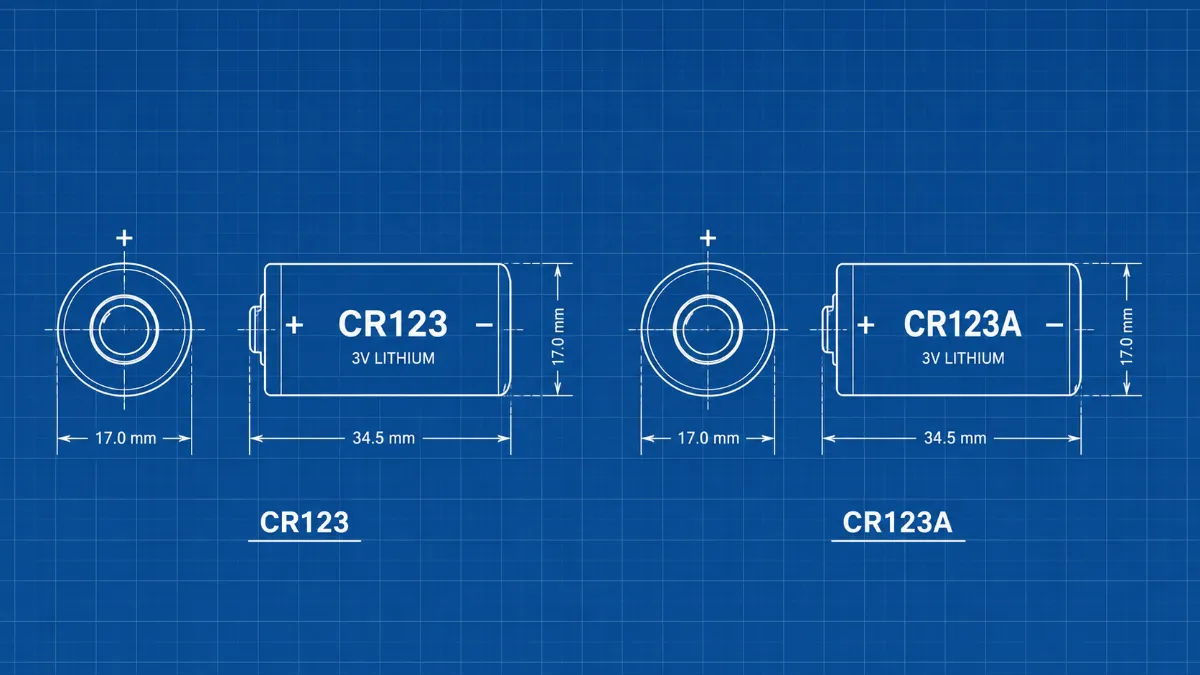
In the world of compact high-performance power cells, CR123 and CR123A batteries are among the most widely used lithium primary batteries. Despite their common presence in critical devices, confusion around their naming, specifications, and interchangeability persists—even among experienced engineers and procurement teams. This guide provides a clear, technically grounded explanation to help you confidently select and source the correct battery for your application.
What Is a CR123A or CR123 Lithium Battery
A CR123A battery is a 3V cylindrical lithium manganese dioxide (Li-MnO₂) primary cell designed for high energy density and long-term reliability. It is classified as a non-rechargeable lithium battery and is optimized for both continuous and pulse discharge applications.
Key physical and chemical characteristics include:
- Chemistry: Lithium manganese dioxide (Li-MnO₂)
- Nominal voltage: 3.0V
- Form factor: Cylindrical
- Energy density: Significantly higher than alkaline or NiMH cells
- Shelf life: Up to 10 years under proper storage conditions
The lithium manganese dioxide chemistry provides excellent stability, allowing these batteries to maintain voltage consistency even under varying load conditions. This makes them especially suitable for mission-critical electronics that cannot tolerate sudden voltage drops.
Are CR123 and CR123A Batteries Absolutely Identical
Yes. CR123 and CR123A batteries are functionally and physically identical.
There is no difference between them in terms of:
- Physical dimensions
- Nominal voltage (3.0V)
- Chemical composition (Li-MnO₂)
- Electrical performance characteristics
They are 100% interchangeable in all compatible devices.
The distinction exists purely at the labeling level. Some manufacturers or distributors use "CR123," while others prefer "CR123A." From an engineering or application standpoint, there is no functional difference.
Deciphering the Nomenclature Behind 123 and 123A Labels
The naming of lithium batteries follows conventions derived from IEC (International Electrotechnical Commission) standards, though real-world labeling often deviates slightly.
Breaking down CR123A:
- C = Lithium chemistry
- R = Round (cylindrical shape)
- 123A = Size designation
The "123A" portion is commonly interpreted as referring to a size roughly equivalent to two-thirds the length of a standard A-size battery (often described as “2/3 A”).
However, in commercial practice:
- Some brands label the battery as CR123
- Others use CR123A
- A few may omit parts of the designation entirely on packaging
These variations are primarily due to branding, regional conventions, or packaging constraints, not technical differences.
For engineers and buyers, the key takeaway is that CR123 and CR123A represent the same standardized cell format, regardless of how the label appears.
Technical Specifications and Performance Comparison Metrics
Understanding the precise specifications of CR123/CR123A batteries is essential for evaluating compatibility with your device, especially in high-drain or precision electronics.
Below is a structured reference table based on typical manufacturer datasheets (e.g., Panasonic, Energizer):
| Parameter | Typical Value | Notes |
|---|---|---|
| Nominal Voltage | 3.0V | Stable discharge curve |
| Nominal Capacity | 1500mAh – 1700mAh | Depends on load and manufacturer |
| Dimensions | 17.0mm (diameter) × 34.5mm (height) | ±0.5mm tolerance typical |
| Weight | ~16g | Varies slightly by brand |
| Cut-off Voltage | 2.0V | Device-dependent |
| Max Continuous Discharge | 1000mA – 1500mA | Higher pulse currents supported |
| Operating Temperature | -40°C to +70°C | Excellent low-temperature performance |
| Shelf Life | Up to 10 years | Low self-discharge rate (<1% per year) |
These specifications highlight why CR123A batteries are preferred in environments requiring high reliability, long storage life, and stable voltage under load.
Sourcing Authentic Power Components for Industrial Applications
While CR123 and CR123A are technically identical, inconsistencies in labeling can introduce confusion during procurement—particularly when sourcing from multiple regions or suppliers.
Key challenges include:
- Inconsistent labeling across manufacturers (CR123 vs CR123A)
- Risk of counterfeit or relabeled cells in open markets
- Variability in production batches and quality control
- Supply fluctuations from major brands such as Panasonic and Energizer
To mitigate these risks, it is critical to:
- Verify manufacturer origin and batch traceability
- Confirm datasheet alignment with actual product markings
- Avoid unusually low-priced inventory lacking certification
- Maintain consistency in sourcing channels
A reliable supply partner plays a crucial role in ensuring that every unit meets original manufacturer specifications. With established sourcing networks and strict quality verification processes, Vigor Components helps ensure stable access to authentic lithium batteries, even during periods of constrained supply.
This reduces the risk of performance inconsistencies, particularly in applications where battery failure is not an option.
Common Commercial and High-Drain Equipment Applications
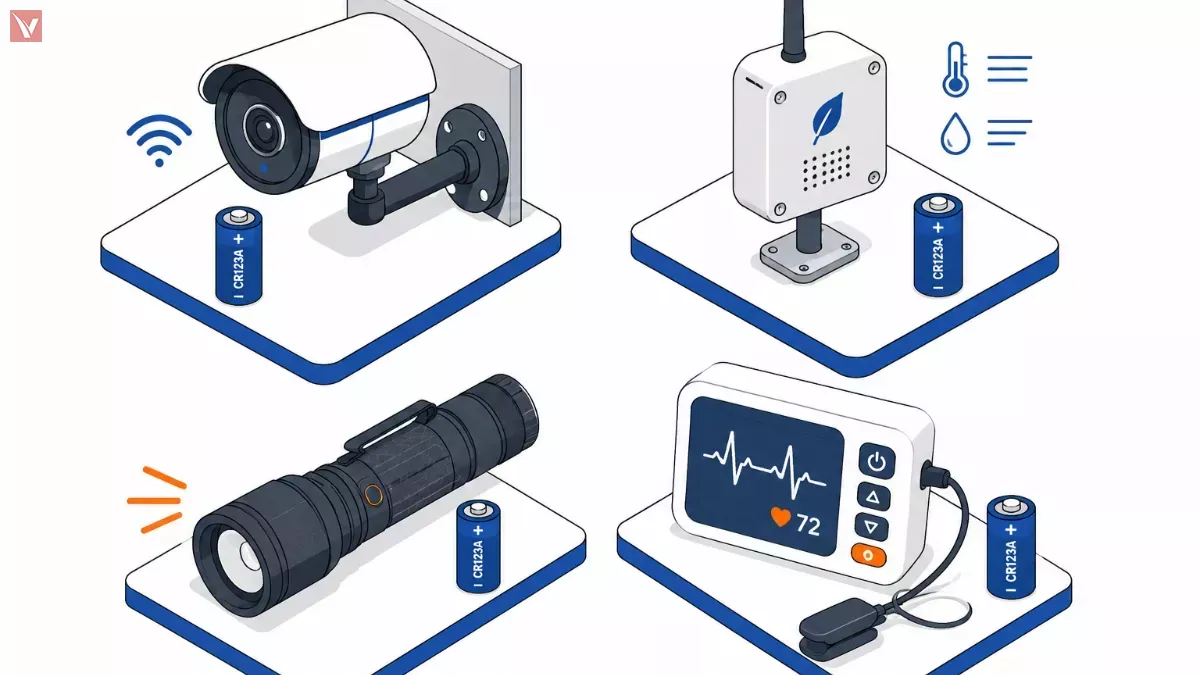
CR123/CR123A batteries are widely used in devices that demand a compact size combined with high pulse current capability.
Typical applications include:
- Smart security cameras
Used in wireless and battery-powered surveillance systems requiring long standby life and reliable bursts of power during recording or transmission. - IoT sensors
Ideal for remote sensing devices due to low self-discharge and excellent performance across temperature extremes. - Tactical flashlights
High-drain capability supports powerful LED output with consistent brightness. - Medical equipment
Found in portable diagnostic devices where stable voltage is critical for accurate readings. - Smoke detectors and alarm systems
Long shelf life ensures readiness over extended periods.
One of the defining advantages of CR123A batteries is their ability to deliver high pulse currents without significant voltage sag, which is essential for devices that operate intermittently but require sudden bursts of energy.
Critical Safety Warnings Regarding Rechargeable Alternatives
A common and potentially dangerous misconception is treating CR123A batteries as interchangeable with rechargeable lithium-ion cells such as RCR123A (16340).
These are not equivalent.
⚠️ Critical Warning:
Do NOT replace a 3.0V CR123/CR123A battery with a 3.7V rechargeable lithium-ion battery (RCR123A or 16340).
The higher voltage can exceed the tolerance of sensitive circuits, potentially causing:
- Permanent damage to electronic components
- Overheating or thermal runaway
- Fire or safety hazards
Key differences:
- CR123A: 3.0V (primary lithium, non-rechargeable)
- RCR123A / 16340: 3.6V–3.7V (rechargeable lithium-ion)
Even though the physical dimensions are similar, the voltage difference is significant enough to destroy precision electronics, especially in tightly regulated systems.
Always verify the device specifications before considering any substitution.
Final Thought
By understanding both the technical equivalence and the practical considerations surrounding CR123 and CR123A batteries, engineers and buyers can make informed decisions that ensure reliability, safety, and performance across a wide range of applications.