
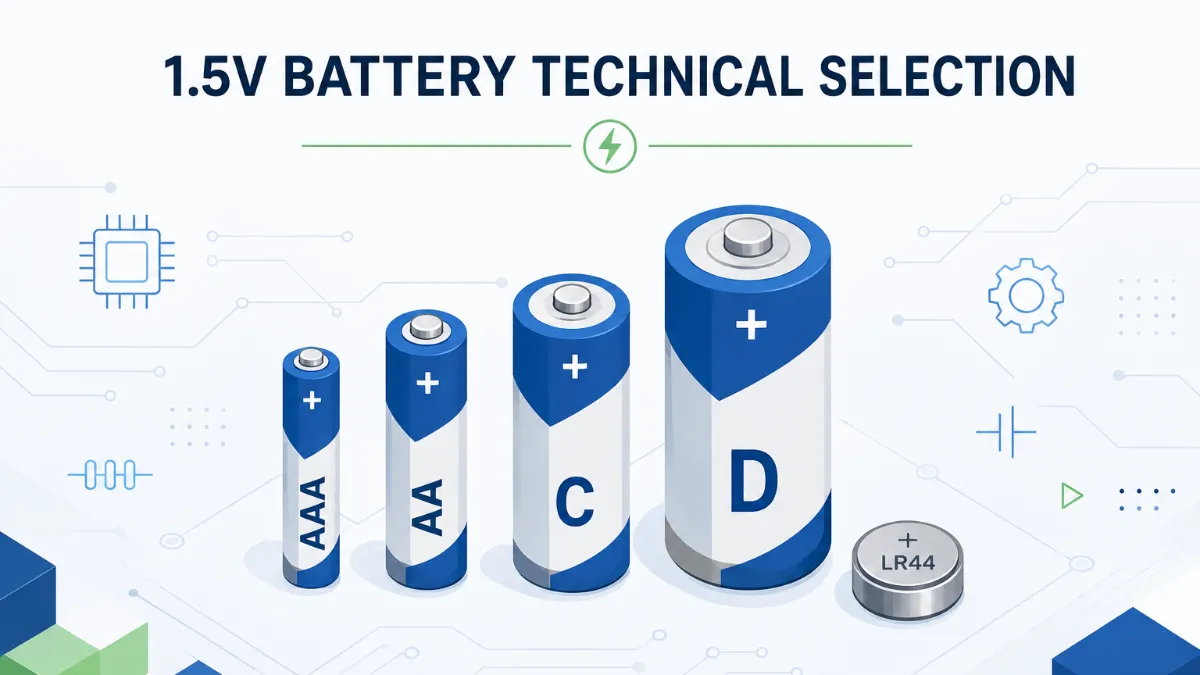
The 1.5V battery remains one of the most widely used power sources in both consumer and industrial electronics. Despite its apparent simplicity, selecting the correct 1.5V battery involves understanding electrochemistry, discharge behavior, device compatibility, and supply chain reliability. This guide provides a structured, engineering-focused overview to help you make informed decisions across design, procurement, and application scenarios.
Understanding the 1.5V Battery Standard
The 1.5V nominal voltage is not arbitrary—it is rooted in electrochemical fundamentals. Most primary battery chemistries used in cylindrical and button cells, such as alkaline (zinc–manganese dioxide), naturally produce an open-circuit voltage close to 1.5V1.5V1.5V.
This voltage became a global standard due to several factors:
- Electrochemical stability: The redox potential of zinc and manganese dioxide provides a stable and safe voltage plateau.
- Series scalability: Devices can easily scale voltage by combining cells (e.g., 2 × 1.5V = 3V).
- Legacy compatibility: Decades of device design—from flashlights to industrial meters—have standardized around this voltage.
- Manufacturing efficiency: Global standardization reduces cost and simplifies supply chains.
In practice, most 1.5V batteries operate within a discharge range of approximately 1.6V1.6V1.6V (fresh) down to 0.8V0.8V0.8V (depleted), depending on load conditions and chemistry.
Common 1.5V Battery Sizes
The physical size of a 1.5V battery is more than a mechanical constraint—it directly determines capacity, internal resistance, discharge stability, and suitability for specific load profiles. From compact consumer electronics to industrial systems, selecting the correct size is essential for both performance and reliability.
Below is a structured breakdown of the most common 1.5V battery sizes, progressing from smaller cylindrical formats to larger cells and finally to button batteries.
AAA Batteries (LR03)
AAA batteries are among the smallest standardized cylindrical 1.5V cells, widely used where space constraints are critical.
- Typical dimensions: 10.5 mm10.5 \, \text{mm}10.5mm diameter × 44.5 mm44.5 \, \text{mm}44.5mm height
- Typical capacity (alkaline): 1000–1200 mAh
- Key characteristics:
- Higher internal resistance compared to larger cells
- Limited current output capability
- Lightweight and compact
AAA batteries are best suited for low-power, intermittent-use devices, such as:
- Remote controls
- Wireless mice and keyboards
- Small sensors
- Portable medical devices
In high-drain scenarios, AAA batteries tend to experience faster voltage drop, which can impact device stability.
AA Batteries (LR6)
AA batteries represent the most widely used 1.5V format globally, balancing size, capacity, and current capability.
- Typical dimensions: 14.5 mm14.5 \, \text{mm}14.5mm diameter × 50.5 mm50.5 \, \text{mm}50.5mm height
- Typical capacity (alkaline): 2000–3000 mAh
- Key characteristics:
- Moderate internal resistance
- Good balance between energy density and output current
- Broad compatibility across devices
AA batteries are suitable for both low and moderate power applications, including:
- Consumer electronics (toys, flashlights)
- Portable audio devices
- Smart home accessories
- Entry-level industrial tools
For many designs, AA serves as the default baseline due to its global availability and predictable performance.
C Batteries (LR14)
C-size batteries are significantly larger, designed for applications requiring higher capacity and sustained current delivery.
- Typical dimensions: 26.2 mm26.2 \, \text{mm}26.2mm diameter × 50.0 mm50.0 \, \text{mm}50.0mm height
- Typical capacity (alkaline): 6000–8000 mAh
- Key characteristics:
- Lower internal resistance than AA/AAA
- Higher current output capability
- Longer runtime under continuous load
C batteries are commonly used in:
- Industrial equipment
- High-output flashlights
- Audio systems
- Emergency lighting
They are particularly effective in devices that operate continuously rather than intermittently.
D Batteries (LR20)
D batteries are among the largest standard 1.5V cylindrical cells, optimized for maximum capacity and high current output.
- Typical dimensions: 34.2 mm34.2 \, \text{mm}34.2mm diameter × 61.5 mm61.5 \, \text{mm}61.5mm height
- Typical capacity (alkaline): 12000–18000 mAh
- Key characteristics:
- Very low internal resistance
- Excellent high-drain performance
- Long operational lifespan
Typical applications include:
- Heavy-duty industrial equipment
- Large flashlights and lanterns
- Backup power systems
- Military or field devices
In engineering terms, D cells are preferred where runtime stability and current delivery outweigh size constraints.
Common 1.5V Button Cells
Button (coin) cells provide 1.5V output in a compact, low-profile form factor, primarily for low-power electronics.
| Battery Type | Diameter (mm) | Height (mm) | Typical Capacity | Common Applications |
|---|---|---|---|---|
| LR44 | 11.6 | 5.4 | 110–150 mAh | Toys, calculators, small instruments |
| LR41 | 7.9 | 3.6 | 25–32 mAh | Medical devices, watches |
| LR1130 | 11.6 | 3.1 | 70–90 mAh | Compact electronics, sensors |
Key characteristics of button cells include:
- Extremely compact size
- Limited current output
- Designed for ultra-low-power, long-duration applications
They are typically used in:
- Wearable devices
- Medical instruments (e.g., thermometers)
- Calculators and small electronics
- Backup memory power in embedded systems
Engineering Perspective on Size Selection
From a design standpoint, battery size selection should align with three primary parameters:
- Current demand: Larger batteries provide lower internal resistance and better support for high-drain loads
- Runtime requirements: Capacity scales with size, directly impacting operational duration
- Form factor constraints: Device size often dictates the maximum allowable battery format
For example, a handheld IoT sensor may prioritize AAA batteries for compactness, while an industrial data logger may require C or D cells to ensure stable long-term operation without frequent replacement.
1.5V Battery Chemistry Explained
The term “1.5V battery” refers to a nominal voltage class, not a single chemistry. In practice, several primary battery chemistries can deliver a 1.5V output, and the three most relevant ones are alkaline, zinc-carbon, and lithium. Each chemistry has a different cost profile, discharge curve, shelf life, and performance under load, which is why the right choice depends heavily on the device and operating environment.
Alkaline Batteries
Alkaline batteries are the most common 1.5V primary cells in global consumer electronics. They use a zinc anode and manganese dioxide cathode with an alkaline electrolyte, and they are valued for their balance of cost, availability, and reasonable energy density.
For general-purpose use, alkaline batteries are often the default choice because they perform well in low-to-moderate drain devices such as remote controls, wall clocks, flashlights, wireless keyboards, and toys. They are widely available in AA, AAA, C, D, and several button-cell formats.
Key strengths of alkaline batteries include:
- Low unit cost.
- Broad global availability.
- Good performance in everyday consumer devices.
- Acceptable shelf life for normal retail and household use.
Their limitations become more visible in high-drain or low-temperature environments. Voltage tends to drop more quickly under heavier loads, and performance can degrade as temperatures fall.
Zinc-Carbon Batteries
Zinc-carbon batteries are also a 1.5V chemistry, but they are generally considered a more basic and lower-cost option than alkaline batteries. They were widely used in older consumer products and remain available in some markets where price is the primary concern.
Compared with alkaline batteries, zinc-carbon cells usually have lower capacity, higher internal resistance, and shorter usable life. This makes them suitable only for very low-drain devices where current demand is minimal, such as simple clocks, basic remotes, or inexpensive toys.
Their main characteristics are:
- Lowest cost among common 1.5V primary chemistries.
- Lower capacity than alkaline.
- Weaker performance under continuous or high-current loads.
- More limited practical use in modern electronics.
In many applications, zinc-carbon is chosen only when cost matters more than runtime or reliability. For products that need stable performance, alkaline is usually the better baseline.
Lithium 1.5V Batteries
Lithium primary batteries in the 1.5V class typically use lithium-based chemistry such as lithium iron disulfide. They are designed for higher performance than alkaline and zinc-carbon cells, especially in demanding environments.
Lithium 1.5V batteries are especially useful when a device needs:
- High current output.
- Strong cold-temperature performance.
- Long shelf life.
- Lower weight.
- Better voltage stability during discharge.
This makes them a strong fit for cameras, outdoor sensors, industrial instruments, security devices, and other electronics that must perform reliably in extreme or variable conditions. Although they are usually more expensive than alkaline or zinc-carbon batteries, the extra cost is often justified by longer runtime, better stability, and lower replacement frequency.
Chemistry Comparison
| Chemistry | Cost | Typical Performance | Best Use Cases | Main Limitation |
|---|---|---|---|---|
| Zinc-carbon | Lowest | Basic, low-drain only | Simple, low-power devices | Shorter life and weaker load performance |
| Alkaline | Moderate | Balanced general-purpose use | Consumer electronics, household devices | Voltage drop under heavy load or cold conditions |
| Lithium | Highest | High drain, stable, long shelf life | Industrial, outdoor, high-performance devices | Higher upfront cost |
The Truth About 1.5V Rechargeable Battery Options
Rechargeable solutions introduce complexity because most traditional rechargeable chemistries do not naturally output 1.5V.
Why Standard Rechargeables Are 1.2V
Nickel-metal hydride (NiMH) batteries have a nominal voltage of 1.2V1.2V1.2V, due to their electrochemical system. While widely used, this lower voltage creates compatibility issues:
- Devices with strict voltage thresholds may not power on.
- Battery indicators may show incorrect charge levels.
- High-drain devices may experience reduced performance.
Emerging 1.5V Rechargeable Lithium Batteries
Newer solutions integrate lithium-ion cells (typically 3.7V) with internal buck converters to regulate the output to a constant 1.5V.
Advantages
- Stable output voltage throughout the discharge cycle.
- Compatible with devices requiring precise voltage thresholds.
- Rechargeable via USB or dedicated chargers.
Limitations
- Internal circuitry introduces failure points.
- Limited current output compared to primary lithium cells.
- Higher cost and variability in quality across suppliers.
Engineering Consideration
When designing or specifying components, verify:
- Maximum continuous current rating
- Conversion efficiency of internal regulator
- EMI impact from switching circuitry
These factors are often overlooked but can significantly affect system reliability.
Selecting the Right Battery for Your Specific Device
Battery selection should be driven by load profile, environment, and lifecycle requirements rather than price alone.
Application-Based Recommendations
- Low-power consumer electronics (remote controls, clocks)
Alkaline AA/AAA provides the most cost-effective solution.
- High-drain devices (cameras, gaming controllers)
Lithium 1.5V batteries ensure stable voltage and longer runtime.
- Industrial instrumentation (multimeters, sensors)
Lithium batteries are preferred for reliability across temperature extremes.
- Medical devices
Use high-quality alkaline or lithium cells with strict batch consistency and certifications.
- IoT and wireless modules
Lithium primary batteries or regulated 1.5V rechargeable lithium solutions depending on duty cycle.
Quick Selection Framework
- Low current + room temperature → Alkaline
- High current or cold environment → Lithium
- Frequent replacement → Rechargeable (with compatibility validation)
Securing Reliable Components for Global Manufacturing Projects
In modern electronics manufacturing, battery selection is only part of the challenge. Ensuring consistent quality and supply continuity is equally critical.
Component failures in power systems often cascade into full product failures. For OEMs and hardware engineers, the risks include:
- Counterfeit or substandard batteries are entering the supply chain
- Batch inconsistencies affecting performance
- Supply disruptions are impacting production timelines
This is where working with a trusted distributor becomes essential.
Vigor Components, recognized as one of the global top electronic component distributors, provides:
- Verified sourcing of genuine batteries and power components
- Stable supply across multiple global warehouses
- Traceable batches for quality assurance
- Support for both prototyping and large-scale production
For companies scaling production or operating across multiple regions, partnering with a reliable distributor reduces procurement risk and ensures consistent product performance.
Final Thought
A 1.5V battery may appear simple, but its selection involves nuanced trade-offs across chemistry, size, performance, and sourcing. By aligning battery characteristics with real-world application requirements and securing components through reliable distribution channels, engineers and procurement teams can significantly improve both product reliability and operational efficiency.