
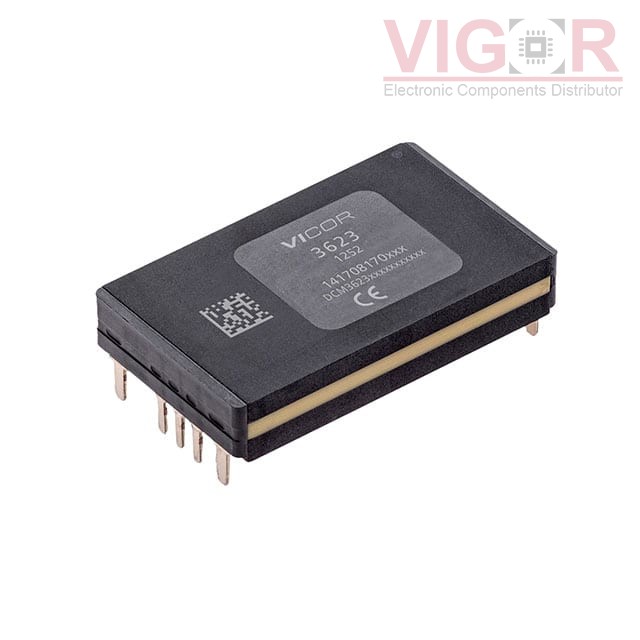
In many industrial and embedded systems, the power stage must also provide isolation, stable regulation, compact size, and predictable fault behavior. That is exactly where the DCM3623T75H26C2T00 fits, as an isolated, regulated converter module built for demanding 48V architectures.
The Vicor DCM3623T75H26C2T00 is designed to accept a wide 36V to 75V DC input and generate a nominal 24V isolated output. According to Vicor, it delivers up to 320W continuous output power and 13.34A continuous current, while reaching 91.8% peak efficiency in a compact 3623 ChiP package. For designers searching for a 48V to 24V DC DC converter module, this makes it a strong candidate in applications where density, efficiency, and system simplicity matter at the same time.
What Is DCM3623T75H26C2T00?
The DCM3623T75H26C2T00 is part of the Vicor DCM family of isolated and regulated DC-DC converter modules. It is not a controller IC or a reference design; it is a complete power conversion building block intended for direct system integration.
Its role is straightforward: convert a nominal 48V input bus into a stable 24V output while maintaining galvanic isolation between input and output. Vicor positions this product for systems that need compact power conversion with built-in protection and array capability, rather than a large discrete power stage.
In practical terms, this means the module can be used either as a standalone converter in systems up to 320W or as part of a scalable architecture with multiple modules in parallel. That flexibility is one reason the Vicor DCM module family is often considered in high-density power designs.
Key Specifications
This part is attractive for advanced power systems. It supports a continuous input range of 36V to 75V, which aligns well with nominal 48V infrastructure and gives margin for real-world bus variation.
The output is a nominal 24.0V rail, and Vicor specifies a trim range from 14.4V to 26.4V. The module provides up to 320W continuous output power and up to 13.34A continuous output current, which places it firmly in the isolated DC DC converter 320W class.
Peak efficiency is listed at 91.8%, while the package size is 38.72 mm x 22.8 mm x 7.21 mm. The device also provides 2250Vdc isolation and is optimized for array operation up to eight units.
| Parameter | Specification |
|---|---|
| Input voltage range | 36V to 75V |
| Nominal input | 48V architecture |
| Nominal output | 24.0V |
| Output trim range | 14.4V to 26.4V |
| Continuous output power | 320W |
| Continuous output current | 13.34A |
| Peak efficiency | 91.8% |
| Isolation | 2250Vdc |
| Package | 3623 through-hole ChiP |
How It Works
At the system level, the DCM3623T75H26C2T00 takes a wide DC input and converts it into an isolated regulated 24V output. Vicor states that the module uses a high-frequency ZVS, or zero-voltage switching, topology, which helps maintain high efficiency across the input range while supporting compact filtering and high power density.
The module also includes control and monitoring functions through its signal pins. The EN pin enables or disables the unit, the TR pin controls trim behavior, and the FT pin provides fault signaling when the powertrain stops. That allows the converter to fit into more advanced systems where power sequencing, supervision, and diagnostics are required.
Another important point is that the module is designed for array operation. Vicor explains that the defined load-line and temperature characteristics help support wireless current sharing between modules, which simplifies scaling compared with some custom parallel power designs.
Main Features and Benefits
These benefits matter because many engineers are not simply looking for a converter that works on paper. They need a module that reduces design risk, shortens development time, and behaves predictably under abnormal conditions. That is where Vicor DCM3623T75H26C2T00 gains practical value beyond raw wattage.
- High efficiency, with 91.8% peak efficiency specified by Vicor, helping reduce thermal loss in 320W designs.
- Wide input support from 36V to 75V, making it well suited to nominal 48V bus systems.
- Stable isolated 24V output for systems that need electrical separation between source and load.
- Compact 3623 ChiP package, enabling a high power density power module approach in space-constrained hardware.
- Up to 320W continuous power and 13.34A output current, giving meaningful power headroom in a small footprint.
- Support for arrays of up to eight units, allowing total power scaling to 2560W without output derating versus a single module.
- Built-in protections, including UVLO, OVLO, OVP, UVP, short-circuit protection, current limiting, and overtemperature protection.
- Signal-level integration through enable, trim, and fault pins, which simplifies system control and monitoring.
Typical Applications
- Industrial automation, where a 48V distribution bus often needs a regulated isolated 24V rail for controllers, I/O, and subsystem power.
- Process control equipment, where stable output and integrated fault protection support reliability in continuous operation environments.
- Communications hardware, where 48V is common and compact isolated conversion is often needed near the load.
- Heavy equipment, where robust power conversion and electrical protection are important under demanding operating conditions.
- Defense and aerospace-related platforms listed by Vicor as typical applications for this converter family.
- Distributed power systems that need a modular 48V to 24V DC DC converter module with scalable array capability.
- Systems that use the module as an intermediate bus stage before downstream point-of-load regulators, especially where tighter local regulation is required.
| Application Area | Why It Fits |
|---|---|
| Industrial automation | Supports 48V distribution and isolated 24V subsystem power |
| Process control | Combines regulation, protection, and compact integration |
| Communications equipment | Matches common telecom-style 48V architectures |
| Distributed power systems | Supports modular scaling through array operation |
Design Considerations
A good technical article should not stop at specs and benefits. Engineers also want to know what must be checked before design-in.
- Verify input source quality, because Vicor notes that excessive source impedance can create stability issues in regulated DC-DC converters.
- Ensure the input voltage slew rate stays below 1V/µs unless a pre-charge circuit is used, to prevent stress on the input stage.
- Plan for external output capacitance, since the module requires external capacitance for loop compensation; Vicor specifies 1000µF to 10000µF per module under stated conditions.
- Review startup conditions carefully, because the module reduces available output current during soft start until the output reaches the threshold needed for full load support.
- Evaluate thermal management early, especially in enclosed or airflow-limited systems, because compact modules still dissipate meaningful heat at high output levels.
- Consider PCB current paths, mounting, and thermal spreading, since high power density always shifts more design responsibility to layout and thermal execution.
- If using multiple units in parallel, verify array startup behavior, symmetry of layout, and downstream load interaction rather than assuming perfect current sharing in every implementation.
This is an important part of the selection process. A module can look ideal in a specification table but still perform poorly in the final system if input impedance, thermal path, or output capacitance are not handled correctly.
DCM3623T75H26C2T00 vs Other Power Modules
Compared with a non-isolated buck solution, the DCM3623T75H26C2T00 offers isolation, integrated fault behavior, and a more scalable modular architecture. A simpler buck stage may be acceptable in low-cost non-isolated designs, but it does not provide the same system-level separation and array-ready behavior documented by Vicor.
Compared with smaller lower-power modules, this part delivers a stronger balance between compact size and serious output capability. Its 320W continuous rating, 2250Vdc isolation, and array support make it more suitable for dense distributed power systems than many lower-power intermediate bus options.
The part should not be framed only as a “24V output converter,” but as a high power density power module designed for compact, isolated, and scalable 48V system architectures.
Learn More
- DCM3623T75H26C2T00 vs DCM3623T50M53C2T00
- DCM3623T75H26C2T00 vs DCM3623T36G26C2T00
- DCM3623T75H26C2T00 vs DCM3623T50M26C2M70
- DCM3623T75H26C2T00 vs DCM3623T36G31C2T00
Frequently Asked Questions
What makes DCM3623T75H26C2T00 different from a standard 48V buck converter?
The main difference is that this module provides galvanic isolation as well as regulation. It also integrates fault handling, trim control, and array operation support, making it more suitable for advanced modular systems than a simple non-isolated buck stage.
Can this module be used as an intermediate bus converter?
Yes. Vicor’s design guidance indicates that DCM modules can feed downstream DC-DC products, which makes them useful as an isolated intermediate bus stage when tighter point-of-load regulation is needed later in the power tree.
Why does the datasheet emphasize array operation?
Because this is one of the product’s key architectural advantages. Vicor specifies that up to eight units can be qualified in parallel for 2560W total capacity, allowing designers to scale power without switching to a completely different converter platform.
What is the most overlooked design risk with this module?
Input stability is often underestimated. Vicor specifically warns that excessive source impedance can lead to system stability problems, which means cable effects, source characteristics, and local input filtering all deserve attention early in the design process.
Does trim only change output voltage, or does it affect other behavior?
Trim does more than adjust voltage. The datasheet notes that when the module is trimmed above nominal output voltage, the current-limit threshold is reduced to preserve safe operating conditions, so trim settings can influence usable power behavior.
Is this product best for direct load powering or for multi-stage architectures?
It can support both, but the best fit depends on the load. For direct 24V loads, the module offers a compact isolated regulated rail. For more complex systems, it can also serve as a building block ahead of downstream regulators, which is often the better approach when tighter regulation or multiple secondary rails are required.