
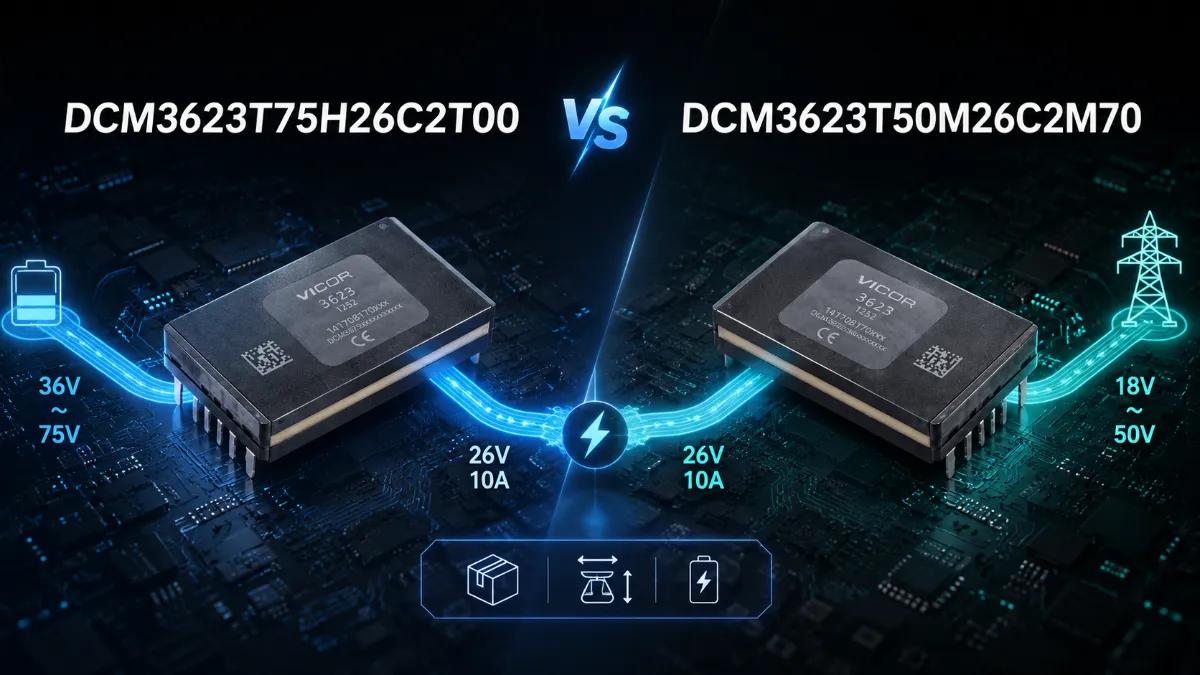
In advanced power system design, selecting a DC-DC converter goes far beyond simply matching the output voltage and power ratings. When hardware engineers and strategic sourcing managers evaluate the Vicor DCM3623 series, the DCM3623T75H26C2T00 and DCM3623T50M26C2M70 frequently appear in cross-reference discussions. Both modules deliver a highly regulated 24V output at 320W within the exact same physical footprint.
However, beneath the surface, these two converters are engineered for radically different operational realities. This guide provides a deep technical comparison of their input architectures and thermal grading, helping project teams avoid critical supply chain and design errors.
Critical Specification Analysis
Before diving into system-level integrations, engineers must verify the baseline electrical and environmental parameters. The table below highlights the critical divergences:
| Specification Parameter | DCM3623T75H26C2T00 | DCM3623T50M26C2M70 |
|---|---|---|
| Input Voltage Range | 36 V to 75 V | 16 V to 50 V |
| Nominal Input Bus | 48 Vdc | 28 Vdc (or 24 Vdc) |
| Rated Output Voltage | 24 Vdc | 24 Vdc |
| Maximum Output Power | 320 W | 320 W |
| Max Continuous Output Current | 13.33 A | 13.33 A |
| Temperature Grade | T-Grade | M-Grade |
| Operating Internal Temp | -40°C to 125°C | -55°C to 125°C |
| Package Configuration | 3623 ChiP | 3623 ChiP |
Input Voltage Window Differences
While both modules output 24V, their primary-side switching architectures are designed for distinct upstream power buses:
- DCM3623T75H26C2T00 (36-75V Input): This module is strictly designed for the 48V telecommunications and data center ecosystem. Its 36V Under-Voltage Lockout (UVLO) and 75V Over-Voltage Lockout (OVLO) thresholds are optimized to ride through standard telecom battery plant fluctuations and PoE (Power over Ethernet) transient surges.
- DCM3623T50M26C2M70 (16-50V Input): This module targets 28V MIL-STD or 24V heavy industrial applications. The ability to maintain a full 24V output even when the input sags to 16V is a massive engineering advantage for systems relying on degraded battery banks or experiencing severe engine-cranking voltage drops.
Attempting to substitute one for the other without redesigning the upstream AC-DC or battery stage will result in either immediate system shutdown (triggering UVLO) or catastrophic component failure (triggering OVLO).
T-Grade vs M-Grade Temperature Ratings
The most crucial difference hidden in the part numbers—and the primary driver of cost and availability—is the temperature grade suffix.
The T75H26 features a T-Grade rating, guaranteeing reliable internal junction operation from -40°C up to 125°C. This is the industry standard for commercial outdoor equipment, industrial automation, and standard 5G base stations.
The T50M26C2M70 features an M-Grade rating, certified for extreme environments from -55°C to 125°C. Achieving this rating requires Vicor to use specialized extreme-temperature silicon, distinct thermal adhesives, and undergo rigorous MIL-STD-level burn-in testing. At -55°C, standard capacitors lose capacitance, and semiconductor electron mobility changes drastically. The M-Grade module is engineered to prevent cold-start failures in these punishing conditions.
Industrial vs Harsh Environment Applications
The combination of input voltage and temperature grading dictates the ultimate end-use application for these converters:
- When to use the T75H26: Standard telecom racks, indoor robotics, commercial security camera networks, and enterprise IT infrastructure. If your system runs on 48V and stays above -40°C, the T-Grade module is the most cost-effective and readily available choice.
- When to use the T50M26C2M70: Aerospace systems, high-altitude UAVs, military ground vehicles (which natively use 28V bus architectures), and arctic exploration equipment. In these scenarios, the 16-50V input accommodates the dirty, noisy 28V generator power, while the -55°C rating guarantees mission-critical startup in sub-zero deployments.
Mechanical Integration and Footprint
Despite their internal differences, both converters utilize Vicor’s standard 3623 ChiP (Converter housed in Package) technology. This identical 38.72mm x 22.8mm mechanical footprint provides significant advantages for hardware teams.
Engineers can design a universal PCB mechanical layout. As long as the primary-side copper traces are rated for the higher input current of the 16-50V module, the same physical heatsinks, mounting clips, and thermal interface materials (TIM) can be reused across both commercial (T-Grade) and defense (M-Grade) product lines, streamlining the manufacturing process.
Alternate Sourcing Solutions from Vigor Components
Sourcing M-Grade components or specific voltage variants often involves navigating allocation constraints and extensive factory lead times. When critical projects stall due to Vicor module shortages, strategic procurement teams need a reliable independent channel.
Vigor Components (https://www.vigorcomp.com/) serves as a premier global independent distributor of high-reliability electronic components. We specialize in securing difficult-to-find, extreme-environment (M-Grade) and commercial (T-Grade) power modules. Our engineering-backed procurement process ensures that you never receive an incompatible voltage variant disguised as a drop-in replacement. With rigorous counterfeit mitigation and comprehensive quality control, Vigorcomp empowers your supply chain to meet strict production deadlines with authentic, fully traceable components.
Frequently Asked Questions
Can I use the M-Grade (T50M26C2M70) module in a standard room-temperature application?
Yes. The M-Grade module exceeds T-Grade specifications and will perform flawlessly at room temperature. However, M-Grade parts are significantly more expensive due to their military-tier testing. It is overkill for standard commercial applications unless you are facing a severe T-Grade shortage.
Why does the M-Grade module support a 16-50V input instead of 36-75V?
M-Grade modules are heavily utilized in aerospace and defense, where the standard intermediate power bus is 28V DC (per MIL-STD-1275 or MIL-STD-704), not the 48V DC standard used in telecommunications.
Is the thermal management approach the same for both modules?
Mechanically, yes, you can use the same top-side or bottom-side heatsinks. However, thermally, the T50M26C2M70 operating at a low 16V input will draw higher input current than the T75H26 at 48V, potentially generating more primary-side localized heat. Always consult the specific derating curves for your worst-case input voltage.