
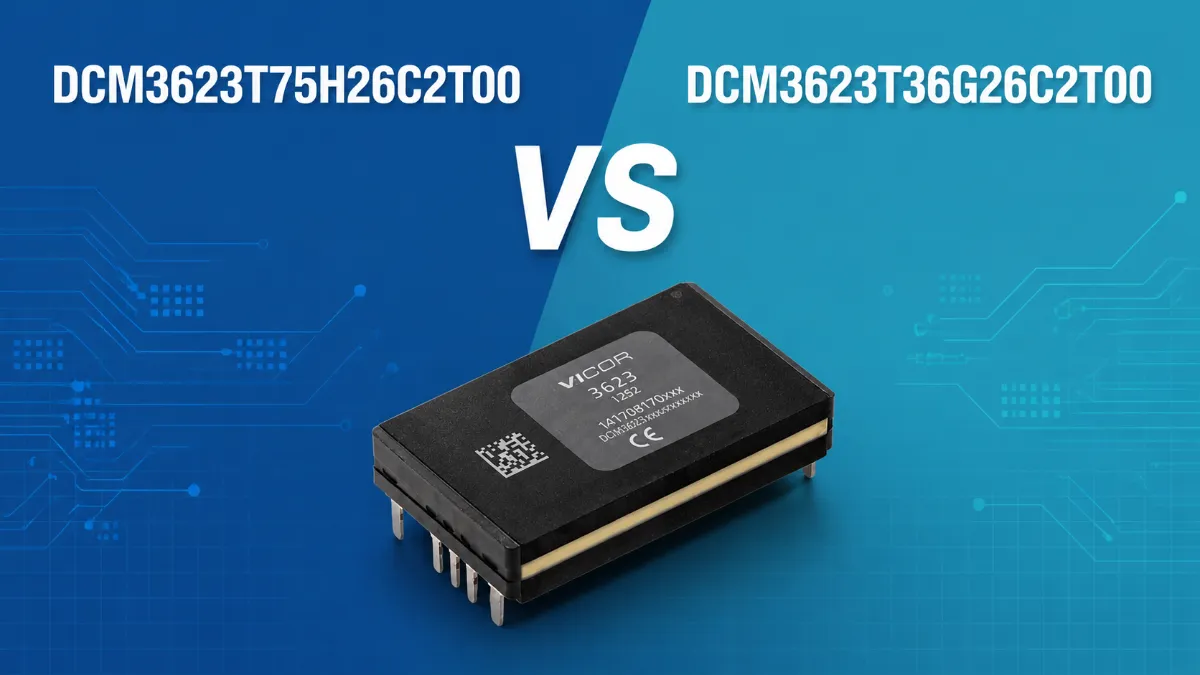
In the realm of high-density power architecture, selecting the right DC-DC converter dictates the stability and reliability of the entire system. Within Vicor’s DCM3623 series, the DCM3623T75H26C2T00 and DCM3623T36G26C2T00 are frequently compared. Both modules share the exact same 3623 ChiP footprint and deliver an identical 24V output at 320W. However, their input stage designs are engineered for entirely different upstream power environments.
This technical guide provides hardware engineers and procurement specialists with a rigorous analysis of their input voltage differences, system-level impacts, and strict supply chain substitution rules.
Key Specification Comparison for Engineers
To understand the core divergence between these two modules, we must look at the primary-side electrical specifications. Below is the side-by-side data:
| Parameter | DCM3623T75H26C2T00 | DCM3623T36G26C2T00 |
|---|---|---|
| Input Voltage Range | 36 V to 75 V | 18 V to 36 V |
| Nominal Input Bus | 48 Vdc | 24 Vdc |
| Rated Output Voltage | 24 Vdc | 24 Vdc |
| Maximum Output Power | 320 W | 320 W |
| Max Continuous Output Current | 13.33 A | 13.33 A |
| Package Configuration | 3623 ChiP (Through-hole) | 3623 ChiP (Through-hole) |
| Temperature Grade | T-Grade (-40°C to 125°C) | T-Grade (-40°C to 125°C) |
48V vs 24V Input Bus Compatibility
The sole defining difference between these two modules is their input voltage window. This parameter dictates which upstream power architecture the module is compatible with.
- DCM3623T75H26C2T00 (36-75V Input): This module is designed for the standard telecom, data center, and PoE (Power over Ethernet) environments operating on a nominal 48V bus. Its wide 36-75V range allows it to handle the typical voltage sags and surges inherent in long-distance 48V distribution networks.
- DCM3623T36G26C2T00 (18-36V Input): This module is tailored for legacy industrial automation, robotics, and commercial 24V battery systems. It efficiently regulates a nominal 24V primary bus to a highly stabilized 24V output, acting as a powerful isolation and stabilization stage.
Expert Engineering Insight:
Engineers shouldn't just look at nominal 24V or 48V when selecting. You must match the Vicor input window based on the actual worst-case fluctuation of the upstream bus. If the chosen input window is too narrow, sudden upstream load transients can easily trigger Under-Voltage Lockout (UVLO) or Over-Voltage Lockout (OVLO), ultimately causing catastrophic equipment downtime.
Security Camera Power System Design Tradeoffs
In demanding B2B applications such as outdoor security cameras and PTZ (Pan-Tilt-Zoom) surveillance networks, power design is critical. These systems often rely on long cable runs from a central power matrix, leading to severe voltage drops (IR drop) across the wire.
When a high-power PTZ motor suddenly engages, or when infrared illuminators turn on in freezing conditions, the instantaneous current draw pulls the upstream voltage down significantly.
If the surveillance system runs on a 48V PoE++ or centralized bus, the T75H26 is the correct choice, as its UVLO won't trigger until the bus drops below 36V.
If the system operates on a localized 24V battery backup or industrial rail, the T36G26 guarantees that even if the battery discharges down to 18V, the camera's internal 24V electronics remain perfectly powered. Selecting the wrong input range here guarantees system resets during critical surveillance events.
Thermal Design and System Impact
Because both modules output 320W, the thermal dissipation on the secondary (output) side is nearly identical. However, the thermal and mechanical footprint on the primary (input) side varies drastically due to the difference in input voltage.
Power is the product of voltage and current ($$P = V \times I$$). Because the DCM3623T36G26C2T00 operates at half the input voltage (nominal 24V) of the T75H26 (nominal 48V), it must draw roughly twice the input current to achieve the same 320W output.
This requires PCB designers using the T36G26 to implement significantly thicker copper pours (2oz or 3oz) on the primary side, wider input traces, and superior thermal via structures near the input pins to mitigate localized $$I^2R$$ heating. You cannot simply use the same PCB layout for both modules.
Drop-in Replacement Feasibility Check
For procurement teams facing supply chain shortages, it is vital to understand that these two modules are not drop-in replacements for one another.
If a BOM specifies the T75H26 (48V input), substituting it with the T36G26 (24V input) will expose the replacement module to 48V. This exceeds the 36V absolute maximum rating of the T36G26, resulting in immediate over-voltage destruction of the component upon power-up.
Conversely, placing a T75H26 into a 24V system will simply fail to turn on, as the 24V bus cannot overcome the 36V startup threshold. Any substitution requires a fundamental redesign of the upstream power supply.
Optimize Supply Chain with Vigor Components
Sourcing high-performance power modules like the Vicor DCM series requires a supply chain partner with deep technical expertise. Relying on unauthorized brokers for hard-to-find parts often leads to procuring the wrong voltage variants or counterfeit components.
Vigor Components is a premier global independent distributor of electronic components. We empower hardware R&D and strategic purchasing teams with traceable, high-quality components. Our engineering-driven approach means we understand the critical difference between a 36-75V and an 18-36V input window. We help you avoid costly BOM mismatches, mitigate EOL (End of Life) risks, and secure reliable inventory for your mission-critical designs. When lead times stretch, Vigorcomp delivers the exact authentic components your schematics demand.
Frequently Asked Questions
Both modules deliver 24V at 320W. Why can't I swap them if the output matches my load?
The modules are incompatible because their input stages require different voltages. The T75H26 expects 36-75V from your system bus, while the T36G26 expects 18-36V. Swapping them will result in either failure to power on (UVLO) or immediate hardware destruction (OVLO).
Will the physical PCB footprint need to change if we redesign our board to use the T36G26 instead of the T75H26?
The mechanical dimensions (3623 ChiP) and pinouts are identical. However, the PCB copper traces on the input side must be redesigned. The T36G26 draws twice as much input current, requiring wider traces and enhanced thermal management at the input pins.
How do I know which module is right for my battery-backed system?
Calculate the maximum float charge voltage and the minimum discharge cutoff voltage of your battery bank. If your battery array swings between 20V and 28V, the T36G26 is required. If it swings between 40V and 56V, the T75H26 is the correct part.