
The global memory market is currently experiencing one of the most aggressive supply squeezes in recent history. As top-tier foundries aggressively reallocate their wafer capacity toward AI-driven High Bandwidth Memory (HBM) and server-grade DDR5, legacy DDR4 prices have surged by 50% to 70%, with lead times stretching dangerously long.
For procurement and supply chain managers, the challenge is no longer just negotiating the best price—it is securing the allocation necessary to keep production lines running. This guide provides actionable procurement strategies to navigate the 2026 DDR4 shortage, establish secure buffer stocks, and safely transition to alternative memory sources without compromising quality.
Analyzing the 2026 DDR4 Price Surge
The current price surge is fundamentally a structural capacity issue, not a temporary market fluctuation. Major memory makers are actively scaling down their mainstream 8Gb and 16Gb DDR4 production lines. With roughly 60% to 70% of new capacity investments funneled into HBM and DDR5 to feed AI data centers, the traditional supply-demand balance for DDR4 has collapsed.
This capacity shift has created a severe bottleneck for non-AI sectors. Industrial, automotive, and networking hardware manufacturers are now competing for a rapidly shrinking pool of DDR4 inventory. Consequently, spot market prices have inflated drastically, and franchised distributors are placing long-standing customers on strict allocation, forcing procurement teams to rethink their entire sourcing playbook.
The Dangers of Panic Buying on Spot Markets
When official lead times extend beyond 20 weeks, the knee-jerk reaction for many procurement teams is to turn to the open spot market. However, panic buying carries significant financial and operational risks.
Spot market brokers often capitalize on shortages by adding 30% to 50% premiums on legacy memory chips. More alarmingly, the grey market becomes flooded with refurbished, remarked, or improperly stored components during extreme shortages. Purchasing from unvetted sources to quickly close a BOM gap can lead to catastrophic line-down situations or field failures, costing far more than the initial spot market premium.
Strategy 1: Locking in Last Time Buys (LTB)
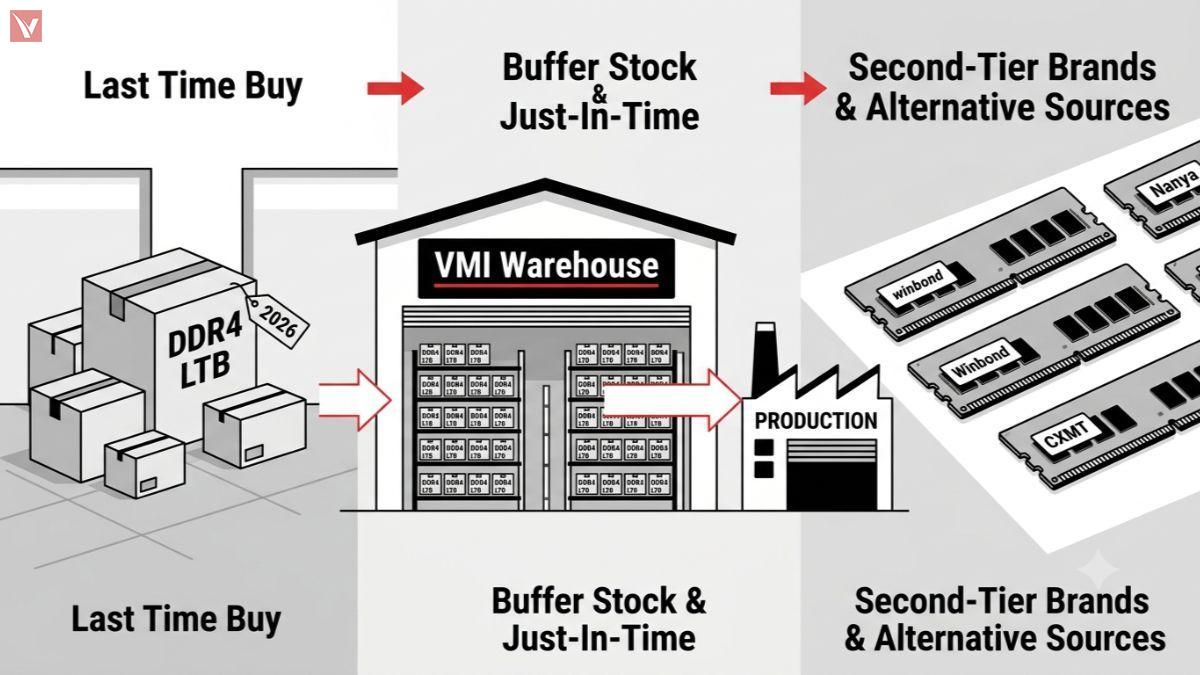
Your immediate, frontline defense against the impending DDR4 End-of-Life (EOL) is maximizing the Last Time Buy (LTB) window provided by original component manufacturers. However, executing a successful LTB is far more complex than simply placing a massive purchase order. It requires precision forecasting and tight cross-departmental alignment.
-
Align with Engineering and Sales: Procurement cannot operate in a silo. You must work closely with hardware engineering and sales teams to accurately forecast the product's remaining lifecycle demand. Overestimating leaves you with dead stock; underestimating leads to premature product termination. Calculate your run rates, expected RMA (Return Merchandise Authorization) volumes, and field service repair needs for the next 3 to 5 years.
-
Secure Upfront Capital: LTB orders usually require significant financial commitment. You must ensure your CFO and finance teams allocate the necessary budget to purchase 12 to 24 months of inventory upfront. Be aware that the LTB window is incredibly strict—for many Samsung and Micron DDR4 lines, final orders must be placed by early to mid-2026, with no exceptions.
-
Negotiate Phased Deliveries: Taking delivery of two years' worth of memory chips all at once creates a logistical nightmare for your warehouse and ties up liquid capital. Negotiate with your primary distributors to schedule staggered delivery dates (e.g., quarterly drops) for your LTB orders. This reduces immediate storage burdens and limits exposure to inventory degradation or environmental damage.
Strategy 2: Establishing Buffer Stock & VMI
If an LTB requires too much upfront capital, or if your demand forecasting is highly volatile, the most strategic alternative is setting up Vendor Managed Inventory (VMI) with a trusted independent distributor.
VMI programs fundamentally shift the financial and logistical burden from your company to the distributor. In this model, the distributor leverages its own capital to source and purchase the required LTB volume from the open market or directly from fabs. They then hold this dedicated buffer stock of your critical DDR4 SKUs in their climate-controlled, AS6081-certified warehouses. You only pay for the inventory as it is pulled and shipped to your production line.
This strategy acts as a massive shock absorber against sudden price spikes, unpredictable allocation cuts, and extended lead times. To clearly illustrate the operational advantages, here is a breakdown of traditional sourcing versus VMI:
| Procurement Factor | Traditional LTB Sourcing | VMI via Independent Distributor |
|---|---|---|
| Capital Expenditure | High upfront cost; cash is tied up in long-term inventory. | Pay-as-you-pull; preserves cash flow and working capital. |
| Storage & Handling | Requires in-house climate-controlled warehousing and security. | Handled entirely by the distributor in certified facilities. |
| Market Risk | High risk of holding obsolete or excess inventory if demand drops. | Flexible terms; distributor can often remarket excess stock globally. |
| Lead Time | Subject to factory delays and staggered shipping limits. | Zero lead time; buffer stock is pre-positioned for immediate dispatch. |
Strategy 3: Qualifying Second-Tier Brands
Top-tier manufacturers like Samsung, SK Hynix, and Micron are the first to exit the DDR4 market because their massive fabs must transition to cutting-edge AI nodes. However, they are not the only players in the memory ecosystem. Procurement managers must drive their engineering teams to qualify second-source alternatives immediately.
Manufacturers such as Nanya, Winbond, and emerging domestic Chinese memory foundries (like CXMT) operate with different business models. They often specialize in supporting the "long tail" of industrial, automotive, and embedded markets, meaning they maintain legacy DDR production lines much longer than the industry giants.
Transitioning to a second-tier brand is not a downgrade in quality, but it does require rigorous technical validation. Procurement must push engineering to initiate:
-
Pin-to-Pin Compatibility Checks: Ensuring the alternative die fits the existing PCB footprint (e.g., 288-pin or 260-pin SO-DIMM formats) without a costly hardware redesign.
-
Timing and Firmware Validation: Verifying that CAS latency, voltage tolerances (strictly 1.2V for DDR4), and timing parameters match the host SoC's memory controller.
While switching brands requires upfront engineering hours, qualifying a second-tier DDR4 chip today will ensure you have a viable, cost-effective supply chain long after the tier-one foundries have moved on.
How to Avoid Counterfeit Memory Chips
As DDR4 becomes scarcer, counterfeiters become more sophisticated. You must ensure that any alternative supply chain partner adheres to rigorous quality assurance protocols.
When sourcing obsolete or hard-to-find memory, only partner with distributors who comply with the AS6081 counterfeit mitigation standard. Your partner should have in-house testing labs capable of performing visual inspections, X-ray analysis, decapsulation, and curve tracing. A documented chain of custody and a 100% quality guarantee are non-negotiable when navigating a shortage market.
Partnering with Independent Distributors
Franchised distributors are highly effective during normal market conditions, but they are bound by the manufacturer's EOL schedules. When the factory stops making DDR4, franchised channels dry up.
Global independent electronic component distributors operate differently. By leveraging vast global sourcing networks, analyzing excess OEM inventories worldwide, and maintaining deep safety stocks, independent distributors serve as the ultimate safety net. They bridge the gap between when a franchised distributor runs out of stock and when your engineering team finally completes a DDR5 platform redesign.
Don't let DDR4 price surges and allocation limits disrupt your production.
At Vigor Components, we specialize in resolving critical supply chain bottlenecks. As a certified global independent distributor, we provide authentic, fully tested DDR4 memory, customized VMI solutions, and expert cross-referencing for alternative brands.。
Contact US →Frequently Asked Questions
How to handle electronic component shortages?
The best approach combines immediate LTB forecasting, establishing VMI programs for buffer stock, and aggressively qualifying secondary brands to diversify your supply chain.
What is Vendor Managed Inventory (VMI)?
VMI is a supply chain agreement where a distributor holds and manages the inventory of specific components for a customer, allowing the customer to pull stock just-in-time and preserve cash flow.
How to spot counterfeit memory chips?
Counterfeit chips can be identified through rigorous lab testing, including X-ray imaging for wire bond consistency, decapsulation to verify the die manufacturer, and chemical testing for remarked surfaces.
How to negotiate memory chip allocations?
Provide accurate long-term forecasts to your distribution partners, commit to scheduled blanket orders, and leverage independent distributors to supplement shortfalls from franchised channels.
What are the best alternative DDR4 brands?
For legacy and industrial applications, brands like Nanya, Winbond, and CXMT often provide extended lifecycle support compared to top-tier foundries like Samsung or Micron.
When will the chip shortage end?
For legacy memory like DDR4, the "shortage" is permanent due to EOL transitions. For the broader memory market, supply will remain tight as long as AI data center demand continues to outpace new fab construction.