Memory upgrades often look simple on paper, but the real choice between DDR4 and DDR5 depends on far more than raw speed. The outline for this article centers on technical evolution, architecture, real-world performance, budget tradeoffs, and supply-chain impact, so the discussion below follows that structure closely while addressing both end users and hardware buyers.
Technical Evolution From DDR3 to DDR5 Memory Systems
To understand what is DDR4 vs DDR5, it helps to first evaluate the different types of memory RAM and the broader evolutionary path from DDR3 to DDR5.
DDR memory evolves in generations because modern processors, chipsets, and workloads place increasing pressure on bandwidth, power efficiency, module density, and signal integrity. Each generation is not just “faster RAM”; it is a coordinated redesign involving the memory controller, motherboard layout, operating voltage, module architecture, and supported capacities.
DDR3 vs DDR4 vs DDR5
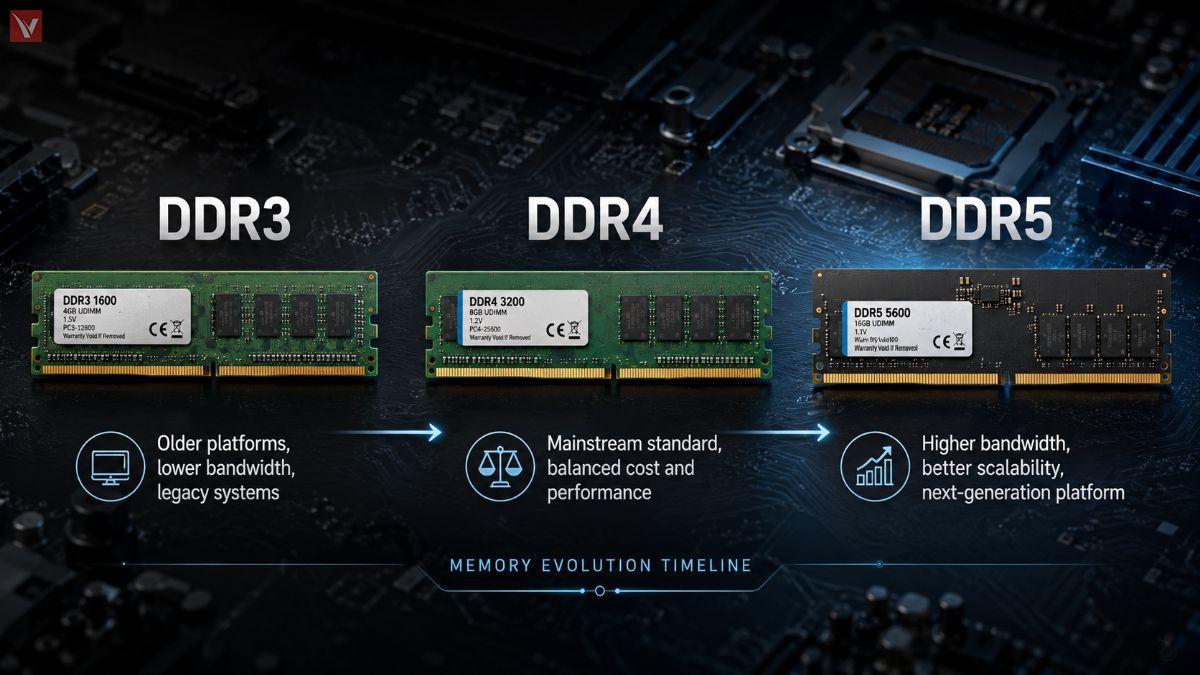
In the timeline, DDR3 represented the era of lower data demand and simpler multitasking environments. It served mainstream desktops, laptops, and embedded platforms well for many years, but its bandwidth ceiling, lower density options, and aging platform compatibility eventually limited its relevance in newer systems.
DDR4 then became the long-standing mainstream standard. Compared with DDR3, it improved transfer rates, supported larger capacities, reduced operating voltage, and delivered a better balance between cost, reliability, and platform maturity. That is why DDR4 remains widely respected today—not as an obsolete technology, but as a mature, stable, and budget-friendly memory standard that still performs effectively in a large number of systems.
DDR5 is the next step in that same pattern. Rather than being only a frequency upgrade, DDR5 introduces deeper architectural changes designed to improve bandwidth scaling, module density, and power management for newer CPUs, advanced gaming systems, workstations, and future-facing infrastructure. The document’s outline specifically emphasizes helping readers see the underlying logic of generational change, and DDR5 fits that role as the new platform for higher-performance and higher-capacity designs.
-
DDR3 was built for older platforms and lighter memory demands.
-
DDR4 became the dependable mainstream standard for years because it offered a strong mix of cost, compatibility, and real-world performance.
-
DDR5 is designed for higher bandwidth, larger module capacities, and newer system architectures.
That is why ddr3 vs ddr4 vs ddr5 is not just a comparison of numbers. It is really a story about how memory standards evolve to match processor development, software complexity, and long-term hardware roadmaps.
Differences Between DDR4 and DDR5
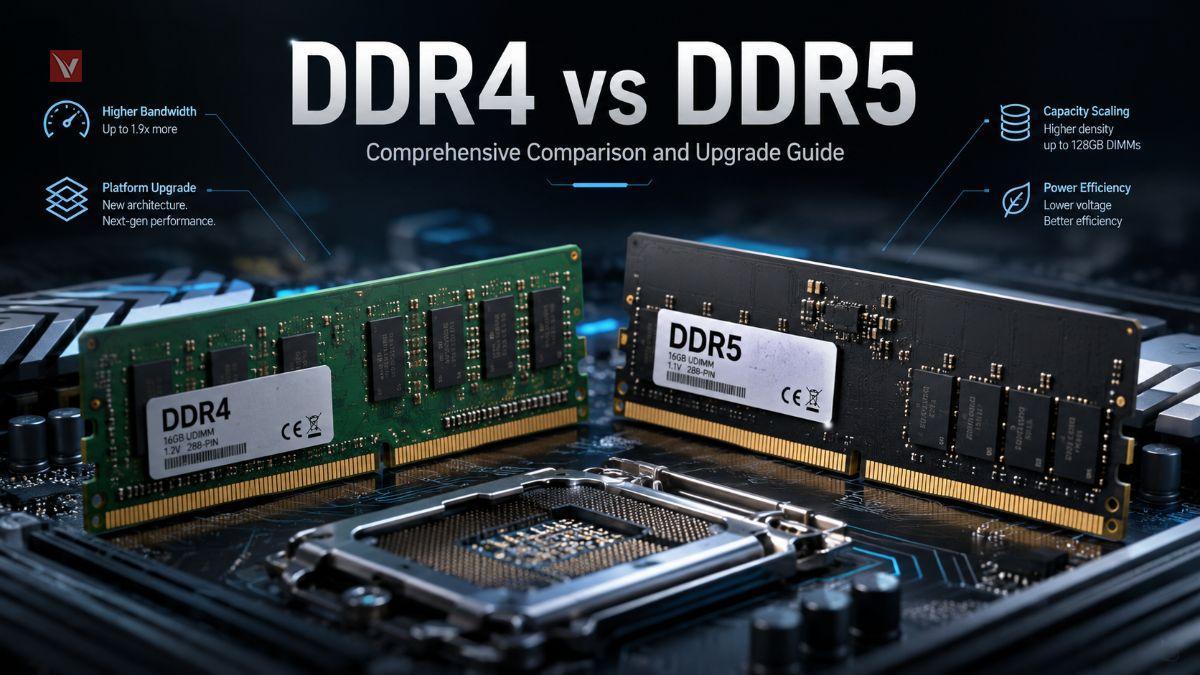
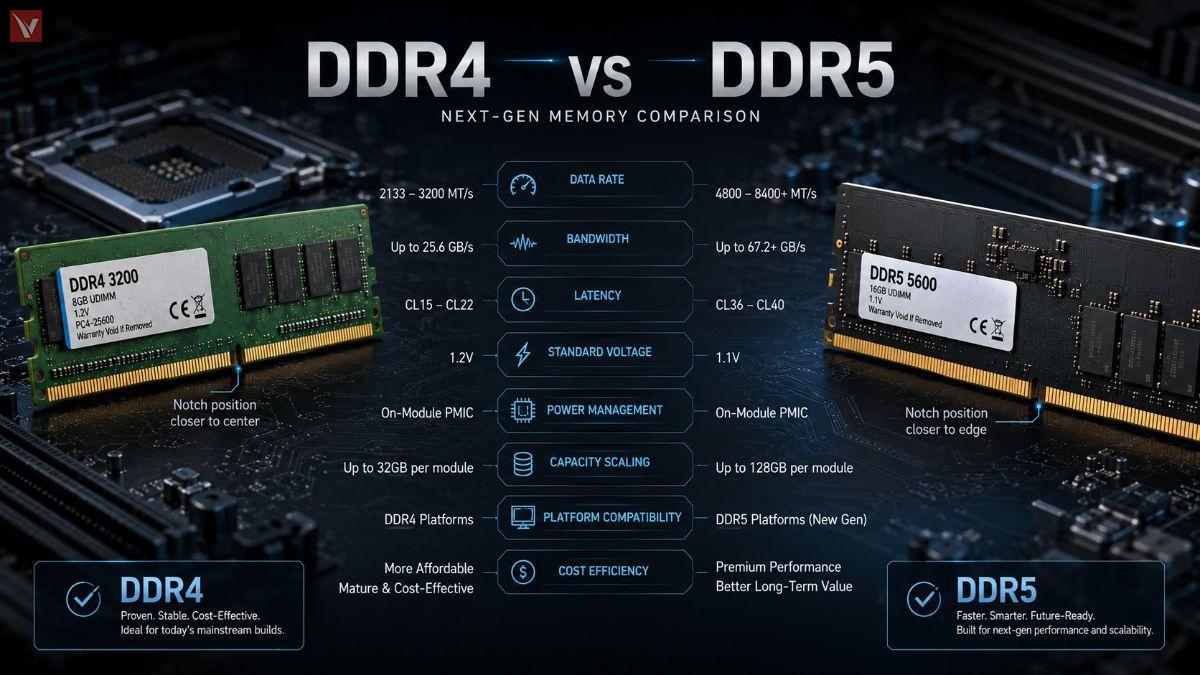
When comparing DDR4 and DDR5, the real difference is not just about one being “older” and the other “newer.” The two memory generations differ in data rate, bandwidth efficiency, voltage behavior, power architecture, module density, and platform compatibility, which means the right choice depends on workload needs, upgrade goals, and total system budget.
For readers asking what is ddr4 vs ddr5, the simplest answer is this: DDR4 is a mature and cost-effective memory standard that still performs well in mainstream systems, while DDR5 is a next-generation standard designed to deliver higher bandwidth, better scalability, and stronger long-term platform relevance.
DDR4
-
Clock Speed: Standard DDR4 memory typically starts at 2133 MT/s and commonly scales through 2400, 2666, 2933, and 3200 MT/s in mainstream systems. Some enthusiast-grade DDR4 modules can run far beyond JEDEC standard speeds through XMP or overclocking, but 3200 MT/s remains the common reference point for stable consumer performance.
-
Bandwidth: A typical DDR4-3200 module provides a theoretical peak bandwidth of 25.6 GB/s per 64-bit channel. This is enough for mainstream gaming, office workloads, standard industrial computing, and many content creation tasks, but it can become a limitation in memory-intensive workloads that depend heavily on high sustained data throughput.
-
Latency: One reason DDR4 remains competitive in real-world use is its relatively mature latency profile. Many DDR4 kits operate with well-optimized timings, and lower latency can help offset some of the raw bandwidth gap versus DDR5, especially in applications where fast response time matters more than maximum transfer rate.
-
Voltage: DDR4 generally operates at 1.2V in standard configurations, with higher voltage often used on performance or overclocked kits. This makes DDR4 reasonably efficient, while also benefiting from years of platform tuning and stable motherboard support.
-
Capacity and Density: DDR4 supports practical capacities that are still more than sufficient for many desktops, laptops, embedded systems, and industrial platforms. In the consumer market, 16GB and 32GB DDR4 configurations remain highly common, and they continue to offer excellent value in budget-to-midrange builds.
-
Power Management Design: In DDR4 systems, power regulation is handled primarily at the motherboard level. This design is well understood, mature, and reliable, but it offers less granular onboard power control than DDR5.
Advantages: DDR4’s biggest strengths are maturity, affordability, broad compatibility, and strong price-to-capacity value. It is especially attractive for users who already own a DDR4-compatible platform or for buyers who want stable performance without paying a premium for next-generation memory technology.
Disadvantages: DDR4’s main limitation is its lower performance ceiling compared with DDR5. It offers lower bandwidth, lower density scalability, and less long-term upgrade headroom for users building a new system around the latest CPU and motherboard ecosystems.
DDR5
-
Clock Speed: DDR5 starts at significantly higher effective data rates than DDR4 and is designed for much broader scaling in future platforms. Mainstream DDR5 kits already operate at speeds that clearly exceed standard DDR4, and higher-end modules continue pushing that ceiling further for gaming, creation, AI-adjacent workloads, and high-performance desktop systems.
-
Bandwidth: The biggest headline advantage of DDR5 is bandwidth. Because DDR5 is built for higher transfer rates, it can provide substantially more theoretical throughput per module than DDR4, which helps newer processors stay fed with data in demanding applications such as high-refresh gaming, professional creation, large asset workflows, and heavy multitasking.
-
Latency: DDR5 often has higher absolute latency numbers on paper than DDR4, which can confuse first-time buyers. However, those raw timing figures do not tell the whole story, because DDR5 compensates with much higher transfer rates and architectural improvements, so overall platform performance can still be better in many modern systems.
-
Voltage: Standard DDR5 typically operates at a lower base voltage than DDR4, improving power efficiency at the memory standard level. This matters more in long-term platform evolution, dense computing environments, and thermally sensitive designs than it does in casual desktop use alone.
-
Capacity and Density: DDR5 significantly improves memory density potential, allowing larger-capacity modules and better scalability for future systems. This makes DDR5 especially appealing for workstations, servers, advanced desktops, and applications where memory expansion and long lifecycle planning matter.
-
Power Management Design: One of DDR5’s more meaningful architectural upgrades is that power management shifts closer to the module itself through onboard PMIC-related design. This improves power delivery control and supports the needs of higher-speed operation, though it also contributes to greater design complexity and cost.
Advantages: DDR5 offers higher bandwidth, stronger scalability, lower standard voltage, better long-term upgrade potential, and closer alignment with modern CPU and motherboard platforms. For users building an all-new system, DDR5 often represents the more future-ready investment.
Disadvantages: DDR5’s drawbacks are mainly cost and platform dependency. It usually requires a newer motherboard and processor, and while prices have become more competitive over time, total migration cost is still often higher than simply staying with DDR4.
Key Technical Comparison
| Specification | DDR4 | DDR5 |
|---|---|---|
| Typical Starting Data Rate | 2133 MT/s | Higher than DDR4 baseline, with much broader scaling |
| Mainstream Performance Tier | Up to 3200 MT/s commonly used | Commonly exceeds DDR4 mainstream speed levels |
| Theoretical Bandwidth | Lower | Higher |
| Latency Characteristics | Mature and often tighter timings | Higher raw latency numbers, but offset by architecture and speed |
| Standard Voltage | 1.2V | Lower than DDR4 standard voltage |
| Power Management | Handled mainly by motherboard | More advanced onboard power management approach |
| Capacity Scaling | Good for mainstream systems | Better for higher-density and future platforms |
| Platform Compatibility | DDR4-supported motherboards and CPUs only | DDR5-supported motherboards and CPUs only |
| Cost Efficiency | Usually better value | Usually higher total platform cost |
| Best Fit | Budget builds, upgrades, mature systems | New builds, premium systems, long-term planning |
Practical Interpretation
In practical terms, DDR4 is still an excellent choice for users who prioritize budget, proven stability, and higher memory capacity at a lower cost. That is why comparisons like 8gb ddr5 vs 16gb ddr4 or 16gb ddr5 vs 32gb ddr4 often favor the larger DDR4 option in real multitasking scenarios, because insufficient memory capacity usually hurts performance more than a generational speed advantage.
DDR5, however, is the stronger option for buyers building on the latest platforms and planning for longer upgrade cycles. If the goal is better bandwidth, improved scalability, and stronger future relevance, DDR5 is the clear direction of the market, while DDR4 remains the smarter value solution for many current systems.
Balancing Capacity and Speed for Budget Hardware Builds
In many everyday workloads, capacity has a stronger effect on overall smoothness than memory generation alone, especially when users run multiple browser tabs, office apps, communication tools, creative software, or games alongside background processes.
If a system runs out of RAM, it begins relying more heavily on storage-based paging or swapping, which creates noticeable lag, loading delays, and inconsistent responsiveness. That is why, in budget builds, a larger-capacity DDR4 kit can often produce a better user experience than a smaller-capacity DDR5 kit, even if DDR5 is theoretically faster.
For example, the practical answer to 8gb ddr5 vs 16gb ddr4 is that 16GB DDR4 is often the safer mainstream choice for multitasking and gaming comfort. While 8GB DDR5 may look newer on the spec sheet, 8GB total capacity can become restrictive quickly in modern usage scenarios.
| Scenario | 8GB DDR5 | 16GB DDR4 |
|---|---|---|
| Basic office work | Usable, but limited for heavier multitasking | More comfortable and consistent |
| Web browsing with many tabs | Can become constrained quickly | Handles larger tab counts better |
| Mainstream gaming | Playable in lighter cases, but easier to bottleneck | Usually smoother overall experience |
| Multitasking | Limited headroom | Clearly better |
| Longer-term usability | Better platform generation | Better practical memory capacity |
Likewise, 16gb ddr5 vs 32gb ddr4 often depends on workload type. For lighter gaming or basic office use, 16GB DDR5 can still be acceptable on a newer platform, but for heavier multitasking, large project files, virtual machines, code compilation, or content creation, 32GB DDR4 can deliver a more consistently smooth experience because it reduces memory pressure far more effectively.
| Scenario | 16GB DDR5 | 32GB DDR4 |
|---|---|---|
| Mainstream home use | Very capable | More than enough |
| Modern gaming | Strong on newer platforms | Excellent when games and background tasks use more memory |
| Heavy multitasking | Good, but can hit limits | Much stronger headroom |
| Content creation | Adequate for moderate workloads | Better for larger projects |
| Workstation-style usage | Limited for demanding tasks | Usually the more practical option |
| Platform future-proofing | Better | Weaker |
A useful rule for budget-conscious builders is this:
- If your workload is light and you want a newer platform, smaller DDR5 may still be reasonable.
- If your workload regularly pushes memory usage, prioritize capacity before chasing memory speed.
- If you already own a DDR4 platform, upgrading to more DDR4 memory may offer better value than migrating everything to DDR5.
When memory is insufficient, the performance penalty is often severe and obvious; when memory speed is lower, the penalty is often smaller and more workload-dependent. That is exactly the tradeoff the outline wants readers to understand.
Real World Performance in Gaming and Productivity Applications
In gaming, the difference between DDR4 and DDR5 is usually more visible at 1080P than at 4K. At 1080P, the CPU often plays a larger role, so faster memory can sometimes help improve frame consistency or minimum frame rates in CPU-sensitive titles; at 4K, the graphics card typically becomes the primary bottleneck, reducing the practical performance gap between DDR4 and DDR5 in many games.
This means users should avoid assuming that DDR5 always transforms gaming performance. For a mid-range or GPU-limited build, the jump from DDR4 to DDR5 may be less meaningful than upgrading the graphics card, improving cooling, or increasing total RAM capacity.
For productivity, the story is more workload-specific. Video editing, code compilation, simulation, and large project handling can benefit from both higher bandwidth and larger memory capacity, but once again, insufficient capacity tends to hurt more dramatically than a moderate frequency difference. A creator with too little RAM may experience timeline stutter, export slowdowns, or app instability long before they notice the full benefit of a faster memory generation.
Large-cache CPUs in the outline is especially valuable. Modern processors with substantial cache can reduce dependence on main memory in some applications, which means the real-world gap between DDR4 and DDR5 may be smaller than synthetic bandwidth figures suggest. In other words, CPU architecture, cache design, and workload behavior all influence whether DDR5’s theoretical advantage turns into a clearly noticeable improvement.
-
Competitive or CPU-sensitive gaming may show measurable benefit from DDR5 on the right modern platform.
-
4K gaming often depends far more on the GPU than on DDR4 vs DDR5.
-
Productivity users should first ensure enough total RAM, then consider generation and speed.
-
CPU cache and platform design can narrow the real-world gap.
Securing Global Supply Chains for Electronic Memory Components
For individual users, choosing DDR4 or DDR5 may come down to price, platform age, and performance goals. For OEMs, industrial hardware makers, and infrastructure buyers, however, the transition can affect long-term BOM stability, redesign schedules, validation costs, and the availability of qualified memory components across production cycles.
This is especially important when legacy platforms still depend on DDR4 while newer hardware programs are shifting toward DDR5. If supply tightens, if production capacity is redirected, or if specific memory ICs move closer to lifecycle constraints, businesses can face expensive delays, qualification problems, and procurement uncertainty that go far beyond the concerns of a normal PC upgrade.
That is why independent distribution has become strategically important. The document explicitly positions Vigor Components as a global independent electronic components distributor with strong sourcing capability and strict quality inspection systems, serving B-end customers with supply support ranging from DDR4 continuity to DDR5 spot delivery.
Why Choose Vigor Components
As a leading global independent electronic components distributor, Vigor Components can support customers seeking stable, compliant procurement channels for DDR4 and DDR5 memory ICs and modules, helping reduce sourcing risk for next-generation hardware projects and long-lifecycle product lines. This positioning directly aligns with the supply-chain and marketing direction specified in the source outline.
Why not click on the link to learn about our products? →