
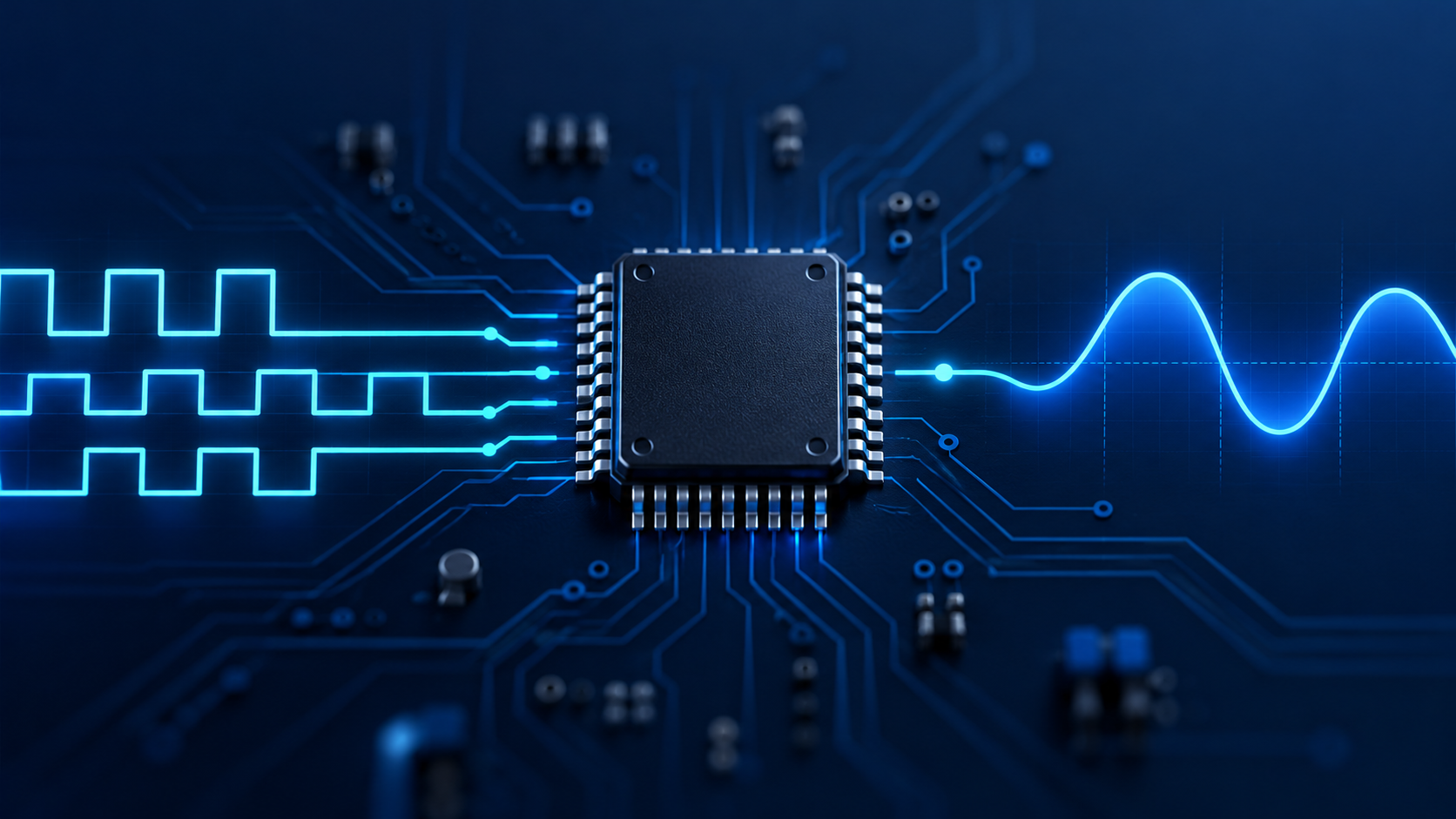
Digital devices process information as binary numbers, but many electronic systems still depend on analog voltages and currents. A digital-to-analog converter (DAC) bridges this gap by transforming digital data into corresponding analog signals.
From audio playback and industrial automation to microcontroller-based control systems, DACs enable digital electronics to interact with the analog world. Understanding how they work, what distinguishes different DAC types, and which specifications matter can help engineers and component buyers choose suitable devices.
What Is a DAC (Digital-to-Analog Converter)?
A DAC, or digital-to-analog converter, is an electronic circuit or integrated circuit (IC) that converts digital numerical values into corresponding analog voltages or currents.
Digital signals represent information using discrete values, typically binary digits (0s and 1s). Analog signals, by contrast, can vary continuously within an operating range.
A DAC connects these two forms of information by producing an analog output determined by the digital input code.
What Does a DAC Do?
The primary function of a DAC is to generate an analog output from digital data. For example, a microcontroller may send a binary value to a DAC, which produces a corresponding output voltage for another circuit.
By changing the input code, the controller can adjust the analog output in defined increments. This enables digitally controlled voltage settings, waveform generation, and other functions requiring analog signals.
A DAC does not simply turn digital data into a perfectly smooth waveform on its own. Its output behavior depends on the converter architecture, update rate, output circuitry, and any filtering used in the system.
How Does a DAC Work?
A DAC uses digital input values to determine the level of its analog output. The exact implementation depends on its circuit architecture, but the basic conversion process is similar across many DAC designs.
First, a digital controller sends a binary code to the converter. The DAC interprets this code and generates an output voltage or current based on its reference and internal conversion circuitry.
For a typical ideal, unipolar, straight-binary voltage-output DAC, the relationship can be expressed as: \(Vout=Vref×D2NV_{out}=V_{ref}\times\frac{D}{2^N} \) Where:
- \(Vout\) is the ideal output voltage.
- \(Vref\) is the reference voltage defining the output scale.
- \(D\) is the decimal value of the digital input code.
- \(N\) is the DAC resolution in bits.
For example, consider an ideal 4-bit DAC with a 3.2V reference. It supports 16 digital codes, ranging from 0 to 15.
An input code of 1000 (decimal 8) produces: \(Vout=3.2×816=1.6VV_{out}=3.2\times\frac{8}{16}=1.6V\) This demonstrates how a numerical value determines an analog output level.
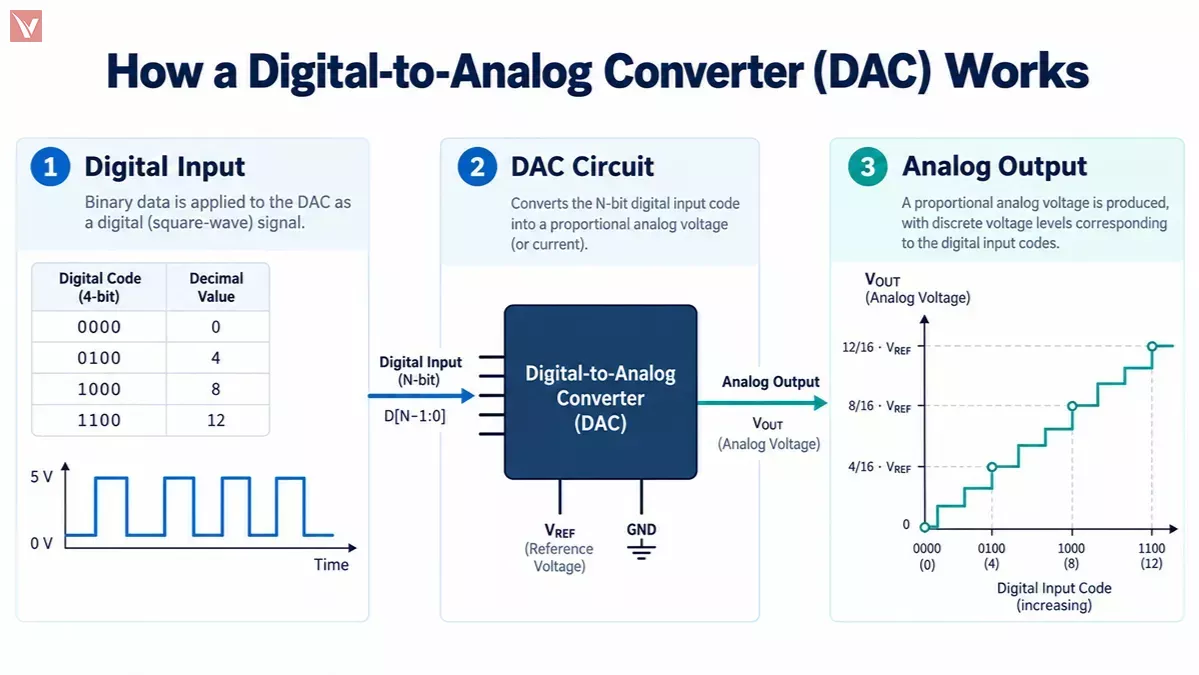
In practice, some DACs require additional filtering or buffering, particularly when generating continuously varying waveforms. Real output accuracy also depends on reference quality, component tolerances, and circuit design.
What Are the Main Types of DACs?
Digital-to-analog converters use different circuit architectures to achieve particular combinations of resolution, speed, accuracy, power consumption, and cost.
Understanding the main architectures helps explain why DAC ICs with similar resolutions can have significantly different performance characteristics.
| DAC Type | Operating Principle | Typical Characteristics |
|---|---|---|
| R-2R Ladder DAC | Uses a resistor network with two resistance values | Relatively simple, scalable architecture |
| Resistor String DAC | Selects voltage levels from a resistor string | Inherently monotonic ideal architecture |
| Delta-Sigma DAC | Uses oversampling and noise shaping | Common in high-resolution audio and precision applications |
| Current-Steering DAC | Switches weighted current sources | Suitable for high-speed signal generation |
- R-2R ladder DACs use networks of resistors to create weighted analog contributions from binary input values. Their architecture makes them useful for demonstrating fundamental conversion principles.
- Resistor string DACs divide a reference voltage into multiple levels and select the required output through switches. They can provide predictable monotonic behavior, although the number of elements grows with resolution.
- Delta-sigma DACs use oversampling and noise shaping to shift quantization noise away from the desired signal band. They are widely associated with audio conversion and other applications requiring high in-band performance.
- Current-steering DACs combine switched current sources to generate analog outputs, making them particularly useful in high-speed waveform generation and communication systems.
No single architecture is best for every application. The appropriate choice depends on the system's performance requirements.
8-bit vs 12-bit vs 16-bit DAC
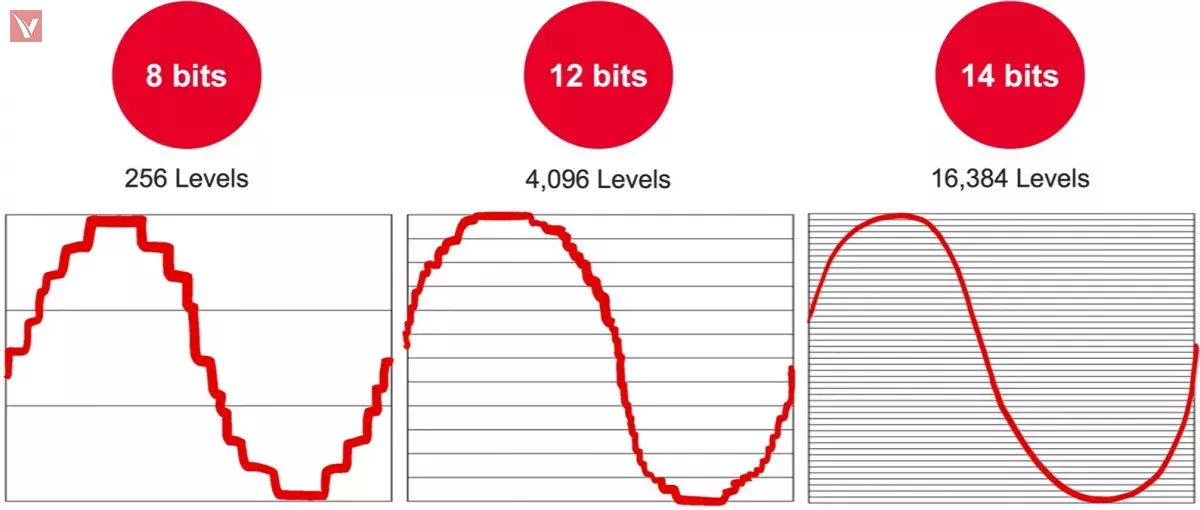
One of the most important DAC specifications is resolution, expressed in bits. Resolution determines how many distinct digital input codes a converter can represent and, for an ideal DAC with a fixed output range, the smallest output increment.
An N-bit DAC supports 2N2^N digital codes.
An 8-bit DAC provides 256 codes, a 12-bit DAC provides 4,096, and a 16-bit DAC provides 65,536.
The table below compares their theoretical voltage steps using the same ideal 0–3.3V conversion scale.
| Specification | 8-bit DAC | 12-bit DAC | 16-bit DAC |
|---|---|---|---|
| Number of digital codes | 256 | 4,096 | 65,536 |
| Ideal LSB step size | 12.891 mV | 0.806 mV | 0.0504 mV |
| Relative step size | 0.39% | 0.02% | 0.00% |
| Example use | Basic analog settings | General-purpose control | Fine-resolution control |
Calculations assume an ideal unipolar DAC with an output scale of 3.3V. Actual output ranges and performance depend on the device.
Does Higher Resolution Mean Better Accuracy?
Not necessarily.
A 16-bit DAC offers smaller theoretical output increments than an 8-bit or 12-bit device, but resolution and accuracy are different specifications.
Resolution describes the converter's available digital code levels. Accuracy describes how closely the actual analog output matches its intended value.
Factors such as integral nonlinearity (INL), differential nonlinearity (DNL), reference voltage error, noise, offset error, and gain error can affect real-world performance.
For example, a 16-bit DAC with significant reference errors may not deliver better absolute voltage accuracy than a well-designed lower-resolution converter.
The practical decision is therefore not simply to choose the highest bit count. Engineers should select sufficient resolution while considering the system's complete error budget, output requirements, and cost.
DAC vs ADC
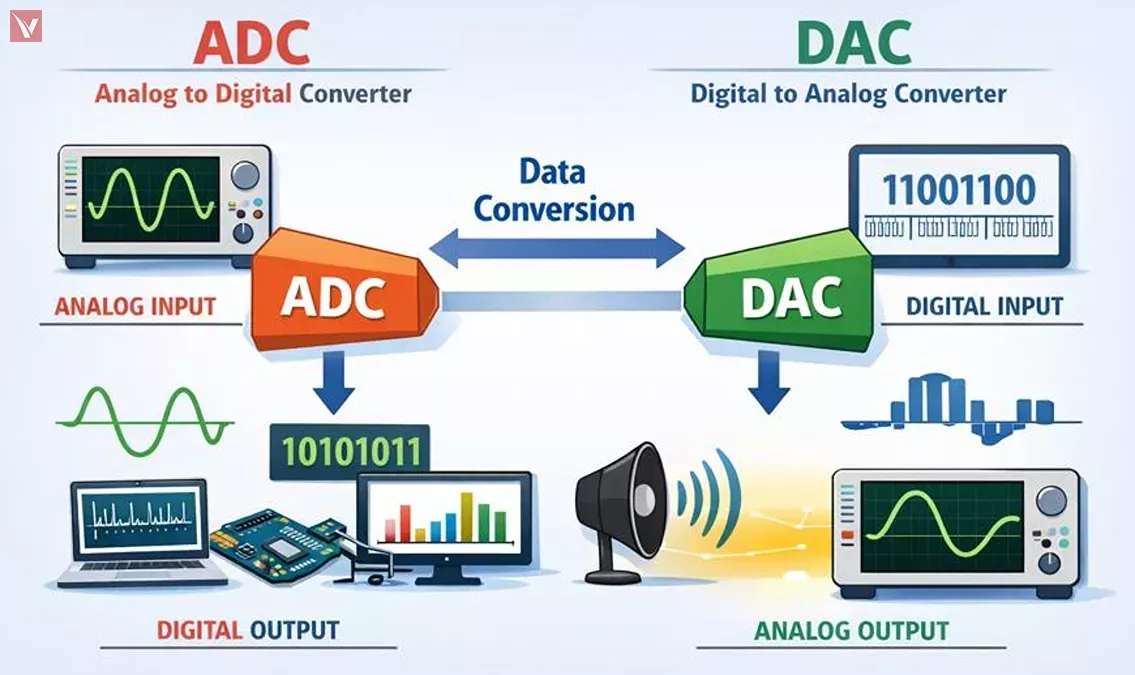
DACs and analog-to-digital converters (ADCs) perform opposite conversion functions, but both play important roles in mixed-signal electronic systems.
A DAC converts digital values into analog signals, while an ADC converts analog signals into digital values that processors and controllers can interpret.
| Feature | DAC | ADC |
|---|---|---|
| Full name | Digital-to-Analog Converter | Analog-to-Digital Converter |
| Conversion direction | Digital to analog | Analog to digital |
| Input | Digital data | Analog voltage or other conditioned analog signal |
| Output | Analog voltage or current | Digital data |
| Common applications | Analog control, waveform generation, audio output | Sensor measurements, data acquisition, audio recording |
For example, a temperature monitoring and control system may use an ADC to digitize a sensor signal and a DAC to generate an adjustable analog control signal.
The two converters complement each other by allowing digital processing systems to receive and produce analog information.
Common Applications of Digital-to-Analog Converters
DACs appear in many industries because digital controllers frequently need to produce analog signals. Their applications extend far beyond sound reproduction.
DACs in Audio and Consumer Electronics
In audio systems, a DAC converts digital audio samples into an analog electrical signal that can be processed by downstream audio circuitry and ultimately reproduced through headphones or speakers.
DAC functions are found in computers, smartphones, digital music players, televisions, and audio equipment. Their implementation and performance requirements vary with the device.
DACs in Industrial Automation and Control
Industrial equipment uses DACs to generate programmable analog output signals for control and adjustment.
For example, a controller can use a DAC to establish voltage setpoints for compatible industrial circuits. Precision and output stability are particularly important when small signal errors could affect system operation.
DACs in Embedded Systems and Microcontrollers
Microcontrollers often process digital information but may need to provide analog outputs.
An external DAC allows a microcontroller to generate adjustable voltages or currents, even when a suitable internal DAC is unavailable.
Many DAC ICs communicate through SPI or I²C interfaces, making them convenient for embedded hardware designs.
DACs in Test and Measurement Equipment
DACs help generate controlled analog signals in programmable power supplies, calibration equipment, and waveform generators.
Depending on the application, designers may prioritize output accuracy, resolution, settling time, or signal bandwidth.
DACs in Communications and Signal Generation
High-speed DACs are used in signal generation and communication transmitters to convert digital waveform data into analog signals.
These systems often require high update rates, appropriate output bandwidth, and strong dynamic performance. Their requirements can differ substantially from those of low-speed precision DACs.
How to Choose the Right DAC IC
Selecting a DAC IC requires more than comparing resolution. The best device is the one whose electrical characteristics, interface, and operating conditions match the intended circuit.
Key Specifications to Consider
Resolution and accuracy: Determine the smallest required output increment and acceptable error. Higher resolution alone does not guarantee greater accuracy.
Output type: Choose between voltage-output and current-output DACs based on what the receiving circuit requires. Some current-output devices need additional circuitry to produce a voltage.
Digital interface: SPI, I²C, and parallel interfaces offer different wiring and communication characteristics. The DAC must be compatible with the controlling processor.
Settling time and update rate: Settling time indicates how quickly the output reaches a specified error band after a change. Update rate describes how frequently the DAC can accept or produce new output values, subject to its design.
Supply voltage and reference: Check the supported supply range, reference arrangement, output swing, and compatibility with the rest of the system.
Other considerations include channel count, package size, power consumption, operating temperature, and component availability.
DAC IC Examples Available at Vigorcomp
The following devices illustrate how DAC resolution and related specifications vary among actual ICs listed by Vigorcomp.
| Part Number | Manufacturer | Resolution | Output Type | Interface |
|---|---|---|---|---|
| DAC081S101CIMK/NOPB | Texas Instruments | 8-bit | Buffered voltage | SPI-compatible |
| DAC121S101CIMK/NOPB | Texas Instruments | 12-bit | Buffered voltage | SPI-compatible |
| AD5683RARMZ | Analog Devices | 16-bit | Buffered voltage | SPI |
The DAC081S101 is an 8-bit, single-channel DAC suitable for designs requiring relatively simple digitally controlled voltage outputs and low power consumption.
The DAC121S101 provides 12-bit resolution in a related low-power voltage-output DAC family, allowing finer theoretical output steps.
The AD5683R offers 16-bit resolution, an integrated voltage reference, and features designed for applications requiring fine output resolution and controlled analog performance.
These devices are examples of different resolution options, not interchangeable replacements. Their reference arrangements, timing characteristics, pin configurations, and other electrical specifications must be checked individually.
Engineers and buyers can explore additional DAC products at Vigorcomp and review the corresponding manufacturer datasheets before making a selection.
Frequently Asked Questions About DACs
Is a DAC Necessary for Every Electronic Device?
No. A DAC is required only when a system needs to produce an analog output from digital information. Purely digital circuits may not need one, while many electronic devices already incorporate DAC functionality.
Is a Higher-bit DAC Always Better?
No. Higher bit depth provides smaller theoretical output steps, but overall performance depends on accuracy, noise, speed, reference stability, and system requirements. The appropriate resolution is application-dependent.
Can a Microcontroller Generate Analog Output Without a DAC IC?
Yes, depending on its capabilities. Some microcontrollers include internal DACs. Others can use pulse-width modulation (PWM) followed by filtering to approximate an analog voltage. However, PWM-based approaches may have different ripple, response-time, and accuracy characteristics compared with a dedicated DAC.
Conclusion
A digital-to-analog converter enables digital systems to generate analog signals for audio, industrial control, embedded electronics, and many other applications.
Understanding the basic conversion principle, DAC architectures, and differences between 8-bit, 12-bit, and 16-bit resolution is a useful starting point. For actual component selection, resolution must be evaluated alongside accuracy, interface, output type, and timing performance.
Explore Vigorcomp's DAC product listings to compare available models and identify components for your application.