
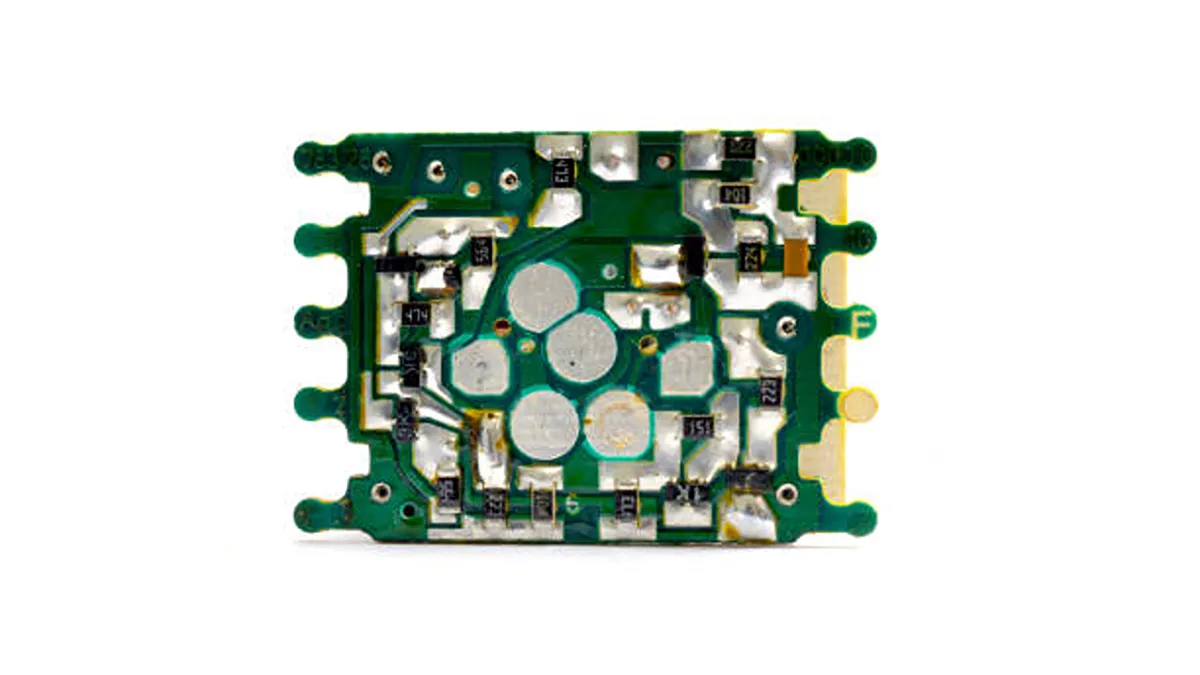
Non-isolated DC-DC converters offer several advantages, including high energy efficiency, compact size, lower component costs, and simpler circuit design. By converting DC voltage without a galvanic isolation barrier, they can provide an efficient and cost-effective way to power electronic systems that share a common electrical reference.
These advantages make non-isolated DC-DC converters especially useful in point-of-load power supplies, embedded electronics, industrial control systems, and battery-powered devices. However, they are not suitable for every application, particularly where electrical safety isolation or independent ground references are required.
This guide explains the key advantages of non-isolated DC-DC converters, compares them with isolated designs, and explores where non-isolated converter modules provide the greatest value.
What Is a Non-Isolated DC-DC Converter?
A non-isolated DC-DC converter is a power conversion device that changes one DC voltage level to another without providing galvanic isolation between its input and output. In common non-isolated designs, such as buck and boost converters, the input and output share an electrical ground reference.
Most non-isolated DC-DC converters use switching regulators to control voltage conversion. By switching semiconductor devices and storing energy in inductors and capacitors, they regulate the output voltage to meet the requirements of connected electronic circuits.
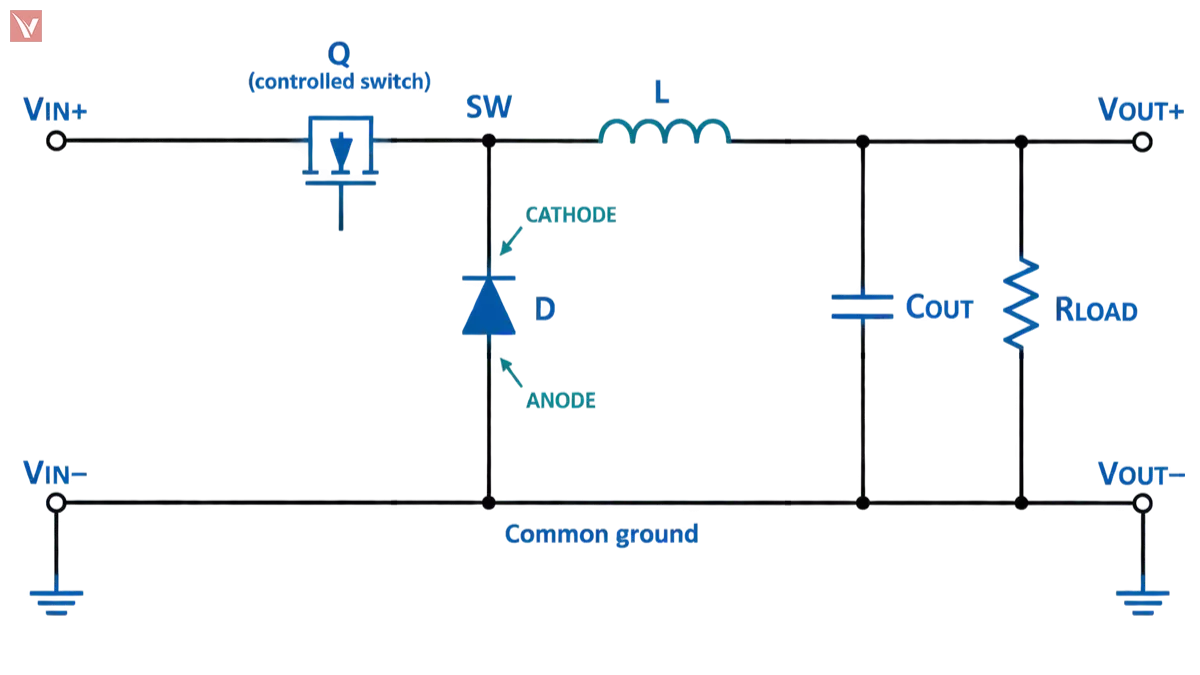
Unlike isolated DC-DC converters, which use an isolation barrier to separate input and output circuits, non-isolated converters do not require an isolation transformer. This can simplify the power conversion circuit and reduce the space and components needed for voltage regulation.
Non-isolated converters are commonly available as regulator ICs, discrete circuit designs, and integrated DC-DC converter modules. They are widely used for local voltage regulation in electronic systems where input and output can safely share a common ground.
This shared-ground architecture is the foundation of their main advantages, including higher potential efficiency, smaller size, and lower implementation costs.
6 Key Advantages of Non-Isolated DC-DC Converters
The main advantages of non-isolated DC-DC converters include higher potential efficiency, compact size, lower costs, simpler circuit design, reduced weight, and responsive voltage regulation. These benefits primarily come from eliminating the need for galvanic isolation between the input and output.
The following six advantages explain why non-isolated converters are widely used in electronic systems where a shared ground is acceptable.
|
Advantage |
Practical Benefit |
|---|---|
|
Higher Efficiency |
Lower power losses and heat generation |
|
Compact Size |
Reduced PCB space requirements |
|
Lower Costs |
Potential savings in components and assembly |
|
Simpler Design |
More straightforward feedback implementation |
|
Lower Weight |
Reduced mass in weight-sensitive systems |
|
Fast Transient Response |
Improved load-step regulation when properly designed |
1. Higher Energy Efficiency
One of the most important advantages of non-isolated DC-DC converters is their potential for high energy efficiency.
Unlike isolated converters that transfer power across an isolation barrier, conventional non-isolated switching converters do not require an isolation transformer. Eliminating this component can reduce magnetic losses and simplify the power conversion path.
Higher efficiency means less input power is wasted as heat. For example, a converter delivering 100 W at 95% efficiency dissipates approximately 5.3 W, compared with 11.1 W at 90% efficiency. These figures illustrate the effect of efficiency on power loss rather than a guaranteed difference between converter types.
Reduced power loss can improve energy utilization, ease thermal management, and extend battery operating time in suitable applications.
However, actual efficiency depends on the topology, semiconductor devices, switching frequency, and load conditions. Designers should evaluate efficiency curves at their intended operating points rather than assume that every non-isolated converter outperforms an isolated alternative.
2. Smaller Size and Higher Power Density
Non-isolated DC-DC converters can achieve compact designs because they do not require the transformer and associated insulation structures used to establish galvanic isolation.
Reducing the size and number of these components can decrease PCB space requirements and overall converter height. This is particularly valuable in electronic systems where several regulated voltage rails must fit within a limited enclosure.
A smaller power conversion circuit can also support higher power density, allowing more output power to be delivered within a given volume.
For example, compact non-isolated point-of-load converters can be positioned close to processors, FPGAs, and other components that require regulated supply voltages.
However, power density depends on the complete design, including inductors, capacitors, thermal management, and EMI filtering. Eliminating isolation components does not automatically guarantee a smaller finished power supply.
3. Lower Component and Manufacturing Costs
Lower implementation cost is another important advantage of non-isolated DC-DC converters.
Compared with an isolated design of similar power requirements, a conventional non-isolated converter can avoid isolation transformers and components needed to transfer feedback signals across an isolation barrier.
This can reduce the bill of materials (BOM), simplify component placement, and decrease certain assembly requirements.
For manufacturers producing electronic equipment at scale, savings in component costs and PCB area can contribute to a lower overall production cost.
However, the final cost depends on the converter's power rating, component selection, thermal requirements, and electromagnetic compatibility (EMC) design. A high-performance non-isolated solution may still cost more than a simpler isolated alternative.
4. Simpler Circuit Design and Control
Non-isolated DC-DC converters often allow simpler power-stage and feedback arrangements because the input and output do not need to be separated by a galvanic isolation barrier.
In a typical shared-ground buck converter, the control circuit can monitor the output voltage directly and adjust switching operation to maintain regulation.
An isolated converter may require additional circuitry, such as an optocoupler or another isolation-compatible feedback method, depending on its topology and control architecture.
Reducing these requirements can simplify circuit implementation and make feedback design more straightforward.
This advantage is particularly useful for board-level voltage regulation, where designers need reliable power conversion without unnecessary isolation complexity.
Nevertheless, proper PCB layout, control-loop compensation, grounding, and protection remain essential for stable operation.
5. Lower Weight
The absence of an isolation transformer can also reduce the weight of a non-isolated DC-DC converter.
Magnetic components contribute to the overall mass of a power supply, particularly when high power levels or additional insulation requirements are involved. Using a simpler non-isolated architecture may reduce the weight of the complete converter assembly.
This can benefit portable electronics, battery-powered equipment, robotics, and other systems where minimizing weight is important.
The actual weight reduction depends on the selected topology, power rating, passive components, and cooling requirements. Engineers should compare complete module or assembly weights rather than rely on topology alone.
6. Faster Transient Response in Suitable Designs
Non-isolated DC-DC converters can provide fast voltage regulation in applications with rapidly changing load currents.
Because a conventional shared-ground design can sense its output directly, it may support a responsive feedback loop without the additional feedback-isolation circuitry required by some isolated designs.
Fast transient response helps minimize output voltage deviations when connected devices suddenly increase or decrease their current consumption.
This characteristic can be valuable in point-of-load power supplies for processors, FPGAs, and digital control circuits.
However, transient response is not inherently faster simply because a converter is non-isolated. Actual performance depends on control-loop bandwidth, switching frequency, output capacitance, PCB layout, and controller design.
When comparing converter options, engineers should examine load-transient test results, including voltage deviation and recovery time, under representative operating conditions.
Non-Isolated vs. Isolated DC-DC Converters: Key Differences
The main difference between isolated and non-isolated DC-DC converters is whether a galvanic isolation barrier separates the input and output circuits. Non-isolated converters typically share a common ground, while isolated converters can provide an electrically independent output reference.
This difference affects efficiency, size, cost, noise management, and electrical safety. The table below highlights the key trade-offs between the two architectures.
| Comparison Factor | Non-Isolated DC-DC Converter | Isolated DC-DC Converter |
|---|---|---|
| Galvanic Isolation | No isolation barrier between input and output | Provides an isolation barrier between input and output |
| Ground Reference | Typically shares a common ground | Can support separate input and output ground references |
| Efficiency | Often higher in comparable applications without isolation requirements | May have additional losses associated with isolation components |
| Size and Weight | Often smaller and lighter | Isolation components may increase size and weight |
| Cost and Complexity | Generally simpler, with potentially lower component costs | Often requires additional isolation-related components and design considerations |
| Electrical Safety | Cannot provide input-to-output safety isolation | Can provide safety isolation when appropriately designed and rated |
| Noise Management | Shared electrical paths may allow interference to propagate | Can separate ground domains, although EMI and parasitic coupling still require attention |
| Floating Output | Conventional shared-ground designs do not provide an independent floating output | Floating outputs are commonly available, subject to device specifications |
When Should You Choose a Non-Isolated Converter?
A non-isolated DC-DC converter is often the preferred choice when the input and output circuits can safely share a common ground and no galvanic isolation is required.
For example, converting 12 V to 5 V on an embedded control board is a common application for a non-isolated buck converter. In this situation, compact size, high efficiency, and lower implementation costs can make the non-isolated approach attractive.
An isolated converter is more appropriate when the system requires independent ground references, separation of different electrical potentials, or a specified safety isolation barrier.
The key selection principle is to determine the system's isolation requirements before comparing efficiency, size, and cost. Where isolation is unnecessary, a non-isolated converter can offer a practical and economical solution without adding isolation-related complexity.
For a practical voltage conversion example, explore our 24V-to-12V DC Converter Guide to learn more about converter selection and design considerations.
Common Types of Non-Isolated DC-DC Converter Modules
Non-isolated DC-DC converter modules are available in several configurations to meet different voltage conversion requirements. Integrated modules may combine switching components, control circuitry, and inductors into compact packages, helping reduce external component requirements and simplify power supply integration.
The three most common conversion types are:
-
Buck (Step-Down) Converters: Reduce a higher input voltage to a lower output voltage, such as 24 V to 12 V or 12 V to 5 V. They are commonly used for point-of-load regulation and embedded electronics.
-
Boost (Step-Up) Converters: Increase a lower input voltage to a higher output voltage, such as 5 V to 12 V. They are useful in battery-powered equipment and systems requiring a higher voltage rail.
-
Buck-Boost Converters: Support voltage conversion when the input may be above or below the desired output. Non-inverting buck-boost designs are particularly useful for maintaining a positive regulated output from a varying power source.
Other topologies, including SEPIC and bidirectional buck-boost converters, support specialized voltage regulation and power-flow requirements.
For a more detailed explanation of step-up and step-down operation, see our Buck Converter vs Boost Converter guide.
Selecting the appropriate topology helps engineers take advantage of the efficiency, compact size, and design simplicity offered by non-isolated DC-DC converters.
Where Are Non-Isolated DC-DC Converter Modules Used?
Non-isolated DC-DC converter modules are widely used in electronic systems that require efficient voltage regulation without galvanic isolation. Their compact size, relatively simple design, and potential for high efficiency make them particularly suitable for applications where multiple circuits share a common ground.
The following applications demonstrate how these advantages support practical power supply designs.
1. Point-of-Load (POL) Power Supplies
Point-of-load regulation is one of the most common applications of non-isolated DC-DC converters. These converters supply regulated voltages close to components such as microcontrollers, FPGAs, processors, and digital signal processors.
For example, a non-isolated buck converter can step down a 5 V supply to 3.3 V for digital logic. Placing the converter near the load can help reduce distribution voltage drops and support stable operation during changing current demands.
Compact integrated modules are particularly useful when PCB space is limited or several voltage rails are required.
2. Industrial Control Systems
Industrial control equipment often uses a 24 V DC supply to power sensors, controllers, communication interfaces, and other electronic circuits.
Non-isolated buck converter modules can generate lower voltages, such as 12 V or 5 V, within a shared-ground control system. Their relatively simple architecture and compact size can help reduce power supply complexity and implementation costs.
However, isolation may still be necessary between field wiring, communication interfaces, or other electrical domains with different ground potentials.
3. Embedded Systems and IoT Devices
Embedded electronics and IoT devices frequently require multiple low-voltage power rails in compact circuit designs.
Non-isolated converters can regulate these voltages while helping minimize PCB space and power losses. For example, a 5 V input may be converted to 3.3 V to power microcontrollers, wireless communication circuits, and digital sensors.
Their efficiency and small size can be beneficial in space-constrained devices, although light-load efficiency and standby power consumption are also important considerations.
4. Battery-Powered Equipment
Battery-powered devices often experience changing input voltages as their batteries charge and discharge.
Non-isolated buck, boost, or buck-boost converters can provide regulated output voltages depending on the battery's operating range and the load requirements.
High conversion efficiency can reduce energy losses and help extend operating time. Compact designs may also reduce the size and weight of portable equipment, robotics electronics, and mobile systems.
In these applications, selecting a suitable converter requires evaluating efficiency across the full battery voltage and load range.
Across these use cases, the main advantage of non-isolated DC-DC converter modules is their ability to provide compact and efficient voltage regulation within a shared-ground power architecture. The appropriate choice depends on the required voltage conversion, operating conditions, and whether electrical isolation is necessary.
For an example of non-isolated voltage conversion in high-density power systems, explore our 48V to 12V DC Converter Guide.
Limitations: When Is Isolation Necessary?
Although non-isolated DC-DC converters offer advantages in efficiency, size, and cost, their lack of galvanic isolation creates important limitations. Understanding these trade-offs helps engineers determine when a shared-ground power architecture is appropriate and when an isolated converter is the better choice.
1. No Electrical Safety Isolation
A non-isolated DC-DC converter does not provide a galvanic barrier between its input and output. Therefore, it cannot serve as the required safety isolation barrier between hazardous voltages and accessible low-voltage circuits.
When an application requires electrical safety isolation, an appropriately rated isolated converter or another suitable isolation architecture must be used. The required insulation level should be determined by the applicable standards and system safety requirements.
2. Shared Ground and Noise Interference
In conventional non-isolated converters, the input and output share an electrical reference. This can allow switching noise, ground disturbances, or unwanted currents to affect connected circuits.
Proper grounding, PCB layout, and filtering can help control these effects. However, when separate ground domains are required to manage interference or ground-potential differences, an isolated solution may be more suitable.
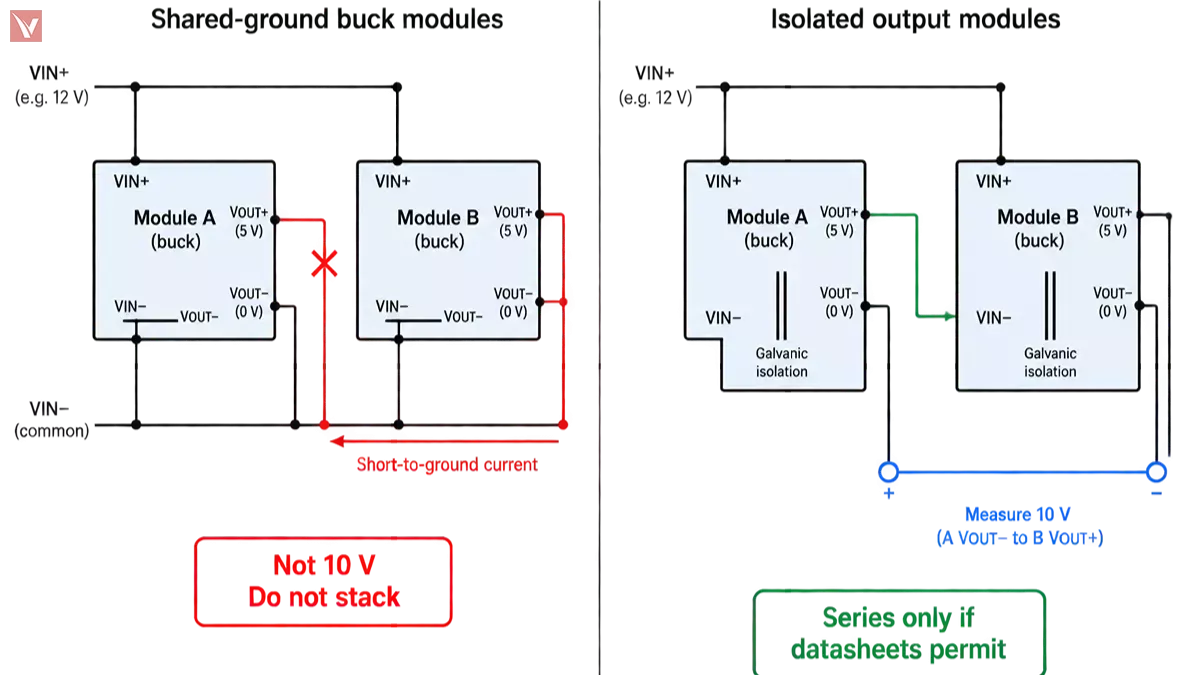
3. Limited Output Referencing and Series Operation
Standard shared-ground non-isolated modules do not provide independently floating outputs. As a result, connecting their outputs in series can create unintended current paths or short circuits.
Isolated converters can provide floating outputs, but series operation should only be used when permitted by the manufacturer's specifications.
When Should You Choose an Isolated DC-DC Converter?
An isolated DC-DC converter should be considered when the application requires:
-
A specified safety isolation barrier between electrical domains.
-
Independent ground references or separation of different ground potentials.
-
A floating output for a particular circuit configuration.
-
Ground-domain separation to help manage interference or unwanted ground currents.
For systems that already have the required safety isolation and can safely share a common ground, non-isolated DC-DC converters remain an attractive choice for efficient, compact, and cost-effective voltage regulation.
How to Choose a Non-Isolated DC-DC Converter Module
Choosing the right non-isolated DC-DC converter module requires more than matching input and output voltages. Engineers should evaluate the following factors to ensure reliable and efficient operation:
-
Input and Output Requirements: Verify that the module supports the full input voltage range and provides the required output voltage and current, including peak load conditions.
-
Efficiency and Thermal Performance: Review efficiency curves at typical operating loads and check thermal derating limits to prevent overheating.
-
Output Ripple and Noise: Ensure the converter meets the power quality requirements of sensitive circuits, particularly in precision or high-speed electronic systems.
-
Protection Features: Consider overcurrent, short-circuit, and thermal protection based on the application's operating conditions.
-
Package and Integration: Check the module's dimensions, pin configuration, operating temperature range, and external component requirements.
The best choice is a module that meets the system's electrical and environmental requirements while delivering the efficiency, compact size, and simplicity that make non-isolated DC-DC conversion attractive.
Conclusion
Non-isolated DC-DC converters offer important advantages, including high efficiency, compact size, lower costs, and simpler circuit design. These benefits make them a practical choice for voltage regulation in systems where galvanic isolation is not required.
However, the right converter depends on the application's electrical requirements, grounding conditions, and operating environment. Understanding these factors helps engineers choose a power conversion solution that balances performance, efficiency, and cost.
Frequently Asked Questions
Can a non-isolated DC-DC converter be used after an isolated AC-DC power supply?
Yes. Non-isolated DC-DC converters are commonly used downstream of isolated AC-DC power supplies to generate additional voltage rails. The upstream isolation barrier can provide the required electrical separation, while the downstream converters regulate voltage efficiently. However, the complete system must still meet its safety and grounding requirements.
Do non-isolated DC-DC converter modules need external components?
It depends on the module's integration level. Some modules include most of the required power components, while others need external input/output capacitors, resistors, or filtering components. Always check the manufacturer's datasheet and recommended application circuit.
Can multiple non-isolated DC-DC converters share the same input supply?
Yes, multiple non-isolated converters can operate from a common DC supply, provided the source supports their combined current and startup requirements. Proper input decoupling, grounding, and PCB layout are important to minimize interference between converters.
What happens if the input voltage falls outside the converter's specified range?
If the input voltage drops below the supported range, the converter may shut down through undervoltage lockout or fail to maintain output regulation. Excessive input voltage can damage the converter. Always verify the operating limits and protection features specified in the datasheet.