
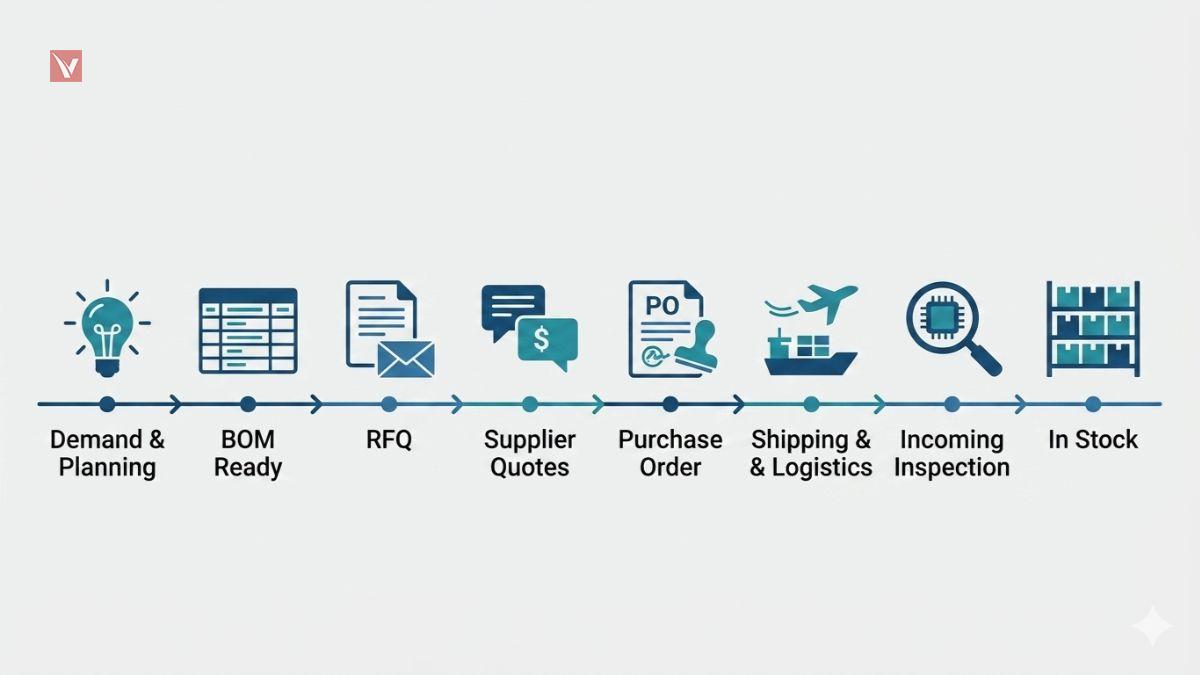
Key Takeaways for Efficient Electronic Component Sourcing
- Treat procurement as a BOM‑to‑delivery lifecycle, not just placing orders.
- Start with a scrubbed, alternate‑ready BOM before launching any RFQ.
- Run a structured RFQ‑to‑PO process that shares clean data across engineering, procurement, and logistics.
- Balance OCM, authorized, and independent distributors to manage lead time, EOL, and spot shortages.
- Optimize for total landed cost and counterfeit‑free supply to protect build continuity and product quality in 2026.
What Does Electronic Component Procurement Mean
Electronic component procurement is the end-to-end process of identifying, validating, sourcing, purchasing, receiving, and managing components that meet a product’s electrical, mechanical, regulatory, and commercial requirements. For modern teams, it is no longer limited to placing orders after a design is complete.
In practice, procurement begins during the design and prototyping stage, when engineering teams select preferred parts, define technical requirements, and identify where sourcing risk may appear later. That means procurement now includes lifecycle checking, BOM data cleansing, cross-referencing alternative parts, supplier qualification, compliance verification, logistics planning, and incoming quality control.
For hardware startups, makers, OEMs, and procurement officers, this lifecycle view matters because a component decision made during prototype build can affect manufacturability, lead time exposure, and total landed cost months later. A poor sourcing decision rarely fails only at the purchasing stage; it usually creates downstream problems in planning, fulfillment, quality, or production continuity.
Essential Requirements Before You Start Buying Parts
Before any RFQ is issued, procurement success depends on the quality of the input data. If the BOM is incomplete, part numbers are inconsistent, or lifecycle risks are ignored, every downstream step—from quoting to receiving—becomes slower, less accurate, and more expensive.
Procurement-ready BOM
Not just an engineering parts list. This is where BOM scrubbing matters. Teams should standardize manufacturer part numbers, remove duplicate lines, fill in missing package and parametric details, verify quantities, and confirm that each line is tied to a real, orderable component. A clean BOM gives suppliers enough precision to quote correctly and reduces avoidable back-and-forth during sourcing.
Part validation
Before buying, each component should be checked for lifecycle status, compliance, and sourcing risk. That includes reviewing whether a part is Active, NRND, or EOL—necessitating a strategy for obsolete electronic parts—while also confirming RoHS/REACH requirements and identifying components that are single-sourced or likely to create long Lead Time exposure later.
Early cross-referencing of alternative parts
Approved alternates should be identified during design or pre-procurement review, not after a supplier reports no stock. For critical BOM lines, teams should document form-fit-function alternatives, align them with engineering approval, and record them clearly so purchasing can react faster during allocation or market disruption.
In short, this stage is about preparing the data, rules, and risk controls that make efficient procurement possible. Once the BOM is scrubbed, validated, and alternate-ready, the sourcing team can move into the actual procurement workflow with much higher speed and confidence.
The Step-by-Step Electronic Component Procurement Process
Once the BOM and sourcing requirements are fully prepared, the procurement process moves into execution. At this stage, the focus shifts from data preparation to supplier engagement, quote comparison, order placement, and delivery control.
-
Define demand and purchasing priorities
Start by confirming what needs to be bought, in what quantity, and for which build stage. Prototype, EVT/DVT, pilot run, and mass production often require different sourcing strategies because the acceptable MOQ, lead time, and cost structure are not the same.
This is also the point where buyers should flag high-risk lines—such as allocation-sensitive ICs, EOL parts, or components with unstable availability—so those items receive earlier sourcing attention than standard catalog parts.
-
Issue a structured RFQ
With a clean BOM in place, the next step is to send a structured RFQ to qualified suppliers. A strong RFQ should include exact MPNs, required quantities, delivery windows, packaging expectations, compliance requirements, and whether approved alternates are allowed.
This is where disciplined procurement teams outperform reactive buyers. A vague RFQ generates vague quotes. A detailed RFQ makes it easier to compare pricing, Lead Time, MOQ, and traceability across multiple sources.
-
Evaluate quotes across multiple sourcing channels
After receiving supplier responses, procurement should compare more than unit price. Teams need to evaluate quoted Lead Time, available stock, MOQ, freight implications, date code requirements, traceability, and any risk tied to source type.
This is also where channel strategy becomes operational. OCMs may be best for long-term supply alignment, authorized distributors for traceable mainstream supply, and independent distributors for securing hard-to-find electronic parts during shortages or spot stock scenarios. Good procurement is not about choosing one channel forever; it is about choosing the right channel for each BOM risk profile.
-
Select suppliers and issue the Purchase Order
Once the best source is selected, the PO should lock down the commercial and technical details clearly. That includes the exact part number, quantity, agreed price, delivery commitment, packaging condition, inspection requirements, and any documentation needed for traceability or compliance.
At this point, procurement should also confirm whether the supplier’s commitments match the quote exactly. Small mismatches in lead time, packing, or alternate approval can create major receiving and production issues later.
-
Manage logistics, receiving, and feedback
Procurement does not end when the PO is sent. Buyers still need to track shipment status, monitor delays, coordinate customs or freight issues, and ensure receiving inspection is aligned with the purchase requirements.
For higher-risk parts—especially shortage buys or material sourced outside authorized channels—receiving controls should include visual inspection, documentation review, and, where necessary, deeper testing. The final step is to feed supplier performance, quality outcomes, and PPV results back into future sourcing decisions so the next procurement cycle becomes faster and more reliable.
Where to Source Components and How Channels Compare
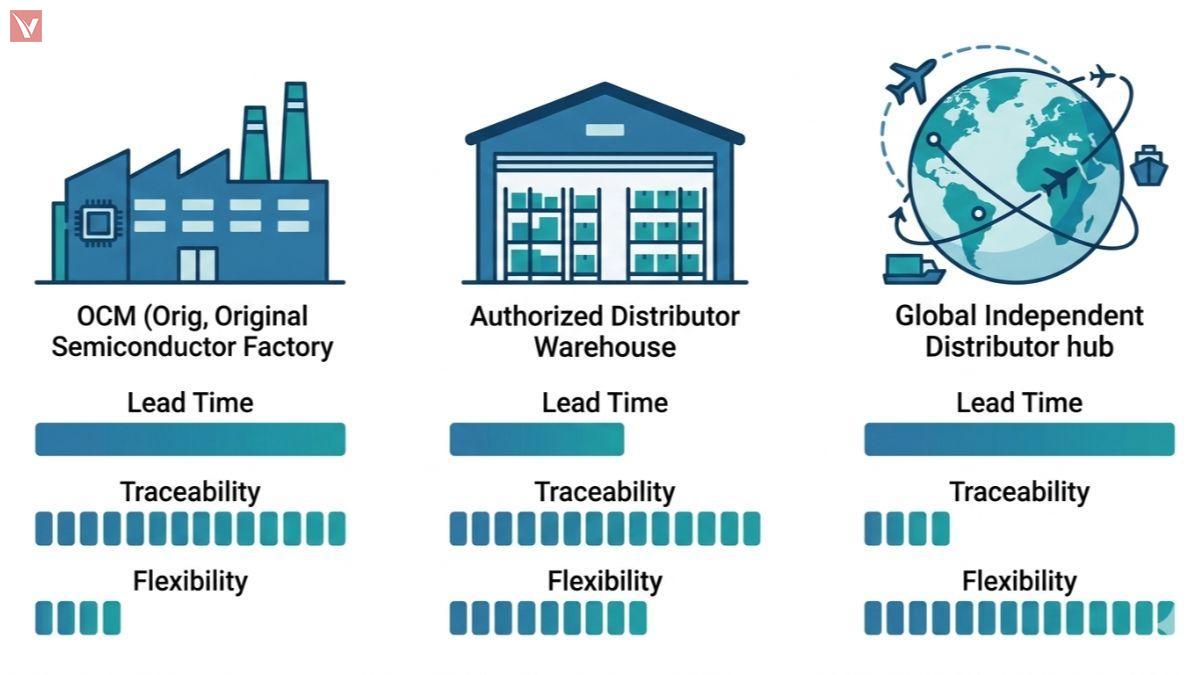
Selecting the right sourcing channel depends on urgency, quality requirements, volume, and lifecycle status. No single channel is ideal for every case.
| Channel | Best fit | Lead time profile | Pricing profile | MOQ flexibility | Traceability | Main trade-off |
| Original Component Manufacturers (OCMs) | Long-term production, strategic programs, direct factory support | Often predictable but not always fast | Stable for planned volume programs | Usually less flexible | Highest | Best control, less agility |
| Authorized Distributors | Mainstream active parts, standard production buying, engineering support | Strong for stocked lines, moderate for factory-backed supply | Transparent and structured | Moderate | Very strong | Good balance, but limited in shortages |
| Independent Distributors | Shortages, allocation, EOL parts, urgent line-down recovery, hard-to-find inventory | Often best for spot stock and immediate supply | Market-driven, can be higher or opportunistic | Usually more flexible | Depends on supplier controls | Fastest access, requires stronger quality screening |
When to Use Each Channel
Use OCMs when:
- Demand is stable and forecastable
- The building requires long-term factory alignment
- Direct technical or quality support is important
- The volume justifies contractual supply planning
Use authorized distributors when:
- Parts are active and widely supported
- Traceability and warranty are top priorities
- Standard catalog procurement is sufficient
- Engineering teams need mainstream sourcing support
Use independent distributors when:
- Parts are constrained or under allocation
- Authorized stock is unavailable
- The part is obsolete or EOL
- A build cannot wait for factory lead times
- You need spot stock, mixed quantities, or rapid gap coverage
Independent sourcing becomes especially valuable when schedule risk is more expensive than price variance. In those cases, fast access to verifiable inventory can protect far more value than a lower quoted unit price.
Why Electronic Component Procurement Breaks Down So Often
Most procurement problems are not caused by a single mistake. They usually happen because several weak controls overlap.
First, global supply chains remain volatile. Allocation events, regional logistics disruption, wafer capacity limits, and sudden demand shifts can all change availability faster than many companies can respond. Long and unstable Lead Time remains one of the biggest reasons teams miss build schedules.
Second, lifecycle risk is often underestimated. Teams continue buying or designing around parts that are already NRND, constrained, or quietly approaching EOL. This creates avoidable redesign pressure and expensive last-time-buy decisions.
Third, engineering and purchasing often operate with different assumptions. Engineering may know which parameters are critical, but procurement may only see the BOM line item. Without shared rules for alternates, buyers may reject good sourcing options or accept unsuitable substitutions.
Fourth, many teams still rely on fragmented quoting workflows. When RFQs, approvals, and supplier responses are scattered across spreadsheets and email chains, version control breaks down. That makes it harder to compare pricing, document supplier commitments, or detect sourcing risk early.
Avoid These Costly Component Sourcing Mistakes
Mistake 1: Ordering Based on Incomplete or Obsolete Data
Many purchasing errors start with bad data, not bad suppliers. If the BOM contains outdated MPNs, generic descriptions, or unverified lifecycle status, quote quality drops immediately.
Common consequences include:
- Wrong part shipment
- Delayed supplier clarification
- Quoting against obsolete inventory
- Compliance mismatch
- Build delays caused by preventable rework
The fix is simple but discipline-heavy: enforce BOM scrubbing and revision control before RFQ release.
Mistake 2: Treating Alternative Components as a Last-Minute Idea
When alternates are only discussed after shortages begin, teams lose leverage. Cross-referencing under pressure usually leads to rushed engineering review, longer approval cycles, and more expensive spot buying.
A stronger strategy is to define approved alternates during the design phase and record them directly in sourcing documentation. That turns a shortage from a crisis into a controlled switch.
Mistake 3: Ignoring Hidden Logistics and Procurement Terms
A quote with a low unit price may still perform badly if it includes:
- Excessive MOQ
- Unfavorable Incoterms
- High freight cost
- Tariff exposure
- Long transit routes
- No cancellation flexibility
This is why experienced buyers focus on total landed cost rather than invoice price alone. In electronics procurement, schedule protection often matters just as much as nominal purchase price.
Mistake 4: Relying Solely on Fragmented Email Systems for Quotes
Email is convenient, but it scales badly. Once multiple suppliers, alternates, revisions, and delivery dates are in motion, fragmented email systems become a hidden operational risk.
Problems typically include:
- Lost quote versions
- Missing lead time updates
- Unclear approvals
- No structured comparison view
- Weak audit trail
At minimum, teams should use a centralized RFQ tracker with clear version control, supplier response fields, and award logic.
Why Choose a Global Independent Electronic Components Distributor
A strong independent distributor can solve problems that traditional channels often cannot solve quickly enough. That includes shortages, obsolete parts, urgent project recovery, regional supply mismatches, and mixed-quantity sourcing needs.
For teams facing unstable availability, a global independent electronic components distributor can provide practical supply continuity by combining global sourcing reach with spot stock access. Vigorcomp is particularly relevant for buyers who need one-stop sourcing support across multiple component categories while also managing schedule pressure and procurement complexity.
Vigorcomp’s broader capability set also supports:
- Global supply chain coverage for active, constrained, and obsolete parts
- Spot stock sourcing for urgent demand
- One-Stop Sourcing support for individual engineers, startups, and procurement teams
- OEM/ODM excess inventory management for slow-moving and obsolete stock liquidation
For product coverage and sourcing scope, see:
Optimize Total Landed Cost and Manage Lead Times
A trusted independent distributor helps buyers evaluate more than just quoted piece price. The real decision should include:
- MOQ
- Freight method
- Tariffs and import costs
- Packaging condition
- Supplier response speed
- Allocation exposure
- Schedule impact of delay
This is where Vigorcomp can create practical value. Its spot stock capabilities and global supply chain network make it easier to source available inventory when standard channels are quoting long or unstable Lead Time. For procurement teams dealing with allocation or sudden shortages, that speed can protect production continuity and reduce the real cost of downtime.
Independent distribution is also useful when a team needs mixed quantities, bridge supply, or short-notice fulfillment that does not align well with factory MOQ structures. In those cases, the best sourcing partner is the one that can combine availability, flexible execution, and credible inspection controls.
Prevent Counterfeits with Strict Inspection and Compliance
Counterfeit prevention is the main quality question in independent sourcing, so the supplier’s inspection framework must be explicit and verifiable. This is where process maturity matters more than marketing claims.
Vigorcomp’s quality approach should be understood as a structured four-step control system:
- Packing & Documentation: Verify packaging condition, shipment conformity, lot information, and all required supporting documents before materials enter the next inspection stage.
- Label & Visual Inspection: Check label consistency, part markings, surface condition, and physical indicators under magnification to identify signs of remarking, damage, resurfacing, or other counterfeit indicators.
- Advanced Testing: Conduct deeper functional and parametric verification to confirm the parts meet required technical specifications rather than only matching external appearance.
- Third-Party Laboratories: Use accredited outside laboratories for higher-risk verification work where deeper analysis is needed, including methods such as X-ray, decapsulation, and expanded authenticity review.
For procurement teams, this kind of layered process is what makes independent sourcing operationally credible. It helps reduce risk while preserving access to inventory that may not be available through authorized channels.
Frequently Asked Questions
Q1
How do I handle a sudden EOL notice?
Start by separating short-term continuity from long-term redesign. First, determine current inventory exposure, outstanding demand, and whether a last-time-buy is justified. Then launch a cross-reference review for technically acceptable alternatives and update the BOM so the obsolete part does not continue propagating into new builds.
Q2
What is the difference between an authorized and an independent distributor?
An authorized distributor sources directly through a manufacturer franchise relationship and usually provides stronger factory-backed traceability. An independent distributor sources through the broader market, which gives better access to shortages, EOL parts, and spot stock, but requires stronger inspection and verification controls.
Q3
How can small teams manage low-MOQ restrictions?
Small teams should prioritize commonly available parts, approve alternates early, and work with suppliers that support cut tape, mixed quantities, and flexible fulfillment. They should also evaluate leftover inventory cost as part of landed cost rather than focusing only on the nominal unit price.
Q4
What should be included in a component RFQ?
A strong RFQ should include exact MPNs, required quantities, target delivery timing, compliance needs, alternates policy, packaging requirements, and any required test or inspection conditions. The more precise the RFQ, the better the quote quality and the faster the sourcing cycle.