
The Role of Converters in Modern Electronic Systems
Converters are functional building blocks that change electrical energy or signal information from one form into another so a source can properly serve a load. In electrical and electronic systems, that usually means changing voltage level, current type, frequency, isolation boundary, or analog-to-digital format to make the rest of the design usable, efficient, and stable.
Converter Definition and Core Function
When engineers define a converter in practice, it is not just a generic “power adapter.” It is a circuit, module, or subsystem that conditions power or signals so different parts of a system can work together correctly. That is why converters show up everywhere from AC front ends and board-level DC rails to sensor interfaces and precision control loops.
When people use the phrase converter in electrical discussions, they are usually referring to several practical categories: AC-DC rectifiers, DC-DC converters, DC-AC inverters, and AC-AC converters such as variable-frequency or voltage-control stages. In modern electronics, the same concept also extends into data conversion, where ADCs and DACs translate between analog real-world signals and digital processing domains.
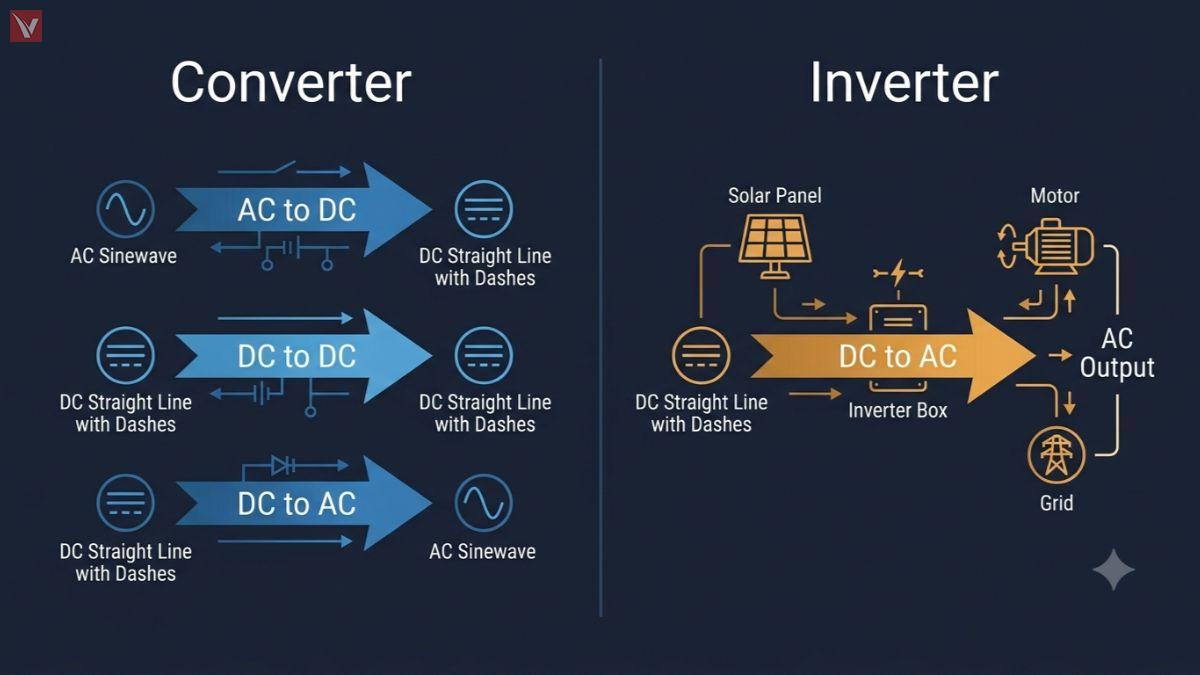
Converter vs Inverter
An inverter is a specific type of converter that takes DC input and generates AC output. This definition applies to standalone inverters; within systems like VFDs, the inverter stage is embedded in a broader AC-AC conversion chain.
A converter is the broader category, covering AC-DC, DC-DC, DC-AC, AC-AC, and signal-domain conversion functions as well.
Consumer products often use “converter” loosely, which is why the terminology becomes confusing in practice. In stricter technical usage, the conversion direction and the system role matter more than the marketing label on the enclosure.
|
Aspect
|
Converter
|
Inverter
|
|---|---|---|
|
Scope
|
Broad category covering multiple conversion functions.
|
Specific DC-AC converter type.
|
|
Typical direction
|
AC-DC, DC-DC, DC-AC, AC-AC, or analog/digital conversion.
|
DC to AC.
|
|
Common system position
|
Front-end power stage, intermediate bus regulation, point-of-load rail, or signal chain interface.
|
Output stage for AC loads, motor drives, UPS, or energy systems.
|
|
Typical forms
|
Rectifier, buck regulator, isolated module, ADC, DAC, VFD stage.
|
Standalone inverter, inverter bridge, motor-drive inverter stage.
|
For engineers comparing inverter vs converter, the simplest rule is this: every inverter is a converter, but not every converter is an inverter.
Four Main Power Converter Types
AC-DC Converters
AC-DC converters, commonly called rectifiers, convert alternating current into direct current for downstream electronics. They are the front end in equipment that runs from mains power and must ultimately feed DC buses, batteries, control boards, or communication electronics.
Typical implementations range from simple rectification stages to regulated switch-mode power supplies and integrated AC-DC modules. In industrial and embedded products, the AC-DC stage often sets the foundation for efficiency, safety, EMI behavior, thermal performance, and downstream reliability.
DC-DC Converters
DC-DC converters change one DC voltage level to another and are central to board-level power architecture. Common topologies include buck for step-down conversion, boost for step-up conversion, and buck-boost when the input may move above or below the desired output.
They appear after battery packs, intermediate buses, telecom rails, and AC-DC front ends to create the local voltages required by processors, sensors, memory, FPGAs, and communications ICs. In practice, this is where engineers spend much of their time balancing efficiency, transient response, ripple, footprint, thermal margin, and isolation requirements.
DC-AC Converters
DC-AC converters, or inverters, generate AC output from DC sources. They are widely used in solar energy systems, UPS platforms, motor drives, and battery-powered systems that must feed AC equipment or controlled AC waveforms.
In higher-performance systems, the inverter stage is not just about creating AC. It also shapes waveform quality, switching losses, control accuracy, and overall system efficiency.
AC-AC Converters
AC-AC converters modify one AC form into another, often by changing voltage magnitude or output frequency. In industry, a common example is the variable frequency drive, which effectively converts incoming AC to DC and then reconstructs controlled AC for motor speed control.
That makes AC-AC conversion especially important in pumps, fans, conveyors, compressors, and other motor-driven systems where control precision and energy savings both matter.
|
Converter type
|
Input
|
Output
|
Main role
|
Typical applications
|
|---|---|---|---|---|
|
AC-DC
|
AC
|
DC
|
Rectification and regulated DC supply.
|
Industrial power supplies, chargers, control cabinets, embedded equipment.
|
|
DC-DC
|
DC
|
DC
|
Voltage step-down, step-up, regulation, or isolation.
|
PCB rails, telecom, battery systems, processors, industrial electronics.
|
|
DC-AC
|
DC
|
AC
|
Inversion for AC loads or controlled AC output.
|
Solar systems, UPS, motor drives, off-grid systems.
|
|
AC-AC
|
AC
|
AC
|
Frequency or voltage transformation.
|
VFDs, motor control, line conditioning, AC regulation.
|
Cross-Domain Converter Types
Not all converters are about power rails. In electronic systems, converters also sit in the signal chain and determine how accurately real-world information reaches software and control logic.
An ADC converts an analog input such as voltage or current into a digital value that a processor can read. A DAC performs the reverse function, turning digital data back into an analog signal for actuation, waveform generation, or closed-loop control.
This matters in industrial automation, measurement equipment, and connected sensing nodes because the system depends on both clean power conversion and accurate data conversion. ADC architecture choices also affect system behavior: SAR devices are often favored for flexible, lower-latency multiplexed acquisition, pipelined converters suit higher-throughput applications, and delta-sigma (ΔΣ) devices are widely used for high-resolution precision measurement in instrumentation, weighing systems, and audio applications, where throughput is secondary to resolution and noise rejection.
|
Data converter
|
Function
|
Common strengths
|
Typical use cases
|
|---|---|---|---|
|
ADC
|
Analog to digital.
|
Bridges sensors and analog signals into digital control or processing.
|
Data acquisition, instrumentation, PLC input paths, condition monitoring.
|
|
DAC
|
Digital to analog.
|
Reconstructs analog outputs for control and waveform generation.
|
Drive control, programmable outputs, test equipment, analog feedback loops.
|
Mechanical and electrochemical conversion also exist as broader engineering concepts, but in electronics practice, the most relevant categories are still power converters and data converters because they directly shape how systems are powered, measured, and controlled.
Renewable Energy and Portable Power
Renewable and battery-based systems rely on several converter stages working together rather than a single “power box.” A typical path may look like this: energy source or charging input, then DC conditioning, then battery management and regulated DC rails, and finally an inverter stage if the load requires AC output.
In solar and storage systems, each stage has a different job. DC-DC stages regulate battery or panel-side voltages, AC-DC stages support charging and auxiliary power paths, and DC-AC stages feed AC loads or grid-facing interfaces. Across all of them, efficiency, heat dissipation, reliability, protection strategy, and control stability are design-level requirements rather than secondary features.
Electronics and Power Electronics
In board-level design, converters are the practical answer to the fact that one incoming rail rarely matches the voltage needs of the full PCB. A system may start with a 24 V or 48 V bus, then step down through isolated or non-isolated DC-DC stages, then finish with local regulation for processors, memory, analog front ends, and RF or sensor domains.
That is why topology selection matters. Buck converters are usually the first choice when the input is always above the output, boost converters fit rails that must be raised, and buck-boost topologies help when battery or bus voltage crosses the target output during operating life. Isolated converters become important when safety, ground separation, noise control, or interface robustness is part of the requirement.
|
Topology
|
Best fit
|
Main advantage
|
Typical tradeoff
|
|---|---|---|---|
|
Buck
|
Input higher than output.
|
Efficient step-down conversion for board rails.
|
No step-up capability, typically non-isolated.
|
|
Boost
|
Input lower than output.
|
Raises bus voltage for downstream loads.
|
Cannot directly step down voltage.
|
|
Buck-boost
|
Input may be above or below output.
|
Flexible regulation over wide input variation.
|
Often higher complexity and larger footprint.
|
|
Isolated DC-DC
|
Safety or noise isolation required.
|
Breaks ground loops and improves protection boundaries.
|
Usually adds cost, size, and design constraints.
|
In many board-level designs, switching converters do not operate alone. A common two-stage architecture pairs a switching converter with a low-dropout linear regulator (LDO): the switching stage handles the bulk of voltage reduction at high efficiency, while the LDO provides the final clean, low-noise rail that sensitive circuits require. This combination is especially prevalent in analog front ends, RF sections, and ADC power supply paths, where switching noise injected directly into the supply would degrade signal integrity and measurement accuracy.
Converter Selection and Component Sourcing
For part selection, the shortlist usually starts with input range, output power, efficiency, isolation, ripple and noise, thermal behavior, switching frequency, EMI performance, control method, and package constraints. On the sourcing side, that selection process increasingly intersects with lifecycle status, lead time risk, alternate part strategy, and second-source planning, especially in long-life industrial programs.
This is where a distributor’s role becomes operational rather than promotional. As one of the global top independent electronic component distributors, Vigorcomp supports engineering and procurement teams across power electronics, converter ICs, ADC/DAC devices, and related semiconductors. That kind of breadth is useful when the job is not only to choose the right converter IC or module, but also to keep BOMs buildable under allocation, EOL exposure, or delivery pressure.
Industrial Automation and Data Processing
Industrial systems depend on converters in two tightly linked paths: the power path and the signal path. PLCs, remote I/O, sensor nodes, HMIs, and motor control assemblies all need stable power conversion before they can deliver reliable data conversion and control.
A common signal chain starts with a sensor output, then an ADC for acquisition, then digital processing in a controller, and finally a DAC or power stage if the system must drive an analog or electromechanical response. At the same time, the communication and control hardware around that chain depends on well-regulated rails, noise control, and often galvanic isolation to preserve signal integrity in electrically harsh environments.
In practice, that means converter selection in industrial automation is never only about nominal voltage conversion. It is about how power quality, latency, accuracy, thermal stress, EMC behavior, and component availability interact across the full system lifecycle.
Closing Perspective
So, what are converters? In modern electronics, they are the devices and circuits that make energy and information usable at every stage of a system, from AC front-end rectification and board-level DC regulation to inverter outputs and precision data acquisition. Once the term is viewed that way, converter stops being a vague label and becomes a practical design category that connects architecture, component choice, and supply-chain execution.
For engineers, that perspective improves topology selection and system partitioning. For procurement teams, it clarifies which parts are strategic, where alternates are realistic, and why distributor support around sourcing, lifecycle risk, and replacement planning can be just as important as the electrical specification itself.