
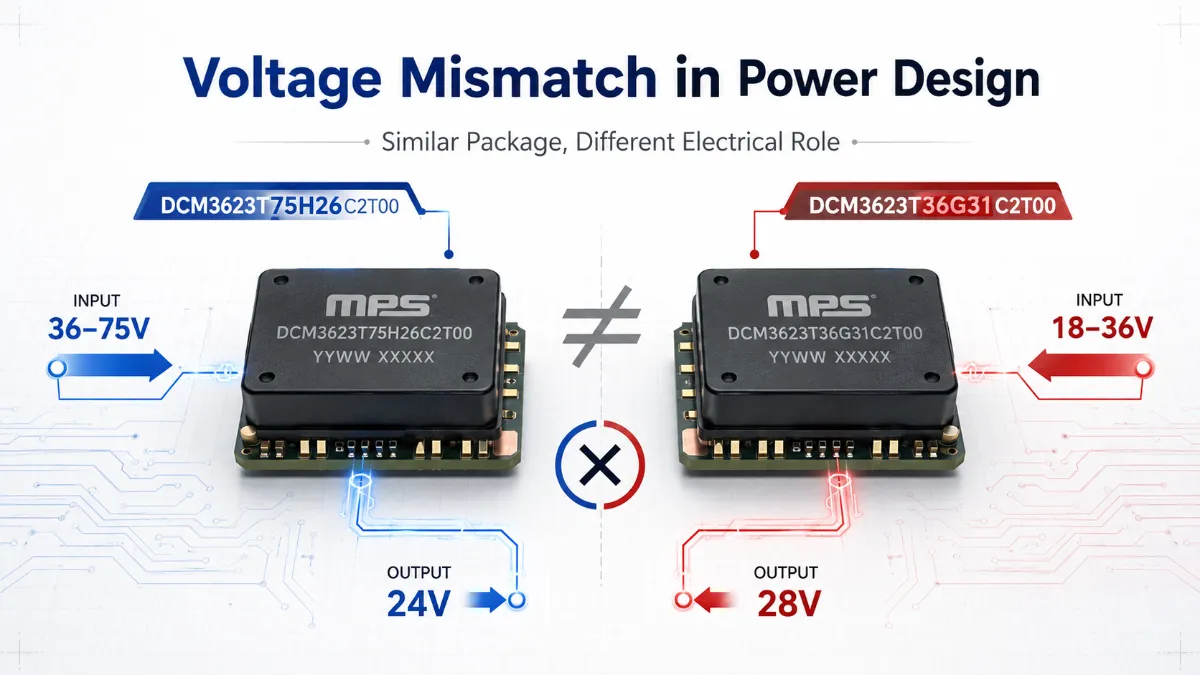
When hardware engineers and strategic procurement teams cross-reference Vicor’s high-density DCM3623 modules, they often look for drop-in replacements to navigate supply chain constraints. However, comparing the DCM3623T75H26C2T00 and DCM3623T36G31C2T00 reveals a critical lesson in power architecture: these two modules feature fundamental mismatches on both the primary (input) and secondary (output) sides.
While they share the exact same 3623 ChiP footprint and 320W power capability, substituting one for the other without a complete system redesign will result in catastrophic failure. This guide breaks down the technical barriers between these modules, focusing on voltage windows, thermal implications, and strict sourcing protocols.
Initial Specs Snapshot and Verification
Before integrating either component into your BOM (Bill of Materials), a strict side-by-side verification of the baseline electrical parameters is mandatory.
| Specification Parameter | DCM3623T75H26C2T00 | DCM3623T36G31C2T00 |
|---|---|---|
| Input Voltage Range | 36 V to 75 V | 18 V to 36 V |
| Nominal Input Bus | 48 Vdc | 24 Vdc |
| Rated Output Voltage | 24 Vdc | 28 Vdc |
| Maximum Output Power | 320 W | 320 W |
| Max Continuous Output Current | 13.33 A | 11.43 A |
| Temperature Grade | T-Grade (-40°C to 125°C) | T-Grade (-40°C to 125°C) |
| Package Configuration | 3623 ChiP (Through-hole) | 3623 ChiP (Through-hole) |
Comparing 36-75V and 18-36V Input Ranges
The primary-side switching architectures of these converters are engineered for completely different upstream power environments.
- DCM3623T75H26C2T00 (36-75V Input): This module is designed to operate on a standard 48V bus, commonly found in PoE (Power over Ethernet) infrastructure, telecommunications, and centralized data center rails. Its wide input window easily rides through typical voltage transients and cable drops in these networks.
- DCM3623T36G31C2T00 (18-36V Input): This converter expects a nominal 24V upstream bus, typically sourced from industrial battery banks or commercial automated systems.
If you place the T36G31 into a 48V system, the 48V bus will exceed the absolute maximum rating of the module, destroying it instantly via over-voltage. Conversely, placing the T75H26 into a 24V system will trigger Under-Voltage Lockout (UVLO), and the module will refuse to power on.
Output Differences Between 24V and 28V
While previous comparisons often featured modules with identical outputs, the divergence here is critical: the T75H26 delivers 24V, while the T36G31 delivers 28V.
This output disparity dictates entirely different end-use applications. For example, in advanced outdoor security camera networks—where PoE++ is converted down to power PTZ (Pan-Tilt-Zoom) motors and internal lens heaters—a strict 24V supply is standard. The T75H26 is perfectly suited for this.
If an engineer attempts to use the T36G31 to supply 28V to a standard 24V security camera or industrial PLC, the extra 4V will likely exceed the maximum voltage tolerance of downstream ICs, leading to immediate logic failure or thermal damage to the load. The 28V output is instead highly specialized, primarily used in aerospace subsystems, RF amplifiers, and specific military-lite motor drives (often aligned with MIL-STD-1275 standards).
Thermal Consequences and Efficiency
Because power is a constant 320W, the difference in output voltage fundamentally changes the output current.
- The T75H26 (24V) outputs a maximum of 13.33A.
- The T36G31 (28V) outputs a maximum of 11.43A.
While a ~2A difference might seem minor, it influences secondary-side PCB copper pour requirements and the rating of downstream filtering inductors.
More importantly, the primary-side thermal stress is drastically different. The T36G31 operating at its lowest input (18V) will pull over 18 Amps of input current to generate 320W, creating localized $$I^2R$$ heating at the input pins. The T75H26 operating at 48V pulls less than half that current, resulting in a cooler primary-side footprint.
Lab Testing for Substitution Validity
Can these modules be substituted for one another? Absolutely not.
In lab qualification testing, substituting these parts represents a dual-mismatch failure. The input stages are incompatible (risking OVLO/UVLO), and the output stages are incompatible (risking damage to the downstream load). Any procurement pivot between these two parts requires hardware engineering to redesign both the AC-DC front end (to change the bus voltage) and the point-of-load regulation (to accept 28V instead of 24V).
Navigating Vicor Shortages with Vigorcomp
When critical BOM items like the T75H26 or T36G31 face extended factory lead times, relying on unauthorized channels often leads to purchasing the wrong voltage variants, resulting in costly board respins.
Vigor Components bridges this gap as your trusted global independent distributor. Our rigorous, engineering-first approach ensures that strategic buyers never confuse a 24V module for a 28V module. We supply authentic, highly traceable electronic components that meet strict E-E-A-T standards. By partnering with Vigorcomp, supply chain experts can secure the exact Vicor part numbers required by the schematic, accelerating R&D and keeping production lines running smoothly.
Frequently Asked Questions
Both modules are 320W. Can I use a buck regulator downstream to drop the 28V from the T36G31 down to 24V?
Yes, you can add a secondary non-isolated Point-of-Load (PoL) buck converter to step 28V down to 24V. However, you must still address the input mismatch (the T36G31 requires 18-36V, not 36-75V), and adding an extra conversion stage decreases overall system efficiency.
Will the Over-Voltage Protection (OVP) of my 24V equipment save it if I accidentally install the 28V T36G31?
It depends on the load's OVP threshold. Some 24V industrial equipment has OVP set at 26V or 27V, which would immediately trip and shut down the equipment if fed 28V. Other equipment lacks robust OVP and will simply overheat and fail.
Are the mechanical footprints completely identical?
Yes. Both utilize Vicor’s 3623 ChiP package. The physical dimensions, pin layouts, and required heatsink mounting hardware are exactly the same, which is why part number verification is crucial—they look identical to the naked eye.