
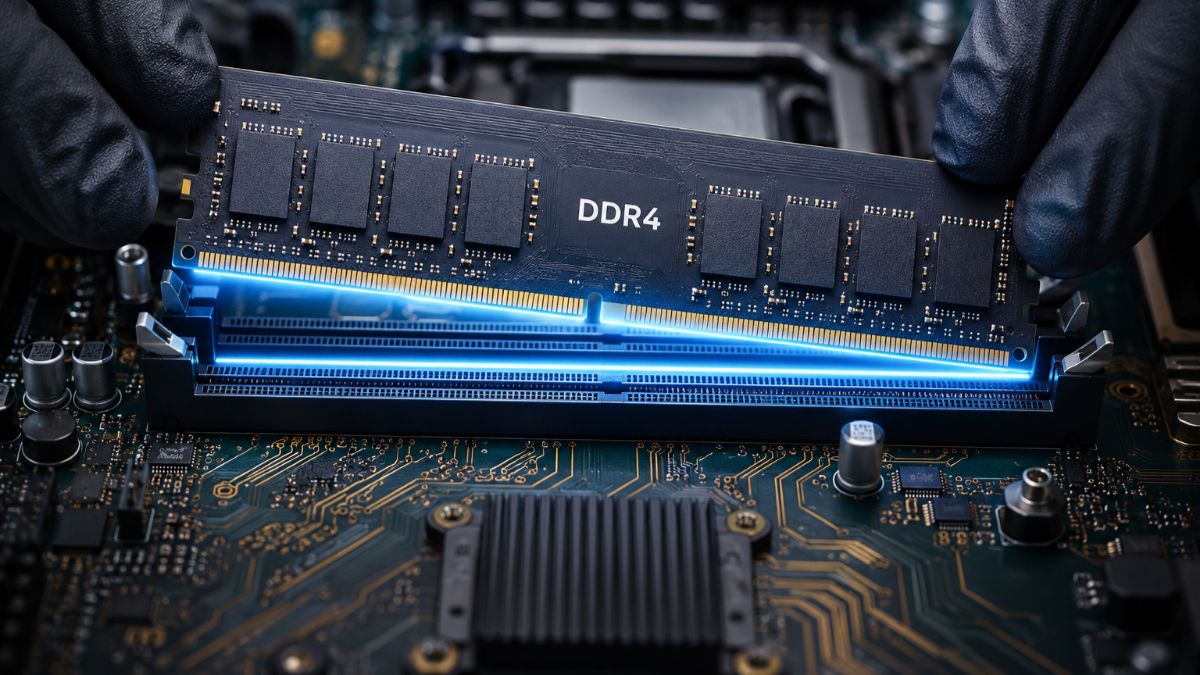
Why DDR4 EOL is a Hardware Engineer's Nightmare
When a specific DDR4 module goes End-of-Life (EOL), the initial panic usually hits the procurement team, but the heaviest burden inevitably falls on hardware engineers. For consumer electronics, upgrading to a newer generation might seem like a natural progression. However, for industrial PCs (IPCs), automotive Electronic Control Units (ECUs), and medical equipment, an unexpected EOL notice is a logistical and financial nightmare.
Redesigning a printed circuit board (PCB) to accommodate a completely new memory architecture introduces unacceptable NRE (Non-Recurring Engineering) costs and months of delays. Engineers are forced to navigate the complexities of power delivery redesigns, signal integrity issues, and grueling recertification processes. Finding a seamless, drop-in replacement becomes the only viable strategy to keep production lines moving without compromising the product's original design integrity.
DDR4 vs. DDR5: Why Pin-to-Pin Replacement Beats Redesign
While DDR5 offers significant performance upgrades, migrating an existing DDR4-based industrial or automotive design to DDR5 is rarely a simple swap. It requires a fundamental overhaul of the system architecture, including routing, Power Management ICs (PMICs), and extensive testing. A true pin-to-pin DDR4 alternative allows you to extend your product's lifecycle without the severe financial and temporal penalties of a full redesign.
| Metric | DDR4 Pin-to-Pin Replacement | Upgrading to DDR5 |
|---|---|---|
| NRE Costs | Minimal to None | Exceptionally High |
| PCB Redesign Required | No | Yes (Routing & PMIC) |
| Time to Market | 2-4 Weeks (Validation only) | 6-12 Months |
| Recertification (EMI/EMC) | Usually Not Required | Mandatory |
For a more comprehensive breakdown of the architectural and performance differences between these two generations, check out our in-depth analysis on DDR4 vs DDR5.
Key Specifications for True DDR4 Pin-to-Pin Compatibility
Identifying a functional DDR4 alternative goes far beyond matching the megabyte capacity. A reliable cross-reference requires rigorous verification of several physical and electrical parameters to ensure the new chip behaves identically to the EOL component.
First, the physical package must match exactly, typically the standard 96-ball FBGA for discrete DDR4 ICs. Electrically, the operating voltage must align strictly with the 1.2V standard (or 1.2V/1.05V for specific low-power applications). Furthermore, engineers must scrutinize the critical timing parameters outlined in the datasheets, including tCK (Clock Cycle Time), tRCD (RAS to CAS Delay), tRP (Row Precharge Time), and CL (CAS Latency), ensuring the alternative memory can operate stably within the existing controller's defined windows.
It is also crucial to match the temperature grades. Standard commercial grades (0°C to 85°C) cannot replace industrial (-40°C to 95°C) or automotive grades (-40°C to 105°C/125°C). If the exact density (e.g., 4Gb) is unavailable due to market obsolescence, engineers must verify if the CPU or memory controller supports downward compatibility using a higher-density chip (e.g., 8Gb) configured to utilize only half its capacity.
The 3-Step Validation Process for Alternative Memory
Even with a perfect datasheet match, dropping a new memory chip onto a complex PCB carries inherent risks. A robust validation process is mandatory to guarantee long-term system stability and prevent costly field failures.
Step1: Signal Integrity and Electrical Validation
Using a high-bandwidth oscilloscope, engineers must capture and analyze the memory's eye diagrams. This confirms that the new chip's signal margins (both timing and voltage) meet JEDEC specifications under your specific board routing conditions, ensuring no excessive jitter or signal reflections are introduced.
Step2: Firmware and BIOS Compatibility Checks
This is the most common pitfall in DDR4 replacement. Different manufacturers (e.g., switching from Samsung to Micron) or even different Die Revisions from the same brand may have distinct initialization sequences or internal bank structures. You must update and verify the SPD (Serial Presence Detect) data within the BIOS/firmware to ensure the SoC's memory controller correctly recognizes and trains the new IC.
Step3: Stress and Corner Case Testing
The system must be pushed to its absolute limits. Utilizing diagnostic tools like Memtest86+ or custom memory stress scripts, the alternative RAM must be tested continuously inside a thermal chamber. Running these tests at the extreme edges of the required temperature range (Margin Testing) ensures the memory won't drop data or trigger system crashes during harsh real-world deployments.
Securing Long-Term DDR4 Supply with Vigor Components
Finding a compatible replacement is only the first step; ensuring that your newly qualified alternative doesn't face an unexpected obsolescence cycle next year is equally critical. For industrial, automotive, and embedded systems, supply chain longevity is just as paramount as technical specification matching.
At Vigor Components, we understand that managing legacy component lifecycles is a persistent challenge for engineering and procurement teams. As a global independent electronic components distributor, we specialize in securing hard-to-find memory chips and providing reliable alternatives when your primary Bill of Materials (BOM) is disrupted. By partnering with us, you gain access to our extensive cross-reference database and our commitment to extended lifecycle support, ensuring your production lines remain resilient against future market shifts.
Struggling to find a true drop-in replacement for your EOL DDR4?
At Vigor Components, our engineering and sourcing teams specialize in cross-referencing obsolete memory and securing validated, pin-to-pin compatible alternatives from a global network of trusted manufacturers.
Contact US →
Frequently Asked Questions
What does pin-to-pin compatible mean?
It means the replacement memory device shares the exact same package footprint, pin layout, and electrical characteristics as the original, allowing it to be swapped onto the PCB without requiring a hardware redesign.
How to cross-reference electronic components?
Use dedicated cross-reference tools, extract key parameters (voltage, timing, package, temperature grade) from the original datasheet, and compare them systematically against potential alternatives from second-tier manufacturers. For a broader methodology beyond memory modules, apply the Form-Fit-Function framework detailed in our [electronic replacement parts cross-referencing guide].
Can I replace a Samsung DDR4 with Micron or Nanya?
Yes. As long as you verify the package, timing parameters, voltage, and temperature grade, and conduct full signal integrity testing, transitioning to an alternative brand is a standard EOL mitigation strategy.
Does memory latency have to match exactly?
Latency does not have to be an exact match, but it must fall within the configurable range of your host SoC's memory controller. Different latencies will require firmware timing adjustments.
How to test memory module stability?
Memory stability must be tested using continuous read/write burn-in workloads, high-temperature thermal cycling, bit-error rate monitoring, and eye diagram analysis.
What is a KGD memory chip?
KGD (Known Good Die) is an unpackaged, bare die memory product that has been fully tested and qualified for direct integration into System-in-Package (SiP) designs, offering high reliability and small footprints.