
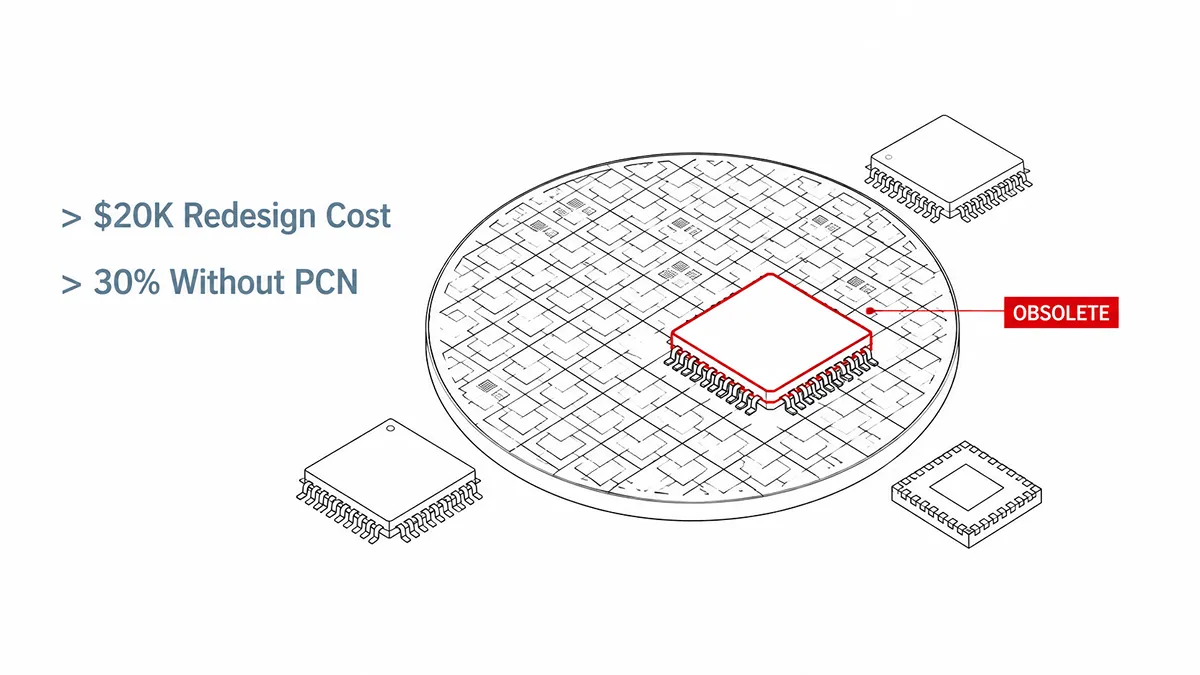
When a critical component reaches its end-of-life (EOL), hardware manufacturers face a difficult dilemma: secure remaining stock, find a cross-reference equivalent, or initiate a board redesign.
Industry data reveals a stark reality for engineers and procurement teams: a single PCB redesign can cost anywhere from $20,000 to $1.8 million, depending on the complexity of the board and the required re-certification processes (such as UL, CE, or medical/aerospace compliance). Furthermore, over 30% of component obsolescence now occurs without any formal Product Change Notification (PCN) or EOL warning.
This comprehensive guide breaks down the strategies to manage obsolete electronic parts, how to assess reliable distributors, and how to avoid costly manufacturing delays in 2026 and 2027.
Component Obsolescence in 2026-2027
The landscape for obsolete electronic parts has shifted significantly. While the severe global chip shortages of previous years have stabilized in some sectors, a new challenge has emerged: a rapid transition toward advanced semiconductor nodes.
As foundries allocate their primary capacity to AI-driven chips, advanced microprocessors, and cutting-edge memory, older, mature-node fabrication lines are being decommissioned. This transition disproportionately impacts industrial, medical, and automotive sectors, which rely heavily on long-lifecycle microcontrollers (MCUs), legacy power management ICs, and standard logic components. Consequently, procurement professionals are seeing an accelerated rate of obsolescence for parts that were previously considered stable.
Component Lifecycle and Supply Status
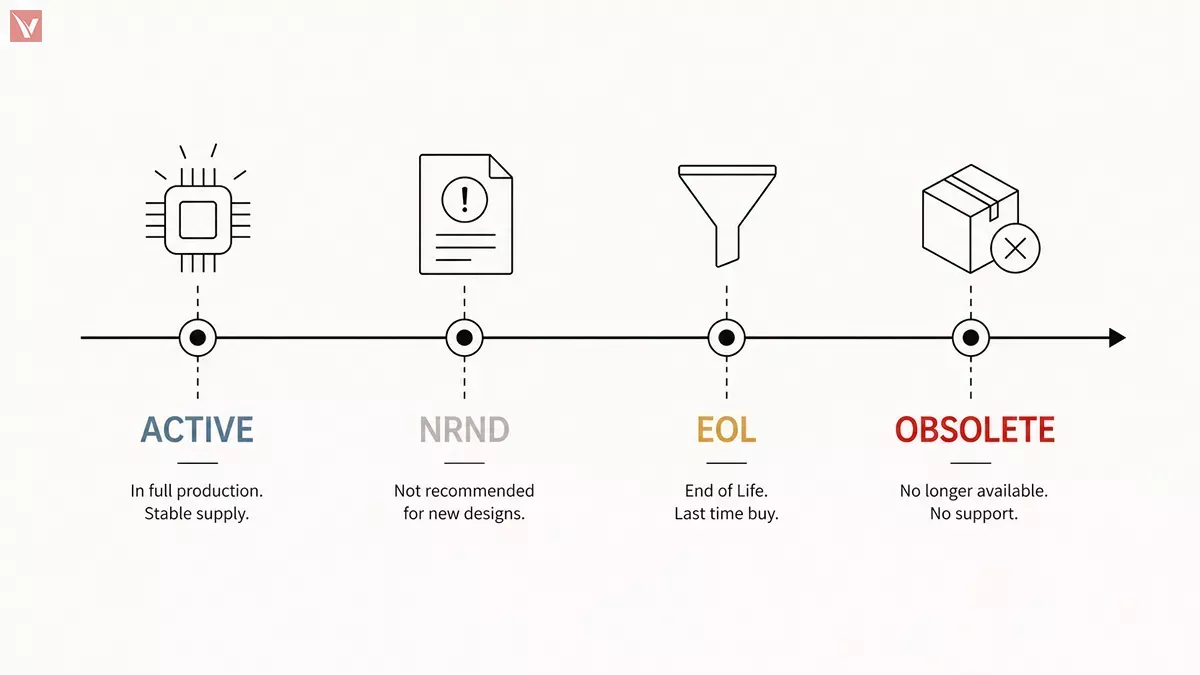
To effectively manage a Bill of Materials (BOM), you must understand the standard lifecycle stages of an electronic component. Recognizing these phases allows teams to transition from reactive sourcing to a proactive electronic component procurement model that mitigates supply chain risks.
- Introduction: The component is newly released. Supply is stable, but adoption is low.
- Growth & Maturity: The part is widely adopted. Lead times are predictable, and multiple authorized distributors hold ample stock.
- Not Recommended for New Designs (NRND): The manufacturer is preparing to phase out the component. Production continues, but the part should not be designed into new products.
- End of Life (EOL): A formal notice is issued (ideally via a PCN), announcing the final dates for orders and shipments.
- Obsolete: The manufacturer has completely ceased production. The only available inventory exists in the open market, surplus stock, or independent distribution channels.
Options for Obsolete Electronic Parts
When a part becomes obsolete, hardware teams generally have four main pathways to keep production lines running.
| Strategy | Best Use Case | Primary Advantage | Primary Risk / Drawback |
|---|---|---|---|
| Last-Time Buy (LTB) | Right after an EOL notice is issued. | Ensures authentic, factory-direct components. | Ties up significant working capital and requires long-term storage. |
| Original Part Sourcing | When LTB window is closed, but exact matches are required. | Avoids PCB redesign and recertification. | Requires rigorous quality control to mitigate counterfeit risks. |
| Replacement Qualification | When original parts are unavailable or prohibitively expensive. | Creates long-term supply chain resilience. | Requires engineering time to validate Form, Fit, and Function (FFF). |
| PCB Redesign | When neither stock nor drop-in replacements exist. | Modernizes the board with newer, cheaper components. | Extremely high costs ($20k $1.8M) and extended time-to-market. |
Last-Time Buy
A Last-Time Buy (LTB) is the most straightforward solution when a formal EOL notice is provided. The manufacturer sets a Last-Time Buy date (the final day to place orders) and a Last-Time Ship date. However, calculating the correct LTB volume is notoriously difficult. Buyers must estimate years of future production demand, factor in yield loss during manufacturing, and account for long-term warranty repairs—all while tying up capital in inventory.
Original Part Sourcing
If the LTB window has closed and your production still requires the exact original component, you must look beyond authorized franchise channels. Sourcing from the open market via independent distributors becomes necessary. When navigating this route, mastering how to source hard-to-find electronic parts is crucial to ensuring you find reliable inventory without falling victim to allocation traps or substandard brokers.
Replacement Qualification
When the original component is completely unavailable on the open market, or the prices have become economically unviable for continued production, finding an alternative is the next step. If you must substitute the part, establishing strict protocols for electronic replacement parts will guide your engineering team through verifying the Form, Fit, and Function (FFF) to ensure the new component integrates smoothly without triggering system failures.
PCB Redesign
Redesigning the printed circuit board should always be the last resort. Aside from the heavy financial burden, a redesign forces the product back through rigorous testing, software firmware updates, and regulatory compliance checks. It is generally reserved for situations where the obsolete part was the central processing unit of the board, or when the product is due for a next-generation upgrade anyway.
Obsolete Electronic Parts Suppliers
Relying on a single data source or a standard aggregator tool is no longer sufficient in 2026. The open market is fragmented, and "ghost stock" (inventory listed by brokers that they do not actually possess) is a prevalent issue.
To secure obsolete electronic parts safely, modern procurement requires a "dynamic search + inventory network verification" mechanism. This means utilizing independent distributors—like Vigor Components—who do not merely scrape public databases, but actively verify physical stock across a vetted, global network of excess OEM/EMS inventory and trusted suppliers. An enterprise-level distributor acts as a firewall, filtering out unreliable sources and confirming stock availability before the purchase order is ever cut.
Replacement Paths for Obsolete Components
When sourcing the original part fails, engineers must look for replacement paths:
- Drop-in Replacement (Pin-to-Pin): The ideal scenario. The new component matches the obsolete part in physical footprint, pinout, electrical characteristics, and software requirements. No board changes are needed.
- Functional Equivalent: The part performs the same electrical function but may have a different package size or pinout. This requires a minor PCB layout spin (updating the footprint) but usually avoids a full architectural redesign.
- Alternative Grade: Using an automotive-grade or industrial-grade version of a commercial-grade obsolete chip. While more expensive, it meets or exceeds the original specifications and can keep production moving.
Quality Control for Legacy Parts
The greatest risk of sourcing obsolete electronic parts from the open market is the infiltration of counterfeit or degraded components. Because these parts are highly sought after, bad actors frequently remarket empty packages, pull used parts from old boards, or remark inferior chips with high-end part numbers.
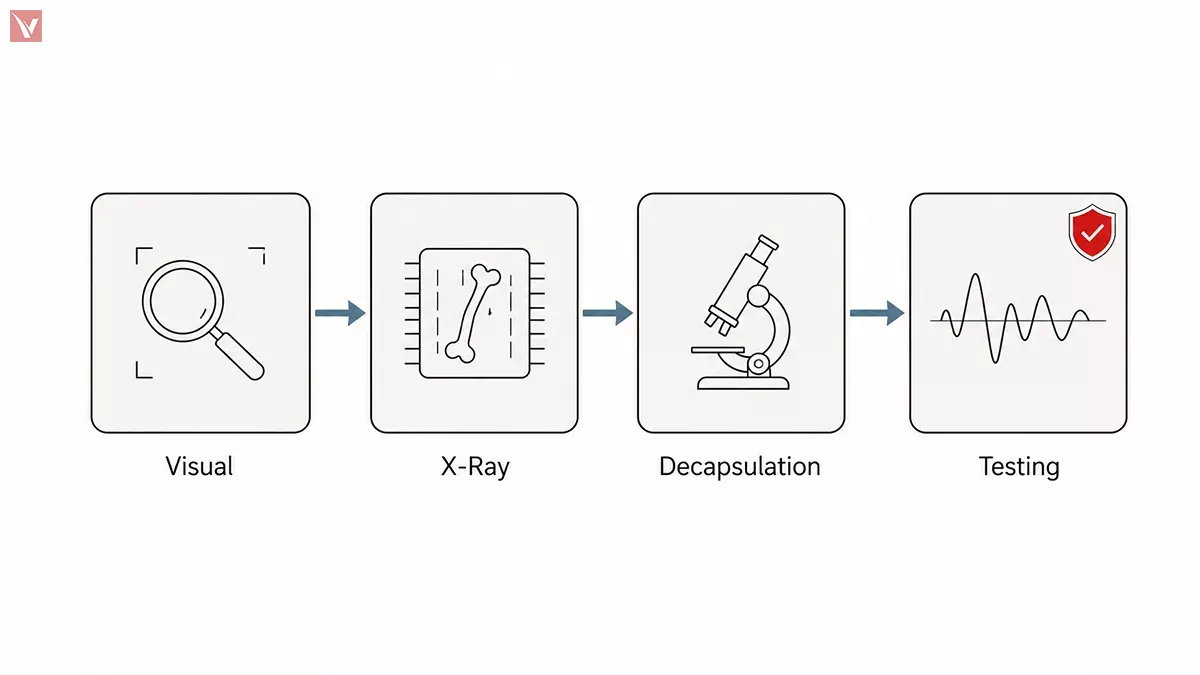
A rigorous quality control protocol is non-negotiable. Leading independent distributors implement strict inspection standards, including:
- High-Magnification Visual Inspection: Checking for resurfaced tops, blacktopping, and irregular manufacturer logos.
- X-Ray Fluorescence (XRF) & Imaging: Verifying the internal lead frame and die size against known authentic databases.
- Decapsulation (Destructive Testing): Using acid to remove the component's casing to inspect the actual silicon die and manufacturer markings underneath.
- Electrical Testing: Testing parameters at various temperatures to ensure the component performs to the original datasheet specifications.
Traceability documentation, including Certificates of Conformance (CoC) and clear supply chain custody, should be standard requirements in your RFQ process.
Frequently Asked Questions
Should we place a last-time buy or qualify a replacement?
This depends on the lifecycle of your end product. If your product is scheduled to be retired within 1-2 years, an LTB is usually the most cost-effective route. If your product has a 5-to-10-year lifespan ahead (common in industrial and medical equipment), qualifying a replacement is the safer long-term investment, as an LTB will tie up too much capital and risk degradation in storage.
How should a last-time buy quantity account for repairs and field service?
Never base an LTB solely on projected manufacturing volumes. You must analyze historical failure rates (RMA data) and warranty obligations. A standard rule of thumb is to add a 10% to 15% buffer to your production estimates to account for field service replacements, testing loss, and manufacturing attrition.
Can a component be obsolete even if no formal EOL notice exists?
Yes. Over 30% of obsolescence events occur without a formal PCN. This often happens when a manufacturer faces sudden raw material shortages, bankruptcy, or when third-party fabs unexpectedly shut down a legacy production line, leaving the component manufacturer unable to fulfill orders.
When is buying surplus stock safer than redesigning a PCB?
Buying surplus stock is safer and more economical when you partner with an independent distributor equipped with an in-house, certified testing laboratory. If the surplus stock can pass comprehensive visual, X-ray, and electrical testing to guarantee authenticity, it is drastically cheaper and faster than absorbing a $100,000+ PCB redesign and the associated downtime.
What records should be retained for obsolete components in a long-life BOM?
Always retain the original manufacturer datasheets, PCN/EOL notices, qualification test reports, and any alternative parts that were considered but rejected during initial development. Maintaining a robust database of alternative components makes pivoting much easier when the primary part vanishes from the market.
References
Supply Chain and Obsolescence Data (2025/2026): Industry consensus hardware lifecycle management reports indicating PCB redesign costs span $20,000 to $1.8M per instance.
Electronic Component Lifecycle Analytics: Internal and industry-wide supply chain audits demonstrating that over 30% of component discontinuations lack formal Product Change Notifications (PCNs).
Quality Assurance Standards: Core counterfeit mitigation practices adapted from AS6081 and IPC standards for the detection and avoidance of fraudulent electronic parts.