
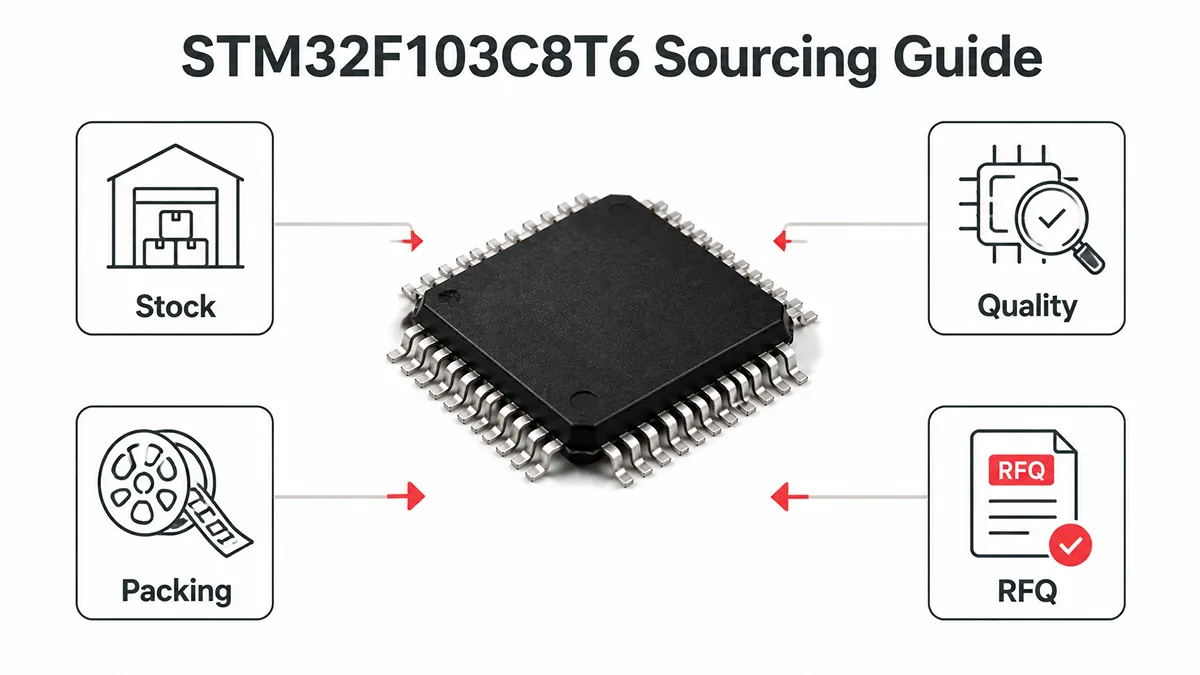
The STM32F103C8T6 is widely used in embedded control, industrial interfaces, sensor applications, and development projects because it combines an Arm Cortex-M3 core, up to 72 MHz operation, 64 KB Flash, 20 KB SRAM, and a broad peripheral set in an LQFP-48 package. For buyers, however, sourcing this MCU is not simply a matter of finding the lowest unit price. The purchasing decision should account for part-number accuracy, available quantity, packaging, lot consistency, inspection expectations, lead time, and the requirements of the final application.
This guide is intended for buyers sourcing STM32F103C8T6 devices for evaluation, repair, pilot builds, or ongoing production requirements. It focuses on the practical questions that arise before placing an order: how to verify supply, compare small and volume orders, and work with a supplier more effectively.
Before requesting a quotation, confirm that the manufacturer part number, package, memory density, and temperature grade match the released BOM. If your engineering team still needs to verify these details, review the STM32F103C8T6 pinout and datasheet before comparing supply offers.
Current Market Status of STM32F103C8T6
The STM32F103C8T6 remains a familiar part number across a wide range of embedded projects. It is part of STMicroelectronics’ STM32F103 medium-density performance line, which integrates USB, CAN, timers, ADCs, and multiple communication interfaces for general embedded control applications.
Its continued popularity creates several different purchasing scenarios:
- An engineer may need a few devices for firmware validation or board repair.
- A design team may require a controlled quantity for pilot production.
- A purchasing department may need repeat supply for a released product.
- A manufacturer may need a replacement source when an approved supplier cannot meet the requested delivery schedule.
These scenarios should not be treated in the same way. A small evaluation order can prioritize quick dispatch and basic verification. A production-oriented order requires stronger attention to lot consistency, packaging condition, documentation, and replenishment planning.
The availability shown online should also be interpreted carefully. “In stock” can mean physically held inventory, supplier-network availability, stock awaiting inspection, or quantity that still requires confirmation. Before relying on a listing for a time-sensitive project, ask the supplier to confirm the available quantity, packaging format, and expected ship-out date.
If supply constraints or cost targets lead your team to consider a lower-density device, treat it as an engineering change rather than a purchasing substitution. Our comparison of STM32F103C6T6 vs STM32F103C8T6 explains the memory and validation checks required before approving that option.
How to Verify Authentic STM32 MCUs
Authenticity review should begin before an order is placed and continue through receiving inspection. A correct-looking part number alone is not sufficient evidence that material is suitable for a project, particularly when the order will be used in production equipment or safety-sensitive control hardware.
The first step is to make sure the requested item is fully defined. For an STM32F103C8T6 order, this normally includes:
- Full manufacturer part number: STM32F103C8T6
- Manufacturer: STMicroelectronics
- Package requirement: LQFP-48
- Requested quantity
- Packaging preference, such as tray, tube, reel, or cut tape
- Acceptable date-code range, if applicable
- Required documentation or inspection expectations
The STM32F103C8T6 is commonly specified as a 32-bit Arm Cortex-M3 MCU with 64 KB Flash, 20 KB SRAM, two 12-bit ADCs, USB, CAN, I2C, SPI, and USART interfaces. A buyer should ensure that an offered device matches the released BOM rather than relying on a shortened family-level description such as “STM32F103 MCU.”
| Verification Area | What to Review | Why It Matters |
|---|---|---|
| Part Number | Full manufacturer part number, package, and specified grade | Prevents incorrect memory density, package, or product-family substitutions |
| Marking and Labels | Part markings, logo appearance, font consistency, label data, and date-code information | Helps identify inconsistencies that require further review |
| Packaging Condition | Tray, tube, reel, moisture protection, label condition, and handling quality | Supports appropriate storage, handling, and traceability review |
| Visual Inspection | Lead condition, surface finish, scratches, resurfacing marks, and contamination | Can reveal signs of poor handling or possible refurbishment |
| Functional Validation | Programming access, device identification, and relevant electrical or functional checks | Confirms that the device performs as required in the intended environment |
Visual review is useful, but it should not be the only control for a higher-risk order. Where project requirements justify it, incoming inspection can be supplemented with functional validation or third-party testing.
Visual inspection should also be combined with functional validation when project risk warrants it. For an example of the ST-Link workflow used to program and check the device, see How to Program STM32F103C8T6.
Projects that rely on analog measurement should also verify the MCU’s ADC configuration and board-level analog design. Read the STM32F103C8T6 ADC setup guide for channel, DMA, and noise-control considerations.
Price Trends and Lead Time in 2026
There is no single “correct” market price for STM32F103C8T6. The unit price can vary according to order quantity, stock condition, packaging, date-code expectations, inspection requirements, shipping destination, and whether the material is available for immediate shipment.
For a 10-piece evaluation order, convenience and fast dispatch often matter more than marginal unit-price differences. Buyers may use this quantity for incoming inspection, repair work, firmware development, or validation on an existing board.
For an order of around 100 devices, the decision becomes more commercially sensitive. At this level, buyers should evaluate not only the quoted price but also whether the supplier can confirm a consistent lot, appropriate packaging, and a realistic delivery schedule.
| Order Type | Typical Use Case | Primary Purchasing Priority | Recommended Supplier Questions |
|---|---|---|---|
| Sample or small order | Prototype work, repair, firmware validation | Fast dispatch and correct part identification | Can the exact MPN and packaging be confirmed before shipment? |
| 10-piece evaluation order | Initial engineering check or small build | Convenience, inspection confidence, and delivery speed | Is the material available now, and can photos or packaging details be provided if needed? |
| Approximately 100 devices | Pilot build, maintenance stock, or controlled production run | Lot control, unit cost, and traceability | Can the quantity be supplied from a consistent lot? What are the date-code and packaging details? |
| Recurring production order | Scheduled manufacturing demand | Supply continuity and commercial planning | Can the supplier support future replenishment and related BOM sourcing? |
Lead time should be confirmed in operational terms rather than assumed from a product-page status. Useful questions include:
- Is the quoted quantity physically available or subject to supplier confirmation?
- Can the order be shipped from one location or does it require consolidation?
- Is inspection completed before shipment?
- Can the supplier support split shipment if the full quantity is not immediately available?
- Are there export, courier, or destination-specific shipping considerations?
A lower quote may not be the lowest overall cost if it creates delays, inspection failures, rework, or unplanned replacement purchasing later in the project.
Bulk Sourcing vs Single Piece Buying
The right purchasing quantity depends on the stage of the design and the level of supply risk the buyer can accept. A small purchase is appropriate when the hardware has not been fully validated. A larger purchase becomes more practical when the design is released, and the buyer can define a clear demand forecast.
A 10-piece order is often appropriate for:
Incoming inspection of a new supply source
- Firmware and programming validation
- Board repair or field-service requirements
- Small engineering builds
- Verification before placing a larger order
An order of around 100 devices can be more suitable when the design has passed engineering review and the buyer needs a practical balance between unit cost, lot control, and inventory planning.
For volume orders of this Arm Cortex-M3 MCU, confirm lot consistency, date codes, packaging, and inspection options before shipment. This is particularly important when the parts will be installed across a controlled production run or used in products that require internal quality records.
For early-stage development, it is also important to distinguish the bare MCU from the board used for evaluation. See our guide to the STM32F103C8T6 and Blue Pill before moving from prototype hardware to a production BOM.
The Blue Pill is a development board built around the STM32F103C8T6, while production sourcing usually involves the bare MCU plus the supporting components required by the final PCB design. The board can be useful for early firmware work, but it should not be treated as a direct substitute for production-level component procurement.
The Role of Independent Distributors
Independent distributors can be useful when buyers need flexibility outside standard manufacturer-authorized purchasing channels. This may include urgent requirements, low-volume needs, discontinued project support, difficult-to-find stock, or purchases that do not align with a manufacturer’s minimum order quantity.
However, an independent distributor should be evaluated on its process, not only on its ability to provide a quotation. Buyers should look for clear communication about:
- Available quantity and stock confirmation
- Packaging and visible condition
- Inspection options
- Documentation requirements
- Delivery timing
- Support for future replenishment or related components
A responsible sourcing process is especially valuable when a project depends on more than one part. An STM32F103C8T6 procurement request may also involve voltage regulators, crystals, USB components, connectors, passives, sensors, or power-management devices. Coordinating these items through a single sourcing contact can reduce administrative work and improve BOM visibility.
Navigating Online Procurement Platforms
Online procurement platforms make component searches faster, but they do not remove the need for due diligence. The best use of an online platform is to shorten the path from part-number search to an informed RFQ or order decision.
When reviewing an online listing, check whether it provides a clear route to confirm:
- Exact manufacturer part number
- Available quantity
- Packaging details
- RFQ or order process
- Delivery destination
- Payment and shipping information
- Contact channels for special requirements
For a simple engineering purchase, an online checkout process may be enough. For larger or more controlled orders, an RFQ is often the better route because it allows the buyer to state requirements that may not appear in a standard product listing.
Before submitting an RFQ, prepare the following information:
| Information to Provide | Why It Helps |
|---|---|
| Exact manufacturer part number | Reduces the risk of receiving an incorrect variant or family-level substitute |
| Target quantity | Allows the supplier to assess available stock and applicable quantity breaks |
| Packaging preference | Helps align the offer with assembly, storage, and handling requirements |
| Delivery destination | Supports more accurate shipping and lead-time planning |
| Date-code or documentation needs | Allows quality and traceability expectations to be addressed early |
| Related BOM requirements | Enables coordinated sourcing for supporting components |
Why Choose Vigor for Electronic Components?
For STM32F103C8T6 procurement, a useful supplier relationship should extend beyond displaying a part number and a unit price. Buyers may need help confirming available quantity, reviewing packaging expectations, aligning delivery requirements, or sourcing supporting components for the same build.
Vigor Components supports global electronics sourcing through an online ordering platform and a quality-focused review process. The objective is to give buyers clearer supply information before material is shipped and to support both immediate orders and longer-term component planning.
What Vigor Components Can Support for STM32F103C8T6 Orders
Depending on order requirements and available supply, Vigor Components can assist with:
- Confirming the full manufacturer part number, requested quantity, and packaging requirement before order processing
- Checking available inventory and discussing quantity breaks for sample, pilot-build, and volume requirements
- Reviewing labels, packaging condition, and visible part markings through its quality-control workflow
- Coordinating additional inspection or third-party testing options when a project has higher traceability or quality-verification requirements
- Supporting BOM-based sourcing for related items, including power-management ICs, oscillators, connectors, passive components, and other STM32-series devices
- Providing a single sourcing contact for buyers managing immediate demand and future replenishment planning
For an RFQ, provide the exact MPN, target quantity, preferred packaging, delivery destination, and any date-code or documentation requirements. This creates a more relevant quotation process and helps identify supply risks before an order is finalized.
Request an STM32F103C8T6 Quote
If you are sourcing STM32F103C8T6 for prototype, repair, pilot-build, or production use, submit your BOM or RFQ with the required quantity, packaging preference, destination, and quality requirements. Vigor Components can review the request and help you evaluate available sourcing options.
Frequently Asked Questions
Can I order a small quantity before committing to a larger purchase?
Yes. A small evaluation order can help a team verify device markings, programming behavior, and fit with the intended hardware before placing a larger production-oriented order.
What should I confirm before ordering STM32F103C8T6?
Confirm the full part number, package, required quantity, packaging preference, destination, and any date-code or quality documentation requirements. Engineering teams should also confirm that the device matches the released BOM.
Is an order of around 100 devices considered bulk purchasing?
For many engineering teams and smaller production runs, 100 pieces is a meaningful volume order. It is often large enough to justify asking about lot consistency, packaging, inspection support, and quantity-based pricing.
How can I reduce risk when buying STM32F103C8T6 from an independent source?
Use layered controls: verify the exact MPN, request supply confirmation, review packaging and label information, conduct incoming inspection, and use functional validation when the project requires it.
Can STM32F103C6T6 replace STM32F103C8T6?
It should not be assumed to be a drop-in procurement substitute. Check memory requirements, firmware size, qualification status, and the released BOM before approving any replacement. Review the STM32F103C6T6 vs STM32F103C8T6 comparison before making a substitution decision.
Should I buy a Blue Pill board or STM32F103C8T6 chips?
A Blue Pill board can be useful for development and firmware experiments. For a custom production design, you typically source the bare STM32F103C8T6 MCU and the other qualified components specified in your BOM.